

A plant stem can look ordinary while fungi live quietly inside it. Researchers isolated such fungi, called endophytes, from stems collected in the Ecuadorian Amazon. Their unexpected ability came to light in the laboratory, when the researchers tested them on a plastic called polyester polyurethane. In a study published in 2011, two isolates identified as Pestalotiopsis microspora could grow with the test material as their only supplied source of carbon, even in experiments without oxygen.[1]
The phrase “plastic-eating fungi” invites a question. What if something living could take apart a material we make to last? A film can crack while most of its material remains, and a polymer chain can split while its carbon still sits in the test vessel. To understand what the Amazon fungi did, it helps to begin with the bonds they could reach.
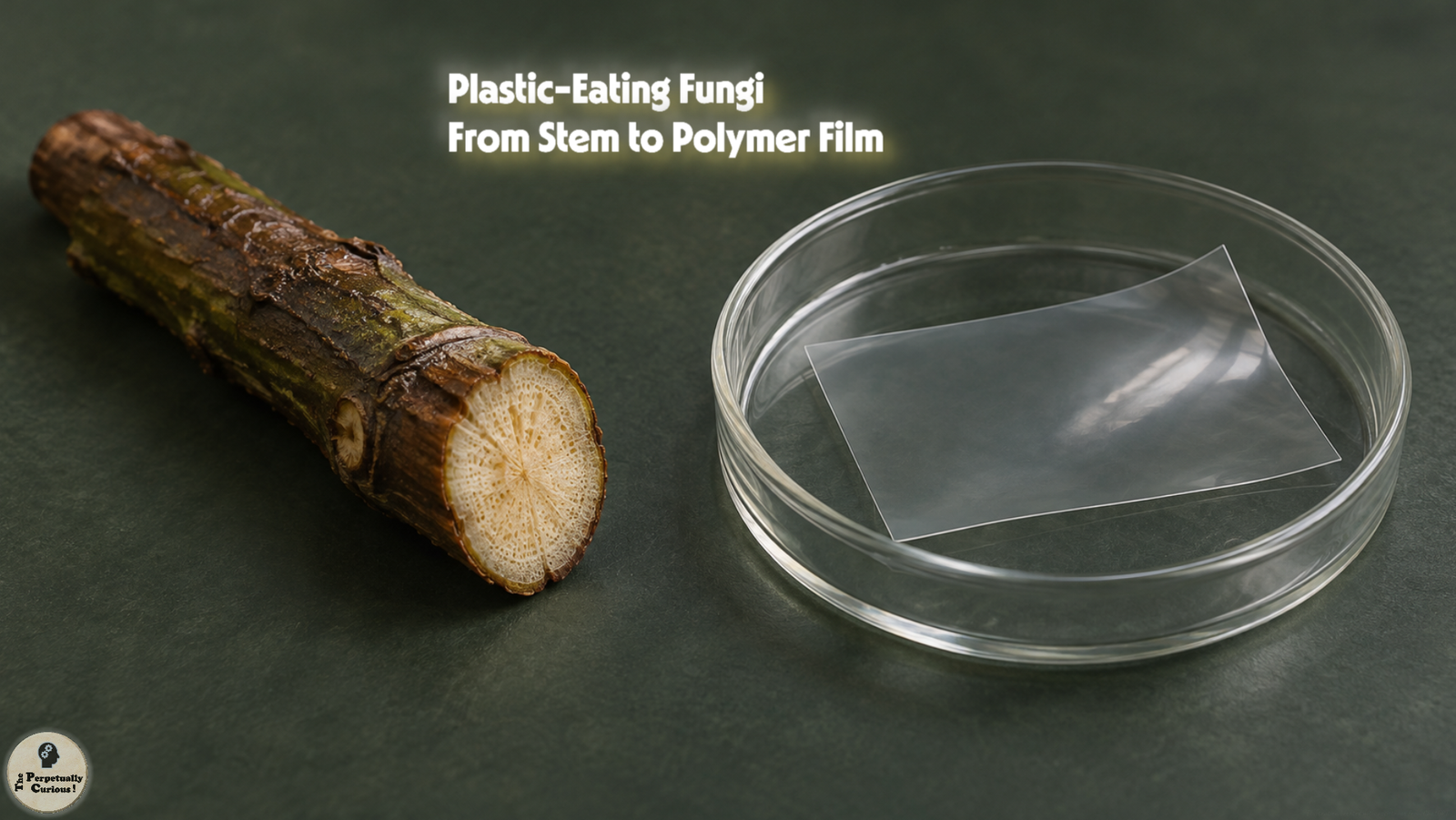
In a stem hidden beneath the rainforest canopy, a fungus met a material that did not exist in nature until humans created it.
Between a chemical bond and a molecule of carbon dioxide, the plastic’s story becomes harder to see, yet no less important to follow.
Sometimes the deepest question is not what disappears, but where it goes.
🧪 Where an enzyme finds a bond it can break
Polyurethane is a family of plastics with uses ranging from flexible cushioning to coatings. Its members share chemical links called urethane bonds, but the rest of their structure can vary. Polyester polyurethane contains ester bonds in its polyester segments. A polyether polyurethane contains a different type of segment, so the success of an enzyme on a polyester formulation tells us little by itself about how it will act on a polyether one.[2]
Think of a polymer as a long molecule held together by a series of chemical links. In esterification, chemists can form an ester bond. In these polyester segments, hydrolysis uses water to split an ester bond. The Amazon study found evidence consistent with ester bonds being broken and implicated a fungal enzyme from a group called serine hydrolases. Splitting bonds along the chain can leave shorter molecules behind.[1][2]
That chemistry gives a fungal enzyme somewhere to start. The 2011 team tested a polyester polyurethane dispersion in both solid and liquid growth media.[1] A later team tested a film and examined its surface under a microscope.
🔬 What a damaged film can tell us
A second team isolated Aspergillus tubingensis from soil at a waste disposal site in Islamabad, Pakistan, and reported in 2017 that it damaged a polyester polyurethane film in the lab. Microscopy revealed surface damage, and infrared measurements provided evidence of chemical changes. In one test, the film broke into smaller pieces in a liquid that also contained glucose.[3]
The cracks and fragments show that the film was coming apart. Glucose gave the fungus a separate source of carbon.[3]The damage alone leaves open whether the fungus used carbon from the plastic. Smaller fragments can still be plastic, a distinction that matters for marine microplastic pollution.
Following the carbon gives researchers a way to see beyond the damage visible in a photograph.
⚖️ Where the plastic carbon goes
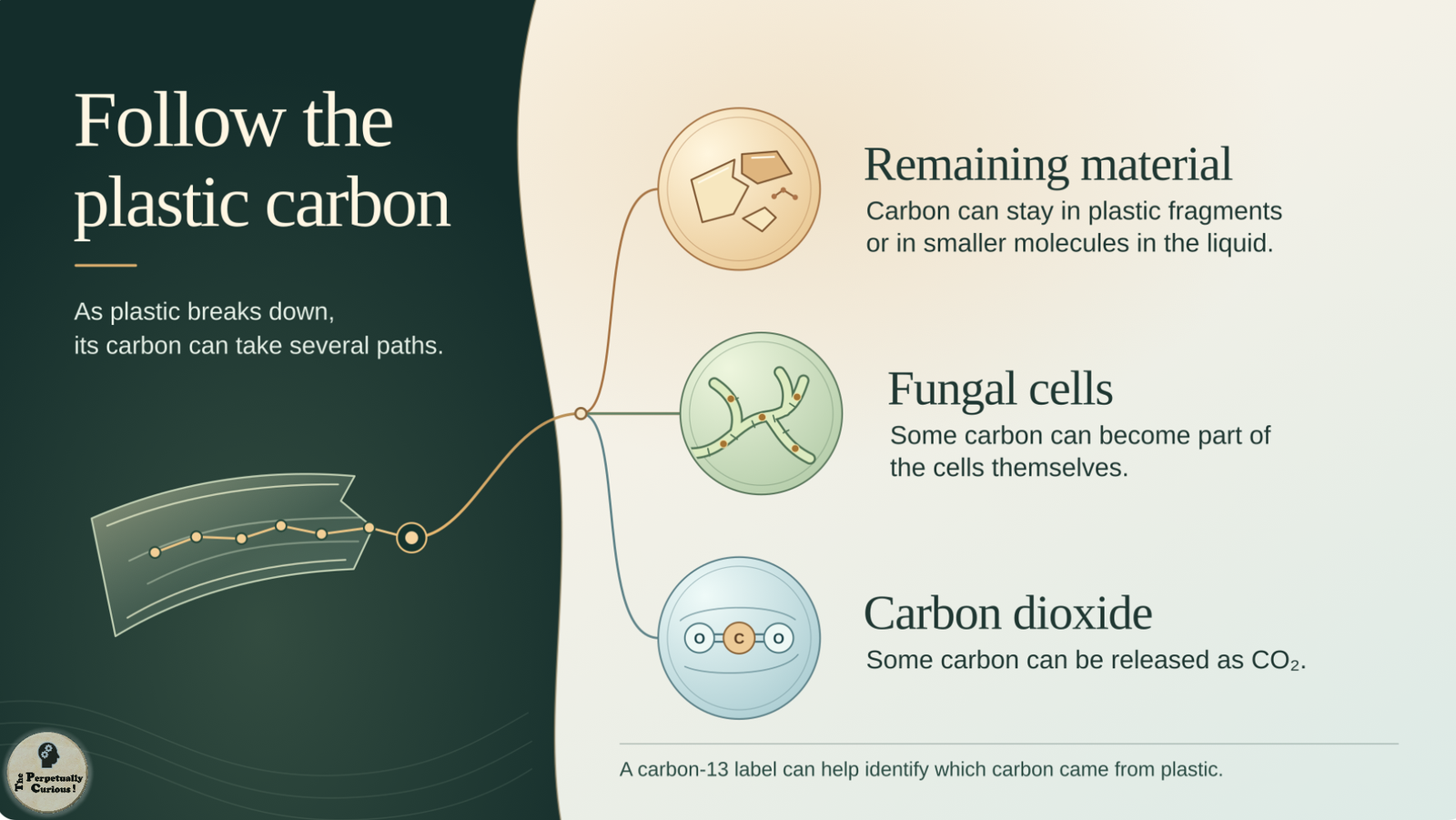
Breaking bonds along a polymer chain can produce shorter molecules.[2] Some of those molecules may remain in the surrounding liquid. Some of their carbon can become part of fungal cells. If plastic-derived carbon ends up in an inorganic product such as carbon dioxide, that portion has undergone mineralization. A study can detect mineralization while much of the plastic remains.[4]
A 2024 study used polyethylene, a different plastic, labeled with carbon-13. This heavier, stable form of carbon served as a tracer in laboratory tests with the marine fungus Parengyodontium album. Total carbon dioxide rose whether the plastic had been exposed to ultraviolet light beforehand or left untreated. With ultraviolet-treated polyethylene, the team measured a clear rise in carbon dioxide carrying the plastic’s label. A small amount of the label also entered fungal cells in that test. With untreated polyethylene, labeled carbon in the cells was below detection. The tracer revealed a difference that measuring total carbon dioxide alone would have missed.[4]
Once a reaction has cut the chains, the products matter as much as the damage to the original plastic. Which compounds can be recovered? Which residues still need treatment?
🏭 What it would take to treat real waste
A laboratory test begins with a material the researchers can describe precisely. Discarded products can combine polyurethane with fabric, adhesives, or other plastics. A test on one clean formulation says little about how that entire mixture will respond. Even two items sold as polyurethane can present enzymes with different chemistry and different surfaces.[2]
One goal is to recover chemical building blocks from a well-characterized source, such as scrap from a single manufacturing process. The test is whether the resulting compounds can be separated and reused.[2]
For a process aimed at reducing persistent waste, researchers need to account for what remains solid, what dissolves in liquid, and what is released as gas. Looking only at the solids can miss part of that picture.[2][4]
The story began with fungi hidden inside a rainforest stem. The experiments that followed raised a question that a damaged film cannot answer on its own. Once a piece of plastic loses its shape, where has its carbon gone?
Pass this article along to someone curious and let the learning travel.
💡 Did you know?
🧬 A species name alone could not predict how well a fungus would act on the test plastic. The Amazon study found markedly different results among related fungal samples, including samples identified as the same species.[1]
🧫 The liquid left after fungal cells were removed could still act on the test plastic. That observation helped the researchers identify activity from an enzyme released outside the fungal cells, where it could encounter the polymer.[1]
What does it mean when scientists say a fungus “eats” plastic?
A fungus growing on plastic could be using another source of food. To show that it uses the plastic itself, researchers can test whether the polymer supplies carbon for growth or trace a label from the plastic into fungal cells.[1][4]
How quickly can a fungus break down polyurethane?
In one 2017 laboratory test, a polyester polyurethane film broke into smaller pieces by the end of two months in a liquid containing glucose. That timing describes fragmentation under the conditions of that experiment.[3]
Does the result without oxygen mean this could work in a landfill?
The experiment isolated one factor by showing that the two fungal samples could use the test polyester polyurethane in the absence of oxygen. A landfill contains many materials with different structures and surfaces. The experiment gives no rate for those materials under landfill conditions.[1][2]
How is this different from mechanical recycling?
One mechanical route grinds polyurethane foam into pieces that can be bonded into new products. This retains much of the original polymer. An enzyme-based route deliberately breaks chemical bonds in the chains. To count as recycling, such a route would also need a use for the compounds it recovers.[2]
Could fungi help remove plastic already in the ocean?
The marine fungus experiment tracked carbon from ultraviolet-treated polyethylene in a laboratory. Whether that process could remove appreciable amounts of ocean plastic remains open.[4] The wider pathway of microplastics in the ocean is a separate problem of transport, exposure, persistence, and biological encounter.
🌱 Let the question travel
If this story changed how you think about a scrap of plastic, share it with someone who would enjoy following the trail from a rainforest stem to a single chemical bond.
Educational context
This article explains what selected laboratory studies can tell us about fungal plastic degradation and what evidence would be needed to assess a waste treatment.
Selected sources
- Russell JR, Huang J, Anand P, et al. (2011). Biodegradation of polyester polyurethane by endophytic fungi. Applied and Environmental Microbiology, 77(17), 6076–6084. [PMID: 21764951]
- Kemona A, Piotrowska M. (2020). Polyurethane Recycling and Disposal: Methods and Prospects. Polymers, 12(8), 1752. [PMID: 32764494]
- Khan S, Nadir S, Shah ZU, et al. (2017). Biodegradation of polyester polyurethane by Aspergillus tubingensis. Environmental Pollution, 225, 469–480. [PMID: 28318785]
- Vaksmaa A, Vielfaure H, Polerecky L, et al. (2024). Biodegradation of polyethylene by the marine fungus Parengyodontium album. Science of The Total Environment, 934, 172819. [PMID: 38679106]
“From Rainforest Floor to Landfill Core: How Nature’s Decomposers Are Learning to Eat Our Plastic Problem.” The Perpetually Curious!, November 2026.
https://www.theperpetuallycurious.org/articles/plastic-eating-fungi/Continue Exploring
For what comes next
Site Updates gathers occasional notes, new additions, and ways to keep in touch. RSS brings new publications to your feed reader in chronological order.
Choose the path that speaks to you, and let the next curiosity find you wherever your wondering takes you.