Explore by topic, question, or idea. Find articles, reflections, videos, puzzles, and curiosity pathways gathered across the site.
Press Enter or select Search. A newly typed query starts globally; filters are applied only through the visible rail.
14 results for “how rain forms”
- The Perpetually Curious! › Canonical › Cosmic ExplorationArticle
🌟 Brown Dwarfs: Between Giant Planets and the Smallest Stars
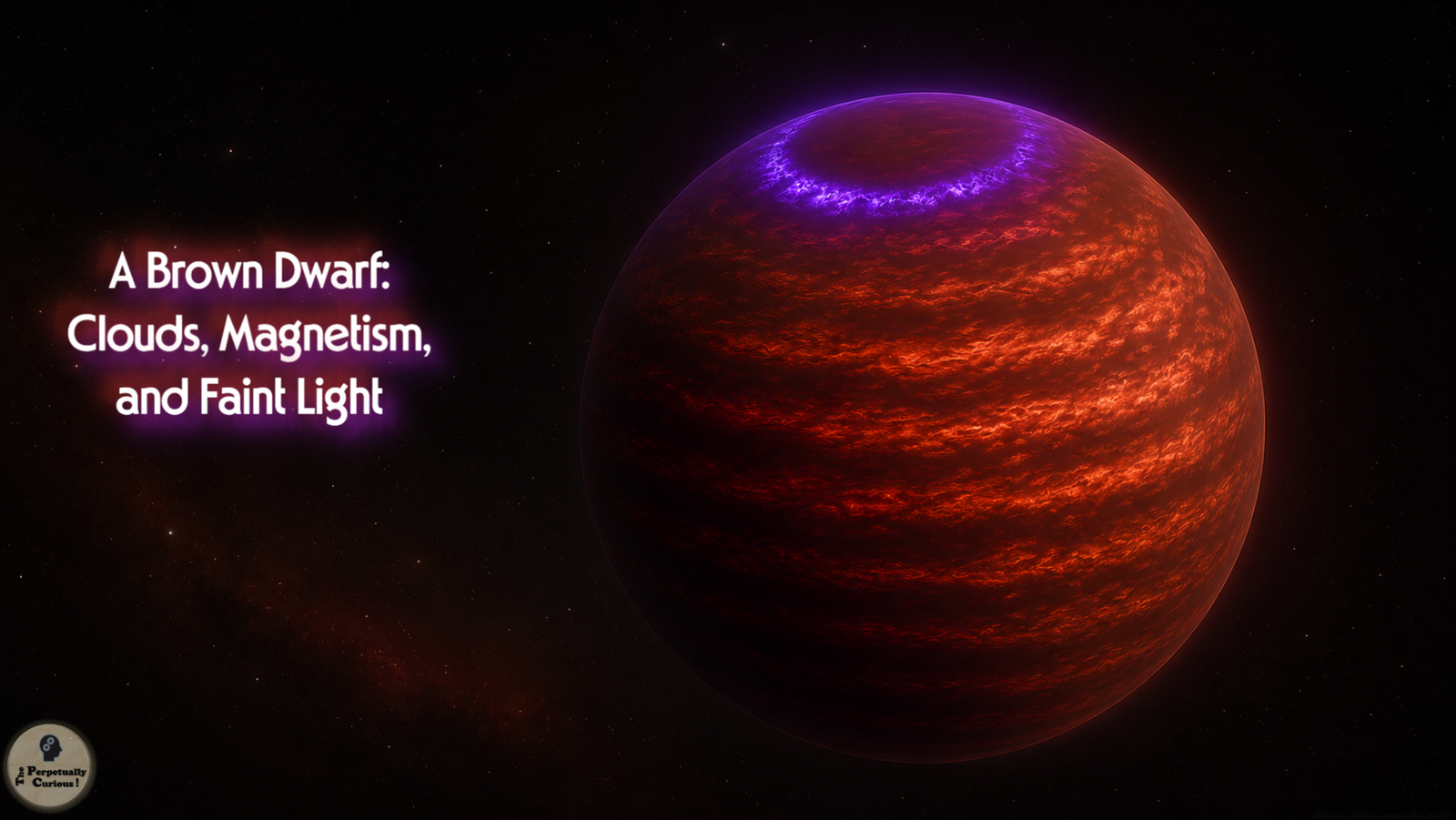
The cosmos often reveals its rules most clearly where familiar categories begin to blur. Between giant planets and the smallest hydrogen-burning stars lies a dim frontier populated by brown dwarfs, objects massive enough for gravity to compress and heat their interiors, yet not…
- The Perpetually Curious! › Canonical › Cosmic ExplorationArticle
🌌 Why Space Feels Cold Among So Many Suns: The Quiet Physics of Cosmic Warmth
From section: 🌠 Why space feels cold among so many sunsThe combined light from distant stars and galaxies therefore forms a real cosmic background, but it is generally faint compared with the intense illumination found near a star. An object between stars may radiate energy faster than it absorbs starlight or generates heat internally. …
- The Perpetually Curious! › Canonical › Cosmic ExplorationArticle
🌙 Quiet Worlds, Vast Stories: Some Lesser-Known Moons of Our Solar System
Most sky‑watchers can name a handful of large moons such as Ganymede, Titan, or Earth’s own Moon, yet scattered across the outer darkness are smaller, quieter companions that rarely appear in familiar summaries. These lesser-known moons do not dominate by size.
- The Perpetually Curious! › Archives › Cosmic ExplorationArticle
🌟 Brown Dwarfs: Why Stellar Ignition Never Takes Hold
A brown dwarf begins with a question that gravity cannot answer by itself. As gas contracts, the interior grows denser and hotter. Yet heating alone does not make a star.