Explore by topic, question, or idea. Find articles, reflections, videos, puzzles, and curiosity pathways gathered across the site.
Press Enter or select Search. A newly typed query starts globally; filters are applied only through the visible rail.
24 results for “how brain form”
- The Perpetually Curious! › Canonical › Planet EarthArticle
🌊 How Nor’easters Form: When the Coast Becomes a Storm Engine
From section: 🌡️ Where cold land air meets a milder oceanAs moist air rises, it cools, and cloud droplets or ice crystals can grow. Some of the cloud processes that form rain can also begin precipitation that reaches the ground as snow. Temperatures through the air below the clouds help determine what finally reaches a particular place.
- The Perpetually Curious! › Canonical › Planet EarthArticle
🌈 When Sunlight Paints the Rain: The Quiet Geometry of Rainbow Formation
From section: 🌟 Supernumerary rainbows: delicate fringes from wave behavior… Ray optics explains where the main arcs appear, while wave interference explains the delicate structure hidden along their edges. With both descriptions in view, the next question is no longer only how the colors form, but why the entire rainbow curves into a circle around the observer.
- The Perpetually Curious! › Canonical › Planet EarthArticle
🌑 How Coal Is Formed: The Slow Birth of Black Stone Across Deep Time
From section: ⏳ Burial, pressure, and the process of coalificationIn some regions, continued heating can produce anthracite, the highest rank of coal. Anthracite may form through deep burial, tectonic deformation, or local heating during mountain-building events. …
- The Perpetually Curious! › Canonical › Planet EarthArticle
🌧️ When Clouds Let Go: Why It Rains and How Raindrops Are Born
From section: 🌤️ Warm clouds and the collision and coalescence storyIn clouds or cloud regions where temperatures remain above freezing, rain can form through collision and coalescence. The process begins with a range of droplet sizes. …
- The Perpetually Curious! › Canonical › Planet EarthArticle
🌧️ When Earth Begins to Breathe: Why Rain Smells the Way It Does
From section: ⚡ Ozone and the sharp scent before a stormIn some storms, especially those involving lightning, another component may be noticeable: ozone. Ozone is a form of oxygen made up of three atoms rather than the usual two. It has a sharp, clean scent that some people detect even before the rain begins.
- The Perpetually Curious! › Canonical › Planet EarthArticle
🌊 Niagara Falls, Where Thundering Waters Shape Time
From section: 🏛️ From spectacle to shared landscape: Tourism, engineering, and hydropowerBy the nineteenth century, Niagara Falls had become a destination for travelers who came to witness its scale and beauty. Artists, writers, and photographers sought to capture its form, while pathways, viewing areas, and nearby accommodations developed to support growing interest.
- The Perpetually Curious! › Canonical › Planet EarthArticle
🌍🌑 Where Two Soils Part Ways: Earth, Moon, and the Stories Written in Dust
From section: 🧪 One Periodic Table, Many Pathways… Iron cycles between oxidized and reduced forms. Clay minerals form through long‑term weathering. Organic matter accumulates as plants and microbes live and die. …
- The Perpetually Curious! › Canonical › Planet EarthArticle
🌊 Where the Waves Leave Their Footprints: Why Beaches Carry Sand
From section: ⚖️ Why Sand Stays While Other Sediments Drift AwayThis distinction between sand and mud is not only a matter of size but also a reflection of the environment in which each material forms. Beaches are shaped by more active movement, while mudflats and marshes often form where water is calmer.
- The Perpetually Curious! › Archives › Planet EarthArticle
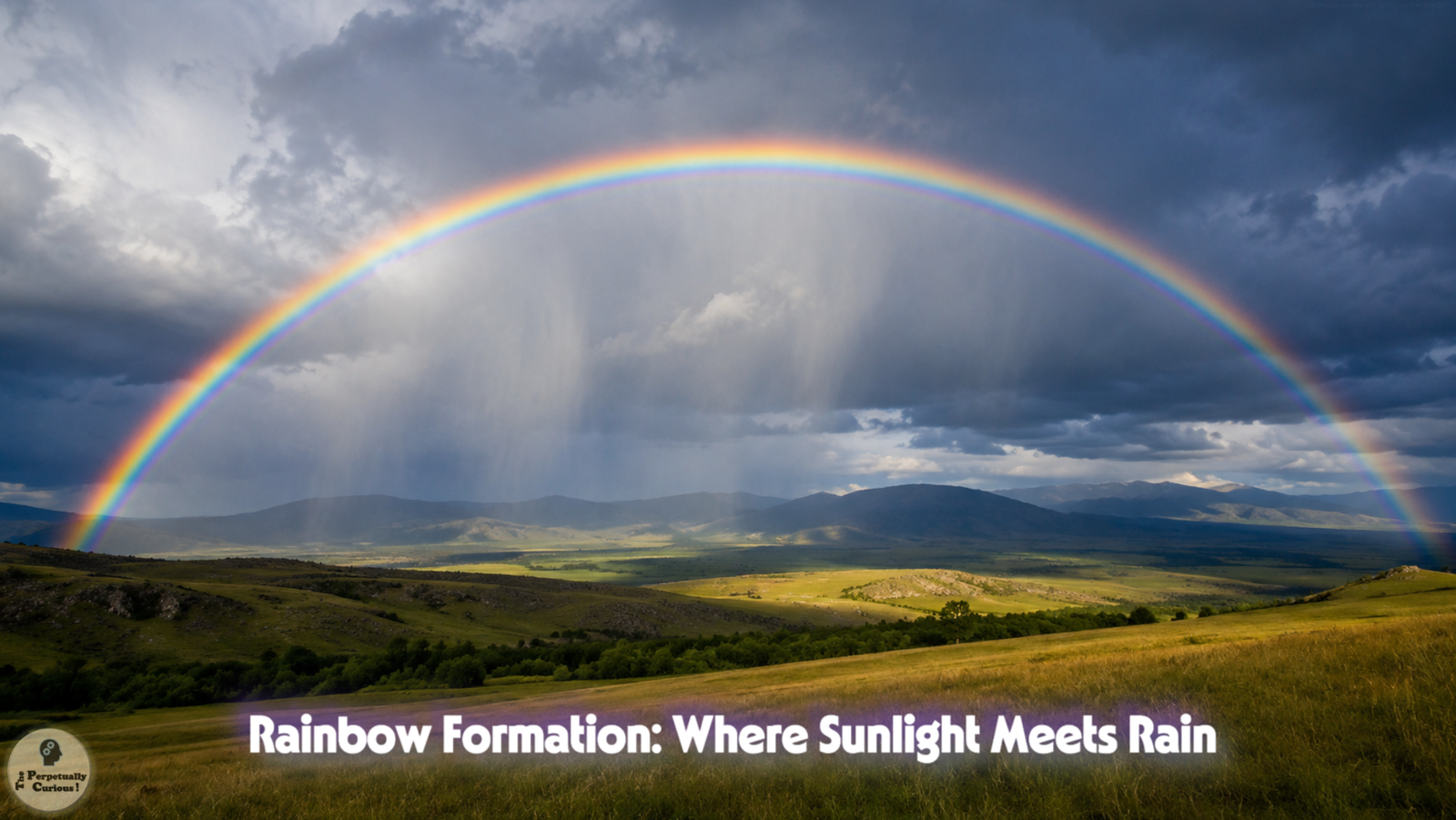
🌈 Rainbow Formation: Why Every Observer Sees a Different Arc
A rainbow can look like a colored bridge resting on a distant valley, field, or line of trees. Yet the arc is not anchored to that landscape. It is assembled for a particular observer by a particular set of illuminated water droplets.
- The Perpetually Curious! › Canonical › Planet EarthArticle
🌊 Where the Salt Stays: Why the Ocean Is Salty but Rivers and Most Lakes Are Fresh
From section: 💡 Did You Know🏔️ Two nearby lakes can have very different salinities. Near Mount Kailash on the Tibetan Plateau, Lake Manasarovar and Rakshastal form a striking pair. Lake Manasarovar is freshwater, while Rakshastal is a saline endorheic lake, meaning that its water does not drain onward to the ocean. …