Explore by topic, question, or idea. Find articles, reflections, videos, puzzles, and curiosity pathways gathered across the site.
Press Enter or select Search. A newly typed query starts globally; filters are applied only through the visible rail.
29 results for “lunar regolith the moon ancient chronicle written in dust”
- The Perpetually Curious! › Archives › Cosmic ExplorationArticle
The Asteroid Belt: Ancient Fragments of Our Solar System's Story 🌌
On New Year's Day 1801, Italian astronomer Giuseppe Piazzi made a discovery that would transform our understanding of the solar system. While searching for a suspected planet between Mars and Jupiter, he found something else entirely: the first of millions of rocky fragments…
- The Perpetually Curious! › Archives › Cosmic ExplorationArticle
🌋 Io: Jupiter’s Volcanic Moon
Sculpted by gravity and painted in sulfur, Io is a volcanic world of mountains and sulfur storms, its restless heart forever beating with tidal fire. Read more »
- The Perpetually Curious! › Canonical › Cosmic ExplorationArticle
🌌 Why Space Looks Dark in a Universe Filled with Light: Understanding the Quiet Cosmos
From section: Frequently Asked Questions+Why does a sunlit surface look bright on the Moon while the sky stays black, but on Earth the sky becomes bright too? Sunlight reveals the lunar surface because it strikes solid matter, while the surrounding sky stays dark because there is no atmosphere to scatter that light. …
- The Perpetually Curious! › Canonical › Cosmic ExplorationArticle
✨ Constellations: Quiet Patterns, Shared Skies, and the Stories We Trace Together
From section: 🕰️ Constellations across cultures and timeDifferent cultures have looked at the same stars and traced different shapes. In parts of the ancient Mediterranean world, observers recognized hunters, lions, and mythological figures. …
- The Perpetually Curious! › Canonical › Cosmic ExplorationArticle
🌌 Borrowing the Orbits of Giants: How Gravity Assists Carry Spacecraft into the Deep
On certain nights, the planets appear as quiet lanterns suspended in the dark, drifting along their ancient paths. To the eye, they seem serene and still. Yet each one is a massive world in motion, circling the Sun with tremendous momentum. For spacecraft, these worlds are not only destinations.
- The Perpetually Curious! › Videos & Podcasts › Cosmic ExplorationPodcast
🌌 Planetary Names Explained: From Ancient Gods to Modern Science | Cosmic Exploration Series Podcast
#PlanetNames #SolarSystem #Astronomy 🪐 Why are the planets named Mercury, Venus, Earth, Mars, Jupiter, Saturn, Uranus, and Neptune? This astronomy podcast explores the origins and meanings of the planet names in our solar system, revealing how ancient observation, mythology…
- The Perpetually Curious! › Archives › Cosmic ExplorationArticle
☀️ Solar Eclipses Explained: The Dance of Shadow and Light
Solar eclipses are among the most captivating events in the sky. They reveal how a rare alignment of Sun, Moon, and Earth can transform the ordinary daylight landscape into something unfamiliar and striking. Daylight softens, shadows sharpen, and the familiar world takes on a new character.
- The Perpetually Curious! › Canonical › Cosmic ExplorationArticle
🛰️ When Fire Meets Air: How Spacecraft Reenter Earth’s Atmosphere
From section: 💡 Did You Know🌙 Lunar returns face more severe heating A spacecraft returning from the Moon approaches Earth at about 25,000 miles per hour (11 kilometers per second), faster than a typical return from low Earth orbit. …
- The Perpetually Curious! › Archives › Cosmic ExplorationArticle
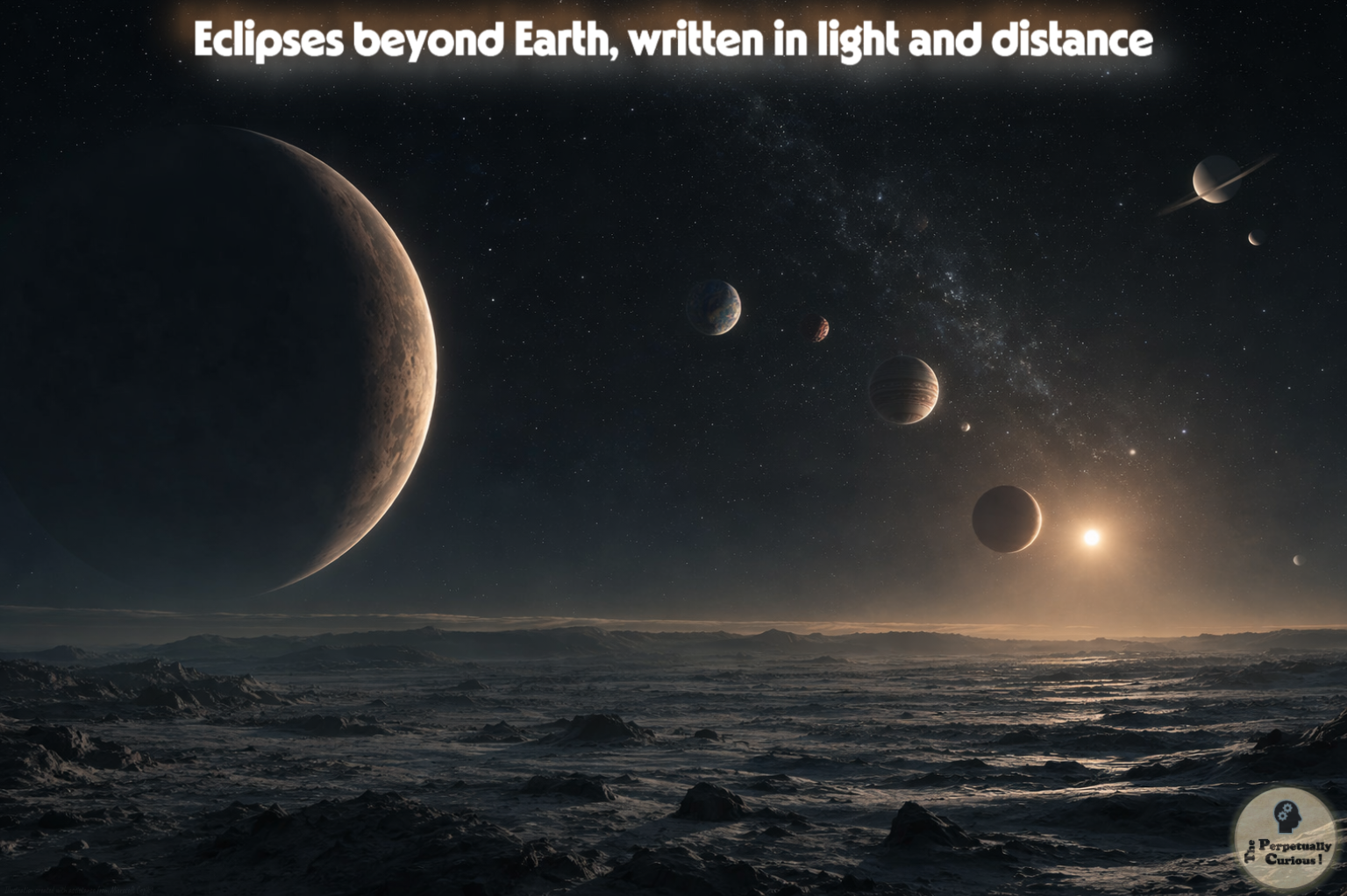
🌘 Eclipses Across the Solar System: When Shadows Travel
From section: A simple alignment, many possible shadowsIn a lunar eclipse, a moon moves into the shadow of its planet.
- The Perpetually Curious! › Archives › Cosmic ExplorationArticle
🔭 The Ten Largest Moons in Our Solar System: A Journey Through Worlds of Ice, Fire, and Hidden Oceans
The solar system is often introduced as a family of planets circling the Sun, yet some of its most remarkable landscapes belong to the moons that accompany those planets. These moons are not passive companions. They are worlds with their own histories, atmospheres, oceans, and internal heat.