Explore by topic, question, or idea. Find articles, reflections, videos, puzzles, and curiosity pathways gathered across the site.
Press Enter or select Search. A newly typed query starts globally; filters are applied only through the visible rail.
216 results for “petrichor how first rain lifts earth hidden scent”
- The Perpetually Curious! › Archives › Planet EarthArticle
🌧️ Petrichor: How First Rain Lifts Earth’s Hidden Scent
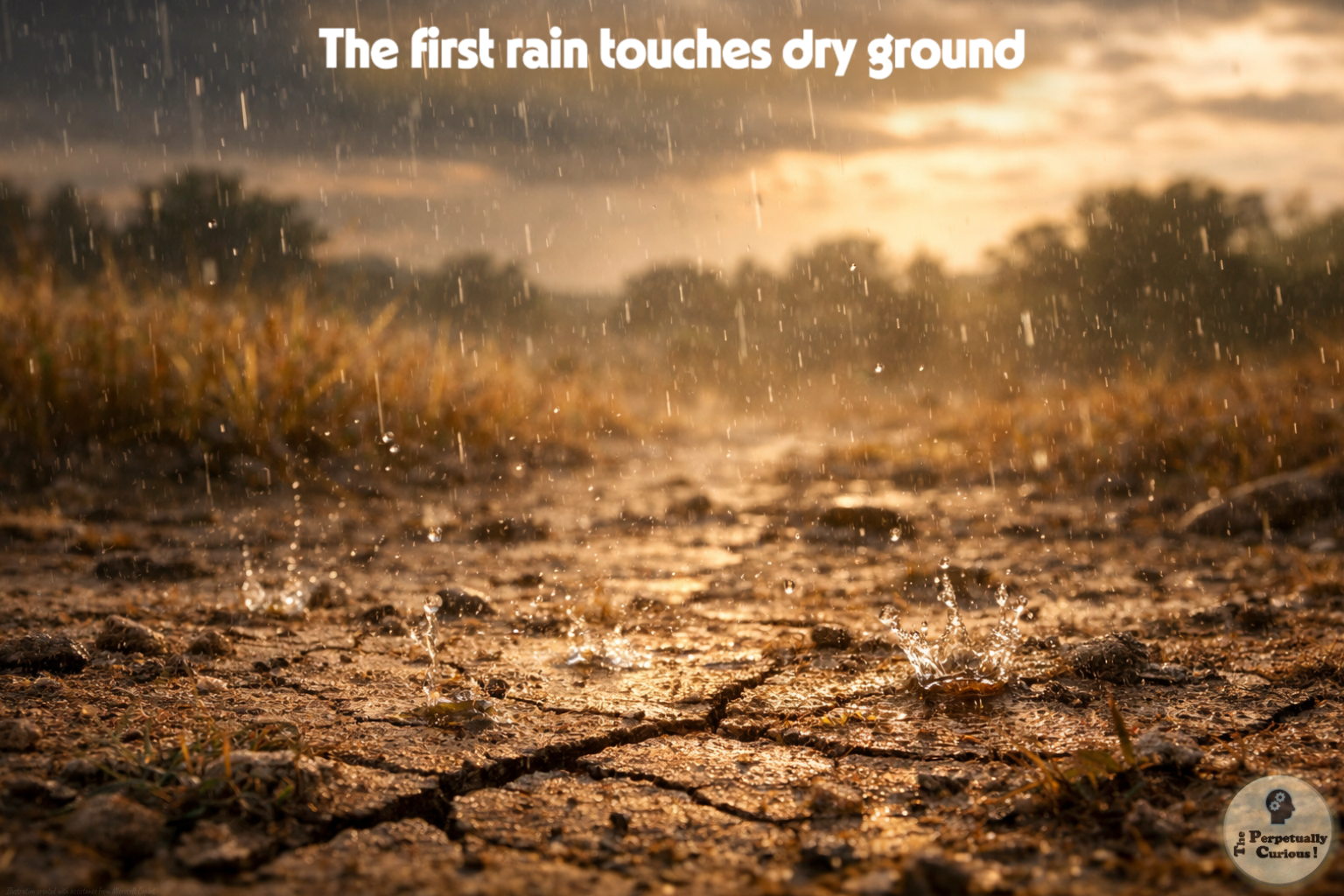
The smell of rain often arrives before we think about its science. A dry path darkens, a garden bed drinks in the first drops, and a scent rises that seems older than the moment itself. It can feel as if rain has a fragrance of its own, but the water is only part of the story.
- The Perpetually Curious! › Canonical › Planet EarthArticle
🌧️ When Earth Begins to Breathe: Why Rain Smells the Way It Does
From section: 🌿 Plant oils waiting for rainWhen the first raindrops fall, the impact disturbs these accumulated oils and lifts them into the air. The exact mixture varies by region, which is why the scent of rain in a forest, a savanna, or a city may feel slightly different while still being recognizably “rain‑like.”
- The Perpetually Curious! › Canonical › Planet EarthArticle
🌧️ When Clouds Let Go: Why It Rains and How Raindrops Are Born
From section: Frequently Asked Questions+Why does rain sometimes smell different in different places? The scent of rain, often called petrichor, varies with local soils, vegetation, microorganisms, and weather conditions. …
- The Perpetually Curious! › Canonical › Planet EarthArticle
🌍🌑 Where Two Soils Part Ways: Earth, Moon, and the Stories Written in Dust
From section: 💡 Did You Know🌱 The scent noticed after rain on Earth arises from compounds released by soil and microbes, a sensory experience that would not occur on the effectively airless lunar surface.
- The Perpetually Curious! › Canonical › Cosmic ExplorationArticle
🌍 When Earth First Took Shape: A Planet Born from Cosmic Dust
From section: 🌟 The Sun’s age and Earth’s place in the Solar System… It is about 4.57 billion years old, while Earth formed slightly later, about 4.54 billion years ago. This places Earth close to the beginning of the Solar System’s story, but not at the very first moment of that story.
- The Perpetually Curious! › Canonical › Planet EarthArticle
🌇 When the Sky Becomes a Painting: Why Clouds Glow Red and Orange at Sunset on Earth
From section: 🌈 How the atmosphere filters colorA deeper appreciation of how Earth sustains the conditions that make these optical effects possible begins with the structure and behavior of its atmosphere. As sunlight enters the air, it encounters countless gas molecules that are far smaller than the wavelengths of visible light, and this size difference allows…
- The Perpetually Curious! › Canonical › Planet EarthArticle
🌈 When Sunlight Paints the Rain: The Quiet Geometry of Rainbow Formation
From section: 🌦 Conditions for seeing a rainbow: timing, position, and subtle variationsRainbows do not occupy one fixed altitude or narrow atmospheric layer. Natural weather rainbows form mainly within the troposphere, the lowest layer of Earth’s atmosphere, where most clouds, mist, and precipitation develop. …
- The Perpetually Curious! › Canonical › Planet EarthArticle
🌌 Sky in Slow Layers: Understanding Earth’s Atmospheric Structure
From section: Frequently Asked Questions+How many main layers does Earth’s atmosphere have? Earth’s atmosphere is commonly described as having five principal layers: the troposphere, stratosphere, mesosphere, thermosphere, and exosphere. …
- The Perpetually Curious! › Canonical › Planet EarthArticle
🌍 Why Mud Is Brown or Black: Where Earth Turns to Quiet Ink
Mud often appears simple at first glance, a dark smear on a boot or a soft bed beneath still water. Yet its color, especially the deep browns and blacks that settle into riverbanks, marshes, and lake bottoms, carries a quiet record of oxygen, water, and life.
- The Perpetually Curious! › CanonicalReflection
Reflections on Earth 🌍
The Meeting of Elements 👁️ Rock that cooled from molten heat now stands in its settled shape. Water reaches it after its long passage through air, cloud, and falling rain. The rock stands in the stillness shaped by cooling, and the water moves over it in measured surges that...