Explore by topic, question, or idea. Find articles, reflections, videos, puzzles, and curiosity pathways gathered across the site.
Press Enter or select Search. A newly typed query starts globally; filters are applied only through the visible rail.
223 results for “small islands in the skin why moles form and why most stop growing”
- The Perpetually Curious! › Archives › PhysicsArticle
✨ Clean Chemistry: The Curious Physics Behind Soap Bubbles
From section: 🧪 Amphiphilic Molecules at WorkFor most soaps, this threshold is just a few millimoles per liter (typically in the 1–10 mM range), though the exact value depends on the type of soap, the presence of salts, and the temperature of the solution.
- The Perpetually Curious! › Archives › PhysicsArticle
The Cosmic Recipe: Understanding the Physical Criteria for Star Formation 🌟
Opening the Cosmic Kitchen 🌌 In the vast expanse of our universe, where darkness stretches for light-years and cold reigns supreme, something extraordinary happens. Stars are born. This process, far from being a simple ignition, represents one of nature's most complex and beautiful phenomena.
- The Perpetually Curious! › Archives › Cosmic ExplorationArticle
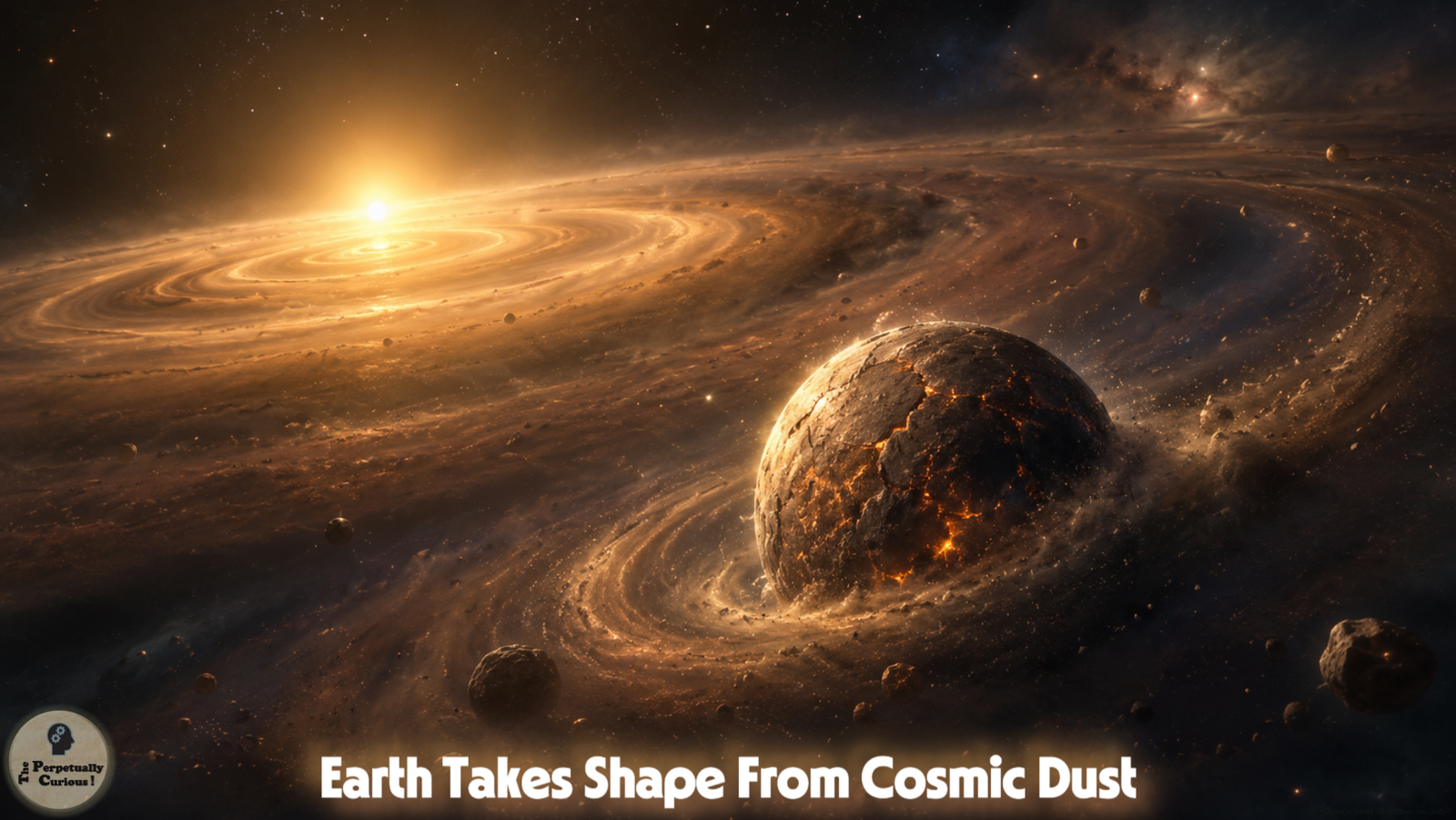
🌍 How Earth Formed: The Slow Assembly of a Young Rocky World
Earth formed through accretion, a long process in which small pieces met, combined, and gradually built larger bodies.
- The Perpetually Curious! › CanonicalReflection
The Terms of a World
👁️ We often call other worlds harsh because they do not make room for us. That judgment belongs to us alone. Their heat, their cold, their storms, and their stillness are simply the conditions they hold.
- The Perpetually Curious! › Canonical › Cosmic ExplorationArticle
🌌 The Universe’s Ancient Whisper: Decoding the Cosmic Microwave Background
From section: ✨ The afterglow of everything… By about 380,000 years after the Big Bang, the temperature had fallen to roughly 4,940°F (about 3,000 K or 2,727°C). Electrons could combine with protons to form neutral hydrogen without being immediately torn apart by energetic photons. …
- The Perpetually Curious! › Canonical › Cosmic ExplorationArticle
🌍 When Worlds Pull: Gravity Across the Planets and What It Reveals About Them
From section: 🌌 Why planets pull differently… Saturn is enormous, yet its reference-level gravity is only slightly higher than Earth’s because surface gravity depends on the balance between mass and radius. Mercury is small, yet its gravity is similar to Mars because it packs substantial mass into a smaller body. …
- The Perpetually Curious! › Canonical › History, Arts, and CultureArticle
🌍 Vertical Worlds: The 14 Lokas in Ancient Indian Cosmology
From section: 🗺️ Fourteen lokas, but not one fixed diagramThe most familiar fourteen-loka arrangement places seven regions above or beginning with the human world:
- The Perpetually Curious! › Canonical › Cosmic ExplorationArticle
🛰️ When Fire Meets Air: How Spacecraft Reenter Earth’s Atmosphere
From section: 🌍 Orbit and the energy that must be surrenderedA controlled return begins with a relatively small but decisive maneuver. The spacecraft performs a retrograde deorbit burn, firing opposite its direction of travel and reducing its orbital speed enough to lower part of its trajectory into denser atmospheric regions. …
- The Perpetually Curious! › Canonical › PhysicsArticle
🌟 When Light Learns to Answer Back: The Quiet Science of Mirrors
From section: 🧪 Why mirrors are usually made of glass and metal… Glass itself is not highly reflective. A clean pane of window glass reflects only a small fraction of the light that strikes it, while most of the light passes through. However, glass has two important advantages. …
- The Perpetually Curious! › Canonical › Cosmic ExplorationArticle
🌑 Shadows Across the Solar System: How Eclipses Unfold Beyond Earth
… Others are slow, muted, and tinted by alien atmospheres. Some occur on worlds where the Sun appears small and distant. Others occur on moons where shadows sweep across icy plains or drift across cloud tops.