Explore by topic, question, or idea. Find articles, reflections, videos, puzzles, and curiosity pathways gathered across the site.
Press Enter or select Search. A newly typed query starts globally; filters are applied only through the visible rail.
132 results for “the cosmic silence unraveling the fermi paradox in an age of discovery”
- The Perpetually Curious! › Canonical › Cosmic ExplorationArticle
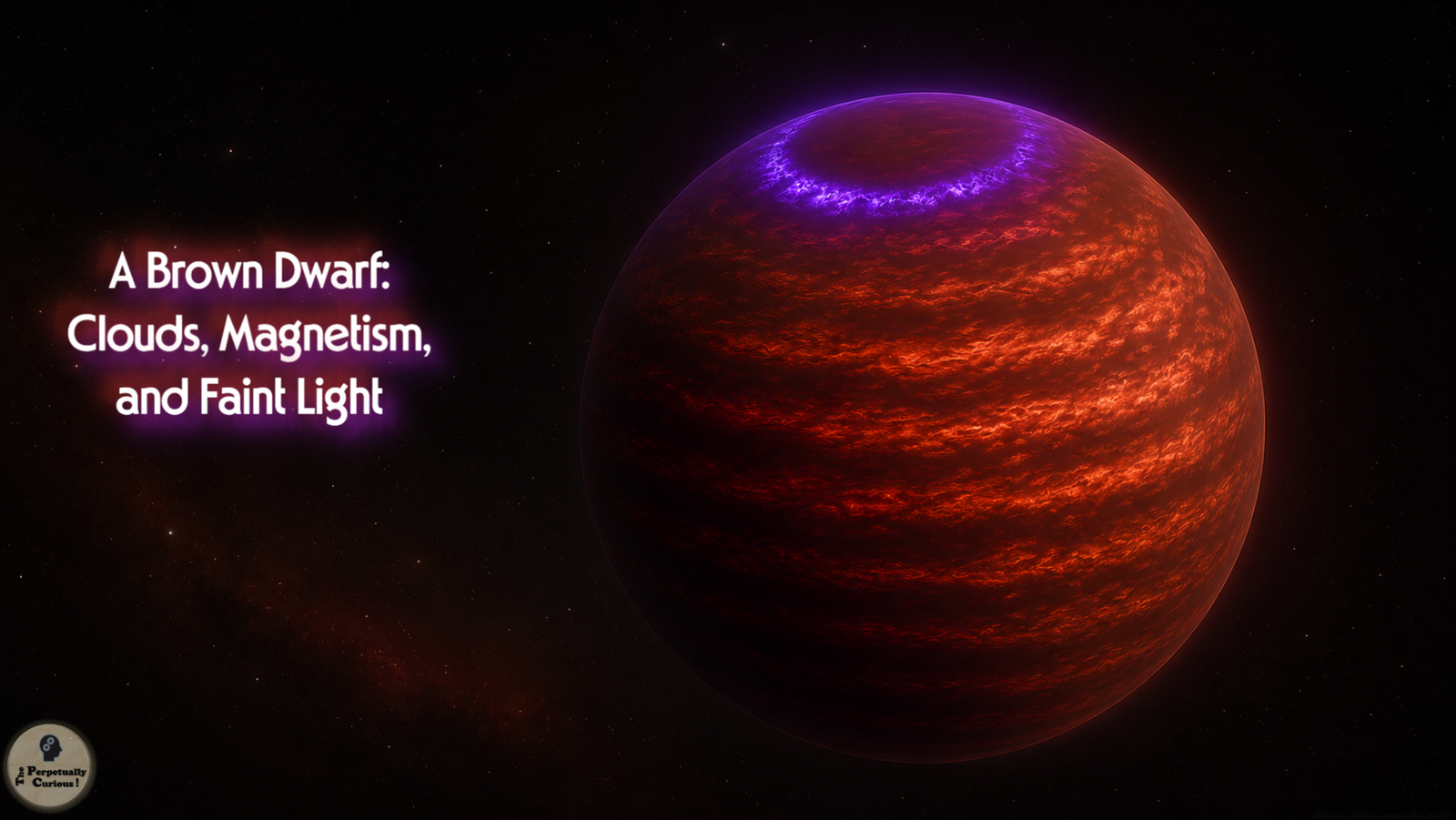
🌟 Brown Dwarfs: Between Giant Planets and the Smallest Stars
From section: 🌌 Formation, companions, and the galactic censusThe Galactic census matters, therefore, not merely as a count. Each well-characterized brown dwarf helps connect formation history, atmospheric change, mass, and age. Together, these objects reveal how densely and diversely the boundary between planets and stars is populated across cosmic time.
- The Perpetually Curious! › Canonical › Cosmic ExplorationArticle
🌑 Shadows Across the Solar System: How Eclipses Unfold Beyond Earth
Shadows move across distant worlds with a patience that belongs to the cosmos.Light bends, fades, and gathers again, shaping moments that unfold in silence.Across the Solar System, every eclipse becomes a brief reminder of how gently the universe turns.
- The Perpetually Curious! › Canonical › Cosmic ExplorationArticle
🌙 Quiet Worlds, Vast Stories: Some Lesser-Known Moons of Our Solar System
Worlds turn in silence, carrying their hidden stories through shadow and light.Each surface holds a memory of what shaped it, waiting for the patient eye to see.
- The Perpetually Curious! › Canonical › Planet EarthArticle
🌍🌑 Where Two Soils Part Ways: Earth, Moon, and the Stories Written in Dust
From their shared birth in cosmic violence to the quiet divergence of two surfaces shaped by entirely different forces, Earth and Moon reveal how the same elemental ingredients can follow profoundly different paths across time.
- The Perpetually Curious! › Archives › Cosmic ExplorationArticle
🌟 Brown Dwarfs: Why Stellar Ignition Never Takes Hold
From section: 🌌 A life powered by stored heatAmong objects of similar age and composition, a more massive brown dwarf can even be slightly smaller than a less massive one. 🌌 A life powered by stored heat Once any early deuterium burning and lithium depletion have run their course, no enduring nuclear source replaces the energy escaping into space.
- The Perpetually Curious! › Archives › Cosmic ExplorationArticle
The Asteroid Belt: Ancient Fragments of Our Solar System's Story 🌌
On New Year's Day 1801, Italian astronomer Giuseppe Piazzi made a discovery that would transform our understanding of the solar system. While searching for a suspected planet between Mars and Jupiter, he found something else entirely: the first of millions of rocky fragments…
- The Perpetually Curious! › Canonical › Engineering & TechnologyArticle
🚂 Echoes of Steam, Currents of Steel: Train Engines and the Rise of High-Speed Motion
The story of train engines is a story of how societies learned to move people and goods across landscapes that once felt impossibly vast. It begins with wooden rails, gravity, and horses, then grows into the thunderous age of steam, the practical reach of diesel power, and the…
- The Perpetually Curious! › Archives › Wilderness & Homestead CreaturesArticle
🐾 The Hyena Paradox: Power, Care, and Clan Life in Africa’s Night
Observations across Africa reveal a striking paradox: the power to bring down large prey paired with the dedication to raising and protecting young within intricate societies.
- The Perpetually Curious! › Canonical › Cosmic ExplorationArticle
🌌 The Hunt for the Invisible: Understanding Dark Matter Through Science’s Greatest Detective Story
… The clues did not arrive from one instrument or one generation. They accumulated across galaxy motions, colliding clusters, gravitational lensing, the cosmic microwave background, and increasingly sensitive underground experiments. …
- The Perpetually Curious! › Canonical › Cosmic ExplorationArticle
🌌 Borrowing the Orbits of Giants: How Gravity Assists Carry Spacecraft into the Deep
This article follows that journey from the challenge of reaching distant planets to the elegant physics that makes gravity assists possible. It traces how a subtle idea in orbital mechanics became one of the most important tools in cosmic exploration, and how it continues to shape the paths of spacecraft today.