Explore by topic, question, or idea. Find articles, reflections, videos, puzzles, and curiosity pathways gathered across the site.
Press Enter or select Search. A newly typed query starts globally; filters are applied only through the visible rail.
24 results for “the hyena paradox power care and clan life in africa night”
- The Perpetually Curious! › Archives › Planet EarthArticle
When Nature's Fury Spirals: Understanding the Science Behind Nor'easters 🌊
Few weather phenomena capture the raw power of nature quite like a nor'easter bearing down on the Eastern Seaboard. These massive storm systems, born from the collision of opposing air masses over the Atlantic, represent some of the most complex and fascinating atmospheric dynamics on Earth.
- The Perpetually Curious! › Canonical › Planet EarthArticle
🌌 Sky in Slow Layers: Understanding Earth’s Atmospheric Structure
From section: 🌍 A thin blue veil around a rocky world… With that framework in place, the ascent begins in the troposphere, where the atmosphere is densest, water vapor is most abundant, and weather and life occupy the same air.
- The Perpetually Curious! › Canonical › Planet EarthArticle
🌊 How Nor’easters Form: When the Coast Becomes a Storm Engine
From section: Frequently Asked Questions+Does one cold night make a tree turn red? Cool conditions can favor red pigment production in some trees when leaves also receive light and retain the capacity to make anthocyanins. No universal temperature threshold applies, and one night rarely explains an entire canopy.
- The Perpetually Curious! › Canonical › Planet EarthArticle
🌊 Where the Salt Stays: Why the Ocean Is Salty but Rivers and Most Lakes Are Fresh
From section: ♻️ The ocean does not grow saltier without endThese inputs and removals operate at different rates for different ions, often across timescales far longer than a human life. Over long intervals, many of the ocean’s major dissolved constituents are governed by dynamic balances in which natural removal processes broadly offset continued inputs. …
- The Perpetually Curious! › Canonical › Planet EarthArticle
🌧️ When Clouds Let Go: Why It Rains and How Raindrops Are Born
From section: 🔊 The sensory physics of rainWind, surrounding noise, terrain, and the temperature structure of the lower atmosphere can further influence how these sounds travel to a listener. Rain does not necessarily become softer at night, but it may seem different as background noise, air movement, and atmospheric conditions change. …
- The Perpetually Curious! › Canonical › Planet EarthArticle
🌈 When Sunlight Paints the Rain: The Quiet Geometry of Rainbow Formation
From section: 🌍 A shared sky, a personal rainbowPerhaps this is part of what gives a rainbow its reflective power. It reveals a pattern governed by the same physical laws for everyone while reminding us that each view of that pattern is assembled along a slightly different path.
- The Perpetually Curious! › Canonical › Planet EarthArticle
🌇 When the Sky Becomes a Painting: Why Clouds Glow Red and Orange at Sunset on Earth
From section: 🌄 Twilight and the lingering glow of the upper atmosphere… The lingering colors of twilight are therefore not remnants of the day but the final expression of sunlight illuminating the highest reaches of the atmosphere before night fully arrives.
- The Perpetually Curious! › Archives › Planet EarthArticle
❄️ Antarctica: Southernmost Continent’s Frozen Symphony of Silence and Light
From section: ❓ FAQ… The water remains liquid due to geothermal heat and pressure. Evidence suggests microbial life may exist in these extreme conditions, though findings remain debated due to contamination concerns and sampling challenges.
- The Perpetually Curious! › Archives › Planet EarthArticle
Where Earth's Temperate Logic Ends: Understanding the Arctic Circle 🌐
The Arctic Circle marks more than a line on our maps. At approximately 66.5 degrees north latitude (about 66°30′ N), this invisible boundary transforms how our planet receives light, how ecosystems function, and how humans experience the passage of time itself.
- The Perpetually Curious! › Archives › Planet EarthArticle
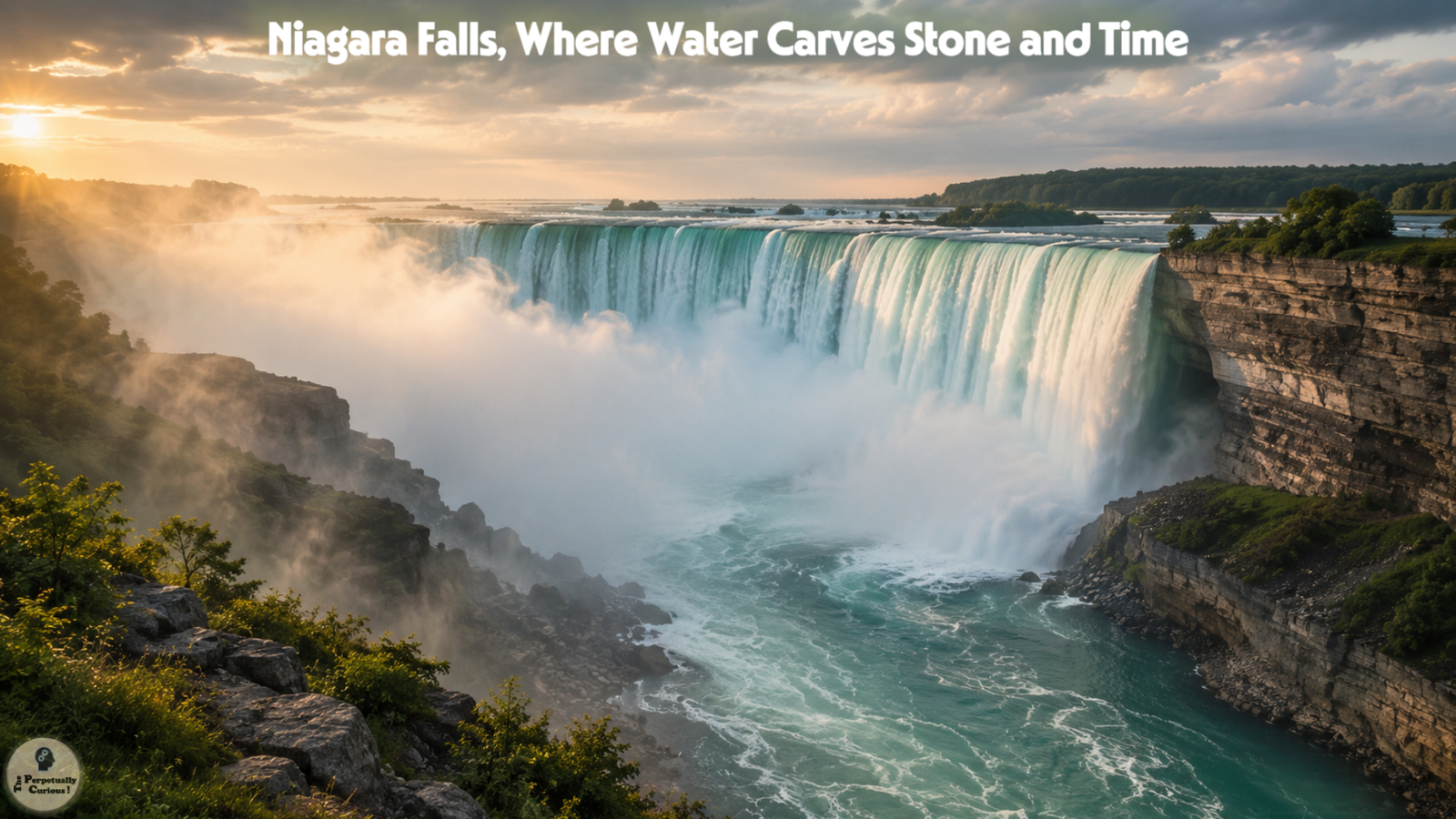
🌊 Niagara Falls Facts: How Water Turns Stone Into Time
From section: Mist as a sign of forceMist as a sign of force Mist may seem delicate, but at Niagara it is also a measurement of power.