Explore by topic, question, or idea. Find articles, reflections, videos, puzzles, and curiosity pathways gathered across the site.
Press Enter or select Search. A newly typed query starts globally; filters are applied only through the visible rail.
10 results for “where does the mind reside a contemplation on consciousness and the dancing synapses”
- The Perpetually Curious! › Archives › Biology & HealthArticle
Where Does the Mind Reside? A Contemplation on Consciousness and the Dancing Synapses 🧠
The Question That Captivates Neuroscience 💭 Standing before the vast neural landscape of the human brain, scientists and philosophers alike find themselves pondering one of existence's most compelling questions. Where does consciousness reside?
- The Perpetually Curious! › Canonical › Biology & HealthArticle
🌡️ When the Skin Remembers the Cold: Why We Get Goosebumps
There are moments when the body seems to answer before the mind has found its words. A sudden chill moves through the air, a musical phrase rises toward its quiet summit, or a story reaches a point that feels suspended in time. In these moments, the skin responds with a familiar texture.
- The Perpetually Curious! › Canonical › Biology & HealthArticle
🌌 What Causes Déjà Vu: The Science Behind Familiar Moments
… A person may step into a hallway, hear a fragment of conversation, or notice the angle of afternoon light, and a quiet ripple of familiarity rises without warning. The mind insists that the moment is new, yet something within it feels remembered.
- The Perpetually Curious! › Archives › Biology & HealthArticle
When Dreams Feel More Real Than Morning: The Science and Mystery of Our Sleeping Mind 🌙
You wake with your heart racing, certain you just spoke with your grandmother who passed away years ago. She stood in your childhood kitchen, wearing that familiar blue apron, but when she opened her mouth to speak, no words came.
- The Perpetually Curious! › Canonical › Biology & HealthArticle
🌫️ The Quiet Maps in Our Hands: Why Palm Lines Form and What They Reveal About Development, Movement, and Meaning
From section: 🔍 Why humans look for meaning in palm linesThe human mind is highly attuned to patterns. It is natural to look at the palm and wonder whether the crossing of two lines or the fork of a crease might say something about a life story. This tendency is not limited to hands. People see shapes in clouds, faces in rock formations, and significance in coincidences.
- The Perpetually Curious! › Canonical › Biology & HealthArticle
🌫️ Why We Get Hiccups: The Reflex Beneath Every Small “Hic”
From section: 🐾 Evolutionary echoes: infants, amphibians, and possible originsWith these evolutionary echoes in mind, it is helpful to return to the present and consider how hiccups appear across the lifespan.
- The Perpetually Curious! › Canonical › Biology & HealthArticle
🌫️ When the World Blurs for a Moment: Why We Sneeze
From section: 🌈 The sensory experience of a sneezeWith this sensory portrait in mind, the article now turns to a brief reflection that connects the science of sneezing with a sense of everyday wonder.
- The Perpetually Curious! › Canonical › Biology & HealthArticle
😮💨 When A Breath Becomes a Yawn: Why We Yawn and What This Quiet Reflex May Reveal
From section: 🧠 When one yawn becomes many: contagious yawning and the social brainNotably, contagious yawning does not fully emerge in children until around four to five years of age, a timeline that roughly overlaps with developing social cognition and theory‑of‑mind skills in structured experimental settings, although some naturalistic observations suggest the behavior may appear somewhat earlier.
- The Perpetually Curious! › Canonical › Biology & HealthArticle
💧 Why We Cry: The Quiet Science of Tears, Sadness, and Grief
From section: 🔍 What science knows, and what remains open… These questions touch the boundary between measurable biology and subjective experience, and the nature of mind offers a broader context for understanding how emotional states emerge from the interplay of neural activity and personal meaning.
- The Perpetually Curious! › Archives › Biology & HealthArticle
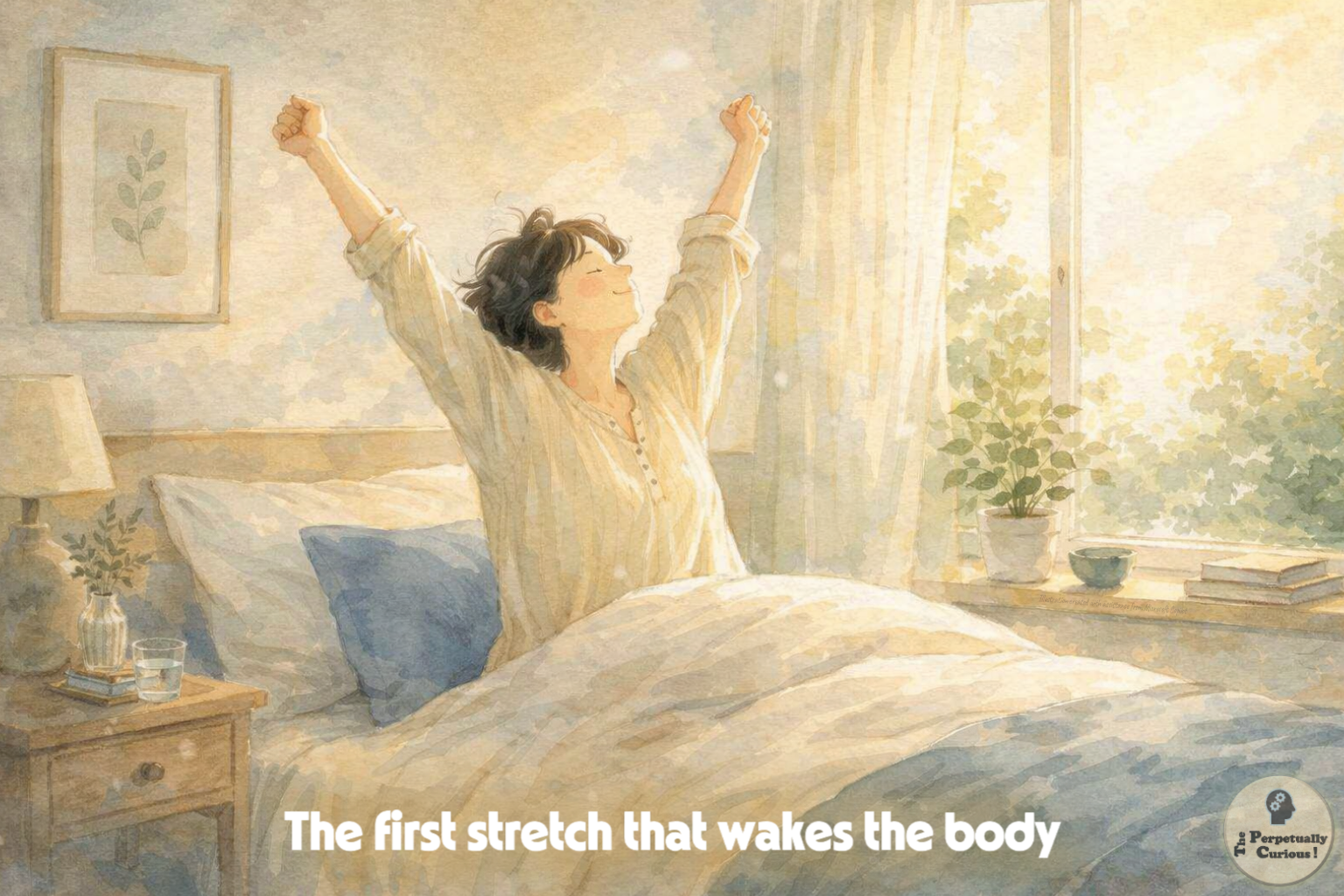
🌅 Pandiculation: How the Waking Stretch Restores Body Awareness
Before the eyes fully focus or the mind has assembled the day, the body may begin moving on its own. The arms rise, the chest opens, the back lengthens, and several muscles tighten before easing into release. This familiar sequence has a scientific name: pandiculation.