

Evening light often feels like a quiet performance, a slow transformation that unfolds across the sky with a sense of calm inevitability. As the Sun approaches the horizon, the air softens, the sky deepens or fades, and clouds begin to glow in shades of amber, rose, and crimson. These changes may appear poetic, yet they arise from a single, elegant sequence of physical processes that shape the way sunlight interacts with the atmosphere. The atmosphere filters the incoming light, the sky reveals the scattered wavelengths, and the clouds display the filtered light that reaches them, a relationship that becomes clearer when considered alongside the behavior of a living atmosphere. Understanding this layered story brings clarity to the colors of sunset and reveals how the sky and the clouds express different parts of the same sunlight.
Sunset color is not a single event but a progression that begins high above the surface and continues downward through the atmosphere. Sunlight first encounters the upper layers of air, where gas molecules scatter shorter wavelengths and allow longer wavelengths to pass through. As the Sun lowers, the path of light through the atmosphere lengthens, and the filtering becomes more pronounced. The sky responds by shifting its color, and the clouds respond by revealing the filtered light that reaches them. The geometry of the horizon, the angle of the Sun, and the composition of the air all contribute to the final display.
This article follows the journey of sunlight from the upper atmosphere to the surface, showing how each stage shapes the colors that appear in the sky and on the clouds. The goal is to reveal the full architecture of sunset color, from the physics of scattering to the geometry of the horizon, and from the behavior of clouds to the influence of aerosols, seasons, and latitude. These elements form a coherent structure that connects the behavior of light, the composition of the atmosphere, and the motion of Earth itself.
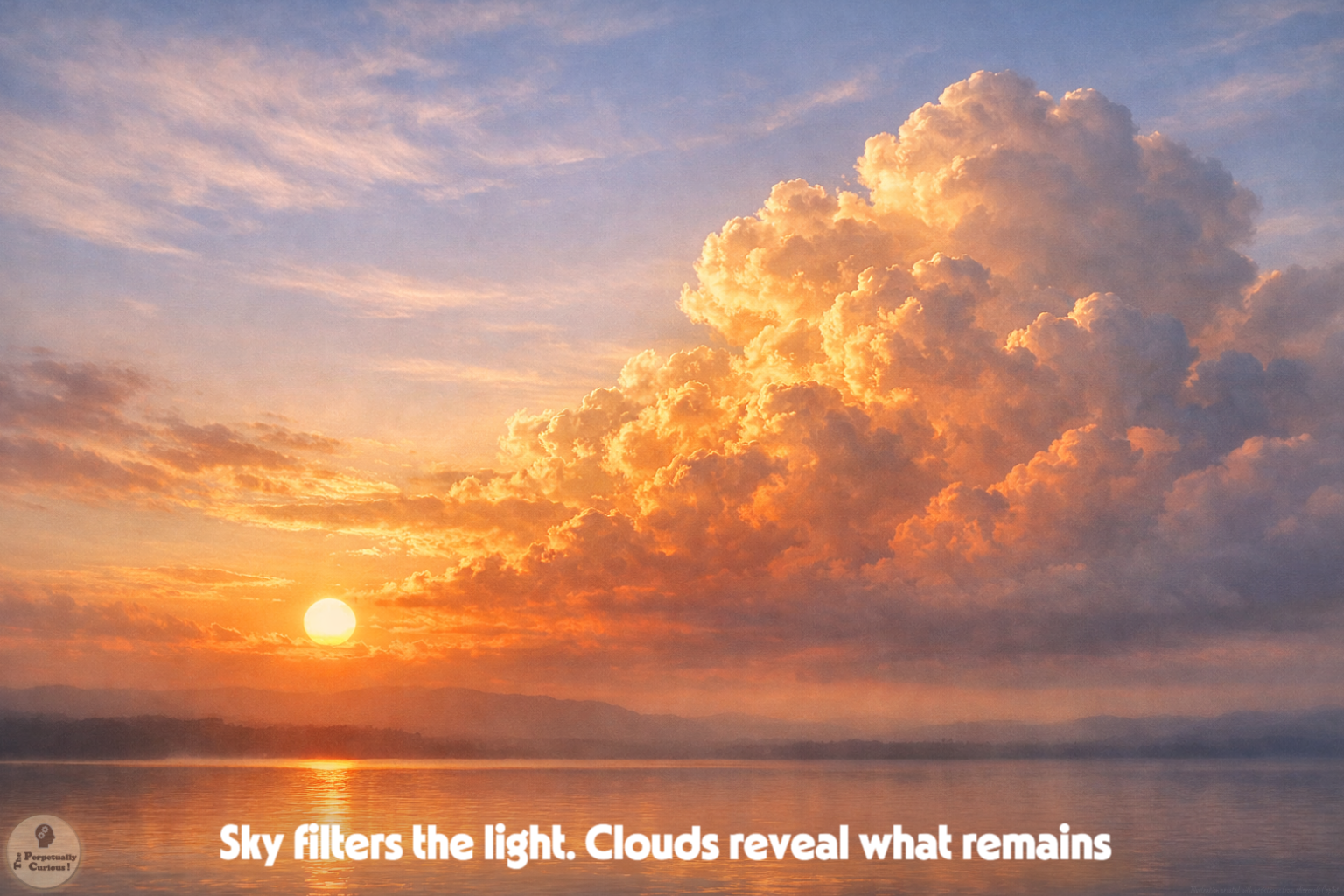
The sky gathers its last colors as if it is remembering the long path of light across the day.
Each shade settles gently into the horizon, carrying the quiet story of how the world meets the Sun.
In this moment, the day closes with a calm that feels both ancient and newly made.
🌤 Sunlight as a hidden rainbow
Sunlight viewed from above Earth’s atmosphere appears essentially white. At the surface, direct sunlight often looks slightly yellow-white because some of the shorter wavelengths have been scattered out of the beam. Even so, the light still contains a broad blend of visible wavelengths, and this mixture becomes easier to understand when considered within the layered structure of Earth’s atmosphere. When these wavelengths reach the eye together, the visual system combines them into a single impression of white light and brightness.
This hidden spectrum helps explain why the same Sun can create a blue midday sky and a warm evening horizon. The Sun continues to emit the same broad range of visible wavelengths, but at sunset, the path through the atmosphere becomes much longer. That extended journey changes the balance of wavelengths remaining in the direct beam that reaches an observer. As shorter wavelengths are scattered more strongly out of that path, the transmitted light becomes progressively richer in yellow, orange, and red.
The journey into how these wavelengths separate begins as sunlight interacts with molecules throughout the atmosphere.
🌈 How the atmosphere filters color
A deeper appreciation of how Earth sustains the conditions that make these optical effects possible begins with the structure and behavior of its atmosphere. As sunlight enters the air, it encounters countless gas molecules that are far smaller than the wavelengths of visible light, and this size difference allows shorter wavelengths to scatter more strongly than longer ones in a process known as Rayleigh scattering. Violet light is scattered most strongly, followed by blue, then green, while red and orange wavelengths pass through with fewer interactions. Although violet light is scattered more efficiently than blue, the sky appears blue rather than violet because the solar spectrum contains less violet light at the surface, the human eye is less sensitive to violet, and some violet light is absorbed in the upper atmosphere.
The sky’s color is therefore created by the scattered light itself. Blue wavelengths are redirected across the entire dome of the sky, filling it with color even though the Sun remains bright and nearly white. The light that continues forward without being scattered defines the color of the Sun and the light that reaches clouds. During midday, only a portion of the blue and violet light is removed from the direct beam, so the Sun appears yellow white and clouds remain pale. As the Sun moves lower in the sky, the filtering effect becomes more pronounced. The light must travel through a longer stretch of atmosphere, and the shorter wavelengths are scattered out of the direct beam more completely. What remains is sunlight enriched in the longer wavelengths that create the warm colors of sunset.
🌤 The sky and the clouds tell different parts of the story
The way clouds and sky divide the labor of light reflects the fact that they interact with sunlight through different physical pathways, each revealing a different aspect of the atmosphere. The sky is colored by scattered light, created when gas molecules redirect shorter wavelengths across the dome of the sky, filling it with blue even when the Sun remains bright and nearly white. Clouds, by contrast, reveal the color of the light that reaches them, because their droplets scatter visible wavelengths broadly and therefore display whatever mixture of colors remains in the direct beam.
During midday, that light is close to white, so clouds appear white, a result that reflects the balanced distribution of wavelengths in the overhead Sun. Near sunset, the light has been filtered by the atmosphere and is dominated by longer red and orange wavelengths, so clouds glow with warm colors that express the selective filtering that has taken place along the Sun’s path. The sky and the clouds therefore express different aspects of the same sunlight as it interacts with the atmosphere. The sky creates the color. The clouds display the color. Together they form a layered record of how sunlight has been scattered, filtered, and transformed on its journey through the air.
🌈 The three‑layer atmosphere model
The layered behavior of Earth’s atmosphere becomes clearer when viewed as three interacting regions, each one shaping the color of the sky in a different way and each one responding to sunlight through its own physical processes.
The first is the gas atmosphere, where Rayleigh scattering occurs and the sky gains its blue color. This layer is composed of molecules that are far smaller than the wavelengths of visible light, and their interactions with sunlight determine which colors are scattered across the sky and which continue forward toward the surface.
The second is the cloud layer, where droplets scatter visible wavelengths broadly and reveal the color of the incoming light. Clouds do not create their own color. They display the color of the light that reaches them, which is why they appear white at midday and warm at sunset.
The third is the aerosol layer, where dust, smoke, and volcanic particles intensify or mute sunset colors. Aerosols scatter light differently from gas molecules and cloud droplets, and their presence can deepen reds, soften oranges, or mute the entire sky depending on their size, composition, and altitude.
These layers work together to shape the sky and cloud colors we see, each contributing its own influence to the evening display. The gas atmosphere creates the scattered light that colors the sky. The cloud layer reveals the filtered light that reaches it. The aerosol layer modifies the final palette by enhancing or diminishing specific wavelengths. Together they form a coherent structure that explains why sunsets vary from day to day, season to season, and place to place.
🌤 The vertical gradient of the sky
The contrast between the bright horizon and the deepening zenith becomes clearer when considered in light of the physics that shape the darkness of space beyond Earth. The sky is not a single color. It forms a gradient that deepens toward the zenith and softens toward the horizon, a pattern created by the different paths that light follows through the atmosphere. Near the horizon, the line of sight passes through a greater depth of air, where more molecules and aerosols scatter blue light out of the direct path. The zenith appears deeper because the path is shorter and the scattered light is less diluted by additional layers of air and haze.
Near sunset, this gradient becomes more dramatic. The lower sky warms as the direct beam loses more of its shorter wavelengths, while the upper sky remains blue or violet because it is illuminated by scattered light from higher, thinner layers of the atmosphere. The horizon often looks paler because low‑angle light passes through more air, more particles, and more opportunities for multiple scattering. The upper sky retains cooler tones because it receives light that has traveled through a shorter and clearer path. Together these layers reveal how the structure of the atmosphere shapes the colors we see, creating a vertical record of how sunlight has been transformed on its journey toward the surface.
🌈 Rayleigh scattering in context
Rayleigh scattering is the foundation of sky color, and it becomes increasingly important as the Sun lowers toward the horizon. Shorter wavelengths, especially violet and blue, are depleted more strongly from the direct beam because they interact more efficiently with atmospheric molecules. As the Sun sinks lower and the light travels through a longer path of air, the transmitted beam shifts progressively toward yellow, orange, and red. The lower the Sun descends, the more pronounced this shift becomes, a transition that parallels the deepening gradients that define a dark sky when sunlight fades from the upper atmosphere. This explains why the Sun appears yellow in the afternoon, why the horizon glows orange at sunset, and why clouds turn red when the Sun is very low. Each stage of this transition reveals how the atmosphere filters sunlight in layers, shaping the colors that define the close of day.
The same filtering can also change the appearance of snow and stone in high mountain landscapes such as Mount Kailash, especially near sunrise or sunset.
This filtered light becomes the source that clouds later reveal through Mie scattering, described in the next section.
☁️ Mie scattering and the colors carried by clouds
The behavior of cloud color is shaped by a different kind of scattering than the one that colors the sky. While Rayleigh scattering acts on tiny gas molecules and separates light strongly by wavelength, Mie scattering occurs when sunlight encounters particles that are closer to, or larger than, the wavelengths of visible light, such as cloud droplets, haze particles, or some aerosols. In many clouds, these droplets scatter visible wavelengths broadly enough that the cloud does not create a strong color of its own. Instead, it reveals the color of the light that reaches it. A similar relationship appears in fine waterfall mist, including the spray around Niagara Falls, where droplets can reveal the color and angle of light passing through the gorge atmosphere.
As sunlight travels through the atmosphere, Rayleigh scattering depletes shorter wavelengths more strongly, gradually enriching the transmitted beam in yellows, oranges, and reds. When this filtered light reaches clouds, Mie scattering redirects that light through the cloud, allowing the cloud to display the color of the incoming beam. During the day, when the Sun’s light contains most of the visible spectrum, clouds often appear white because they scatter the full mixture of visible wavelengths. Near sunset, when the beam has been shaped by a long atmospheric path, the same cloud layer can reveal the warm colors that remain.
Mie scattering also helps explain why clouds can appear gray when they fall into shadow, why thin clouds can show gradients of color, and why high clouds may glow long after the Sun has set. Because this scattering depends on particle size relative to wavelength, cloud thickness, and illumination geometry, it responds strongly to the structure of the cloud itself. Thick clouds block and absorb more light, creating darker tones, while thin clouds can allow filtered sunlight to pass through in layers. In this way, cloud scattering becomes the mechanism that displays the atmosphere’s filtered light, turning clouds into canvases that reveal the changing spectrum of the sky.

🌅 The long journey of sunset light
The changing balance of wavelengths during sunset is rooted in the steady output of the Sun itself, which is described by the physics of solar luminosity. When the Sun is high overhead, its light travels through a relatively short column of air before reaching the ground, a path that interacts with atmospheric molecules in a way that preserves most of the visible spectrum. As the Sun lowers, that path length increases, and the light must pass through far more atmosphere than it did earlier in the day.
Along this extended journey, the shorter wavelengths are scattered more strongly and are gradually removed from the direct beam. The transmitted light becomes progressively richer in the longer wavelengths that survive the trip. By the time the Sun approaches the horizon, the light that reaches an observer has been sifted and refined by the atmosphere, leaving behind the warm yellows, oranges, and reds that define the evening sky. These colors mark the final stage of a continuous transformation that begins with the full midday spectrum and ends with the long wavelengths that remain after the atmosphere has done its work. Beyond the sunset itself, the same wavelength-selective filtering can also make a rainbow near sunrise or sunset appear predominantly red.
🌈 Clouds as screens for filtered sunlight
Clouds respond to filtered sunlight in a different way from the open sky. Their droplets and ice crystals are much larger than air molecules, so they scatter visible wavelengths broadly rather than separating them by color. During the day, when incoming sunlight remains close to white, clouds often appear white or pale gray. Near sunset, the atmosphere has already removed much of the blue and violet light from the direct beam, so clouds illuminated by that beam can glow amber, orange, rose, or crimson. The clouds are not producing those colors on their own. They are displaying the color of the light that reaches them: when sunlight reaches clouds with most of its visible spectrum intact, they appear white; when the atmosphere has filtered that light, they glow with the wavelengths that remain.
🌥 Height, thickness, and the drama of cloud color
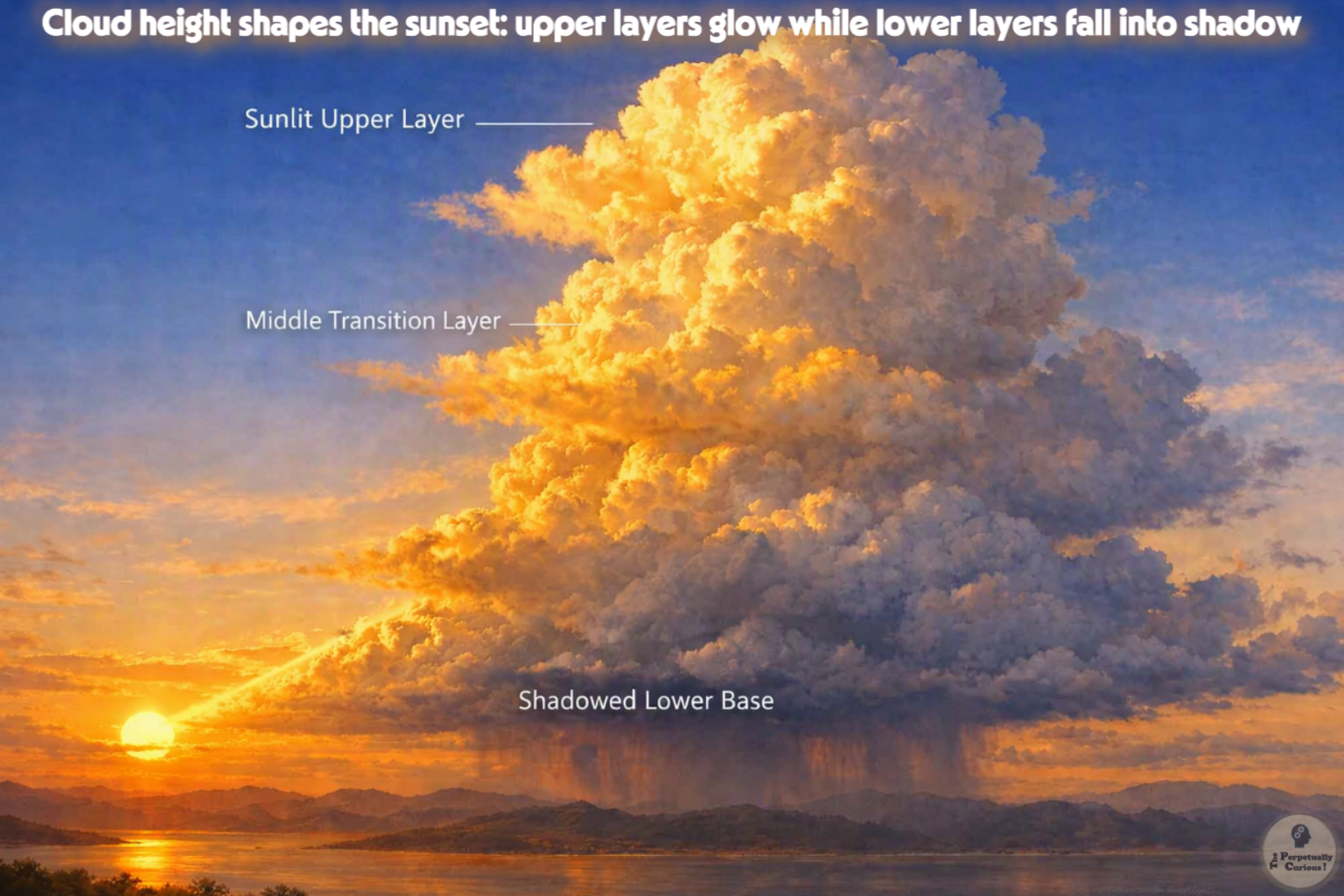
The height and thickness of clouds determine how they participate in the evening display. High clouds can remain illuminated after the ground and lower clouds have entered shadow, which is why they may continue glowing after the Sun has disappeared from view. Mid‑level clouds may show warm tones along their sunlit edges while their interiors remain subdued. Low clouds fall into shadow earlier and may appear gray or muted even while higher clouds still catch filtered sunlight. Thick clouds can behave like layered sculptures, with upper surfaces glowing while their bases remain dark. Together these variations reveal how the vertical structure of the atmosphere shapes the colors we see.
🌫 The influence of particles, haze, and distant events
The atmosphere is rarely composed of gas molecules alone. Dust, sea salt, smoke, pollution, and volcanic aerosols can all reshape sunset color by scattering and absorbing light. Fine particles high in the atmosphere can deepen reds, extend purples, or soften oranges, especially when they remain illuminated after the Sun has set. Dense smoke, heavy haze, or low‑level ash can have the opposite effect, muting the sky into brown, gray, or washed‑out tones. The result depends on particle size, altitude, composition, and concentration, a sensitivity that reflects how Earth’s atmosphere filters incoming sunlight.
Volcanic eruptions and wildfires can create unusually vivid twilight displays across entire regions. Fine ash and sulfate aerosols can linger in the upper atmosphere for months, enhancing reds and purples long after the original event has passed. Even distant events can influence local skies, as particles transported across continents or oceans subtly reshape the palette of the horizon.
🌍 Earth’s rotation and the illusion of a sinking Sun
The geometry that makes the Sun appear to descend toward the horizon is closely related to the alignments that create solar eclipses on Earth. The Sun does not sink in space each evening. Instead, Earth rotates on its axis, and an observer’s location turns away from the direction of the Sun. This rotation creates the apparent descent of the Sun, even though the Earth–Sun distance remains essentially unchanged throughout the day and the Sun’s light continues to reach Earth with the same steady source.
As the observer’s position turns farther from the incoming sunlight, the Sun appears to approach the horizon. The horizon itself acts as a boundary created by Earth’s curvature, and once the observer rotates beyond the line of sight, the Sun slips from view even though it has not moved downward in space. This simple geometric relationship explains why sunrise and sunset occur at predictable times and why the colors of evening light unfold in a sequence shaped by the structure of Earth’s atmosphere. The sinking Sun is therefore not a physical descent but a visual consequence of Earth’s rotation, a daily reminder of the planet’s motion beneath the sky.
🌅 The horizon as a stage for the final transformation
The interplay of light and shadow near the horizon echoes the larger patterns of eclipses beyond earth, which reveal how alignment and perspective shape what an observer sees. The horizon is the line where Earth’s surface curves away from view, a boundary created by the planet’s geometry and shaped by the steady motions that govern the apparent motion of the Sun across the sky. As the Sun approaches this line, its light must pass through the densest and dustiest part of the atmosphere, a region where the filtering becomes strongest and where the warmest colors emerge.
Near the horizon, the path of sunlight becomes so long that nearly all shorter wavelengths are removed, leaving behind a beam enriched in reds and oranges. This is why the horizon glows with intense color even when the upper sky remains cooler in tone, a contrast shaped by the layered structure of the atmosphere. The horizon becomes a stage where the final transformation of sunlight unfolds, revealing the last surviving wavelengths after their long journey through air, haze, and particles. These colors form the closing chapter of the day’s illumination, shaped by the same atmospheric processes that define the structure of Earth’s sky from midday brightness to twilight glow.
🌈 Refraction, distortion, and the shape of the setting Sun
The distortions that reshape the Sun near the horizon resemble the optical challenges that space telescopes must account for when observing distant light through or beyond an atmosphere. As the Sun approaches the horizon, Earth’s atmosphere bends its light upward, lifting the apparent solar disk slightly above its true geometric position. Because the lower edge of the Sun is seen through denser air than the upper edge, it is refracted more strongly, creating the familiar flattened or oval shape. Wavelength‑dependent refraction can also separate colors slightly, helping explain rare effects such as the green flash. Near the horizon, temperature gradients in the air can introduce additional distortions, producing shimmer, ripples, mirages, or subtle shifts in the Sun’s outline.
Together these effects reveal that the setting Sun’s changing shape is not a property of the Sun itself but a consequence of how its light travels through Earth’s atmosphere. The Sun remains round. The atmosphere reshapes it.
🌄 Twilight and the lingering glow of the upper atmosphere
As twilight deepens and the first stars appear, the sky begins to reveal the quiet geometry of constellations that emerge each night. After the Sun sets, the sky enters twilight, a period when the Sun is below the horizon but still illuminates the upper atmosphere. Each phase reveals a different layer of the sky, shaped by how sunlight continues to scatter through the atmosphere even after the direct beam has slipped from view.
Civil twilight begins when the Sun has just moved below the horizon, from 0 to 6 degrees, and the lower atmosphere still receives enough scattered light to keep the landscape bright. As the Sun sinks farther, nautical twilight begins, from 6 to 12 degrees below the horizon, and the sky darkens enough for the horizon to blend with the sea. Astronomical twilight follows, from 12 to 18 degrees below the horizon, when the Sun is deep enough that its scattered light no longer interferes with the visibility of faint stars, leaving the sky close to its fully dark nighttime state.
During these phases, the upper atmosphere continues to glow because it remains high enough to catch sunlight long after the ground has fallen into shadow. The lingering colors of twilight are therefore not remnants of the day but the final expression of sunlight illuminating the highest reaches of the atmosphere before night fully arrives.
🪐 Cloud colors on other worlds
The diversity of cloud behavior across the Solar System becomes even more striking when viewed across the wide range of planetary environments. Each world reveals a different relationship between sunlight and atmosphere, shaped by the chemistry of the air, the size of suspended particles, and the depth of the surrounding haze. Some worlds scatter light through dense layers of hydrocarbons, while others filter it through thin veils of ice crystals or clouds composed of exotic compounds. The result is a spectrum of skies that range from muted and hazy to sharp and crystalline, each one shaped by the physics that governs its atmosphere.
Clouds on other planets reveal how atmospheric composition shapes the colors of the sky. On Venus, thick sulfuric acid clouds reflect sunlight into a bright yellow‑white glow beneath a dense, cloud‑laden sky. On Mars, fine dust suspended in a thin atmosphere creates sunsets where the sky near the Sun turns blue while the surrounding sky glows yellow‑orange. On Jupiter and Saturn, towering ammonia clouds reflect sunlight in layers of white, ochre, and soft brown, shaped by the depth and temperature of the atmosphere. On Titan, a thick hydrocarbon haze filters sunlight into a deep orange glow that permeates the sky, a transformation shaped by the chemistry of its atmosphere.
Each world offers its own version of the evening sky, shaped by the physics of its atmosphere and the light of its Sun, revealing how the same star can paint entirely different colors across the Solar System, a diversity that echoes the shifting geometry of planetary shadows.
🌌 The quiet continuity of sunset
The quiet sense of motion that sunset evokes reflects the steady rhythm of Earth’s rotation beneath the sky. Sunset is not a single moment but a gradual unfolding, a transition shaped by Earth’s motion and the atmosphere’s changing path through sunlight. It begins long before the Sun touches the horizon and continues long after it has disappeared, a continuity shaped by the layered behavior of the atmosphere.
As the Sun lowers, the atmosphere filters and reshapes the light in stages, each one revealing a different part of the spectrum. Even after the Sun has set, the upper atmosphere remains illuminated, carrying the last traces of color across the sky, a lingering glow that resembles the faint patterns visible in a dark sky once night fully arrives. This continuity reminds us that sunset is not an ending but a transformation, a shift in perspective shaped by Earth’s rotation and the structure of the atmosphere. Every sunset follows the same architecture of light and air, yet each one reveals a new variation of the same enduring design.
Pass this article along to someone curious and let the learning travel.
💡 Did You Know
🌤 High clouds can continue glowing long after the Sun has dipped below the horizon because they remain illuminated by sunlight that travels above lower atmospheric layers.
🌈 A faint lavender or purple tint sometimes appears after sunset when scattered blue light mixes with the remaining red light in the atmosphere, a blend shaped by how the upper air continues to scatter shorter wavelengths even after the Sun has set.
🌸 The pink band that appears opposite the Sun shortly after sunset is known as the Belt of Venus, created when reddened light from the setting Sun is backscattered by the upper atmosphere on the opposite horizon.
🌧 Storms can produce unusually vivid sunsets because rain removes larger particles from the air, allowing finer aerosols to enhance red and orange light.
🌅 The Sun sets slightly later than geometry predicts because atmospheric refraction lifts it above its true position, a subtle distortion that mirrors the optical challenges faced by space telescopes.
💚 The green flash occurs when the atmosphere refracts shorter wavelengths more strongly, and because violet and blue light have already been scattered out of the line of sight, green becomes the shortest surviving wavelength briefly lifted above the horizon.
🔥 Wildfire smoke can intensify red sunsets by scattering shorter wavelengths and allowing deeper reds to dominate, especially when fine particles are suspended high in the atmosphere.
🌍 Sunsets differ by latitude because high latitudes experience long twilight arcs while equatorial regions experience short, sharp transitions.
💧 Humidity can soften sunset colors into pastels, while clearer dry air can sharpen contrast.
🌋 Volcanic eruptions can create global twilight displays by injecting reflective particles into the stratosphere, where they scatter sunlight in ways that deepen or extend the colors of dusk.
🌄 Crepuscular rays, often called “God rays,” appear to fan outward from the Sun even though they are nearly parallel; perspective makes them seem to converge.
🌒 The Earth’s shadow, or antitwilight arc, rises on the eastern horizon after sunset as a blue-grey band topped by the pink Belt of Venus.
Why do clouds look white during the day but red at sunset?
Because clouds scatter whatever light reaches them. During the day, that light contains most of the visible spectrum, so clouds appear white. At sunset, the direct beam is enriched in red and orange wavelengths after passing through a long stretch of atmosphere.
Why is the sky blue?
Because gas molecules scatter shorter wavelengths more strongly than longer ones, a behavior that aligns with the physics of our living atmosphere.
What is Mie scattering?
Mie scattering is the scattering of light by particles that are close to, or larger than, the wavelengths of visible light, such as cloud droplets, haze particles, or some aerosols.
Why do clouds show the color of the sunset instead of creating their own colors?
Because Mie scattering redirects whatever filtered light reaches the cloud, revealing the color shaped earlier by Rayleigh scattering in the atmosphere.
Why are clouds white during the day?
Because Mie scattering distributes the full mixture of visible wavelengths, producing a white appearance when the Sun’s light contains most of the spectrum.
Why do clouds turn red or orange at sunset?
Because Mie scattering displays the warm wavelengths that remain after Rayleigh scattering has depleted the shorter wavelengths more strongly from the direct beam.
Why do some clouds look gray even when others are brightly colored?
Because thick clouds absorb more light and fall into shadow sooner, and Mie scattering cannot brighten them without sufficient incoming illumination.
Why do contrails and cirrus clouds show vivid colors?
Because their small ice crystals scatter, refract, and redirect low-angle sunlight, allowing the filtered colors of the setting Sun to become visible.
Why does the horizon look warm at sunset?
Because sunlight travels through a long atmospheric path that removes shorter wavelengths, leaving behind the longer ones that create warm colors.
Why does the Sun appear flattened near the horizon?
Because atmospheric refraction bends its light upward, a distortion similar to the optical corrections required by space telescopes.
Why does the Sun sometimes appear to pause at the horizon?
Because atmospheric refraction lifts the apparent solar disk above its true geometric position, delaying the moment when it seems to touch the horizon. Some observers also perceive a pause due to contrast effects against the brightened horizon sky, but the Sun’s angular rate of descent does not change.
Why does the Sun sometimes look larger near the horizon?
Because the “large Sun” is a psychological illusion created by foreground context, not an optical effect of the atmosphere.
Why does the sky turn purple after sunset?
Because red light from the horizon mixes with scattered blue light above, creating a blended tint when the upper atmosphere continues to scatter shorter wavelengths.
Why does the sky stay bright after the Sun has set?
Because the upper atmosphere continues to scatter sunlight during twilight, a lingering glow that resembles the faint illumination patterns of a dark sky.
Why does the sky darken so quickly after astronomical twilight?
Because the Sun’s light no longer reaches the upper atmosphere, a transition that mirrors the deep darkness associated with the darkness of space.
Why does the sky fade unevenly after sunset?
Because different altitudes stop receiving sunlight at different times, creating a layered dimming pattern.
Why does the sky near the horizon sometimes look brighter than the zenith?
Because the line of sight passes through more air and therefore more scattered light, increasing overall brightness even as colors shift.
Why do some clouds look gray at sunset?
Because they fall into shadow before the Sun illuminates higher clouds, a geometry that resembles the shadow patterns seen during solar eclipses.
Why do high clouds glow after the Sun has set?
Because they remain in sunlight while the surface has entered shadow, a layered illumination pattern shaped by the vertical structure of the atmosphere.
Why do thin clouds show color gradients during sunset?
Because their varying thickness reveals different amounts of filtered light.
Why do clouds sometimes glow from below during sunset?
Because the Sun’s low angle allows its light to illuminate the underside of clouds that would normally be lit from above.
Why do clouds sometimes glow white even at sunset?
Because they are illuminated by scattered skylight rather than direct filtered sunlight.
Why do clouds sometimes appear blue or purple during twilight?
Because they are illuminated by the cool scattered light of the upper atmosphere rather than the warm direct beam.
Why do sunsets differ by season?
Because winter air is often clearer and summer air is often more humid, which changes how light is scattered and absorbed.
Why do sunsets differ by latitude?
Because the angle of the Sun’s path changes the length of twilight, with high latitudes experiencing long twilight arcs and equatorial regions experiencing short transitions.
Why do sunsets last longer in some places than others?
Because the Sun’s angle of descent varies with latitude, a geometric effect that resembles the slow passage of eclipse shadows.
Why do sunsets look different after wildfires?
Because smoke particles enhance red and orange wavelengths by scattering shorter wavelengths out of the direct beam.
Why do sunsets sometimes look hazy or muted?
Because aerosols scatter light in all directions, reducing contrast and softening colors.
Why do sunsets look different after rain?
Because rain can remove larger particles from the air and often leaves behind clearer, cleaner conditions that allow warm wavelengths to stand out more strongly. In some settings, finer aerosols may remain and contribute to enhanced reds and oranges.
Why do sunsets look more dramatic after snow?
Because snow events are often followed by cold, clear air with reduced humidity and aerosol loading, which increases atmospheric transparency and enhances the vivid transmission of warm wavelengths. Snow-covered surfaces can also reflect reddened light upward, which can amplify the warm glow near the horizon.
Why do sunsets look different after cold fronts?
Because cold fronts can sweep out haze and pollution, increasing clarity and enhancing contrast in the filtered beam.
Why do sunsets look different over deserts?
Because dry desert air often contains fewer large scattering particles, which can increase atmospheric clarity and allow warm wavelengths to dominate. Fine suspended dust, where present, can further intensify reds and oranges.
Why do sunsets look different over cities?
Because urban aerosols and pollution alter scattering, often muting colors or shifting them toward brownish tones.
Why do sunsets look more vivid in winter at mid-latitudes?
Because cold, dry air often reduces haze and increases the efficiency of long-wavelength transmission.
Why do some sunsets show multiple color bands?
Because different atmospheric layers filter sunlight to different degrees, creating stacked gradients of warm and cool tones.
Why do some sunsets show a bright yellow band before turning orange or red?
Because moderate filtering removes some blue light while leaving enough green and yellow to create a transitional band.
Why does the sky sometimes show a second, fainter Belt of Venus?
Because multiple scattering in the upper atmosphere can create layered backscattered bands of pink light.
Why do mountains or buildings turn orange before the sky does?
Because solid surfaces reflect the reddened direct beam immediately, while the sky’s scattered light changes more gradually.
Why do airplane passengers see longer sunsets?
Because higher altitudes remain in sunlight longer, delaying entry into Earth’s shadow.
Why do sunsets look different at high altitude?
Because thinner air scatters less light, producing sharper contrasts and deeper blues above the warm horizon.
Why do sunsets look different when viewed over mountains?
Because mountains block low-angle sunlight unevenly, creating complex shadow patterns and color gradients.
Why do sunsets look different on other planets?
Because each world has a unique atmospheric composition, pressure, particle load, and scattering behavior, so sunlight is filtered differently from planet to planet.
🤝 Sharing the wonder, one sky at a time
If this exploration of how light, air, and cloud layers shape the colors of sunset has offered a moment of clarity or quiet fascination, sharing it may help someone else see the evening sky with the same renewed attention. Each shared link becomes a small reflection of the larger interplay of sunlight and atmosphere that inspired these words, carrying the idea forward in the same gentle way that evening light travels through the air. In sharing the experience, you invite someone else to pause, look upward, and notice how the sky changes from one moment to the next, revealing its quiet transformations to anyone who takes the time to watch.
“When the Sky Becomes a Painting: Why Clouds Glow Red and Orange at Sunset on Earth.” The Perpetually Curious!, June 2026.
https://www.theperpetuallycurious.org/articles/why-clouds-turn-red-at-sunset/Continue Exploring
For what comes next
Site Updates gathers occasional notes, new additions, and ways to keep in touch. RSS brings new publications to your feed reader in chronological order.
Choose the path that speaks to you, and let the next curiosity find you wherever your wondering takes you.