

A river can begin as rain on a mountainside, run across stone, gather in a lake, and eventually meet the sea. Along the way, the water may look clear and taste fresh. Yet the ocean at the end of that journey is unmistakably salty. This creates a quiet puzzle: if rivers carry water into the sea, why do they not become salty too, and why do so many lakes remain fresh?
The answer lies in what water carries, how long it stays, and where it can leave. Rivers are not free of salt, and freshwater lakes are not chemically pure. They contain small amounts of dissolved minerals. The difference is that flowing water usually carries those minerals onward, while evaporation removes water but leaves most dissolved ions behind. Across landscapes and geological time, the water keeps moving, but some of its mineral passengers remain.
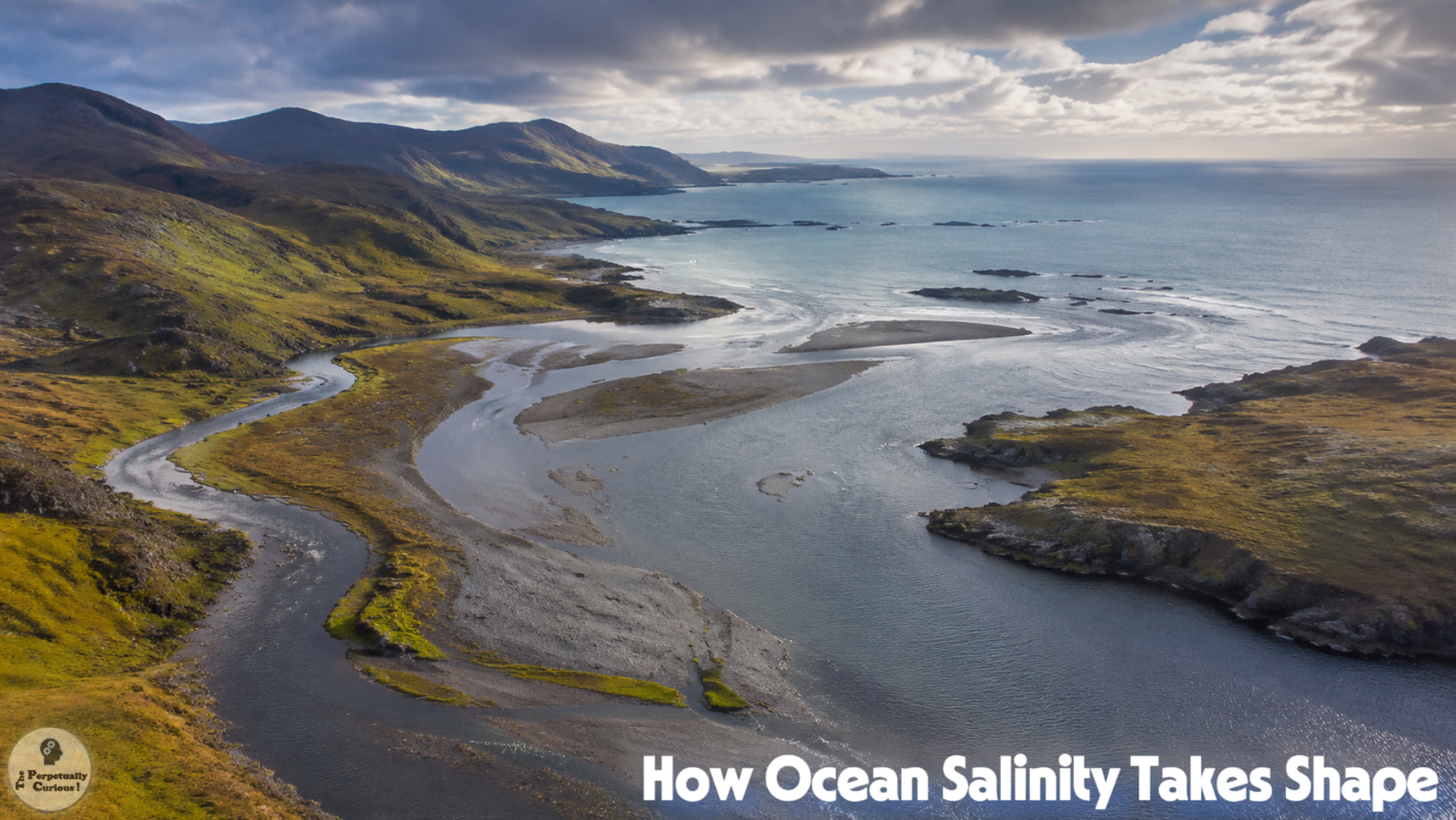
A quiet shimmer moves through the world where fresh water meets the open sea, carrying the memory of stone and sky.
Salt follows the long path of time, settling where the ocean keeps its oldest stories.
In that meeting of rivers and tides, the planet breathes in slow and patient rhythms.
⛰️ Much of the salt begins with a journey through rock
When raindrops are born in clouds, they contain relatively little dissolved mineral matter. They are not perfectly pure, however. Droplets can take up gases and particles from the air, and rainwater becomes mildly acidic as carbon dioxide dissolves into it. After the water reaches soil, it may encounter still more carbon dioxide released by roots and microorganisms.
This weak acidity helps water react with rock. Over time, chemical weathering releases electrically charged particles called ions. Sodium, calcium, magnesium, potassium, bicarbonate, sulfate, and chloride are among the many ions that may enter streams, groundwater, and rivers. The exact mixture depends on local rock, soil, climate, vegetation, and the amount of time the water remains in contact with the ground.
Weathering can free both visible fragments and dissolved material. Rivers may carry weathered grains from mountains to beaches, while ions become invisible once dissolved. A river can therefore look perfectly clear while carrying minerals toward a lake or ocean. In this scientific sense, the word salt refers to more than the sodium chloride used at the table. Many combinations of positive and negative ions are salts, and natural water usually contains a varied collection of them.
Weathering explains how minerals enter moving water. It also sharpens the central question. If rivers are continually gathering dissolved ions from the land, why do they usually remain fresh?
🏞️ Rivers carry salts without storing most of them
Most rivers are continuously renewed by rain, melting snow, springs, groundwater, and tributaries. Their water moves downstream rather than remaining in one basin for geological lengths of time, and dissolved ions move with it. Although a river may transport a large total mass of salts each year, those ions are usually dispersed through a much greater mass of water, so their concentration remains far below that of seawater.
Fresh water is therefore a relative term, not a claim that the water contains no dissolved material. River chemistry can vary widely. Water flowing across readily dissolved limestone may carry abundant calcium and bicarbonate, while rivers in dry regions may become more mineral-rich as evaporation concentrates their water. Groundwater inputs, sea spray, road salts, irrigation return flows, and other natural or human influences can also raise dissolved-ion concentrations. Near the coast, tides may push seawater into a river mouth, creating a shifting zone of brackish water.
Even with these variations, a typical flowing river has an important escape route: its downstream current. Some ions are removed, recycled, or temporarily stored along the way, but much of the dissolved load continues toward a lake or ocean instead of accumulating indefinitely in the river. To understand why many lakes share this freshwater character, the next step is to ask whether a lake also has somewhere to send what enters it.
💧 Most freshwater lakes have somewhere for water to go
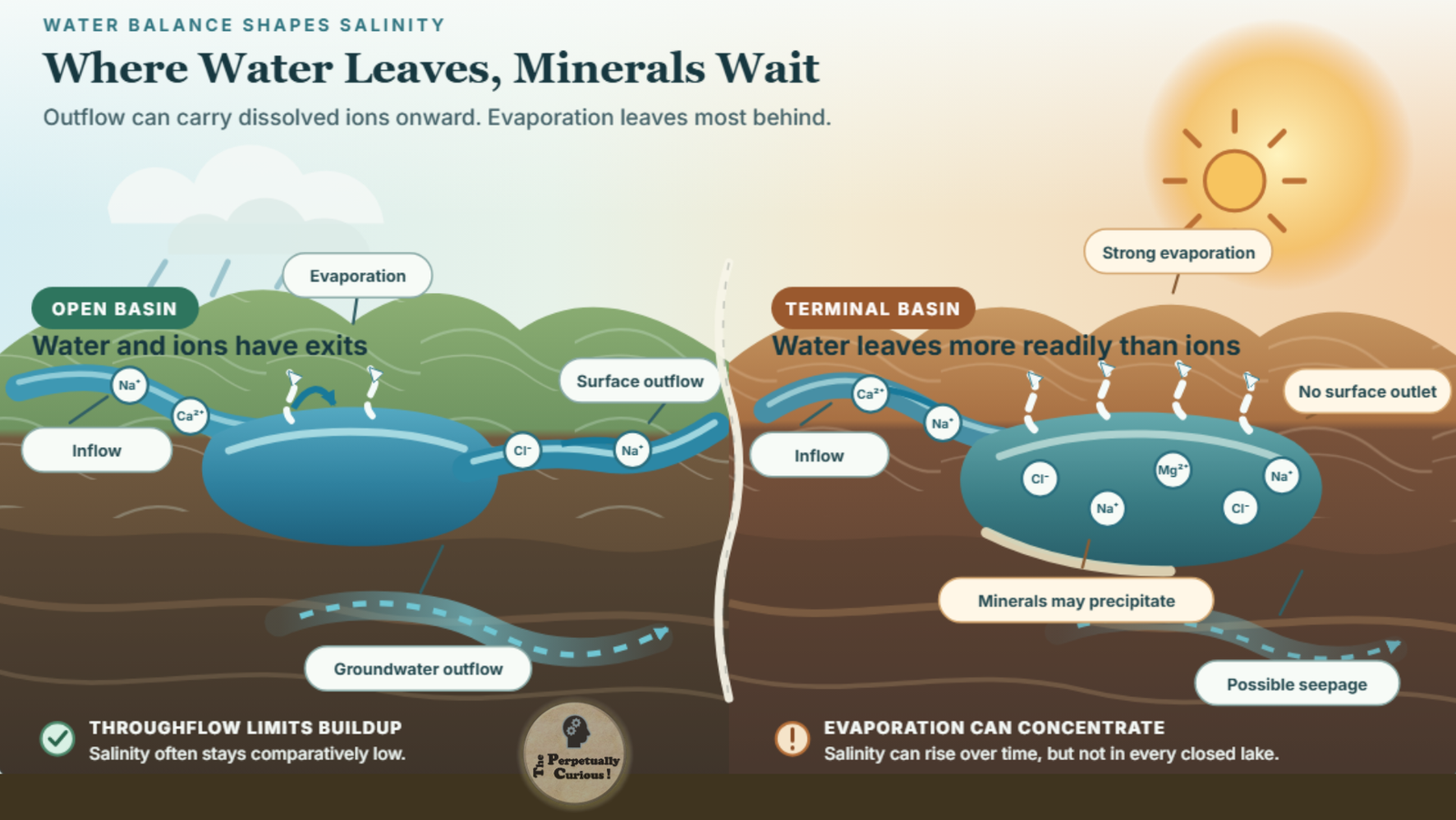
Many freshwater lakes function as open basins. Rivers and streams enter them, and an outlet carries water onward. Dissolved minerals arrive and mix throughout the lake, but some eventually leave with the outflow. Rainfall, snowmelt, and groundwater replenish the water, while continued throughflow helps prevent most dissolved ions from accumulating without limit.
A visible surface outlet is not the only escape route. Groundwater seepage can also export water and dissolved ions. Some lakes without an outflowing river remain fresh because evaporation is modest, mineral inputs are low, subsurface leakage is substantial, or their waters have not remained trapped long enough to become strongly concentrated.
The Great Lakes drainage system offers a large-scale example. Water moves from lake to lake, passes through connecting rivers, and ultimately reaches the Atlantic Ocean through the St. Lawrence River. The lakes hold enormous volumes of water, but they are not the final stop in the journey.
An outlet does not guarantee that a lake will always remain fresh. Salinity still depends on the balance among inflow, outflow, evaporation, groundwater exchange, climate, and the mineral content of the surrounding basin. Yet effective surface or groundwater outflow gives dissolved ions a way to leave. Remove or greatly weaken those exits, especially where evaporation is high, and the chemistry begins to change.
🧂 When a basin has no drain, minerals wait behind
Some lakes interrupt this onward journey. A lake with no surface outlet is commonly described as a terminal lake or as part of a closed, endorheic basin. Water can enter through rivers, rain, snowmelt, or groundwater, but it leaves mainly through evaporation and, in some settings, subsurface seepage. When water evaporates, water molecules enter the atmosphere while most dissolved ions remain behind. Repeated over long periods, especially where evaporation is strong, this separation can concentrate the lake water and make it saline.
The Great Salt Lake and the Dead Sea are familiar examples of terminal lakes. Evaporation does not create their salts. Minerals arrive through runoff and groundwater, then become concentrated because the departing water does not carry most of them away. If the water becomes sufficiently concentrated, some minerals may reach saturation, crystallize, and settle as solid deposits.
Closed lakes are not all equally salty. Their chemistry reflects the basin’s geological history and shape, the kinds of rock being weathered, the amount and composition of inflow, the rate of evaporation, possible groundwater leakage, and the minerals that precipitate from solution. A terminal lake can also change markedly as wetter and drier periods alter its volume. The essential idea is not merely that the lake lacks a surface outlet. It is that water can leave much more readily than its dissolved mineral load.
The ocean is not a closed basin in the same sense because it exchanges materials with the atmosphere, seafloor, sediments, and living organisms. Yet the physical separation between evaporating water and lingering ions also operates there on a planetary scale.
🌊 The ocean is where many water journeys meet
Rivers carry dissolved ions from the continents into the sea. Groundwater discharges along coasts, windblown material settles onto the ocean surface, and seawater circulates through hot rock beneath the seafloor, where chemical reactions can add some substances and remove others. The ocean is therefore connected not only to the land but also to the crust below.
At the same time, vast quantities of ocean water evaporate into the atmosphere. Evaporation separates water molecules from dissolved ions, so the rising water vapor carries almost none of the ocean’s dissolved salts. Sea spray can still carry tiny salt particles into the air through a different process. Much of the water vapor later returns as rain or snow over ocean and land. Water is continually recycled, while many dissolved ions remain in the ocean for far longer.
On average, seawater contains about 3.5 pounds of dissolved salts for every 100 pounds of seawater (35 grams per kilogram), or roughly 3.5 percent by mass. This is an average rather than a universal value. Still, it reveals the long-term result of countless exchanges among rain, rock, rivers, the seafloor, sediments, and the atmosphere.
Yet one detail remains unexplained. If rivers supply many kinds of dissolved ions, why are sodium and chloride so dominant in seawater?
⚗️ Seawater is not simply concentrated river water
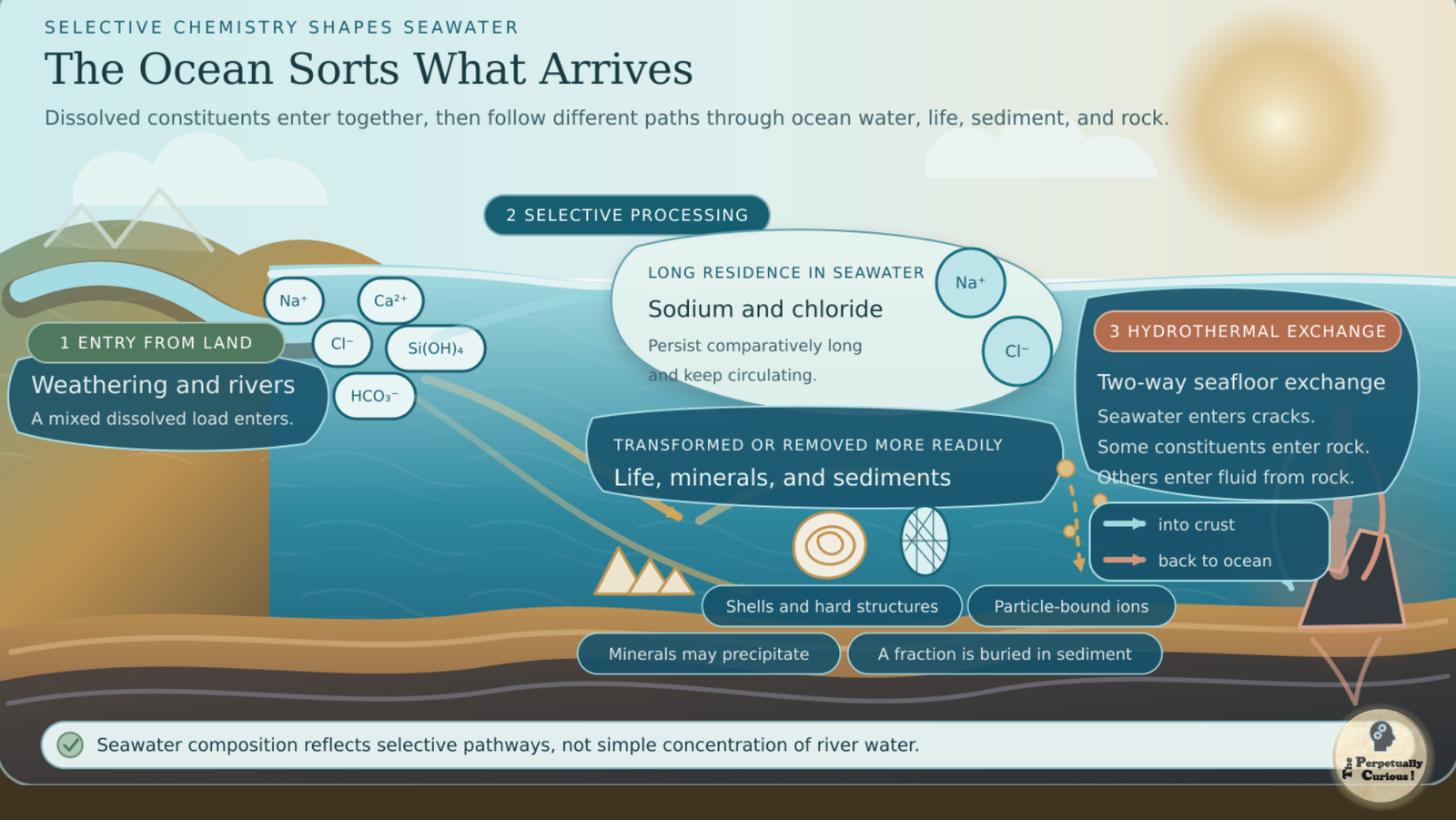
The ocean does not preserve every incoming ion in the same proportion. Some ions remain dissolved for very long periods, while others are removed more readily through chemical reactions, biological activity, or interactions with sediments and the seafloor. Sodium and chloride are comparatively persistent, so they have become the most abundant dissolved ions in seawater.
Calcium, bicarbonate, and silica follow different pathways. Many marine organisms draw calcium and carbonate from seawater to build shells and skeletons, while diatoms and some other organisms use dissolved silica to form protective structures. Much of this material is recycled after the organisms die, but a fraction becomes buried in sediments. Minerals can also precipitate directly from seawater, while ions may attach to particles or become incorporated into altered oceanic crust.
Hydrothermal systems add another layer of selective exchange. Seawater seeps into cracks in the seafloor, becomes heated, and reacts with volcanic rock. The returning hydrothermal fluid has a different composition because some elements have been removed from the water and taken up by the crust, while others have been released from the rock into the fluid. These systems are not merely underwater sources of additional salt. They are chemical reactors that both add substances to and remove them from circulating seawater.
This selective processing explains why seawater is not simply a more concentrated version of river water. It also leads to the final part of the puzzle: if dissolved ions keep arriving, why does ocean salinity not rise without limit?
♻️ The ocean does not grow saltier without end
Dissolved ions enter the ocean, but they also leave its circulating waters. Some are taken up in shells or incorporated into minerals, and a fraction is eventually buried in sediments. In restricted marine basins, intense evaporation can form thick evaporite deposits, storing large quantities of salt in rock. Water-rock reactions beneath the seafloor remove certain elements from seawater, while sediment burial and geological recycling carry other substances out of the ocean’s dissolved inventory.
These inputs and removals operate at different rates for different ions, often across timescales far longer than a human life. Over long intervals, many of the ocean’s major dissolved constituents are governed by dynamic balances in which natural removal processes broadly offset continued inputs. This does not mean that overall ocean salinity has remained perfectly fixed throughout Earth’s history. Changes in climate, ocean volume, continental arrangement, seafloor activity, and the formation or dissolution of salt deposits can shift those balances over geological time.
For the present-day question, however, the conclusion is clear. Rivers do not make the ocean endlessly saltier simply by continuing to flow. They participate in a much larger chemical cycle with both entrances and exits. That long-term chemical balance is global, but it does not erase regional differences.
🗺️ Salinity is a moving map of the water cycle
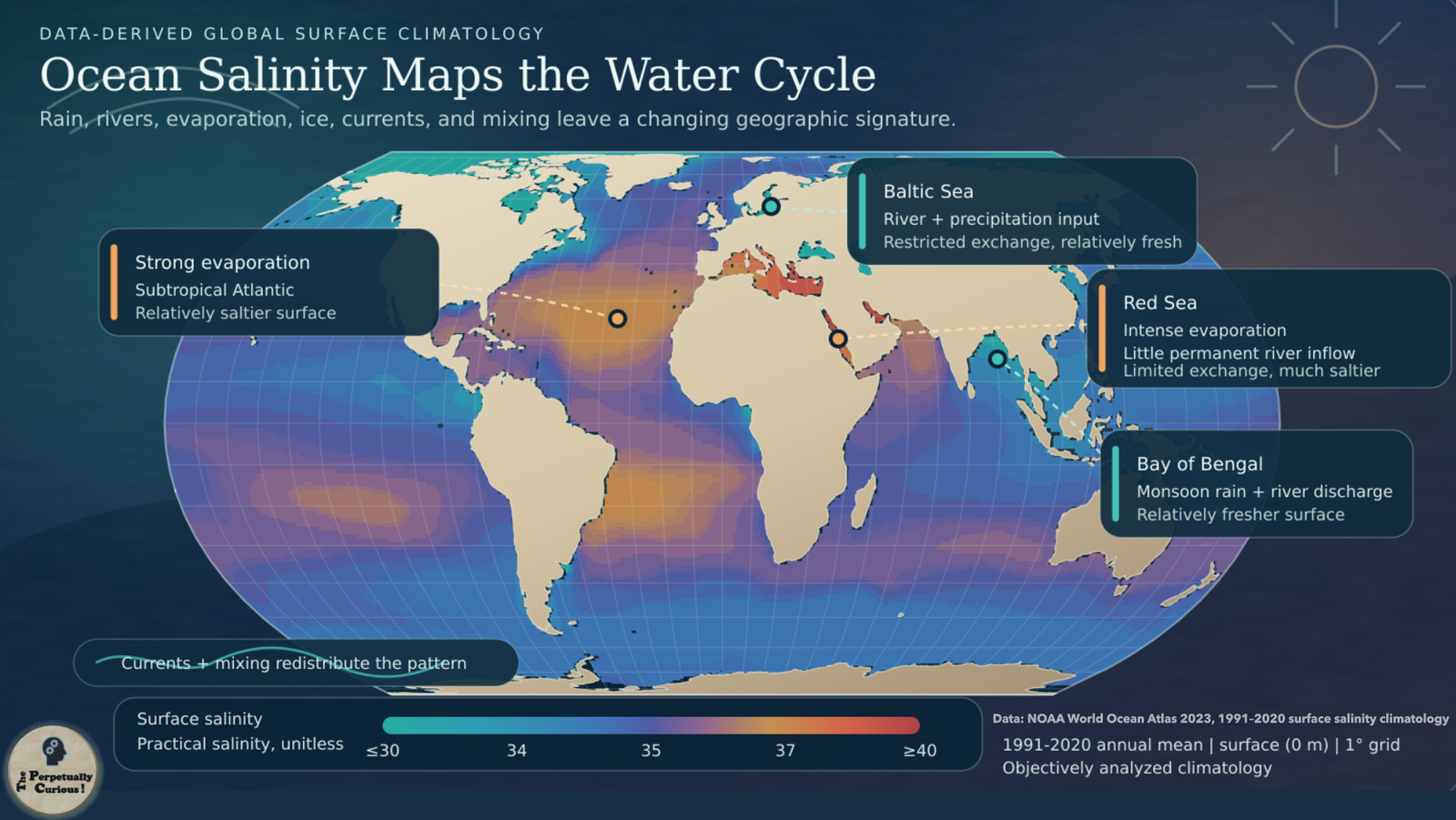
Those differences trace the movement and redistribution of freshwater. Where evaporation is strong and replenishment from rainfall and river inflow is limited, surface water often becomes saltier. Where precipitation is abundant, river discharge is substantial, or ice melts, surface salinity may fall. Currents and vertical mixing continually redistribute these patterns. The Baltic Sea has relatively low salinity because river inflow and precipitation are substantial, while its exchange with the open ocean is restricted. The Red Sea is much saltier because evaporation is intense, permanent river input is almost absent, and exchange with the wider ocean is constrained.
The boundary between fresh water and salt water is also gradual rather than absolute. Estuaries, coastal lagoons, and river deltas often contain brackish water, where river flow and seawater meet in proportions that change with tides, seasons, storms, and droughts.
This changing boundary matters to living organisms as well as to water chemistry. Bull sharks are among the relatively few sharks able to move between marine and fresh waters by adjusting how their bodies regulate water and ions. The movement of bull sharks between rivers and the sea offers a living example of salinity as a gradient rather than a wall.
Fresh water and salt water are therefore not separate planetary stories. They are different expressions of the same cycle. Rain begins with little dissolved mineral matter, rock lends ions to the passing water, rivers carry them onward, lakes either release or retain them, and the ocean sorts them through chemistry and time. Water travels in circles. Salt follows more slowly, leaving a mineral memory along many of the paths the water has taken.
Pass this article along to someone curious and let the learning travel.
💡 Did You Know
🚿 Fresh water is not necessarily soft water. A river or lake can be fresh because its overall salinity is low yet still be hard because it contains appreciable amounts of calcium and magnesium. Salinity and hardness describe different chemical properties, and water hardness is the property addressed by softening processes.
🏔️ Two nearby lakes can have very different salinities. Near Mount Kailash on the Tibetan Plateau, Lake Manasarovar and Rakshastal form a striking pair. Lake Manasarovar is freshwater, while Rakshastal is a saline endorheic lake, meaning that its water does not drain onward to the ocean. Their contrast reflects differences in basin drainage and water balance rather than distance alone.
🧪 Not every saline lake has seawater-like chemistry. A closed basin may become rich in carbonates, sulfates, chlorides, or a different mixture of dissolved substances as inflowing water, basin geology, evaporation, groundwater exchange, and mineral precipitation reshape its chemistry.
🧊 Sea ice leaves much of its salt behind as it forms. The growing ice lattice excludes most dissolved salts. Some concentrated brine remains trapped in channels within the young ice, while some drains into the water below. This expelled brine can make nearby seawater saltier and denser, sometimes helping it sink and contribute to ocean circulation. Sea ice is therefore generally much less saline than the seawater from which it formed, especially as it ages, although it is not chemically pure.
🧂 Salt can move from ocean to rock and back again. When seawater evaporates in restricted basins, minerals can crystallize into evaporite deposits. Later uplift, exposure, dissolution, and weathering may return some of those ions to rivers and the sea. Geological storage can therefore pause the journey without ending it.
Why is the ocean salty while rivers are usually fresh?
Rivers contain dissolved salts, but their water is continually renewed and moves downstream. The ocean receives ions from rivers, groundwater, atmospheric material, and seafloor reactions, while evaporation removes water with very little dissolved salt. Over long periods, persistent ions such as sodium and chloride remain in circulation and become concentrated relative to river water.
Why are sodium and chloride the dominant ions in seawater?
The ocean does not retain every incoming ion equally. Calcium, carbonate, silica, and some other dissolved substances are removed comparatively readily through biological activity, mineral formation, sediment burial, and reactions with the seafloor. Sodium and chloride remain dissolved for much longer, allowing them to become the most abundant ions in seawater.
Is the salt in seawater the same as table salt?
Not exactly. Table salt consists primarily of crystalline sodium chloride. When it dissolves, the sodium and chloride separate into ions, just as they occur in seawater. Natural seawater, however, is not simply table salt dissolved in water. It also contains magnesium, sulfate, calcium, potassium, bicarbonate, and many minor and trace constituents.
Is rainwater completely pure before it reaches the ground?
No. During raindrop formation inside clouds, droplets can absorb gases and collect aerosols, dust, sea salt, microorganisms, and pollutants from the atmosphere. Rainwater usually contains relatively little dissolved mineral matter, but carbon dioxide makes it mildly acidic and helps it react with soil and rock after reaching land.
Why are some lakes salty while most lakes are fresh?
Many saline lakes occupy closed or weakly drained basins where water has little opportunity to escape except through evaporation. Rivers and groundwater continue delivering dissolved ions, but evaporation removes water while leaving most of those ions behind. Over time, the remaining water can become highly saline, although the exact chemistry depends on the surrounding geology, groundwater exchange, climate, and mineral precipitation.
Can a lake with an outlet still become salty?
Yes. An outlet usually helps remove dissolved ions, but lake salinity depends on the entire water and mineral balance. Strong evaporation, small or intermittent outflow, saline groundwater, mineral-rich inflow, or human changes to water movement can allow salts to accumulate.
Can a river ever become salty?
Yes. River salinity can rise through saline groundwater, readily dissolved salt-bearing rocks, strong evaporation, irrigation return flows, road salts, or other inputs. Near the coast, tides can also move seawater upstream, creating brackish or locally saline reaches whose extent shifts with river flow and tidal conditions.
Is the ocean becoming saltier today?
The ocean is not becoming steadily saltier simply because rivers continue to deliver dissolved ions. Over long periods, major salt inputs are broadly balanced by removals into sediments, minerals, altered oceanic crust, and geological deposits. Salinity can nevertheless change as freshwater is redistributed. Some regions become saltier as evaporation increases or precipitation decreases, while others become fresher through rainfall, river discharge, or ice melt. Even the global average can shift slightly as water moves among the ocean, land, atmosphere, and ice, without a comparable change in the ocean’s total salt inventory.
Is every part of the ocean equally salty?
No. Surface salinity responds to the balance of evaporation and precipitation, freshwater runoff, ice formation and melting, and ocean circulation. The open ocean has a recognizable average, but coastal waters, rainy regions, dry subtropical zones, polar seas, and enclosed seas can differ considerably.
Does salt evaporate with ocean water?
Most dissolved salts do not enter water vapor during ordinary evaporation. Water molecules escape from the surface, leaving the ions behind. Salt can still reach the atmosphere through breaking waves and sea spray, which produce tiny salt-containing droplets and particles.
🌊 Let curiosity travel with the water
If this journey from rain-touched rock to the open ocean offered a new way of seeing familiar water, we invite you to share it with friends and colleagues. Passing it onward helps the story reach another curious mind and keeps the current of discovery moving.
“Where the Salt Stays: Why the Ocean Is Salty but Rivers and Most Lakes Are Fresh.” The Perpetually Curious!, August 2026.
https://www.theperpetuallycurious.org/articles/why-is-the-ocean-salty/Continue Exploring
For what comes next
Site Updates gathers occasional notes, new additions, and ways to keep in touch. RSS brings new publications to your feed reader in chronological order.
Choose the path that speaks to you, and let the next curiosity find you wherever your wondering takes you.