

A walk through a grassy path, an afternoon tending plants, or a day working near low vegetation can leave no memorable mark. Then, days later, a fever arrives. In places where scrub typhus occurs, the connection between those two events may be as small as a mite larva and as easy to miss as its bite. Understanding this illness begins with that quiet gap between exposure and recognition.
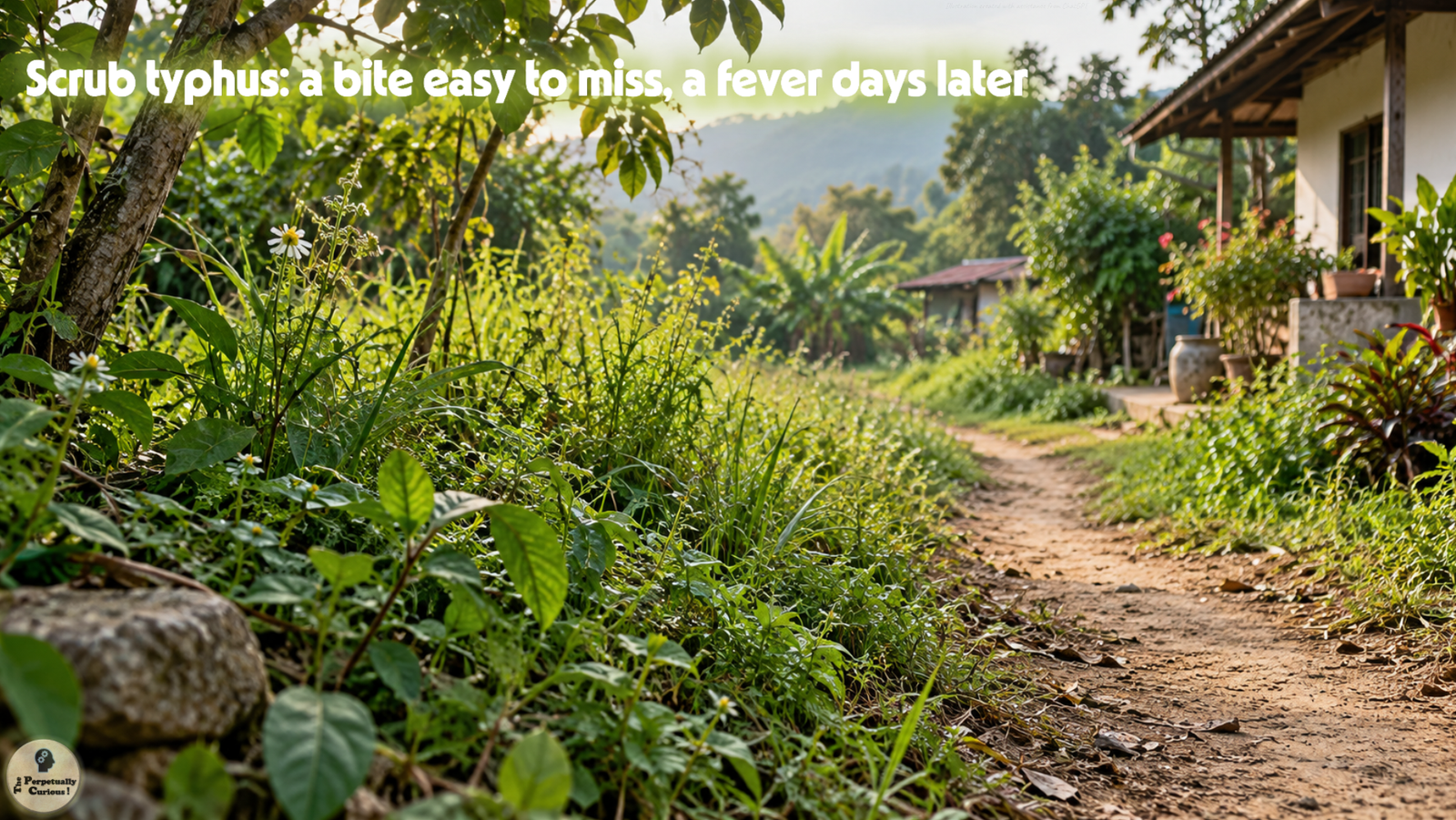
A small encounter in the grass can pass quietly, yet linger in the story of a day.
In the stillness between touch and fever, the landscape holds its quiet truths.
Understanding grows gently when we listen to the places where our paths and the unseen briefly meet.
🌿 An unseen encounter among the leaves
Scrub typhus is a bacterial infection transmitted by the bite of certain infected chiggers, the larval stage of mites. Chiggers are mites, not ticks. In much of the illness’s established range, the bacterium responsible is Orientia tsutsugamushi.
Most recognized cases have come from parts of South, East, and Southeast Asia, including India, and from the western Pacific and northern Australia. Cases have also been documented in southern Chile, where a related Orientia bacterium has been identified. Risk depends on local conditions and contact with infected chiggers, which can occur in vegetated places near homes as well as farther afield. A country name or a landscape alone cannot tell the whole story. When an infected chigger bites, a clue may appear on the skin, although the encounter itself can pass unnoticed.
🔎 A small mark with an incomplete story
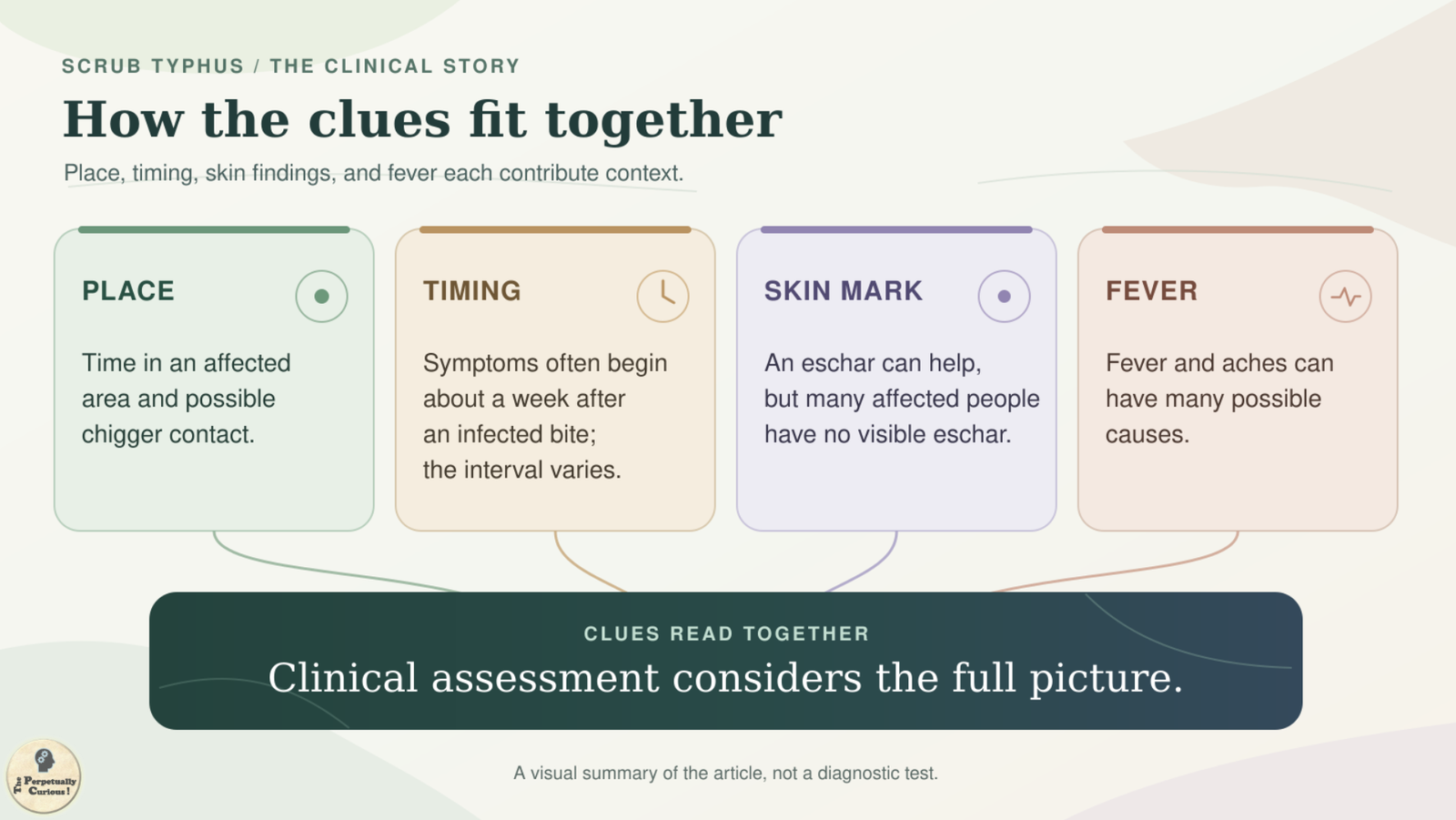
At the bite site, some people develop an eschar, a small sore with a dark, scab-like center. It may be painless and hidden in a skin fold or beneath clothing. Its appearance can also be less obvious against darker skin. An eschar can help a clinician recognize scrub typhus, but many affected people have no visible eschar, and similar marks can occur in other illnesses.
After the bacterium enters at the bite site, it can spread through the lymphatic system and bloodstream. When the skin offers little warning, a fever may be the first sign that the encounter mattered.
🌡️ When the body answers with fever
Symptoms often begin about a week after an infected bite, although the interval varies. Fever, chills, headache, and muscle aches are common; swollen lymph nodes or a rash may also occur. Illness can range from mild to serious. Without appropriate treatment, complications can affect the lungs, kidneys, brain, or other organs.
These symptoms do not identify scrub typhus by themselves. Depending on the setting, dengue fever can also begin with fever and aches, although it is a viral illness transmitted mainly by mosquitoes. Malaria and leptospirosis may enter the clinical picture as well. The events preceding the fever therefore become part of the evidence.
🧭 Why the story around the fever matters
A clinician may consider where a person has lived or traveled, whether their activities brought them into possible contact with chiggers in an affected area, how the illness has unfolded, and whether an eschar is present. Blood tests or a sample from an eschar can help investigate the cause, but the timing and availability of tests matter. Antibodies may not yet be detectable early in illness, while molecular tests can sometimes detect bacterial DNA.
That uncertainty has a practical consequence. Scrub typhus is treated with antibiotics, commonly doxycycline, and early treatment is associated with better outcomes. When the clinical picture raises strong suspicion, clinicians may begin treatment before laboratory confirmation. A fever after possible exposure still has many possible causes, so diagnosis and treatment depend on medical assessment rather than a single symptom or a remembered bite.
🍃 A landscape to understand, not fear
The same attention to place that helps make sense of an illness also helps explain how contact with chiggers can be reduced. In affected areas, clothing that covers the skin and repellents suitable for chiggers can reduce exposure. There is currently no vaccine for scrub typhus.
The wider lesson is one of proportion. A nearly invisible encounter can matter, but contact with vegetation alone does not mean infection. The quiet gap between an ordinary day and a later fever narrows when the clues are read together: place, timing, a possible skin mark, and a fever that does not name its own cause.
Pass this article along to someone curious and let the learning travel.
💡 Did you know?
🌾 The word “scrub” refers to brushy vegetation historically associated with the illness. It does not refer to scrubbing the skin or to personal cleanliness, and the disease is not confined to one kind of landscape.
🔬 Only the larval stage of these mites feeds on people and other vertebrates. Nymphs and adults generally feed on small invertebrates or their eggs. The bite that can transmit scrub typhus therefore belongs to one stage in a longer mite life cycle.
Is scrub typhus the same disease as typhoid fever?
No. Their names sound alike, but scrub typhus is an Orientia infection transmitted by infected chiggers. Typhoid fever is caused by Salmonella Typhi and is commonly acquired from food or water contaminated with the bacterium.
Does every chigger bite cause scrub typhus?
No. Transmission requires a chigger carrying a scrub typhus-causing bacterium. Chigger bites can occur without this infection.
Can scrub typhus spread between people through ordinary contact?
No. The usual route to human infection is the bite of an infected mite larva.
Does a negative early antibody test rule it out?
No. Detectable antibodies can take time to develop. Clinicians may consider the full clinical picture and, where available, other testing, including molecular tests that look for bacterial DNA.
Can a person have scrub typhus more than once?
Yes. Reinfection can occur. Protection after one episode may be limited, especially when a later exposure involves a different strain of Orientia.
🌱 Let understanding travel gently
If this account has helped connect an overlooked bite with a puzzling fever, we kindly invite you to share it with friends and colleagues. Your help in carrying careful, compassionate understanding to a wider audience is deeply appreciated.
📚 Educational context
This article explores how scrub typhus is transmitted, how it can affect the body, and why clinicians consider exposure history, symptoms, and test results together. It is for educational purposes and does not provide personal medical advice, diagnosis, or treatment recommendations. The patterns described here cannot determine whether an individual bite, skin mark, fever, or test result indicates scrub typhus. Questions about symptoms, possible exposure, testing, or care should be discussed with a qualified healthcare professional.
“Scrub Typhus: When a Tiny Bite Becomes a Fever.” The Perpetually Curious!, September 2026.
https://www.theperpetuallycurious.org/articles/scrub-typhus-chigger-bite/Continue Exploring
For the curious mind: want to explore this theme through a few questions? Visit the Classic Quiz Studio, nestled under Explorations opens in a new tab ,and see where a few well-placed questions lead: Biology & Health Quizzesopens in a new tab
For what comes next
Site Updates gathers occasional notes, new additions, and ways to keep in touch. RSS brings new publications to your feed reader in chronological order.
Choose the path that speaks to you, and let the next curiosity find you wherever your wondering takes you.