

A snowfall can change the brightness of an entire street. Dark roofs turn pale, branches carry thin white lines, and the ground seems to gather light that bare soil would absorb. Yet the ice in a snow crystal can be as clear as a small piece of glass. How do so many transparent pieces become a white landscape?
The answer lies in the paths light takes through snow. Between ice and air, a familiar winter scene becomes an intricate arrangement of small boundaries, each offering light another direction to travel.
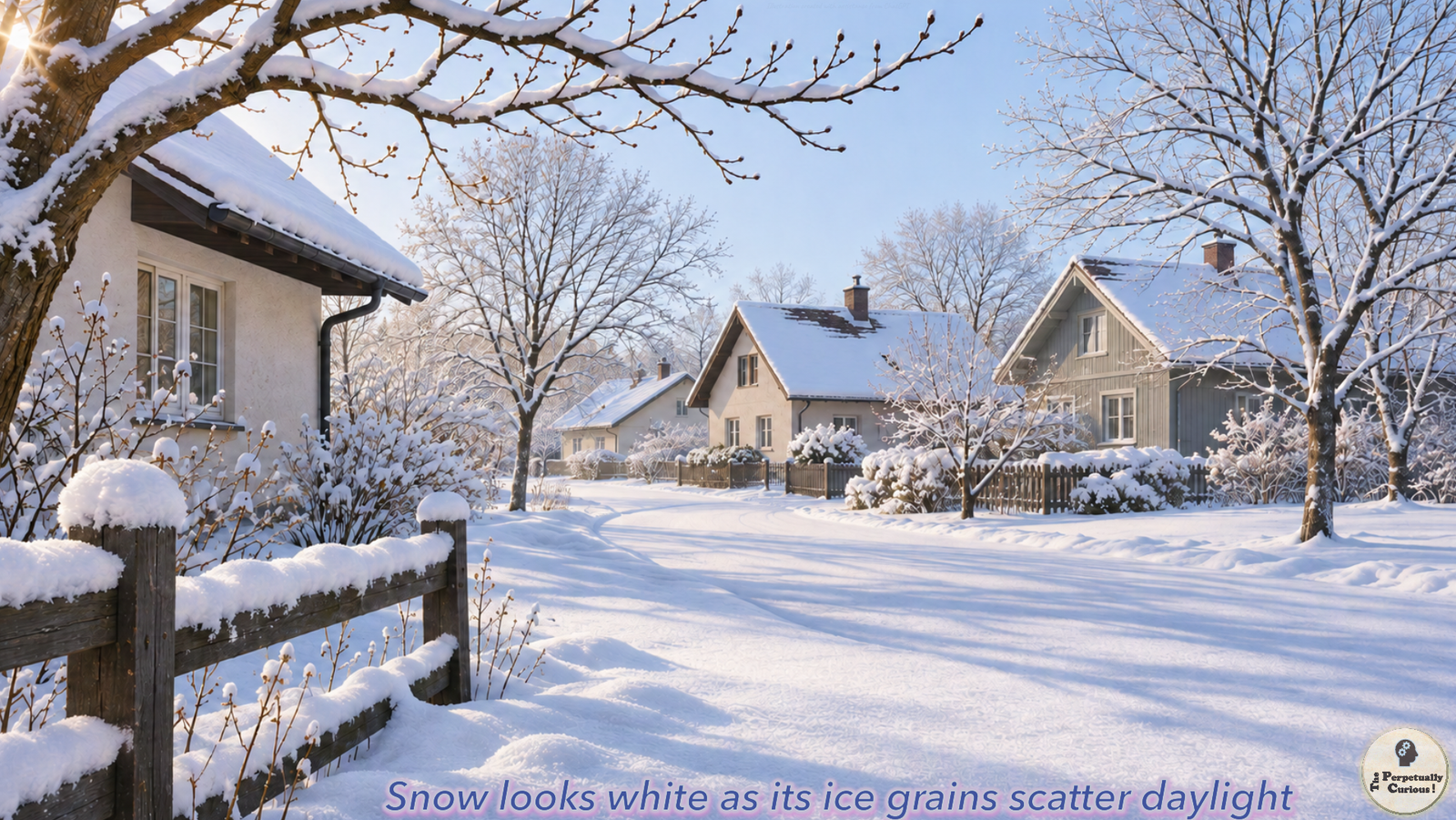
The winter landscape keeps no store of white within it.
What appears as brightness is only light finding countless paths through ice and air.
For a brief season, the world seems to gather the day more gently before returning it to the sky.
🔬 The clear ice inside a snowflake
Snow crystals grow in cold clouds as water vapor deposits onto ice, one of the processes involved in precipitation growth inside clouds. Temperature and moisture help determine whether a crystal develops into a plate, a column, a branching star, or a less regular form. The familiar sixfold pattern reflects the molecular arrangement of ordinary hexagonal ice, although many falling crystals look irregular rather than perfectly symmetrical.[1]
That geometry shapes the crystal, but it does not give the ice a white pigment. Through a short path in clean ice, relatively little visible light is absorbed. Smooth regions of an individual crystal can therefore look clear, while its edges and facets catch the light and appear bright.
A related distinction appears in glass made from sand: a clear pane can preserve a view, while a collection of transparent grains redirects light at many separate surfaces. The material matters, but so does its arrangement.
Snow takes that distinction into the open air. Once crystals accumulate, light encounters far more than a single transparent object.
💫 Many boundaries, many directions
A snow layer is a mixture of ice and air. When light reaches a boundary between them, some is reflected, while some enters the ice and may bend, a process called refraction. After leaving one grain, it can meet another. Repeated encounters redistribute the light through the snowpack, and much of it eventually emerges toward the surface.
This is multiple scattering. The brightness emerges from a network of interactions, including encounters below the surface, rather than from one continuous reflective coating.
Under ordinary daylight, clean snow returns a broad mixture of visible wavelengths. During the relatively short paths through ice that contribute much of the surface reflection, little visible light is absorbed. That returning mixture appears white.[2]
This differs from the familiar blue sky. Air molecules scatter shorter visible wavelengths more strongly than longer ones. The much larger grains in snow redistribute visible wavelengths far more evenly across the spectrum. Both scenes involve scattering, but the size and arrangement of the scattering structures change the result.
These many paths explain why a snowbank can look white. Its brightness also depends on how much of the incoming light finds a way back out.

🌨️ Why a fresh snowfall looks so bright
In fresh snow, fine grains and delicate branches often provide a large surface area where ice meets air. In a sufficiently deep, clean layer, repeated scattering can return a large fraction of the sunlight reaching it. Scientists describe that reflected fraction as its albedo.
Depth matters because a thin dusting may still allow light to reach the darker ground beneath. The color of the underlying surface can then influence the appearance of the snow. A thicker layer gives light more opportunities to scatter before reaching that ground.
Brightness also depends on illumination and viewing conditions. Snow beneath a dim overcast sky may look subdued even when it remains highly reflective. A surface can return a large fraction of the light it receives while receiving much less light in the first place.
Once the snowfall ends, however, the structure that produces this brightness begins to change.
💧 When snow settles and melts
The snowpack continues to change after it lands, even below freezing. Grains change shape, bonds develop between them, and the layer settles. Melting and refreezing can produce coarser structures in which light travels farther through ice between scattering opportunities. This increases the chance of absorption, especially in the near-infrared, wavelengths just beyond visible red that our eyes cannot see.
Liquid water can also replace some of the air between grains. Water and ice have similar refractive indices, meaning that light bends relatively little when passing between them. Wetted boundaries therefore redirect light less strongly than boundaries between ice and air. These changes help explain the more translucent appearance of wet snow and slush.[3]
Visible gray patches can have several causes. Dust and soot absorb light, a thinning layer can reveal darker ground, and shade can reduce illumination. Grain structure matters too, but its effects are often stronger in the near-infrared than in visible light. A change in density alone does not explain every change in appearance.
These changes help explain how much light returns. A further question arises when the returning light takes on a different color.
🔷 Two ways snow can look blue
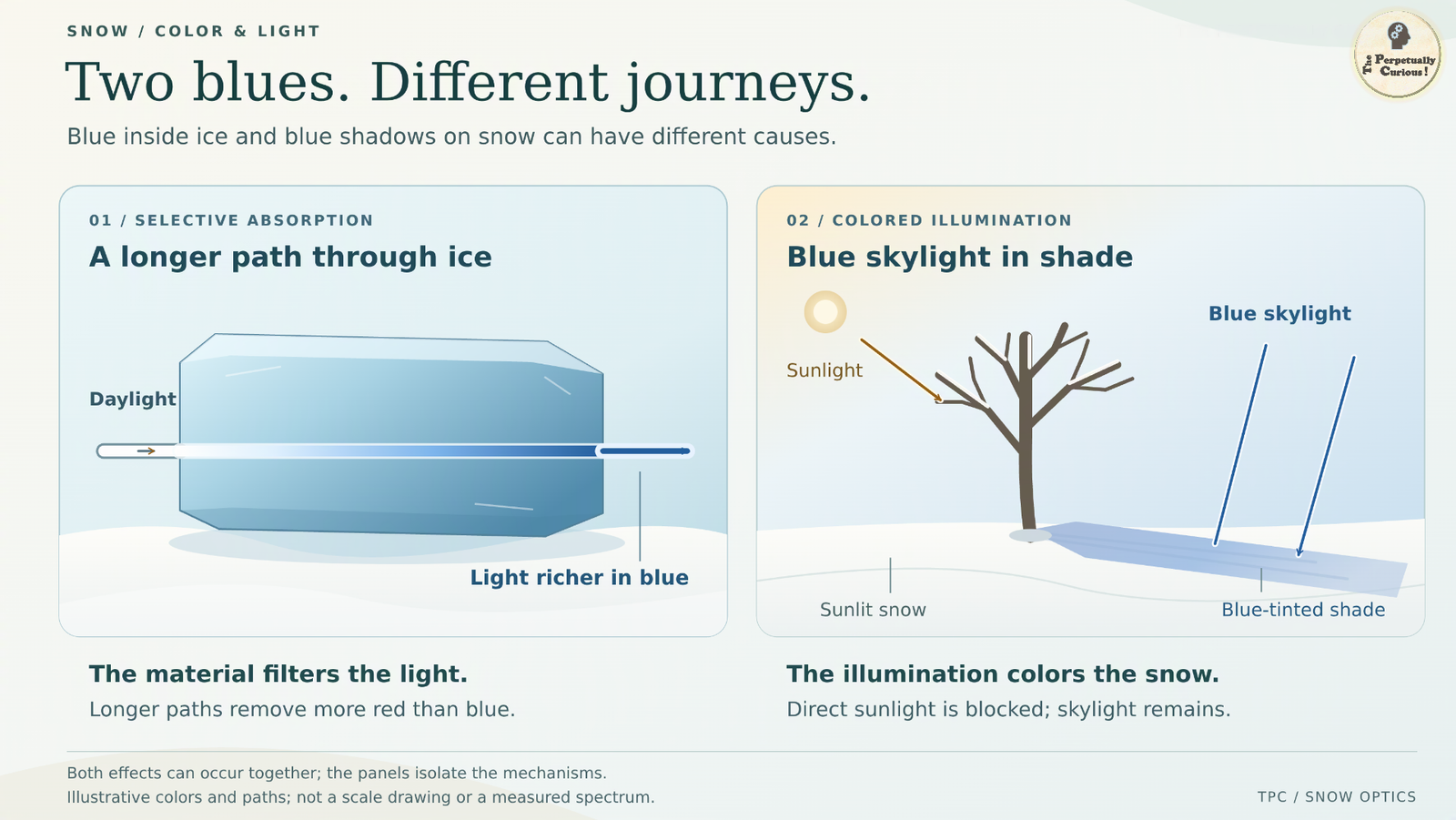
Clean ice absorbs red light more strongly than blue light. Over a short path, the difference is small. Over a sufficiently long journey through snow or ice, more red light is removed, leaving the emerging light richer in blue. This can give deep snow cavities, glacier crevasses, and some thick ice their blue appearance.[2]
A blue shadow on snow may have another origin. A shadow changes the illumination: an object blocks direct sunlight, while light from the blue sky can still reach the shaded surface. That illumination can give the snow a blue tint without requiring a long journey through the snowpack.
At sunrise or sunset, snow can also take on warm tones. Like red and orange sunset clouds, it can reveal the color of the light reaching it.
The quiet blue inside a snowbank and the blue shade beneath a tree may look similar, yet they record different journeys of light.
✨ The brief geometry of a sparkle
Alongside these changes in color, individual points of light sometimes flash across the snow. A smooth ice facet can reflect sunlight toward an observer when its orientation is just right. As the observer moves, other facets meet that condition, and the pattern of bright points changes.[4]
This directional reflection follows the same geometric rule as reflection from a mirror. The wider snow surface sends light in many directions, while a suitably aligned facet produces a concentrated glint.
Sparkle depends on the available facets, the lighting, and the viewing angle. Fresh snow can glitter beautifully, but the deciding relationship is between the light, the ice, and the eye.
That brief flash and the surrounding whiteness bring the story back to the same question: how does the arrangement of a material shape the light we see?
🌍 A white landscape, understood differently
The white background, blue hollow, and sudden glint are different expressions of light meeting ice. Many scattering paths return a broad mixture of colors, longer paths through ice can change that mixture, and an aligned facet can concentrate a reflection. Illumination adds another layer by changing the light available in the first place.
Related patterns appear beyond winter. Clouds contain droplets or ice particles that scatter light, while white foam contains many boundaries between water and air. Their structures differ, yet transparent ingredients can give each a white appearance under suitable illumination.
The street in the opening scene is still receiving familiar daylight, but a new arrangement of ice and air changes how much returns and where it goes. Across roofs and branches, the snow seems to gather the light. Its whiteness is the visible result of many small encounters, each sending the winter day in another direction.
Pass this article along to someone curious and let the learning travel.
💡 Did you know?
🧣 The ice-and-air structure that redirects light also affects heat flow. Much of the volume of fresh, fluffy snow is air, and holding that air relatively still among the grains helps the snow insulate the ground beneath it.
📡 Two snow surfaces that look similarly white can reflect different amounts of infrared radiation. Comparing wavelengths helps scientists study changes in grain size that are less apparent to the eye.[3]
🌨️ A snowflake can be one ice crystal or a cluster of crystals that have joined during their descent. The large, soft flakes visible in a snowfall do not necessarily correspond to single elaborate stars.[1]
Why can an ice cube look cloudy if ice is transparent?
Bubbles, cracks, and other internal structures can redirect light inside an ice cube. A cloudy appearance does not require the ice itself to contain a white pigment. Snow provides many such scattering opportunities through its network of ice and air.
Does snow stay white at night?
Snow reflects the light available to it. It may appear pale under moonlight, warm beneath some streetlights, or strongly colored under colored lamps. In complete darkness, it is not visible.
Can snow reach the ground when the air is above freezing?
Yes. Snow can survive a shallow layer of air above 32°F (0°C) if it does not melt completely before reaching the ground. The temperature profile and conditions during the descent matter, so snowfall does not require every part of the air column to remain below freezing.
Why do sleet, graupel, and freezing rain look different from snow?
In U.S. weather terminology, sleet consists of ice pellets, commonly produced when falling snow melts partly and then refreezes. Graupel forms when supercooled droplets freeze onto snow crystals, producing cloudy or white pellets. Freezing rain reaches a surface as liquid and freezes there, often forming a relatively clear glaze. Their different structures provide different paths for light. A nor’easter can bring several of these precipitation types to different places within the same storm.
Do six sides make snow white?
No. Sixfold symmetry helps explain familiar crystal shapes, but whiteness does not depend on a perfect six-armed outline. Irregular grains can also produce a white snowpack. Grain size, shape, impurities, depth, and illumination all influence its optical behavior.
Why can snow sometimes look pink, red, or orange?
The color can come from the light or from material within the snow. Warm sunlight can cast reddish or orange tones across otherwise clean snow. In some melting snowfields, pigments in snow algae can produce pink or red blooms.[2] The appearance alone does not identify the cause.
Why does roadside snow often turn gray?
Dust, soot, and road grime can absorb visible light and darken snow. Salt can contribute differently: when dissolved in water, it lowers the freezing point and helps liquid brine persist, promoting melting and structural change. The resulting slush may also contain dark particles. Salt changes the freezing conditions; it is not itself a gray pigment.
Why can footprints look darker than the surrounding snow?
The depression can place part of the snow in shade and tilt other parts toward or away from the light. Its contrast may therefore change with the Sun’s position or the observer’s viewpoint. Compaction and moisture can also change the structure, so a dark footprint does not measure density alone.
📣 Let the wonder travel
If this glimpse into snow has brought a familiar winter scene into clearer focus, share it with someone who enjoys finding an unexpected question in an ordinary view. A small change in understanding can travel far beyond the first snowfall.
📘 Educational context
This article explains general optical and atmospheric processes. The appearance of a particular snow surface depends on its structure, impurities, depth, illumination, and viewing conditions.
Selected sources
- University Corporation for Atmospheric Research (UCAR), Center for Science Education. (n.d.). Snowflakes.
- National Snow and Ice Data Center (NSIDC). (n.d.). Science of Snow.
- Warren SG. (2019). Optical properties of ice and snow. Philosophical Transactions of the Royal Society A: Mathematical, Physical and Engineering Sciences, 377(2146), 20180161. [PMID: 30982450]
- University of Wisconsin–Madison, The Weather Guys. (2020). What is snow sparkle? Published February 17, 2020.
“Where Winter Holds the Light: Why Snow Is White.” The Perpetually Curious!, November 2026.
https://www.theperpetuallycurious.org/articles/why-is-snow-white/Continue Exploring
For what comes next
Site Updates gathers occasional notes, new additions, and ways to keep in touch. RSS brings new publications to your feed reader in chronological order.
Choose the path that speaks to you, and let the next curiosity find you wherever your wondering takes you.