Explore by topic, question, or idea. Find articles, reflections, videos, puzzles, and curiosity pathways gathered across the site.
Press Enter or select Search. A newly typed query starts globally; filters are applied only through the visible rail.
23 results for “why space looks dark”
- The Perpetually Curious! › Archives › Cosmic ExplorationArticle
🌌 The Silent Storm Above: Understanding Our Orbital Debris Challenge
This growing constellation of space junk represents one of the most pressing challenges for humanity's continued exploration of the cosmos.Read more »
- The Perpetually Curious! › Canonical › Cosmic ExplorationArticle
🌌 The Universe’s Ancient Whisper: Decoding the Cosmic Microwave Background
From section: 🔬 Physics written in ancient light… When scientists arrange the temperature variations by angular scale, they obtain a power spectrum with a sequence of peaks and valleys. The positions and relative heights of those peaks constrain the geometry of space, the amount of ordinary matter, the amount of dark matter, and other cosmological parameters.
- The Perpetually Curious! › Canonical › Cosmic ExplorationArticle
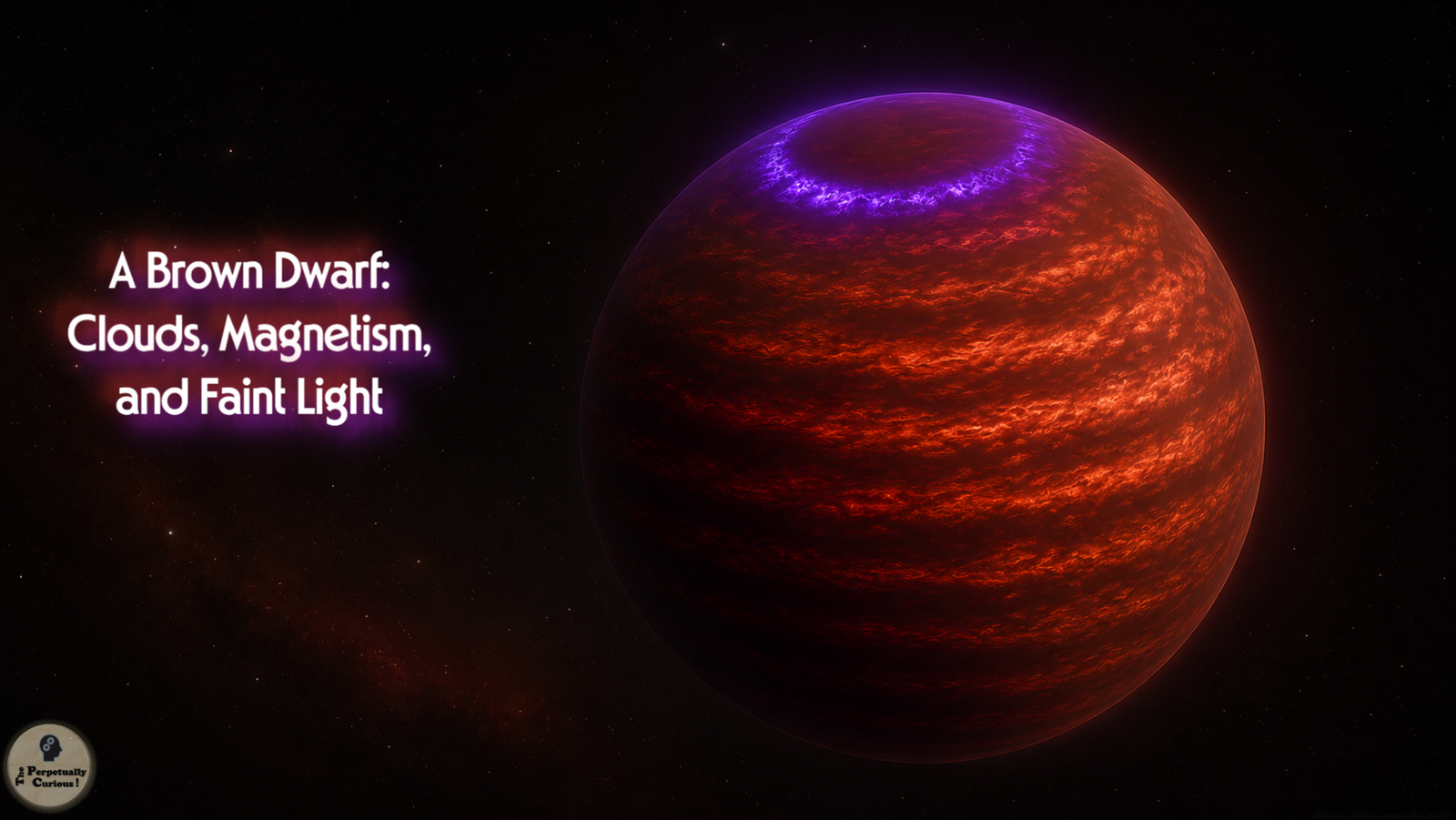
🌟 Brown Dwarfs: Between Giant Planets and the Smallest Stars
From section: ⚡ Brief nuclear momentsOnce these limited nuclear reactions end, no enduring fuel source replaces the energy radiated into space. Brown dwarfs then continue along their defining path of gradual cooling. …
- The Perpetually Curious! › Canonical › Cosmic ExplorationArticle
🌍 When Worlds Pull: Gravity Across the Planets and What It Reveals About Them
Gravity moves through every world with its own quiet signature, shaping how each planet holds its place in the dark.Across these distant spheres, the same pull becomes a different story.In that silent exchange, the architecture of motion reveals itself.
- The Perpetually Curious! › Canonical › Cosmic ExplorationArticle
🌑 Shadows Across the Solar System: How Eclipses Unfold Beyond Earth
From section: 🌞 Solar eclipses across the Solar SystemFrom the Martian surface, the Sun appears smaller than it does from Earth, yet still larger than either moon. The result is a fleeting, almost delicate interruption of sunlight. Robotic missions have captured these events, showing the moons as dark shapes gliding across the solar disk.
- The Perpetually Curious! › Canonical › Cosmic ExplorationArticle
✨ Constellations: Quiet Patterns, Shared Skies, and the Stories We Trace Together
From section: 🕰️ Constellations across cultures and time… In parts of the ancient Mediterranean world, observers recognized hunters, lions, and mythological figures. In Indigenous Australian traditions, dark constellations formed from the shadows of the Milky Way represented animals and ancestral beings.
- The Perpetually Curious! › Archives › Cosmic ExplorationArticle
🌟 Brown Dwarfs: Why Stellar Ignition Never Takes Hold
From section: 🔥 When contraction almost makes a starNuclear reactions must release energy consistently enough to offset what the object radiates into space.
- The Perpetually Curious! › Archives › Cosmic ExplorationArticle
The Cosmic Journey: Understanding Our Galactic Year 🌌
Right now, you are racing through space at an astonishing 514,000 miles per hour (828,000 kilometers per hour), carried on a journey so vast that comprehending it challenges human intuition. This relentless motion never stops.
- The Perpetually Curious! › Archives › Cosmic ExplorationArticle
Worlds Beyond Worlds: The Extraordinary Story of Exoplanets 🌌
In the vast theater of space, thousands of alien worlds dance around distant stars, each one rewriting our understanding of what a planet can be.Read more »
- The Perpetually Curious! › Canonical › Cosmic ExplorationArticle
🌍 When Earth First Took Shape: A Planet Born from Cosmic Dust
From section: 🌋 Fire within: Differentiation and the shaping of Earth’s interiorThe next major chapter follows from this restless beginning. Earth had grown large enough to reorganize itself from within, but it still moved through a crowded young Solar System. Another large body, traveling through the same region of space, would collide with proto-Earth and change the planet’s future.