Explore by topic, question, or idea. Find articles, reflections, videos, puzzles, and curiosity pathways gathered across the site.
Press Enter or select Search. A newly typed query starts globally; filters are applied only through the visible rail.
174 results for “how brain form”
- The Perpetually Curious! › CanonicalReflection
Quiet Cycles of Life
… Ancient plant material becomes coal. The same element moves through air, water, living tissue, and rock, changing form while remaining itself.
- The Perpetually Curious! › CanonicalReflection
Starborn Memory Within
… These atoms you have borrowed will continue their journey, perhaps becoming part of new life, new stars, new possibilities. You are not a permanent structure but a temporary pattern in the cosmic flow, a form that arose, developed consciousness, and will eventually release its components back to the larger dance.
- The Perpetually Curious! › Canonical › Planet EarthArticle
🌐 How SONAR Uses Sound to Map the Hidden Ocean Depths
From section: 📡 From echo to informationAs these interpretations accumulate, they form the basis for mapping underwater landscapes, tracking objects, and studying marine life, allowing individual echoes and ambient sounds to become part of a larger picture of the ocean.
- The Perpetually Curious! › Canonical › Planet EarthArticle
🌍 Why Mud Is Brown or Black: Where Earth Turns to Quiet Ink
From section: 🌍 When soil becomes waterlogged, it turns into mudDifferent soil types can influence the minerals and organic matter that eventually form mud, but the color of mud itself is governed mainly by oxygen availability, iron chemistry, and organic accumulation.
- The Perpetually Curious! › Canonical › Cosmic ExplorationArticle
✨ Constellations: Quiet Patterns, Shared Skies, and the Stories We Trace Together
From section: 🌌 What a constellation really isA constellation, in modern astronomy, is a defined region of the sky rather than a physical gathering of stars. The stars that appear to form a shape are usually separated by vast distances. …
- The Perpetually Curious! › CanonicalGateway
🧠 Beyond the Fear Center: What the Amygdala Contributes to Emotion
The amygdala is often introduced as the brain’s “fear center,” as though a small switch deep in the temporal lobes turns fear on. The label points toward important biology, but it compresses several distinct processes into one place.
- The Perpetually Curious! › CanonicalGateway
👀 In View Today
Each day, one idea from across The Perpetually Curious! takes visual form, offering a quiet moment to pause, notice, and wonder. Follow where it leads into the fuller story beyond the frame. Each view is only one opening.
- The Perpetually Curious! › Archives › PhysicsArticle
✨ Clean Chemistry: The Curious Physics Behind Soap Bubbles
From section: 🧪 Amphiphilic Molecules at WorkMicelles form because the hydrophobic tails tuck themselves away from water while the hydrophilic heads remain exposed, creating the lowest‑energy arrangement.
- The Perpetually Curious! › Archives › Cosmic ExplorationArticle
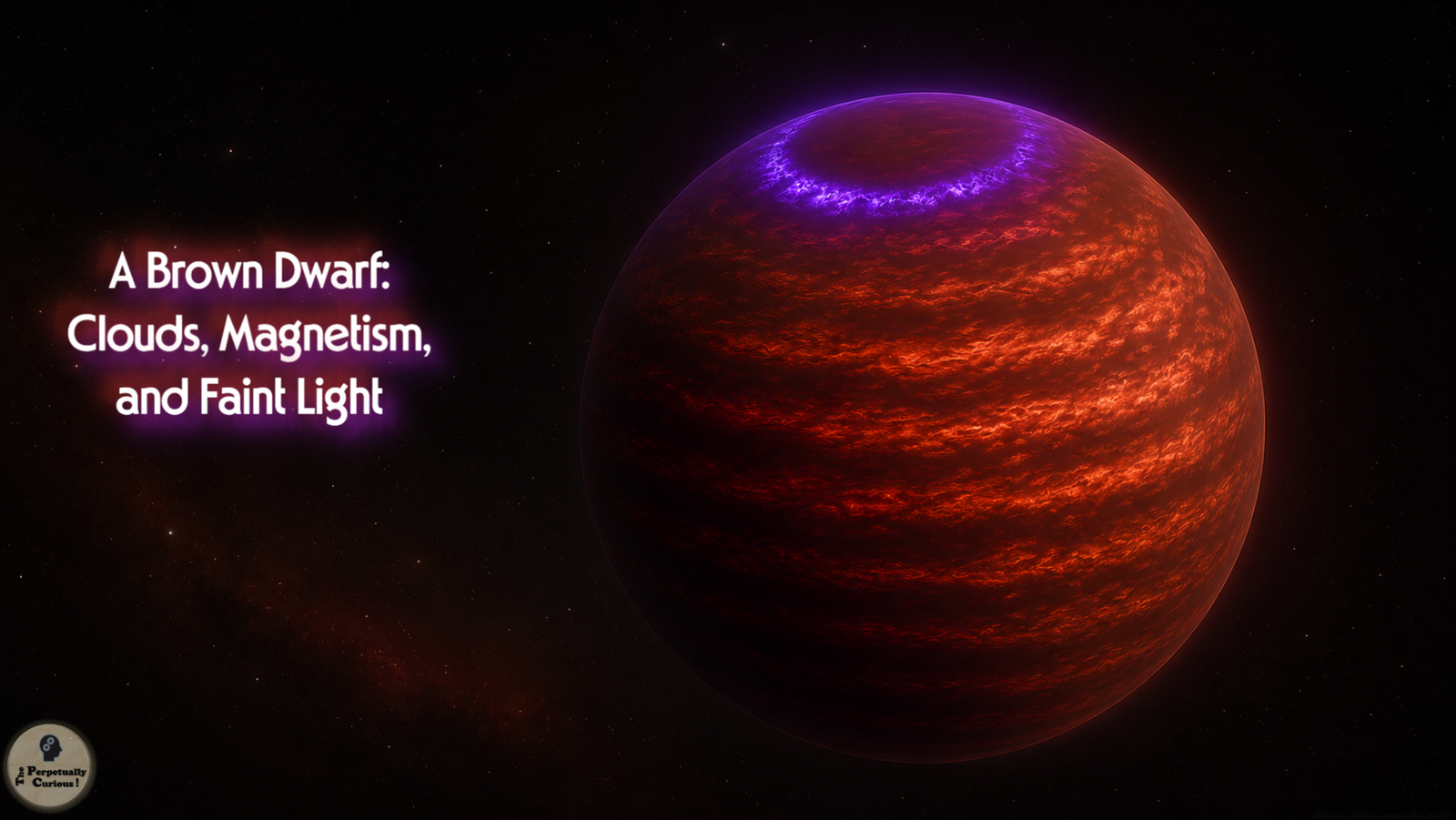
🌟 Brown Dwarfs: Why Stellar Ignition Never Takes Hold
From section: 🔥 When contraction almost makes a star… 🔥 When contraction almost makes a star A young brown dwarf can form through fragmentation and gravitational collapse broadly similar to the formation of a low-mass star.
- The Perpetually Curious! › Archives › Wilderness & Homestead CreaturesArticle
🌍 African Wildlife and Landscapes: A Heritage of Beauty and Balance
These environments form a living record of natural history, where beauty and dynamic ecological functioning emerge from interactions among climate, landforms, water, and the species that inhabit them.