Explore by topic, question, or idea. Find articles, reflections, videos, puzzles, and curiosity pathways gathered across the site.
Press Enter or select Search. A newly typed query starts globally; filters are applied only through the visible rail.
18 results for “the art and science of bonsai crafting living harmony in miniature trees”
- The Perpetually Curious! › Archives › Cosmic ExplorationArticle
🌍 Why Earth Has a Living Atmosphere
From section: 🔭 Opening the QuestionThe question of why Earth has a stable, temperate, long‑lived atmosphere opens into a chain of ideas that stretch from the earliest days of the Solar System to the slow work of oceans, rocks, and living organisms.Read more »
- The Perpetually Curious! › Canonical › Cosmic ExplorationArticle
🌌 The Hunt for the Invisible: Understanding Dark Matter Through Science’s Greatest Detective Story
From section: 🎭 Living within the visible minorityDark matter also changes the scale of what "ordinary" means. Atoms, stars, planets, gas, dust, and living bodies account for only about 5 percent of the universe's total energy density. Dark matter contributes about 27 percent, while dark energy accounts for roughly 68 percent.
- The Perpetually Curious! › Archives › Cosmic ExplorationArticle
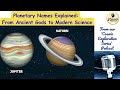
🌌 Planetary Names Explained: From Ancient Gods to Modern Science
💡 Have you ever wondered why the planets in our solar system bear such distinctive names? From swift Mercury to majestic Jupiter, these names reflect ancient traditions that connect cultural understanding with the science of the skies. Read more »
- The Perpetually Curious! › Canonical › Cosmic ExplorationArticle
🌌 The Universe’s Ancient Whisper: Decoding the Cosmic Microwave Background
From section: 🔭 The continuing questThe field’s plans also change as funding and scientific priorities evolve. CMB-S4 was developed as a major next-generation ground-based project, but the United States Department of Energy and National Science Foundation ended project support in July 2025, leading to an orderly shutdown. …
- The Perpetually Curious! › Canonical › Cosmic ExplorationArticle
🛰️ When Fire Meets Air: How Spacecraft Reenter Earth’s Atmosphere
From section: 🌎 Returning through fireSpacecraft designs, guidance strategies, and landing systems differ across missions and nations, but vehicles returning through Earth’s atmosphere share the same physical dependence. The same living atmosphere that sustains weather and life also removes most of the energy carried in orbital motion. …
- The Perpetually Curious! › Canonical › Cosmic ExplorationArticle
The Cosmic Recipe: Understanding the Physical Criteria for Star Formation 🌟
From section: 🎨 Beyond the recipe: understanding stellar diversity… Across successive generations, this enrichment changes the material available for later stars, planets, atmospheres, and living systems.
- The Perpetually Curious! › Videos & Podcasts › Cosmic ExplorationPodcast
🌌 Planetary Names Explained: From Ancient Gods to Modern Science | Cosmic Exploration Series Podcast
From section: Video context#PlanetNames #SolarSystem #Astronomy 🪐 Why are the planets named Mercury, Venus, Earth, Mars, Jupiter, Saturn, Uranus, and Neptune? This astronomy podcast explores the origins and meanings of the planet names in our solar system, revealing how ancient observation, mythology, language, culture, and modern science…
- The Perpetually Curious! › Canonical › Cosmic ExplorationArticle
🌌 Borrowing the Orbits of Giants: How Gravity Assists Carry Spacecraft into the Deep
From section: 🛰️ Cassini, New Horizons, and the Art of Multiple FlybysThe Voyager missions were not the only ones to rely on gravity assists. Later spacecraft used the technique in more complex ways. The Cassini mission to Saturn, for example, used a sequence of flybys to build up the energy needed to reach its distant target.
- The Perpetually Curious! › Archives › Cosmic ExplorationArticle
💫 When Galaxies Feast: The Quiet Art of Cosmic Cannibalism
Galaxies often appear serene when viewed from a distance, as if they drift through the universe in gentle isolation. Yet their histories are shaped by encounters that unfold over immense spans of time. These encounters are not always dramatic or violent.
- The Perpetually Curious! › Archives › Cosmic ExplorationArticle
The Moon's Ancient Dance: Understanding Lunar Phases Through Science and Story 🌙
Every approximately 29.5 days, Earth’s sole natural satellite completes a shape-shifting performance that has captivated humanity since our species first gazed skyward.