Explore by topic, question, or idea. Find articles, reflections, videos, puzzles, and curiosity pathways gathered across the site.
Press Enter or select Search. A newly typed query starts globally; filters are applied only through the visible rail.
272 results for “the ten largest moons in our solar system a journey through worlds of ice fire and hidden oceans”
- The Perpetually Curious! › Canonical › Planet EarthArticle
🌍🌑 Where Two Soils Part Ways: Earth, Moon, and the Stories Written in Dust
From section: 🌋 From a Shared Beginning to Divergent WorldsEarth and Moon are companions in space, and their relationship is not only poetic but also physical. The leading scientific view is that the Moon formed after a giant impact in the early history of the solar system, when a large body collided with the young Earth and ejected material into orbit. …
- The Perpetually Curious! › Archives › Cosmic ExplorationArticle
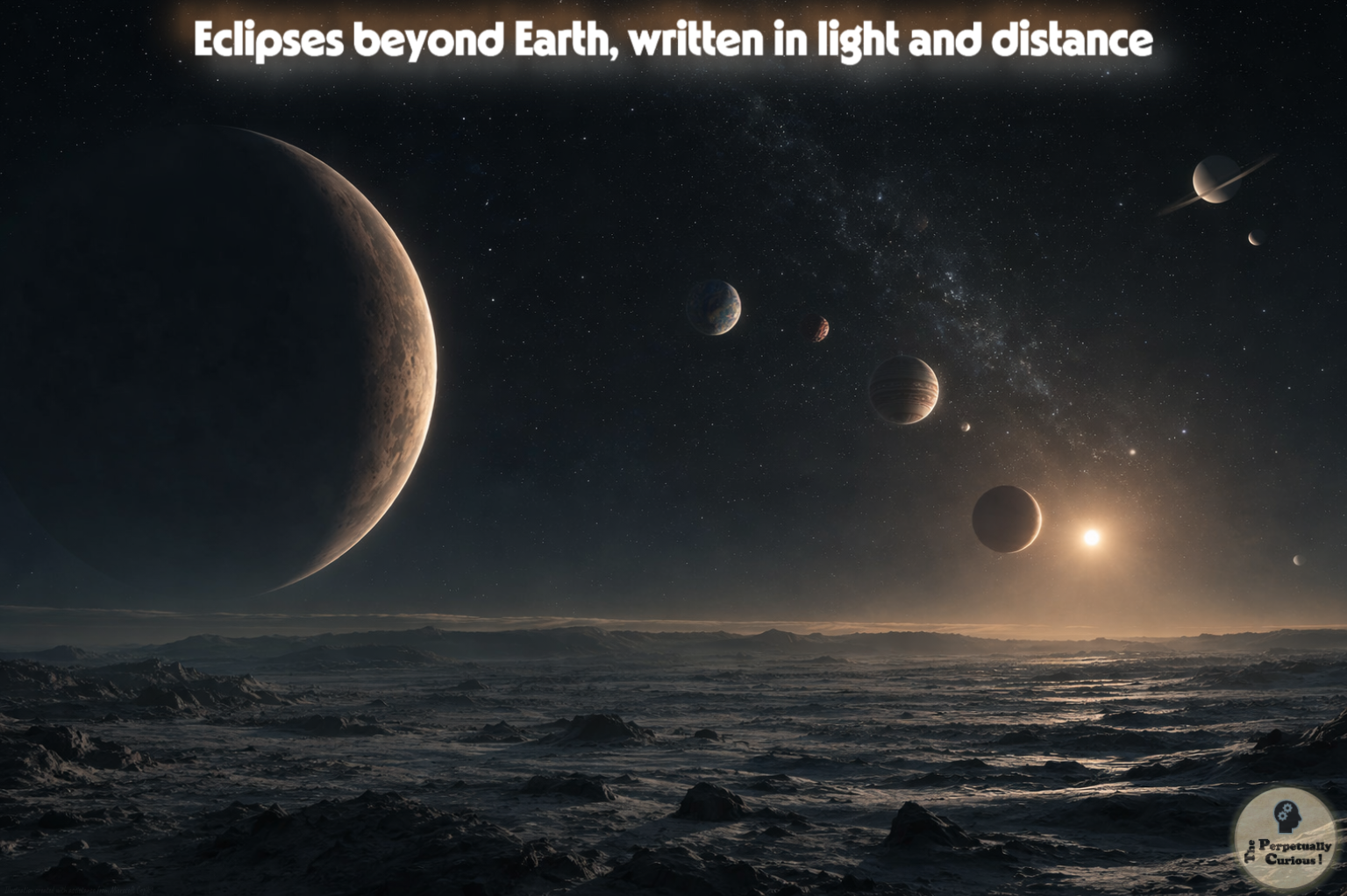
🌘 Eclipses Across the Solar System: When Shadows Travel
Across the Solar System, the same geometry repeats with different planets, moons, rings, distances, and atmospheres.
- The Perpetually Curious! › Canonical › Food & LifestyleArticle
🥛 Milk Across Cultures: A Journey Through Nature’s Dairy Diversity
From section: 🌸 Share the wonderKnowledge travels much as food traditions do, through hands, homes, and conversations. If this journey offered a new way to see a familiar glass, pass it along and let another curiosity begin.
- The Perpetually Curious! › Archives › Cosmic ExplorationArticle
The Asteroid Belt: Ancient Fragments of Our Solar System's Story 🌌
On New Year's Day 1801, Italian astronomer Giuseppe Piazzi made a discovery that would transform our understanding of the solar system. While searching for a suspected planet between Mars and Jupiter, he found something else entirely: the first of millions of rocky fragments…
- The Perpetually Curious! › Canonical › History, Arts, and CultureArticle
🌍 Vertical Worlds: The 14 Lokas in Ancient Indian Cosmology
From section: 🌌 From three worlds to a layered cosmos… Several Upanishads gave sustained attention to the relation between action, conduct, knowledge, death, and rebirth. Puranic literature then presented more expansive sacred geographies, often organizing the cosmos through nested continents, oceans, mountains, heavenly spheres, and subterranean regions.
- The Perpetually Curious! › Canonical › Cosmic ExplorationArticle
🌍 When Earth First Took Shape: A Planet Born from Cosmic Dust
From section: 💡 Did You Know🌌 Computer simulations of planetary formation suggest that giant impacts were common in the early Solar System, helping scientists understand how collisions could create moons, alter planetary spin, and reshape young worlds.
- The Perpetually Curious! › Archives › PhysicsArticle
🌍 When Worlds Pull: Gravity Across the Planets and What It Reveals About Them
Gravity is the quiet sculptor of the cosmos. It shapes the paths of planets, guides the drift of moons, and anchors every step taken on the surface of a world. When we compare gravity across the Solar System, we begin to see how each planet carries its own gravitational signature.
- The Perpetually Curious! › Canonical › Wilderness & Homestead CreaturesArticle
🧫 Tides of Chemical Worlds: How Animals Meet the Molecules Around Them
Before an animal sees or hears another creature, it often meets its chemistry first. Across forests, oceans, and grasslands, animals move through landscapes shaped not only by terrain and climate, but also by chemistry.
- The Perpetually Curious! › Canonical › Planet EarthArticle
🌊 Where the Salt Stays: Why the Ocean Is Salty but Rivers and Most Lakes Are Fresh
From section: 💧 Most freshwater lakes have somewhere for water to goThe Great Lakes drainage system offers a large-scale example. Water moves from lake to lake, passes through connecting rivers, and ultimately reaches the Atlantic Ocean through the St. Lawrence River. The lakes hold enormous volumes of water, but they are not the final stop in the journey.
- The Perpetually Curious! › Canonical › Planet EarthArticle
🌇 When the Sky Becomes a Painting: Why Clouds Glow Red and Orange at Sunset on Earth
From section: 🪐 Cloud colors on other worlds… Some worlds scatter light through dense layers of hydrocarbons, while others filter it through thin veils of ice crystals or clouds composed of exotic compounds. The result is a spectrum of skies that range from muted and hazy to sharp and crystalline, each one shaped by the physics that governs its atmosphere.