Explore by topic, question, or idea. Find articles, reflections, videos, puzzles, and curiosity pathways gathered across the site.
Press Enter or select Search. A newly typed query starts globally; filters are applied only through the visible rail.
241 results for “why space looks dark in a universe filled with light understanding the quiet cosmos”
- The Perpetually Curious! › Canonical › Cosmic ExplorationArticle
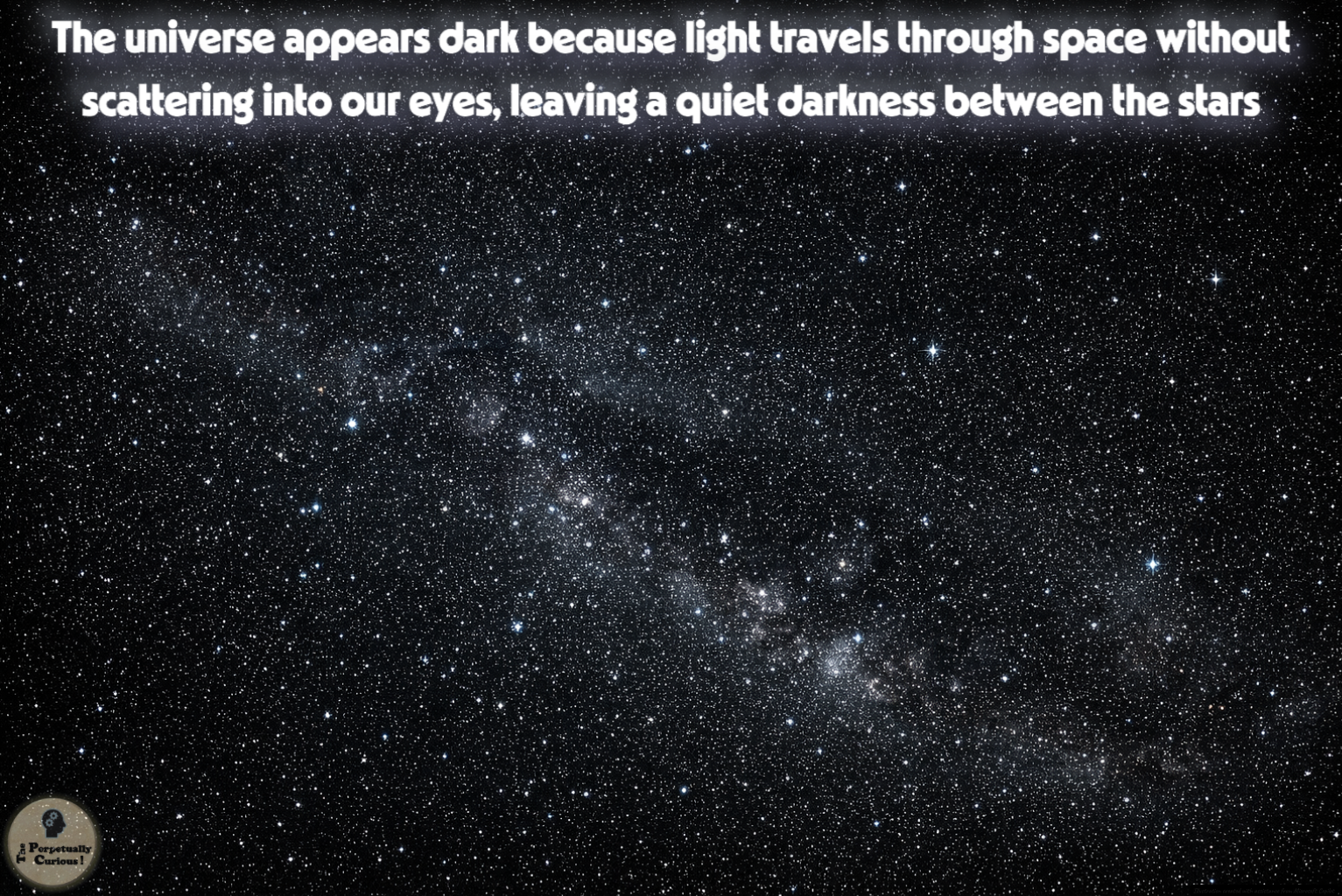
🌌 Why Space Looks Dark in a Universe Filled with Light: Understanding the Quiet Cosmos
From section: 🌠 Seeing darkness with new understandingThis perspective can invite a sense of wonder that is grounded in careful physics. The dark sky is not a failure of the universe to shine. It is the visible trace of how light, matter, and time are arranged on the largest scales. …
- The Perpetually Curious! › Archives › PhysicsArticle
🌌 Why Space Looks Dark: Light, Matter, and the Quiet Cosmos
Space can look surprisingly dark, even in a universe filled with stars. That darkness is not simply the absence of light. It is often the result of how light travels, what it meets, and what it does not meet. On Earth, daylight becomes a bright blue sky because sunlight…
- The Perpetually Curious! › Canonical › Cosmic ExplorationArticle
🌌 Why Space Feels Cold Among So Many Suns: The Quiet Physics of Cosmic Warmth
From section: ☀️ Radiation, absorption, and why darkness does not mean cold… A surface in direct sunlight can reach a high temperature while the sky behind it remains visually dark. The reasons why space looks dark concern how visible light reaches an observer, not whether a nearby object is absorbing enough radiant energy to become warm.
- The Perpetually Curious! › CanonicalReflection
Empty Rooms and Ancient Light
… A single unwanted glow can overwhelm delicate signals from distant sources. In these carefully controlled quiet places, we receive long-traveling light, and translate it into understanding.
- The Perpetually Curious! › Canonical › Cosmic ExplorationArticle
🌌 The Hunt for the Invisible: Understanding Dark Matter Through Science’s Greatest Detective Story
In the quiet architecture of the cosmos, unseen matter shapes the paths of galaxies and the stories they tell.Its presence is felt in every curve of starlight, a patient influence woven through the structure of space.We stand within this vast design, aware of only a fraction of what holds the universe together.
- The Perpetually Curious! › Canonical › Cosmic ExplorationArticle
🌌 The Universe’s Ancient Whisper: Decoding the Cosmic Microwave Background
From section: 🌍 Living within the afterglowThe CMB also offers a clean example of why space can look dark even in a universe filled with light. An optically dark sky can still contain radiation at radio, microwave, infrared, ultraviolet, X-ray, and gamma-ray wavelengths. …
- The Perpetually Curious! › Canonical › Cosmic ExplorationArticle
The Cosmic Recipe: Understanding the Physical Criteria for Star Formation 🌟
A star begins in quiet darkness, gathering its strength grain by grain until light becomes possible.The first glow rises from patience and pressure, a small promise held within the cold.In time, the universe answers, and a new point of warmth joins the long story of creation.
- The Perpetually Curious! › Canonical › History, Arts, and CultureArticle
🌍 Vertical Worlds: The 14 Lokas in Ancient Indian Cosmology
From section: 🌌 From three worlds to a layered cosmosEarly Vedic language frequently evokes a threefold cosmos: earth, the intermediate region, and heaven. These were not merely empty containers. They formed a living field in which deities, ritual action, weather, light, and human life could be related to one another.
- The Perpetually Curious! › CanonicalGateway
🌌 Cosmic Exploration | ✍️ Articles
From section: 🌌 Galaxies, Cosmology & Deep TimeWhy Space Looks Dark in a Universe Filled With Light
- The Perpetually Curious! › Canonical › NatureArticle
🌅 The Quiet Geometry of Dawn: How Early Morning Light Shapes the Landscape
From section: 🌅 The first gradients of light: shapes returning to the eyeAs light continues to increase, the outlines that first emerged in the half‑dark begin to gather texture and depth, preparing the landscape for the more articulated forms that appear as the growing light strengthens.