

Rainbows often arrive with a sense of gentle timing, appearing just as a storm begins to loosen its hold on the sky. Sunlight returns through thinning clouds, rain still hangs in the distance, and an arc of color seems to gather between them. For a moment, the rainbow feels almost suspended in place, familiar enough to recognize at once, yet elusive enough to invite a second look. Its beauty may appear effortless, but the effect depends on a precise alignment of light, water droplets, and the observer. What seems to stretch across the sky begins inside countless individual droplets, where sunlight bends, reflects, separates into color, and emerges along particular paths. The arc is therefore not simply painted onto the rain. It is a geometry of light that appears only from the right point of view, raising a quiet question: when we see a rainbow, what exactly are we looking at?
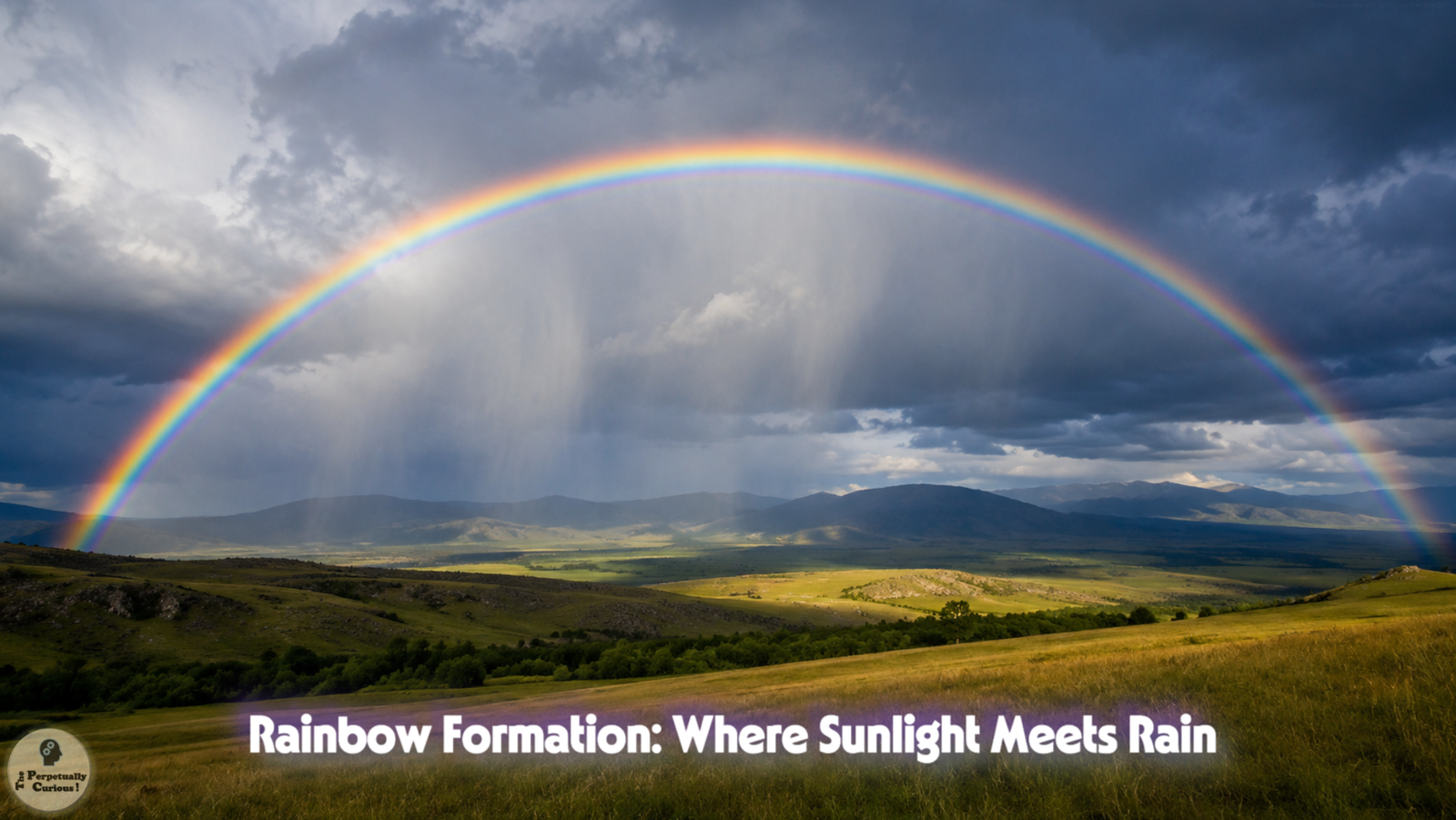
The sky gathers its colors in a circle of light that waits for the patient eye.
A moment of rain and sun becomes a quiet geometry that rises only when we look.
In that brief alignment, the world offers a soft reminder of how light finds its way through water.
🌤 Setting the scene: light, raindrops, and the observer
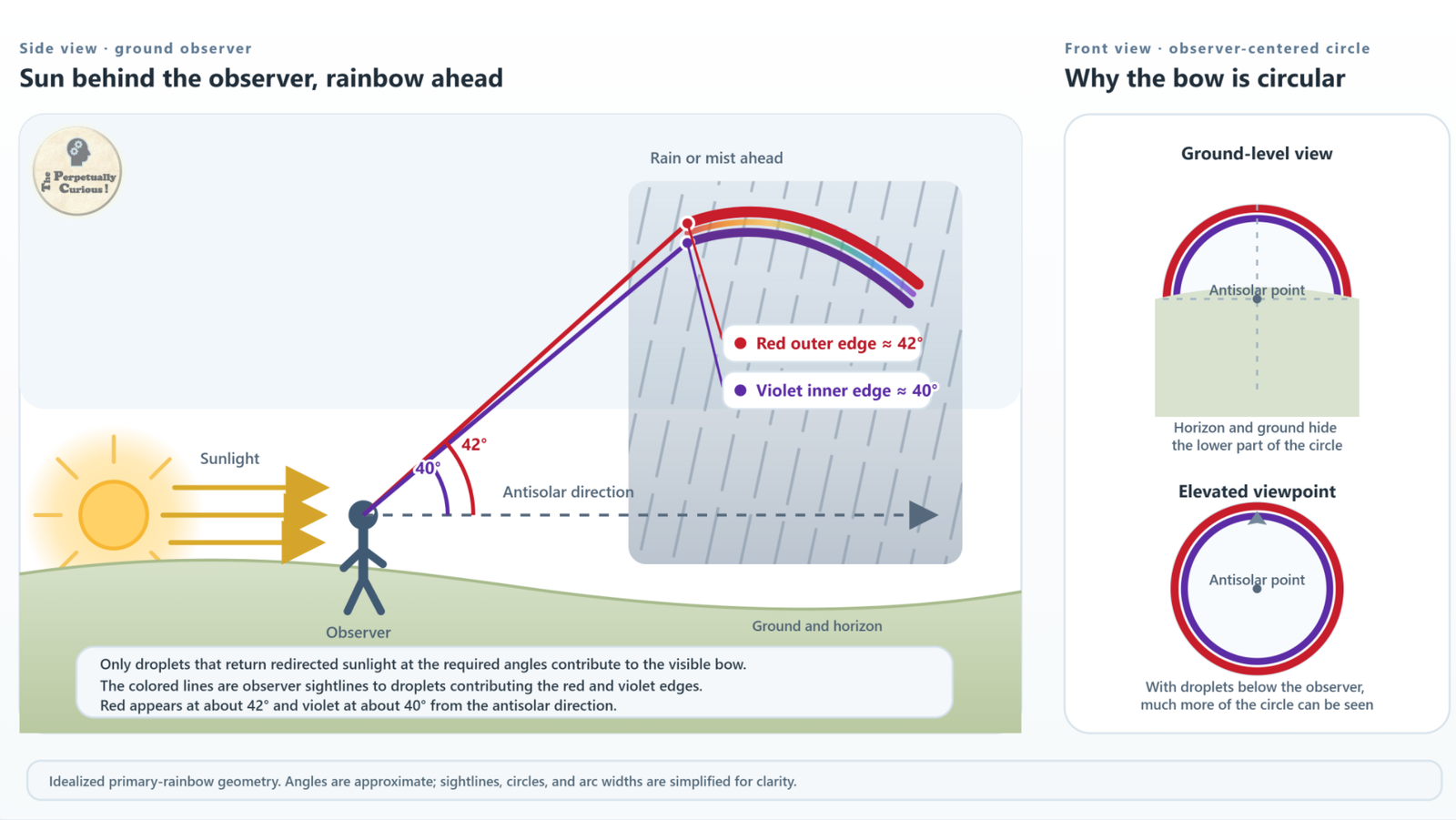
A rainbow is not a fixed object hanging in one place in the sky. It is an observer-dependent optical event shaped by the Sun, a field of illuminated water droplets, and the viewer’s position. With the Sun behind the observer and falling raindrops or mist ahead, only light returned from droplets at the required angles can reach the eye.
Although many droplets may fill the air, only a particular group contributes to the visible arc at any given moment. As the observer moves, that group changes, which means that a nearby person sees a similar rainbow formed from a different set of droplets. The rainbow therefore has no single location apart from the geometry that brings it into view.
To understand how this shifting field of droplets can produce such an orderly arc, the view must now narrow from the sky to a single droplet and the path of light within it.
💧 Inside a raindrop: refraction, reflection, and dispersion
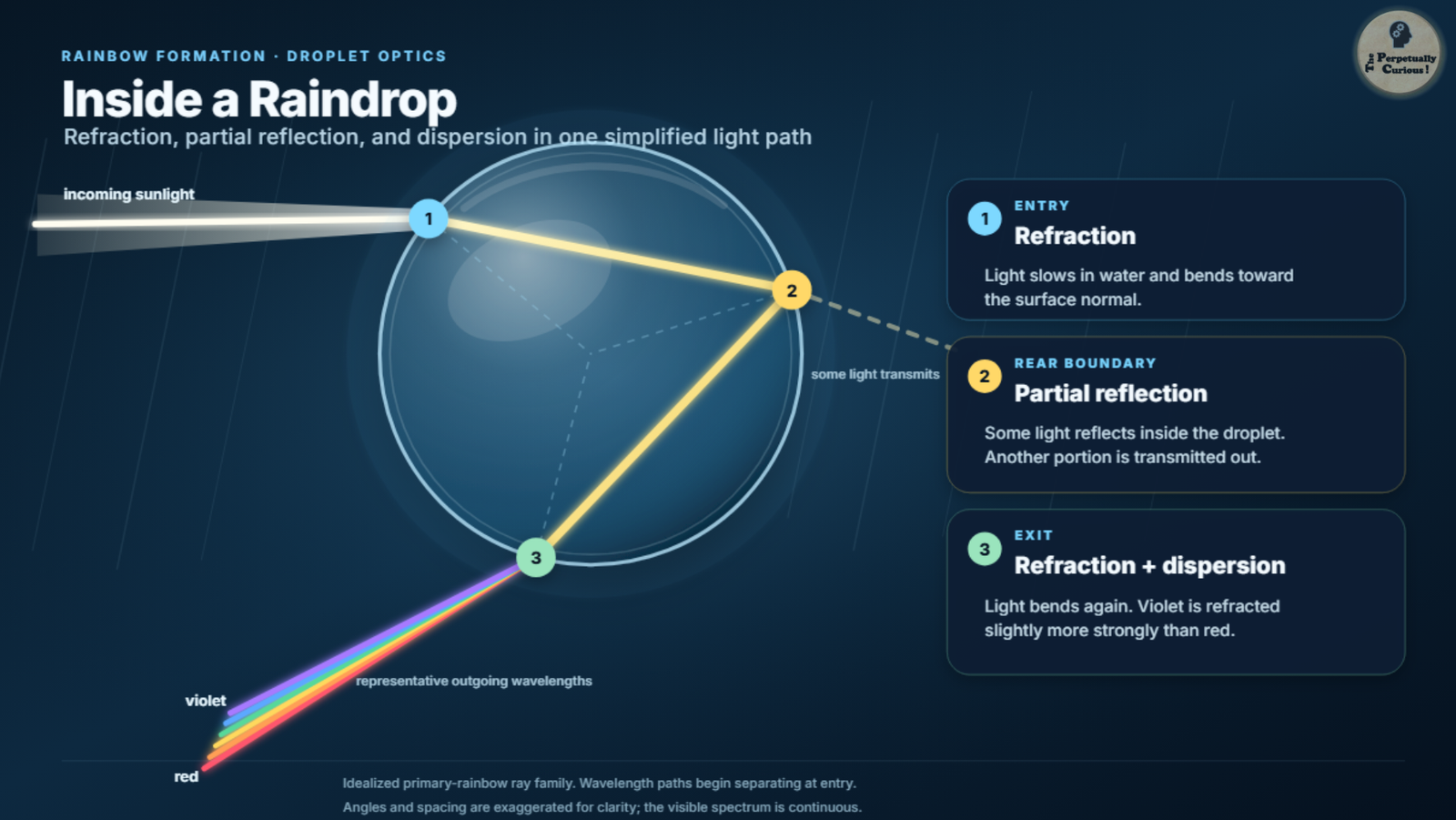
When sunlight reaches a nearly spherical water droplet, its path begins to change. First, the light is refracted as it crosses from air into water. Refraction is the bending of light at the boundary between two materials, caused by a change in its speed. How sharply the ray bends depends on its angle of entry and on water’s refractive index, which describes how strongly the material alters the path of light.
The ray then reaches the curved rear surface of the droplet. There, part of the light passes out, while another part reflects back through the water. Unlike ordinary mirrors, which usually depend on a reflective metal coating, a raindrop produces this partial reflection at the boundary between water and air. The rays that form the primary rainbow undergo one such internal reflection before reaching the front of the droplet again.
As the light exits, it is refracted a second time. Because water bends different wavelengths by slightly different amounts, the separation that begins at entry increases as the light leaves the droplet. Violet light is refracted slightly more strongly than red light, creating the spread of color known as dispersion.
Most emerging rays do not contribute equally to the visible rainbow. Near certain directions, however, many neighboring light paths leave the droplet at almost the same angle. Their concentration brightens the familiar arc and leads directly to the next question: why does the primary rainbow appear at an angle of about 42 degrees?
📐 The geometry of the arc: why about 42 degrees matters
When many possible light paths are traced through a droplet, a distinctive pattern appears. Near one particular path, small changes in where a ray enters produce very little change in the direction from which it finally emerges. Neighboring rays therefore leave the droplet crowded into a narrow range of angles, concentrating light into the bright edge of the primary rainbow.
For red light, the total change in direction is about 138 degrees relative to the incoming sunlight. Viewed from the observer’s perspective, this places the outer red edge roughly 42 degrees from the antisolar point, the direction directly opposite the Sun. Violet light is bent slightly more strongly because water has a slightly higher refractive index for shorter wavelengths, so it appears closer to the center of the bow, at about 40 degrees. The colors between them form a continuous spread only a few degrees wide, even though the eye often perceives them as distinct bands.
The rainbow is therefore not merely an arc but part of a cone of light centered on the antisolar point, with the observer at its tip. Droplets positioned along the surface of that cone can direct rainbow light toward the eye, while droplets outside it cannot contribute to that same visible arc. One internal reflection creates this familiar geometry. When light reflects twice inside a droplet, a second and broader arc begins to take shape.
🌈 Primary and secondary rainbows: more reflections, different angles
The primary bow follows the one-reflection path described above. Some rays, however, undergo two internal reflections within the droplet. The corresponding refraction-and-reflection geometry places their angular concentration farther from the antisolar point, creating the secondary rainbow outside the primary arc. Its red inner edge lies at an angular radius of about 51 degrees from the antisolar point, while violet extends farther outward, to roughly 54 degrees.
The secondary bow is usually much fainter because each internal reflection is only partial. At every encounter with the water-air boundary, some light is transmitted out of the droplet, leaving less light to continue along the path that forms the secondary bow. The remaining rays are also spread across a broader angular range. Its color order is reversed: red appears along the inner edge, facing the primary bow, while violet lies on the outer edge.
Between the two arcs is Alexander’s dark band. Primary-rainbow rays brighten the region inside the primary bow, while secondary-rainbow rays add more light beyond the secondary bow. The space between them receives less concentrated rainbow light, so it appears noticeably darker by comparison.
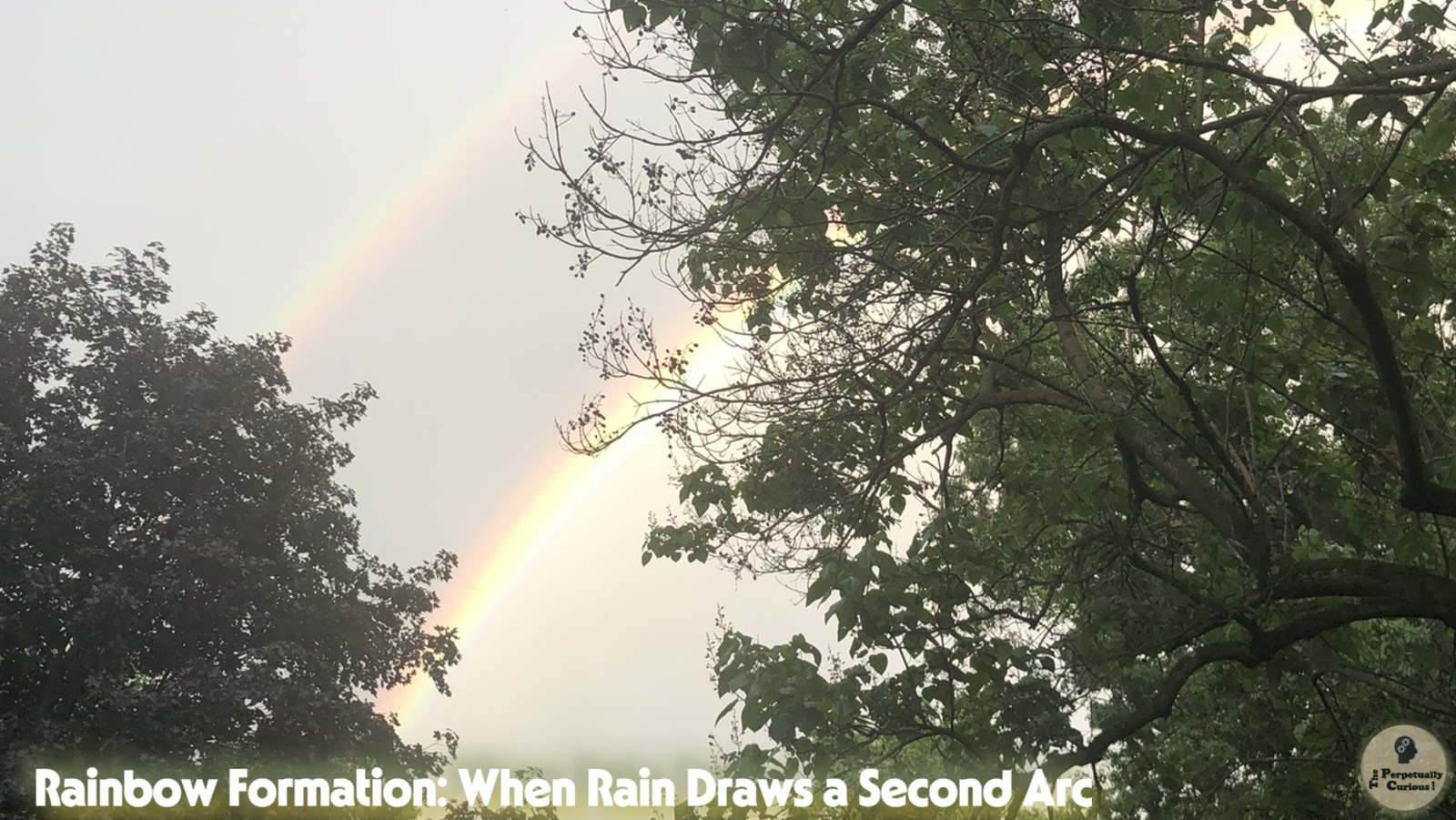
A double rainbow therefore reveals two distinct journeys through the same kind of droplet: one shaped by a single internal reflection and the other by two. In the observational photograph below, the brighter primary bow appears lower in the frame, while the much fainter secondary bow lies above and outside it. Alexander’s dark band is not discernible in this photograph, although a suggestion of the secondary bow’s reversed color order can be seen upon close inspection of the full-size image. As with any transient atmospheric photograph, the visibility of these features depends on the moment of capture, lighting, atmospheric contrast, and camera exposure.
🌟 Supernumerary rainbows: delicate fringes from wave behavior
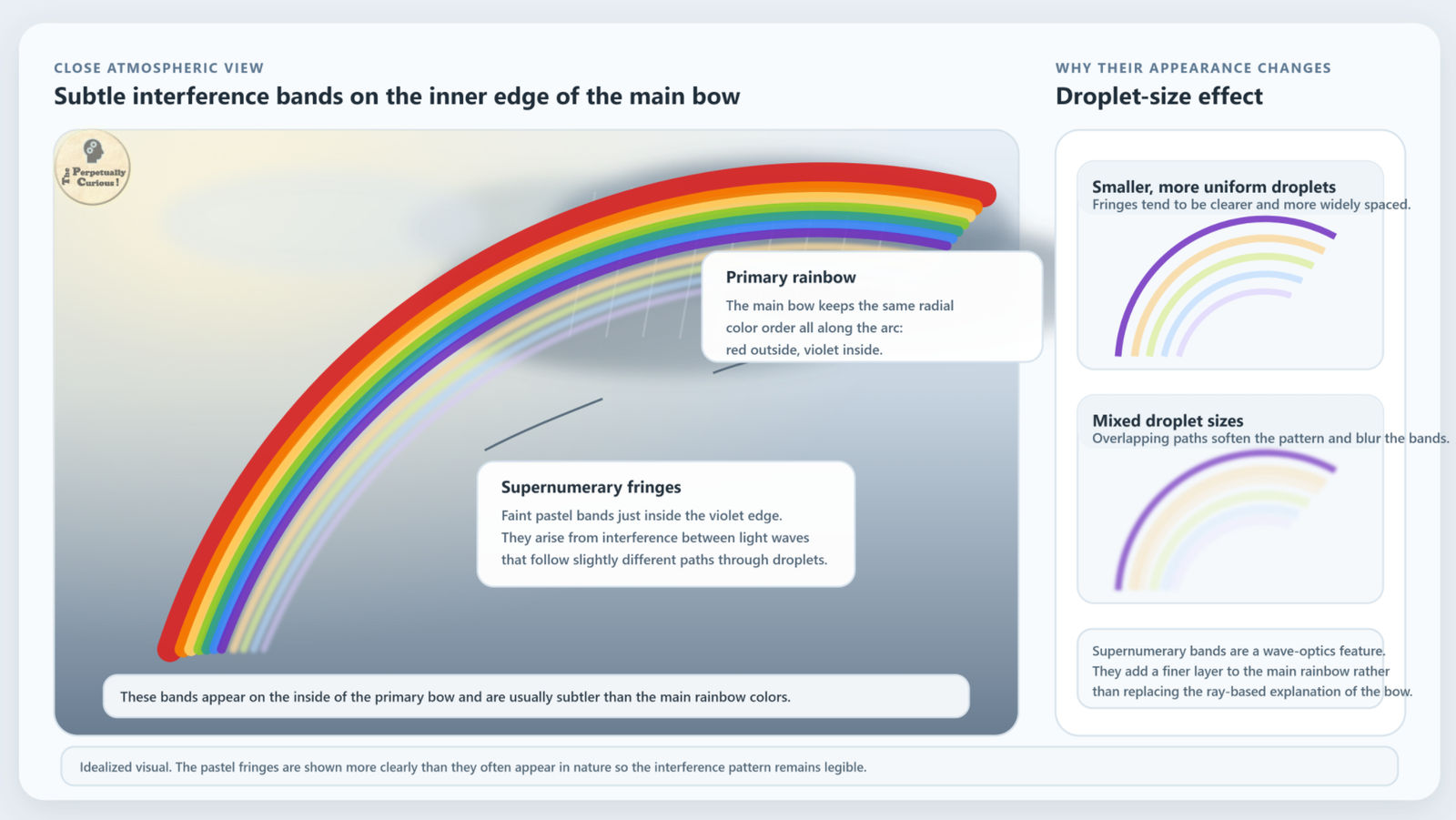
Just inside the primary rainbow, faint pastel-colored bands may appear as though the main arc has been quietly echoed. These are supernumerary rainbows. Unlike the primary and secondary bows, which can be described largely by tracing rays through droplets, these delicate fringes reveal the wave nature of light.
They arise because neighboring light waves can follow slightly different paths through the same droplet and still emerge in nearly the same direction. When their crests and troughs align, the waves reinforce one another and form a brighter band. When they arrive out of step, they partly cancel, leaving a dimmer region. The alternating reinforcement and cancellation create a sequence of closely spaced fringes, much as interference produces the shifting colors of soap bubbles, although the geometry and material involved are different.
Their spacing and clarity depend strongly on droplet size and uniformity. Smaller, relatively uniform droplets tend to produce more widely spaced and often more visible supernumerary bands. When many different droplet sizes are present, their fringe patterns overlap and soften one another, causing the extra colors to blur into the primary arc. If the droplets become extremely small, the display begins to take on the broader, paler character of a fogbow.
Supernumerary rainbows therefore add a finer layer to the phenomenon. Ray optics explains where the main arcs appear, while wave interference explains the delicate structure hidden along their edges. With both descriptions in view, the next question is no longer only how the colors form, but why the entire rainbow curves into a circle around the observer.
🎯 Why rainbows are circular: cones of light and changing viewpoints
From the ground, a rainbow usually appears as a curved arc, but its underlying geometry is circular. The rays reaching the observer lie along a cone centered on the antisolar point, with the observer at its tip. Droplets positioned around that cone can direct rainbow light toward the eye from every direction, forming a circle centered opposite the Sun. The horizon and surrounding landscape usually conceal the lower portion, leaving only the familiar arc above the ground.
From an elevated viewpoint, such as an aircraft, illuminated droplets may lie both above and below the observer, allowing much more of the circle to become visible. The primary bow’s red outer edge remains about 42 degrees from the antisolar point in every direction. An aircraft’s shadow may appear near the center of the circle, sometimes accompanied by a much smaller set of colored rings called a glory. A glory and a circular rainbow may appear in the same view, but they are separate optical phenomena.
Changing viewpoint does not alter the rainbow’s circular geometry. It changes how much of the observer-centered cone is supplied by visible, illuminated droplets and how much is concealed by the horizon. The extent of the bow that can be seen therefore depends on the Sun’s height, the observer’s position, and the location of the droplet field.
🌦 Conditions for seeing a rainbow: timing, position, and subtle variations
For an observer near ground level looking toward droplets above the horizon, rainbows are most often visible when the Sun is lower than about 42 degrees in the sky. As the Sun rises, the antisolar point moves farther below the horizon, carrying more of the rainbow’s circular geometry out of view. The elevated-view exception described above becomes possible when illuminated droplets lie below the observer.
The essential arrangement is simple but precise: direct sunlight must reach water droplets ahead while the Sun remains behind the observer. A dark cloud bank beyond the illuminated rain can make the colors appear stronger by contrast, but a clear background is not required for the rainbow to form.
Rainbows do not occupy one fixed altitude or narrow atmospheric layer. Natural weather rainbows form mainly within the troposphere, the lowest layer of Earth’s atmosphere, where most clouds, mist, and precipitation develop. The necessary droplets may be suspended high within a distant rain shaft or only a few feet above the ground in fountain spray.
Falling rain is therefore only one possible source. Rainbows may appear in sea spray, fountains, fine mist, and the rising spray of Niagara Falls, wherever enough illuminated droplets occupy the required angles around the antisolar point. Mountains can also create favorable viewing conditions by encouraging clouds, rain, and mist while providing elevated viewpoints from which droplets may lie below the observer.
Moonlight can produce the same underlying geometry, creating a lunar rainbow or moonbow when the Moon is bright enough. These bows often appear pale to unaided vision because human color perception becomes less sensitive under low illumination.
Across these varied settings, the same optical geometry can emerge, even though every visible bow belongs to a particular moment and viewpoint.
🌍 A shared sky, a personal rainbow
Rainbows have appeared in stories, art, and symbolism across many cultures, though the meanings attached to them vary widely. Ideas of transition, connection, or renewal are common in some traditions, but every interpretation begins with the same physical encounter: light meeting water in a sky shared by those beneath it.
The geometry is universal, yet each visible rainbow is personal. Every observer receives light from a different set of droplets positioned at the required angles around that observer’s antisolar point. Two people standing near one another may see bows that look nearly identical, but the light reaching each pair of eyes has traveled through different droplets. The rainbow therefore belongs neither wholly to the distant rain nor solely to the sky. It is completed by the observer’s position within the scene.
Its appearance is also fleeting because the alignment continually changes. Droplets fall, clouds move, the Sun shifts, and even a few steps by the observer cause a new set of droplets to form the visible arc. What seems fixed for a moment is actually being rebuilt continuously from light, water, and viewpoint.
Perhaps this is part of what gives a rainbow its reflective power. It reveals a pattern governed by the same physical laws for everyone while reminding us that each view of that pattern is assembled along a slightly different path.
The observational video below records one variant of the phenomenon under a particular set of conditions: a rainbow arc visible through the tree canopy, with rain softly audible in the background.
Pass this article along to someone curious and let the learning travel.
💡 Did You Know
💧 Smaller, relatively uniform droplets can reveal extra bands.
Supernumerary rainbows become clearer when the contributing droplets are similar in size. Smaller droplets generally produce more widely spaced fringes, while a mixture of droplet sizes causes the patterns to overlap and blur.
🌈 The colors of a rainbow are not divided into fixed bands.
Visible light forms a continuous spectrum. Human vision groups that gradual change into familiar color regions, so the boundaries between red, orange, yellow, green, blue, and violet are perceptual rather than sharply separated in the sky.
🔴 Different parts of the visible arc are usually supplied by different droplets.
A droplet sending red light toward an observer is generally positioned at a slightly different angle from one sending violet light toward the same observer. Every illuminated droplet separates sunlight into colors, but only particular rays from particular droplets reach the eye.
🌅 A rainbow near sunrise or sunset may appear mostly red.
When sunlight travels through a longer path in the atmosphere, much of its blue and green light is scattered away before it reaches the droplets. The remaining red and orange light can produce a reddish bow through the same atmospheric filtering that helps clouds glow red and orange at sunset.
🌤 The sky inside the primary rainbow often appears brighter.
Primary-rainbow rays do not brighten only the narrow colored arc. They also add light to the region inside it. This illuminated interior makes Alexander’s dark band between the primary and secondary bows appear even more pronounced.
🕶️ Polarized sunglasses can strengthen or weaken a rainbow.
Light from the primary rainbow is strongly polarized. Rotating polarized lenses may make portions of the bow appear brighter, dimmer, or nearly disappear, depending on how the lenses are oriented relative to the polarized light.
☀️ Some higher-order rainbows appear on the Sun-facing side of the sky.
Tertiary and quaternary rainbows arise from three and four internal reflections. Unlike the familiar primary and secondary bows opposite the Sun, these exceptionally faint arcs occur toward the Sun and are difficult to distinguish against the surrounding glare.
What causes the colors in a rainbow?
The colors appear because water refracts different wavelengths of sunlight by slightly different amounts. This dispersion spreads the incoming light into a continuous spectrum, with red bent slightly less strongly than violet.
What causes a double rainbow, and why is the secondary bow fainter and reversed?
A double rainbow forms when one family of rays undergoes one internal reflection inside the droplets, creating the primary bow, while another undergoes two reflections, creating the secondary bow outside it. The second reflection changes the exit geometry and reverses the color order, placing red on the inner edge and violet on the outer edge of the secondary arc. The secondary bow is fainter because some light escapes at each encounter with the droplet’s surface, and the remaining light is spread across a broader range of angles.
Why is the sky darker between the primary and secondary rainbows?
This region is called Alexander’s dark band. Primary-rainbow rays brighten the sky inside the primary arc, while secondary-rainbow rays add more light beyond the secondary arc. The region between them receives less concentrated rainbow light and therefore appears darker by comparison.
Why do some rainbows appear more vivid than others?
Vividness depends on sunlight intensity, droplet size and uniformity, atmospheric clarity, and background contrast. Larger, relatively uniform raindrops often produce narrower and more saturated color bands, while a dark cloud bank behind the illuminated droplets can make the same bow appear brighter.
What are supernumerary rainbows, and why do they appear only sometimes?
Supernumerary rainbows are faint, pastel-colored fringes that sometimes appear just inside the primary bow. They form when light waves following slightly different paths through droplets interfere with one another, creating alternating brighter and dimmer bands. They are most visible when the contributing droplets are relatively small and similar in size, while a broad mixture of droplet sizes tends to blur the fringes.
Why does the Sun need to be behind the observer?
Rainbow light emerges from droplets at particular angles relative to the incoming sunlight. With the Sun behind the observer and illuminated droplets ahead, those redirected rays can enter the eye. When the Sun is in front, the observer-centered geometry required for an ordinary rainbow is absent.
Why do we usually see only part of a circular rainbow?
A rainbow is fundamentally circular because its light reaches the observer along a cone centered on the antisolar point. From the ground, the horizon, surrounding landscape, and absence of visible illuminated droplets below the observer usually conceal the lower portion. From an aircraft, mountain, cliff, or other elevated position, droplets may lie beneath the observer, allowing a much larger part of the circle, and sometimes nearly the entire circle, to become visible.
Why can you never reach the end of a rainbow?
A rainbow has no fixed endpoint resting on the landscape. As the observer moves, the antisolar point moves with them, and a different set of droplets occupies the angles required to send rainbow light toward the eye. The visible arc therefore shifts continually, keeping its apparent “end” beyond reach.
Can a rainbow form without falling rain?
Yes. Any suitable collection of illuminated water droplets can form a rainbow, including fountain spray, lawn sprinklers, sea mist, and waterfall spray. Falling rain is only one way of supplying droplets large enough to produce a vivid bow.
Does a rainbow form in a particular layer of Earth’s atmosphere?
A rainbow has no fixed altitude or exclusive atmospheric layer. Natural weather rainbows usually appear within the troposphere, the lowest layer of Earth’s atmosphere, because that is where most clouds, mist, and precipitation develop. However, the same optical geometry can arise only a few feet above the ground in sprinkler or fountain spray, or much higher within a distant rain shaft.
Why do rainbows often appear near mountains and waterfalls?
Moist mountain landscapes such as the Great Smoky Mountains often combine frequent rain, fog, and elevated viewpoints. Mountains can force moist air upward, where it cools and condenses, while waterfalls continuously produce fine spray. These settings do not change the optical rules of rainbow formation, but they can supply suitable droplets and favorable viewing geometry more frequently.
Can wind distort a rainbow?
Wind does not bend a rainbow as though it were a fixed object, because the bow is an observer-dependent pattern of light rather than a structure suspended in the sky. It can, however, move and reshape the rain, mist, or spray producing the bow. Strong airflow and aerodynamic forces may also deform larger droplets slightly, which can soften or subtly shift fine optical features. As the droplet field changes, portions of the rainbow may brighten, fade, break apart, or appear to move while the underlying observer-centered geometry remains.
How long can a rainbow last?
A rainbow has no fixed lifetime. It remains visible only while the light source, droplets, and observer maintain the required alignment. A bow produced by a passing shower may last only seconds or minutes, while one formed in steady fountain or waterfall spray may persist much longer. Even when the arc appears stable, the individual droplets contributing its light are continually changing.
How is a moonbow different from a daytime rainbow?
A moonbow follows the same basic optical geometry as a sunlight rainbow, but it is illuminated by moonlight, which is reflected sunlight. Because moonlight is much dimmer than direct sunlight, moonbows often appear white or faint to unaided vision, although long-exposure photographs may reveal their colors. Since the available moonlight varies with lunar phases, moonbows are most readily observed near the full Moon.
Can rainbows be seen from aircraft or space, and could one form on the Moon?
From an aircraft, illuminated droplets below the observer may reveal a nearly complete circular rainbow. From orbit, instruments can detect rainbow-related cloud features, including cloudbows and glories, when sunlight, droplets, and the viewing direction align, although these displays may not resemble the broad arcs seen from the ground. A natural atmospheric rainbow cannot form above the nearly airless lunar surface because the Moon’s extremely thin exosphere cannot support clouds, rain, or suspended liquid-water droplets.
Why do fogbows appear white instead of colorful?
Fogbows form in droplets much smaller than ordinary raindrops, often about 0.0004 to 0.002 inch (10 to 50 micrometers) across. Wave effects broaden the individual color bands until they overlap, producing a mostly white arc with only faint reddish or bluish edges. This differs from the repeated scattering that explains why snow appears white.
What is the difference between a rainbow and a glory?
A rainbow is produced mainly by refraction, partial internal reflection, dispersion, and the concentration of rays near particular angles. A glory is a much smaller set of colored rings centered closely around the observer’s shadow and formed through near-backscattering and wave interference in tiny droplets. The two phenomena may appear together, but a full circular rainbow is not itself a glory.
📣 Sharing this arc of light
If this exploration gave you a new way to see a rainbow, consider sharing it with friends, colleagues, or fellow curious readers. Passing it along may help another person discover how sunlight, water droplets, and viewpoint come together to create one of the sky’s most familiar yet intricate displays.
“When Sunlight Paints the Rain: The Quiet Geometry of Rainbow Formation.” The Perpetually Curious!, July 2026.
https://www.theperpetuallycurious.org/articles/rainbow-formation/Continue Exploring
For what comes next
Site Updates gathers occasional notes, new additions, and ways to keep in touch. RSS brings new publications to your feed reader in chronological order.
Choose the path that speaks to you, and let the next curiosity find you wherever your wondering takes you.