

High above Earth’s landscapes, spacecraft trace arcs through a realm where air gradually thins toward the quiet of orbit. Launch carries them outward through Earth’s layered atmosphere, but return brings the same atmospheric envelope into a very different role. At orbital speed, even sparse gas becomes aerodynamically consequential, producing shock waves, intense heating, and rapid deceleration while guidance shapes the path home.
Atmospheric reentry is therefore not simply a fall from space. It is a carefully managed exchange among motion, air, vehicle shape, guidance, and thermal protection. The journey begins with ascent, reaches its turning point in orbit, and continues through deorbit, hypersonic entry, and the quieter final stages of landing. The atmosphere that supports weather and life becomes the medium through which spacecraft return safely to Earth. To understand that homecoming, the story must first begin with the journey outward.
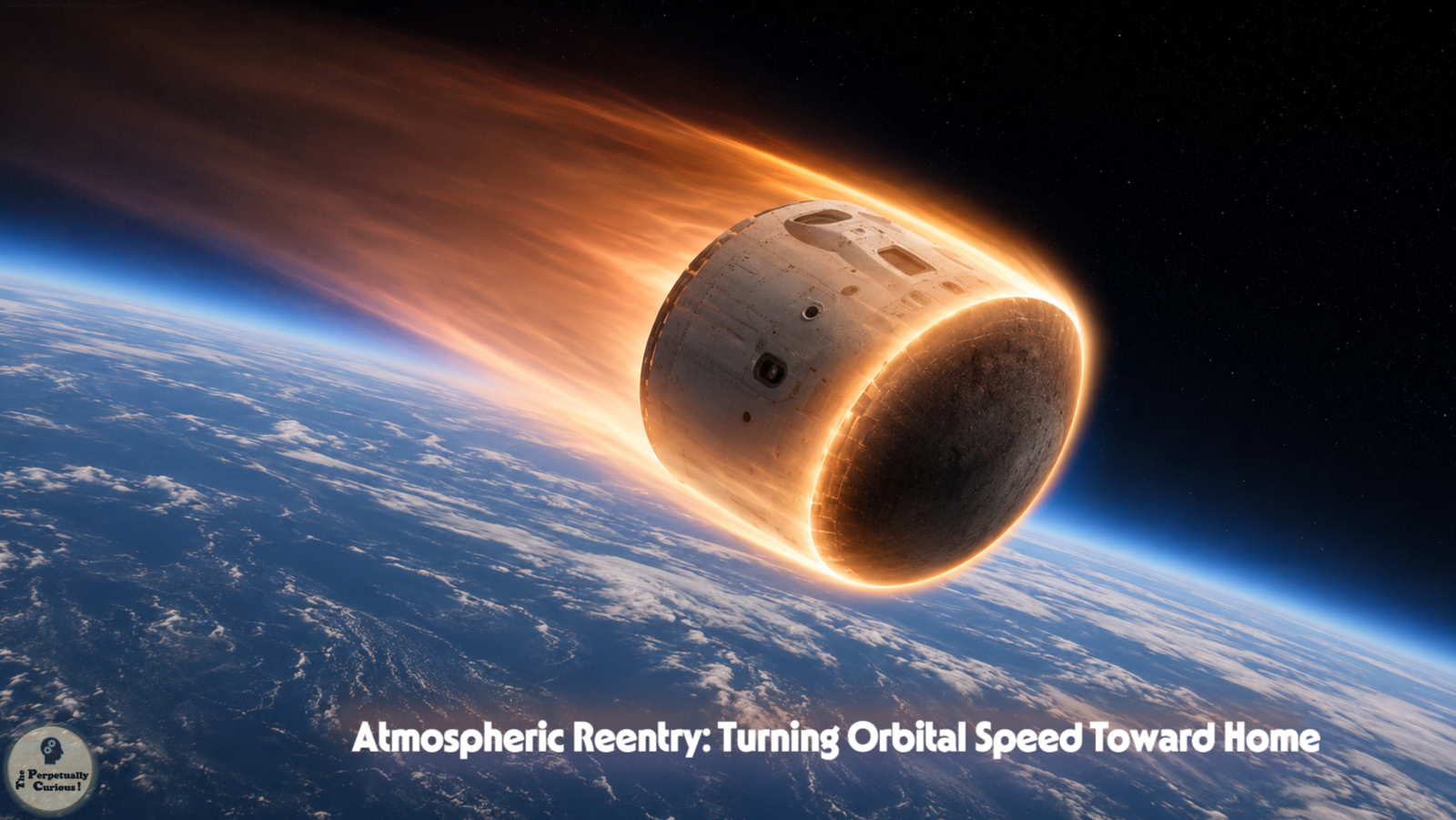
The sky receives the returning craft with patient light.
Heat fades, and the long arc of its journey settles into calm air.
The world waits below, steady and familiar, ready to welcome it home.
🚀 Leaving Earth and rising through thinning air
Every reentry story begins with an ascent. During launch, a spacecraft must first pass through the dense lower atmosphere, where aerodynamic pressure, vibration, and structural loads can become significant. The trajectory and engine thrust are managed so that the vehicle continues accelerating while remaining within safe limits. Although atmospheric density decreases steadily with altitude, aerodynamic loading does not simply decline from liftoff. As speed rises, dynamic pressure first builds toward a maximum, commonly called Max Q, and then falls once the thinning air becomes the dominant influence.
The spacecraft continues through the troposphere, stratosphere, mesosphere, and thermosphere. These layers are distinguished by their temperature structure, but the vehicle does not encounter them as sharply separated shells. Instead, it experiences a continuous decline in atmospheric density as the surrounding air becomes increasingly sparse.
At about 62 miles (100 kilometers), the Kármán line is commonly used as a practical boundary between atmosphere and space. It is not a physical edge. Gas continues far above this altitude, becoming progressively thinner rather than disappearing. Aerodynamic resistance becomes dramatically weaker, yet residual drag still acts on spacecraft in low Earth orbit and can gradually lower the paths of satellites and orbital debris over time.
This gradual transition matters because the atmosphere never releases the spacecraft at one precise height. During ascent, its influence fades rather than vanishes. During return, the same tenuous gas becomes consequential again when encountered at orbital speed. By the end of the climb, the spacecraft is no longer pushing through dense air, but it remains within Earth’s gravity and the outermost traces of its atmosphere. It has entered orbit carrying the immense kinetic energy that must later be redirected through a deliberate journey home.
🌍 Orbit and the energy that must be surrendered
Once in low Earth orbit, a spacecraft typically travels at about 17,500 miles per hour (7.8 kilometers per second). At this speed, it is continuously falling around Earth while moving forward fast enough to follow the planet’s curvature. The atmosphere at these altitudes is extremely thin, so the vehicle may complete many orbits before residual drag produces a substantial change in its path.
A controlled return begins with a relatively small but decisive maneuver. The spacecraft performs a retrograde deorbit burn, firing opposite its direction of travel and reducing its orbital speed enough to lower part of its trajectory into denser atmospheric regions. The burn does not remove most of the spacecraft’s kinetic energy. Instead, it places the vehicle on a path where the atmosphere can perform the much larger task of deceleration.
As the spacecraft encounters increasing amounts of air, drag and the formation of a powerful shock layer transfer most of its organized motion into internal energy and movement within the surrounding gas and wake. Smaller portions propagate as sound and radiation. Only a limited but still severe fraction reaches the spacecraft, which is why its shape, trajectory, and thermal protection system must be carefully designed.
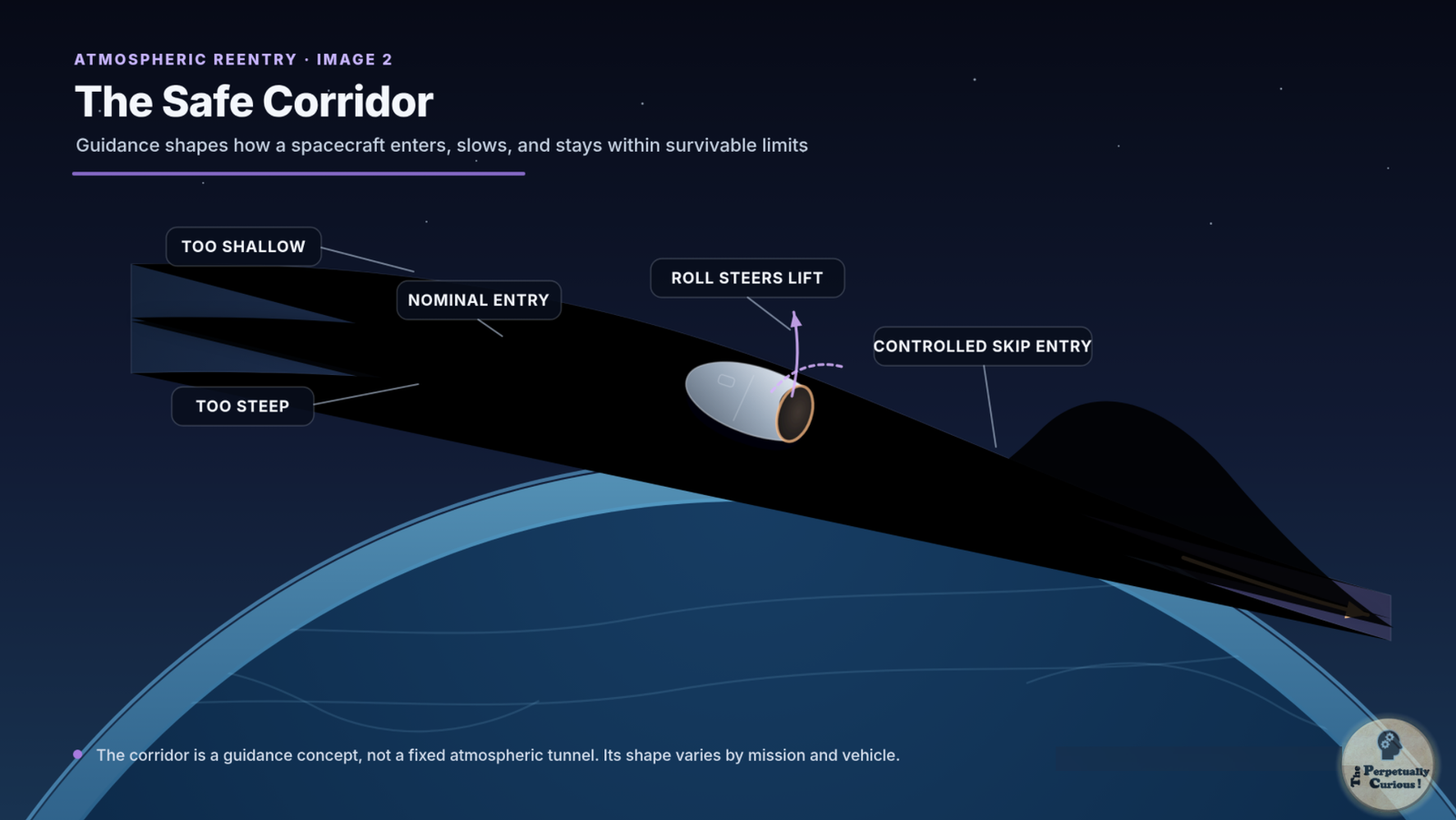
The entry path must remain within a safe corridor. A trajectory that is too steep can produce excessive heating, deceleration, and structural loads, while one that is too shallow may not provide enough braking or may carry the spacecraft temporarily back toward thinner air. Some missions deliberately use a controlled skip entry, but doing so requires precise guidance. Orbit therefore gives way not to a simple fall, but to a carefully timed transition from orbital motion to atmospheric energy management.
🔥 Meeting the thin air and the beginning of reentry
Reentry is often referenced from an entry-interface altitude of roughly 62 to 75 miles (100 to 120 kilometers), although the exact convention varies by mission and vehicle. The atmosphere remains extremely thin at these heights, but the spacecraft is moving so quickly that even sparse gas begins to exert measurable aerodynamic force. As the vehicle descends into denser air, atmospheric braking strengthens rapidly.
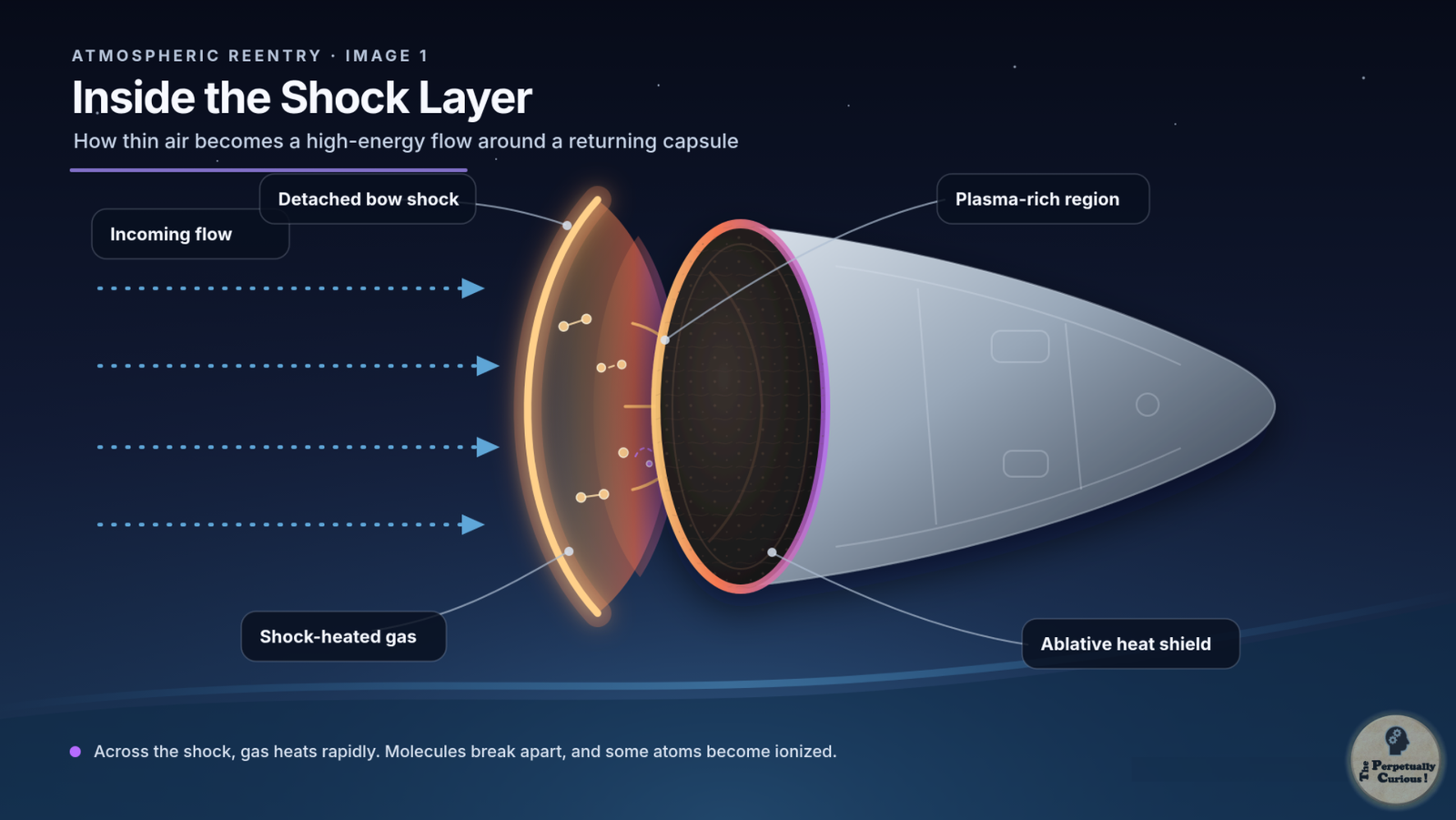
At hypersonic speed, the gas ahead of the spacecraft cannot adjust smoothly to the approaching vehicle. A detached bow shock forms, and the air passing through it is abruptly slowed, compressed, and heated. This shock-driven process converts part of the spacecraft’s organized motion into internal energy within the surrounding gas. Heat then reaches the vehicle mainly through convection from the energetic flow and, under sufficiently intense entry conditions, radiation from the shock layer. Surface friction and other viscous effects also contribute, but they do not by themselves explain the extreme thermal environment.
In the hottest regions, shock-layer gas temperatures can exceed about 5,000°F (2,800°C) and may rise considerably higher during especially energetic lunar or interplanetary returns. These gas temperatures are not the same as the temperature of the heat shield itself or the rate at which heat reaches its surface. The energy first excites and breaks apart nitrogen and oxygen molecules, and at still higher energies some atoms become ionized. The result is a chemically reacting, partially ionized flow that may develop into a plasma-rich sheath around parts of the spacecraft.
The first meaningful encounter with the upper atmosphere therefore marks more than the return of drag. It begins a rapid transformation of the surrounding air, creating the shock layer, high-temperature chemistry, and plasma conditions that shape the next phase of descent.
📡 Plasma, shock waves, and the quiet of blackout
As the shock-heated gas becomes partially ionized, a plasma-rich sheath can develop around parts of the spacecraft. This environment is neither uniform nor identical from one mission to another. Its density and shape depend on entry speed, vehicle geometry, atmospheric conditions, and the chemistry of the surrounding flow.
The charged particles can disrupt communication between the spacecraft and the ground. Radio signals may be absorbed, refracted, or reflected, especially when the local electron density becomes high enough to prevent certain frequencies from propagating through parts of the sheath. The effect depends on signal frequency, electron density, geometry, and mission design. Some spacecraft experience a complete blackout, while others encounter partial degradation or intermittent communication. During any loss of contact, onboard guidance, navigation, and control systems continue operating through preprogrammed logic and data from onboard sensors.
The plasma-rich sheath develops within the same bow-shock system that creates the severe entry environment. The detached shock stands ahead of the spacecraft, while the layer between the shock and the surface contains rapidly changing pressure, temperature, density, and chemical composition. Vehicle shape influences the shock’s distance from the surface and the distribution of heating, while the thermal protection system limits how much energy reaches the underlying structure.
Communication blackout is therefore not a separate event, but one expression of the larger aerothermodynamic transition. After the most intense portion of entry, continued deceleration and declining shock-layer temperatures generally reduce ionization and improve communication conditions. Meanwhile, aerodynamic forces provide the guidance system with greater control authority than during the earliest, thinnest portion of entry.
🧭 Guidance, control, and the choreography of descent
Even when communication is interrupted, reentry is not a passive fall. It is a guided passage through forces that change rapidly with speed, altitude, atmospheric density, and vehicle orientation. Before aerodynamic control becomes strong, small thrusters may help establish or maintain the spacecraft’s attitude. As the surrounding air grows denser, the vehicle increasingly relies on lift, drag, and controlled rotation to shape its path.
Many capsules are designed with an offset center of gravity that causes them to meet the airflow at a slight angle and generate modest lift. By rolling the capsule, guidance systems rotate the direction of that lift, allowing the vehicle to adjust its range, manage deceleration, and remain within the intended entry corridor. Winged vehicles such as the Space Shuttle generate substantially more lift and use aerodynamic control surfaces and banking turns to achieve greater control over range and direction.
The safe entry corridor is constrained by several competing demands. A path that is too steep can increase heating, deceleration, and structural loads, while one that is too shallow may not provide enough braking during the intended atmospheric pass or may carry the vehicle back toward thinner air. Some missions deliberately use a controlled skip entry, briefly rising after an initial atmospheric encounter before descending again. In those cases, the upward motion is part of the planned guidance strategy rather than a loss of control.
Deceleration is not only a question of how much speed must be lost, but also how quickly that loss occurs. A rapid slowdown concentrates deceleration loads into a shorter interval, placing greater stress on the spacecraft and its occupants. Lift, banking, and carefully designed entry paths can distribute the loss of speed across more time and distance, helping the vehicle surrender its energy without imposing one extreme deceleration event.
Onboard systems compare the planned trajectory with measurements and navigation estimates of acceleration, orientation, velocity, and position. Guidance commands are then adjusted as conditions unfold. The spacecraft does not follow a perfectly fixed path through an unchanging atmosphere. It continually responds to the forces it encounters, using the air not only to slow down, but also to shape the route home.
🌬️ How changing air reshapes the descent
The guidance system can shape the path only by responding to an atmosphere whose forces change continuously with density and speed. Dynamic pressure depends on atmospheric density and the square of the spacecraft’s velocity. It generally rises as the vehicle encounters denser air, reaches a maximum, and then declines as continued deceleration reduces speed. Peak heating, peak deceleration, and peak dynamic pressure therefore do not necessarily occur at the same moment.
Named atmospheric layers provide useful altitudinal context, but they do not perform fixed reentry roles. Plasma formation, maximum heating, structural loading, communications disruption, and aerodynamic control occur at different heights for different missions. Their timing depends on entry speed, trajectory, vehicle shape, mass, lift, and changing atmospheric conditions.
As the spacecraft descends, the surrounding flow evolves continuously. Sparse upper-atmospheric gas first becomes strong enough to produce shocks and heating. Denser air then strengthens aerodynamic forces, but continued loss of speed eventually causes those forces and the extreme thermal environment to weaken. Guidance systems and thermal protection must therefore respond to a changing sequence of heat flux, pressure, chemistry, and structural load rather than to a simple passage through predetermined atmospheric zones.
The atmosphere presents every spacecraft with a changing environment, but the vehicle’s own mass, size, and shape help determine where and how strongly that environment slows it. Those differences lead to an important design question: why do some spacecraft begin slowing higher in the atmosphere while others descend much deeper?
⚖️ Why some spacecraft slow higher while others descend deeper
Not every spacecraft responds to the atmosphere in the same way. Engineers describe much of this difference through a property called ballistic coefficient, which compares a vehicle’s mass with its drag-producing area and aerodynamic shape. All else being comparable, a vehicle with a lower ballistic coefficient experiences greater deceleration under the same atmospheric conditions and tends to lose speed higher in the atmosphere. A vehicle with a higher ballistic coefficient can penetrate deeper before undergoing similar deceleration.
This difference shapes much of the return. It influences where heating and aerodynamic loads build, how rapidly orbital energy is lost, and how much altitude remains for parachutes, gliding flight, or other landing systems. Slowing in thinner air can reduce the peak heat rate, but it does not automatically reduce total heat exposure, which also depends on the duration and full path of the descent.
A broad heat shield can therefore serve two connected purposes: protecting the spacecraft from incoming heat and presenting a large area to the airflow for effective braking. Engineers must balance these advantages against structural mass, stability, guidance authority, landing accuracy, and mission requirements. The atmosphere responds to the vehicle as a whole, including its mass, shape, orientation, speed, and trajectory. Those same design choices determine not only where the spacecraft slows, but also how it must survive the heat along the way.
🛡️ Heat shields and the art of surviving fire
The heating pattern shaped by a spacecraft’s trajectory and design determines the protection it needs. Reentry vehicles rely on thermal protection systems to limit how much energy reaches their structures, equipment, and occupants. These systems do not prevent the surrounding gas from becoming extremely hot. Instead, they control heat transfer into the spacecraft and keep internal temperatures within safe limits throughout the changing conditions of descent.
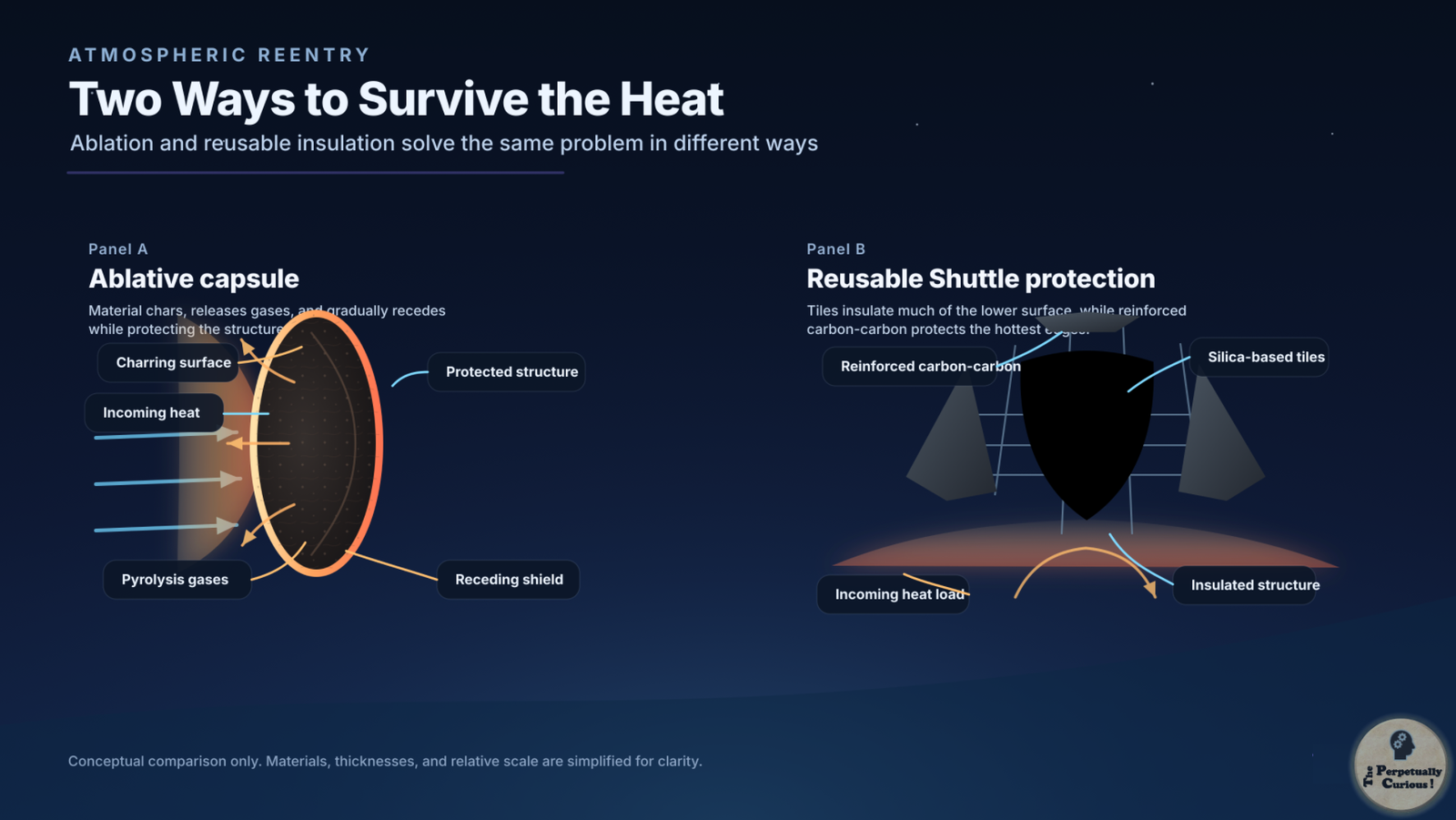
Ablative heat shields protect the vehicle by allowing specially designed surface materials to transform as they are heated. The material may char, decompose through pyrolysis, release gases, and gradually recede. These processes absorb and carry away energy, while the remaining char layer and outward-flowing gases can provide additional protection to the material beneath. Apollo capsules used ablative shielding, and several modern crewed and robotic vehicles continue to use related systems for severe entry environments.
Reusable thermal protection systems manage heat differently. On the Space Shuttle, lightweight silica-based tiles insulated much of the orbiter by conducting heat very slowly toward the underlying structure. Areas exposed to the most intense heating, including the nose cap and wing leading edges, used reinforced carbon-carbon components capable of enduring much higher surface temperatures. Other regions used materials selected for their particular combinations of temperature, pressure, and mechanical stress.
Engineers evaluate thermal protection systems through computational modeling, laboratory material testing, high-temperature ground facilities, and flight data. They examine not only peak temperature, but also heat flux, exposure time, surface chemistry, material recession, structural loads, and the possibility of local damage. The objective is not to eliminate reentry heating, which cannot be done, but to manage the limited yet severe fraction of energy that reaches the vehicle.
Ablation and reusable insulation therefore represent different solutions to the same problem. One approach deliberately transforms or consumes protective material, while the other slows the passage of heat through carefully arranged surfaces. Some spacecraft combine several methods across different regions. The Space Shuttle provides a vivid example of how vehicle shape and a distributed thermal protection system worked together during repeated returns through the atmosphere.
🛰️ The Space Shuttle and the craft of controlled descent
The Space Shuttle shows how vehicle shape, guidance, and thermal protection can function as one integrated reentry system. Unlike a capsule, which generates only modest lift, the Shuttle orbiter was a winged reentry vehicle capable of producing substantial aerodynamic lift. This gave its guidance system greater control over range, direction, and energy loss, ultimately allowing the vehicle to reach a runway without propulsion.
The orbiter entered the upper atmosphere at roughly Mach 25. Its nose cap and wing leading edges encountered some of the most severe heating and were protected by reinforced carbon-carbon. Lightweight silica-based tiles insulated much of the lower surface, while other regions used materials selected for their expected combinations of temperature, pressure, and mechanical stress.
During the hypersonic phase, the Shuttle performed a sequence of banking reversals. Banking rotated the direction of lift, allowing the guidance system to control cross-range, regulate descent and deceleration, and manage the orbiter’s remaining energy. These turns also influenced how long different regions of the vehicle remained within particular heating conditions, but their purpose extended well beyond distributing heat across the surface.
The entry profile balanced several competing limits. The atmosphere had to provide effective braking while heating, dynamic pressure, and structural loads remained within the orbiter’s design envelope. As speed decreased, the Shuttle transitioned from hypersonic entry toward increasingly familiar aerodynamic flight, converting its remaining altitude and velocity into the controlled approach needed to reach the runway. Because it was an unpowered glider, it could not perform a powered go-around once committed to landing.
🪂 From fiery descent to controlled landing
After the most intense phase of entry, continued deceleration weakens the bow shock and reduces ionization in the surrounding gas. Heating subsides, although the altitude and timing vary with entry speed, trajectory, vehicle shape, and atmospheric conditions. Radio communication generally improves as the plasma-rich sheath dissipates, while the airflow transitions from the hypersonic regime toward increasingly familiar supersonic and subsonic conditions.
Capsules continue slowing through aerodynamic drag before deploying recovery systems suited to their design. Some use drogue parachutes for stabilization and initial deceleration before larger main parachutes open. The final descent may end in an ocean splashdown or a landing on solid ground, sometimes aided by cushioning systems, retrorockets, or other braking methods. Deployment sequences and altitudes differ among vehicles, so no single recovery profile applies to every mission.
Winged vehicles use their remaining energy differently. They convert altitude and speed into gliding range, controlling their approach until aerodynamic flight leads to a runway. Although the severe heating phase has passed, the final descent still demands precise management of direction, speed, and remaining energy.
By this stage, the atmosphere has changed from an extreme hypersonic environment into the familiar air that supports parachutes, wings, and controlled descent. The spacecraft has surrendered most of the speed that once sustained its orbit, leaving a final question at the center of the journey: where did that immense energy go?
🌐 Where the orbital energy goes
Atmospheric reentry is fundamentally an exercise in energy transformation. The spacecraft begins its return carrying immense kinetic energy in its orbital motion, and most of that energy is transferred to the surrounding atmosphere as the vehicle slows. It becomes internal energy and large-scale motion within the shock layer, turbulent wake, and displaced air, while smaller portions propagate as sound and radiation. A much smaller fraction reaches the spacecraft, but even that fraction creates an extreme thermal challenge.
The thermal protection system manages this incoming energy by insulating the structure, reradiating heat, absorbing energy, or carrying it away through controlled material changes. At the same time, aerodynamic drag continues transferring organized kinetic energy into atmospheric heating and motion until the vehicle is slow enough for parachutes, wings, or other landing systems to complete the return.
This energy pathway connects the full journey. Launch builds speed, orbit preserves it, the deorbit maneuver redirects the trajectory, and the atmosphere removes most of the remaining motion before landing. Reentry is therefore not a simple exchange of speed for fire, but a carefully controlled redistribution of energy among spacecraft, air, and protective materials. That controlled surrender of motion is what allows descent to become a homecoming.
🌎 Returning through fire
That carefully managed surrender of motion carries meaning beyond engineering. A spacecraft descending as a bright streak has crossed from orbital flight into the denser air of Earth, surviving a passage in which speed, heat, guidance, and protective materials must remain carefully balanced. For crews and observers, the glow can become a visible sign that exploration is becoming return.
Spacecraft designs, guidance strategies, and landing systems differ across missions and nations, but vehicles returning through Earth’s atmosphere share the same physical dependence. The same living atmosphere that sustains weather and life also removes most of the energy carried in orbital motion. The air that launch must overcome becomes the medium that makes landing possible.
That symmetry completes the journey. A spacecraft leaves Earth by climbing through the atmosphere and comes home by meeting it again at immense speed. Reentry turns the gradual transition between sky and space into a place of both danger and welcome, where fire is not the end of exploration but a sign that home is drawing near. Beneath that visible drama are several counterintuitive details that reveal how delicately the return is controlled.
Pass this article along to someone curious and let the learning travel.
💡 Did You Know
🛡️ Blunt shapes can reduce heat transfer
A blunt spacecraft holds its bow shock farther from the surface, creating a thicker shock layer. Under comparable entry conditions, this separation can reduce the rate at which heat reaches the vehicle relative to a sharper leading shape.
🌙 Lunar returns face more severe heating
A spacecraft returning from the Moon approaches Earth at about 25,000 miles per hour (11 kilometers per second), faster than a typical return from low Earth orbit. Because kinetic energy increases with the square of velocity, that additional speed creates a substantially greater thermal protection challenge.
🔥 Lower peak heat rate can still mean greater total heat exposure
A shallower entry path may spread heating across a longer interval, reducing the highest instantaneous heat rate while increasing the total energy absorbed over time. Engineers must therefore consider both heating intensity and duration.
↗️ A skip entry is not a literal bounce
During a controlled skip entry, aerodynamic lift curves the spacecraft’s path upward after its initial atmospheric pass. The vehicle does not strike or rebound from a solid boundary because the atmosphere has no sharp surface.
🔊 Reentry can produce sonic booms along parts of the ground track
A spacecraft that remains supersonic during the later stages of descent continues generating shock waves. These pressure disturbances may reach observers on the ground, sometimes after the brightest visible glow has already faded.
Together, these details show that reentry depends not only on peak conditions, but also on duration, trajectory, vehicle design, and the way energy is distributed through the atmosphere.
Several practical questions remain, beginning with how a spacecraft leaves orbit and how engineers keep its return within survivable limits.
What is atmospheric reentry in simple terms?
Atmospheric reentry is the passage of a spacecraft into denser regions of an atmosphere at high speed. During return to Earth, aerodynamic forces slow the vehicle while guidance and thermal protection systems keep heating, deceleration, and structural loads within survivable limits.
What starts a spacecraft’s return from orbit?
A controlled return usually begins with a retrograde deorbit burn. The spacecraft briefly fires its engines or thrusters opposite its direction of travel, reducing its orbital speed enough to lower part of its path into denser atmosphere. The maneuver does not slow the spacecraft for landing by itself. It places the vehicle where atmospheric braking can begin.
Where does atmospheric reentry begin?
There is no single physical boundary where reentry suddenly starts. Missions often define an entry interface at roughly 62 to 75 miles (100 to 120 kilometers), depending on the vehicle and trajectory. The Kármán line at 62 miles (100 kilometers) is a widely used conventional boundary between atmosphere and space, not a sharp atmospheric edge.
Where does the spacecraft’s orbital energy go?
Most of the kinetic energy lost during reentry is transferred to the surrounding atmosphere. It becomes internal energy and motion within the shock layer, turbulent wake, and displaced air, while smaller portions propagate as sound and radiation. A much smaller but still severe fraction reaches the spacecraft and must be managed by its thermal protection system.
Why does a spacecraft become so hot during reentry?
At hypersonic speed, a detached bow shock forms ahead of the spacecraft. Gas passing through the shock is abruptly slowed, compressed, and heated. Energy then reaches the vehicle mainly through convection from the energetic flow, while radiative heating can become important during faster lunar or interplanetary returns. Surface friction and other viscous effects contribute, but they do not fully explain the extreme thermal environment.
What is a plasma sheath, and why does it matter?
A plasma sheath is a region of partially ionized gas that can develop around parts of a spacecraft when shock-layer temperatures become high enough to remove electrons from some atoms. The charged particles may weaken, redirect, or block certain radio signals. Whether a complete blackout occurs depends on electron density, signal frequency, spacecraft geometry, and mission design.
How do heat shields protect spacecraft?
Ablative shields char, decompose, release gases, and gradually recede, absorbing or carrying away energy in the process. Reusable systems use insulating materials that slow the passage of heat into the structure. Many spacecraft combine several protective materials because heating varies across the vehicle.
Why do many meteoroids burn up while spacecraft survive reentry?
Both meteoroids and spacecraft encounter severe heating when they enter the atmosphere at high speed. Many meteoroids are small and lack engineered thermal protection. Depending on their size, composition, internal strength, speed, and entry angle, they may ablate, fragment, or vaporize as they slow. Some larger or more durable pieces survive and reach the ground as meteorites. Spacecraft are deliberately shaped, oriented, guided, and protected to manage the same underlying forces.
Can engineers predict the exact reentry path?
Engineers can predict and constrain a reentry trajectory with great precision, but they cannot know every condition perfectly in advance. Atmospheric density, winds, navigation uncertainty, and small differences in aerodynamic behavior can shift the path. Guidance systems use onboard measurements to update commands during flight, while landing regions include margins for the remaining uncertainty. Reentry is therefore carefully controlled, but not mechanically predetermined.
Why do spacecraft glow during reentry?
The visible glow comes mainly from hot, chemically reacting gas in the shock layer and wake. Excited atoms and molecules emit light as their energy states change. The spacecraft’s surface may also radiate visibly when it becomes sufficiently hot, while ablative materials can add glowing particles and gases to the trail.
How do engineers predict reentry heating and loads?
Engineers combine computational fluid dynamics, high-temperature material models, arc-jet and plasma-wind-tunnel testing, structural analysis, and flight data. These methods estimate heat flux, pressure, chemical reactions, material recession, and mechanical loads across the vehicle. Because no model reproduces every aspect perfectly, designs incorporate testing, uncertainty analysis, and safety margins.
🌱 Letting the journey through fire and air travel on
If this exploration of atmospheric reentry has deepened your curiosity, please consider sharing it with friends, colleagues, or other curious minds. A shared article can carry the story farther, inviting more readers to see Earth’s atmosphere not simply as the air above us, but as the remarkable medium through which spacecraft surrender speed, shape their descent, and find their way home.
“When Fire Meets Air: How Spacecraft Reenter Earth’s Atmosphere.” The Perpetually Curious!, July 2026.
https://www.theperpetuallycurious.org/articles/atmospheric-reentry/Continue Exploring
For the curious mind: want to explore this theme through a few questions? Visit the Classic Quiz Studio, nestled under Explorations opens in a new tab ,and see where a few well-placed questions lead: Cosmic Exploration Quizzesopens in a new tab
For what comes next
Site Updates gathers occasional notes, new additions, and ways to keep in touch. RSS brings new publications to your feed reader in chronological order.
Choose the path that speaks to you, and let the next curiosity find you wherever your wondering takes you.