

Space appears to hold a quiet paradox. Countless stars blaze at temperatures far beyond ordinary experience, yet the immense regions between them are often described as profoundly cold. The contrast becomes clearer once temperature is separated from the everyday sensation of cold air. A vacuum is not a frigid substance pressing against an object, and starlight passing through emptiness does not give that emptiness a shared ambient warmth.
Temperature does not belong to empty space as a single universal property. It can characterize particle populations and physical objects, while certain radiation fields can also be described by temperature. Within the same region of space, these systems may occupy very different thermal states because each receives, stores, generates, transfers, and releases energy differently. What appears to be one cold environment is therefore a mosaic of overlapping energy balances.
Resolving the paradox begins with what temperature measures and how heat moves when air is absent. From there, the explanation follows energy through radiation and radiative equilibrium, encounters the faint relic glow of the cosmic microwave background, and returns to the contrasting thermal environments near stars, planets, spacecraft, and human bodies. The first question, then, is what temperature means when there may be almost no matter present.
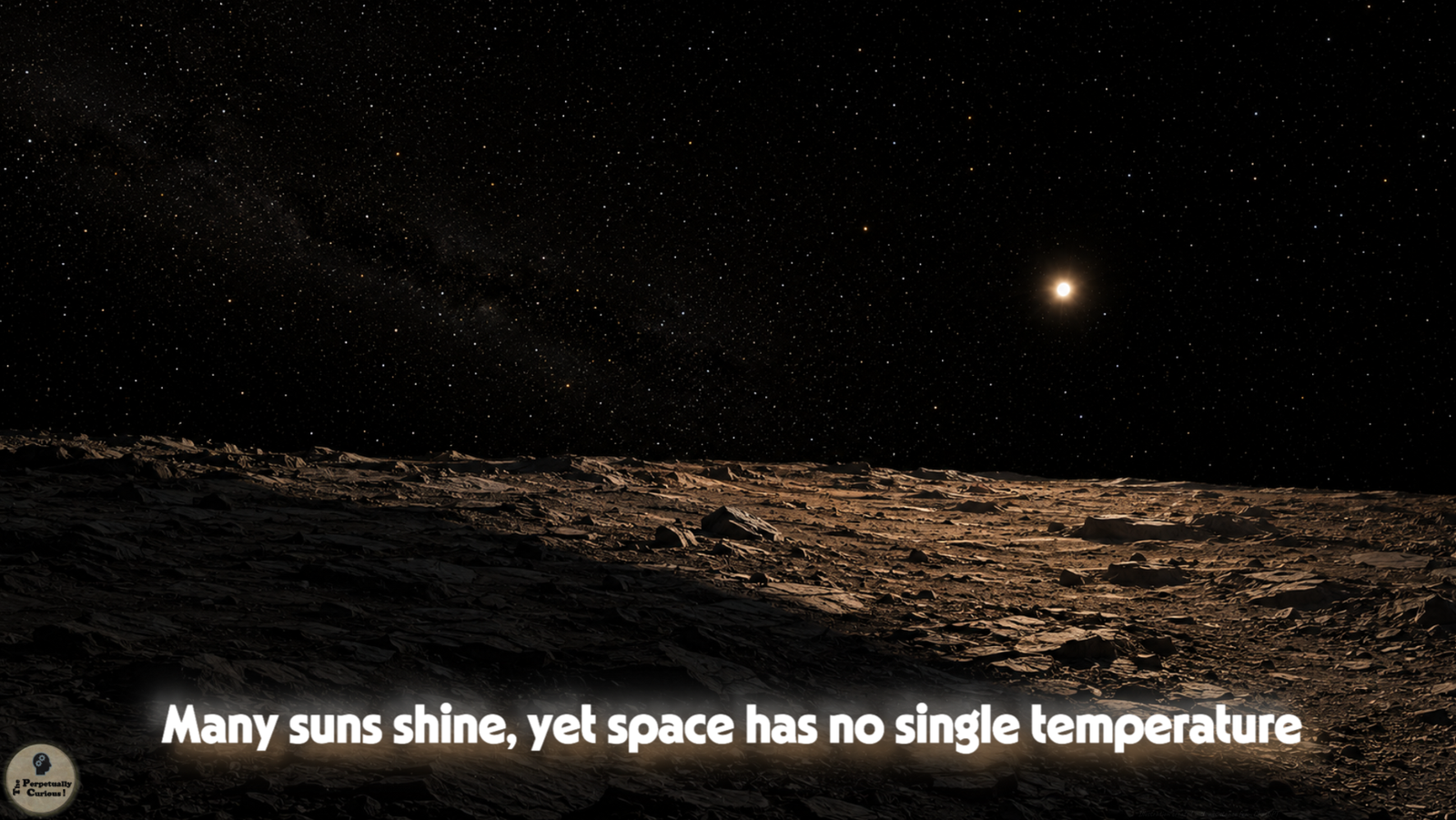
A stillness lives between the stars, shaped not by coldness but by the patient drift of light.
In that wide and quiet distance, warmth becomes a conversation of radiance and time.
Space holds its silence gently, letting every object find its own way of being warm.
🌡 What temperature really means in the cosmos
Temperature is often imagined as a thermometer reading or the sensation of warmth on a summer day. In physics, however, it is a property of a system’s thermal state. When systems in thermal equilibrium can exchange energy, temperature helps determine the direction in which energy flows as heat. It is related to how energy is distributed among the microscopic ways a system can move, vibrate, rotate, or otherwise respond.
For a monatomic ideal gas in thermal equilibrium, temperature is directly related to the average translational kinetic energy of its particles. A higher temperature means greater average kinetic energy, although individual particles still move across a range of speeds. This familiar relationship is important, but it is not a universal definition of temperature. Molecules can also store energy through rotation and vibration, solids through collective atomic vibrations and other excitations, and a thermal radiation field can possess a temperature even though it is not matter.
Temperature is also not the same as the total thermal energy contained in a system or the amount of heat it can readily transfer. A small population of highly energetic particles may have a high kinetic temperature while carrying little energy per unit volume. A much larger or denser system at a lower temperature may contain far more thermal energy overall. This distinction becomes essential in space, where particles can be extremely energetic yet too sparse to heat an object efficiently through collisions.
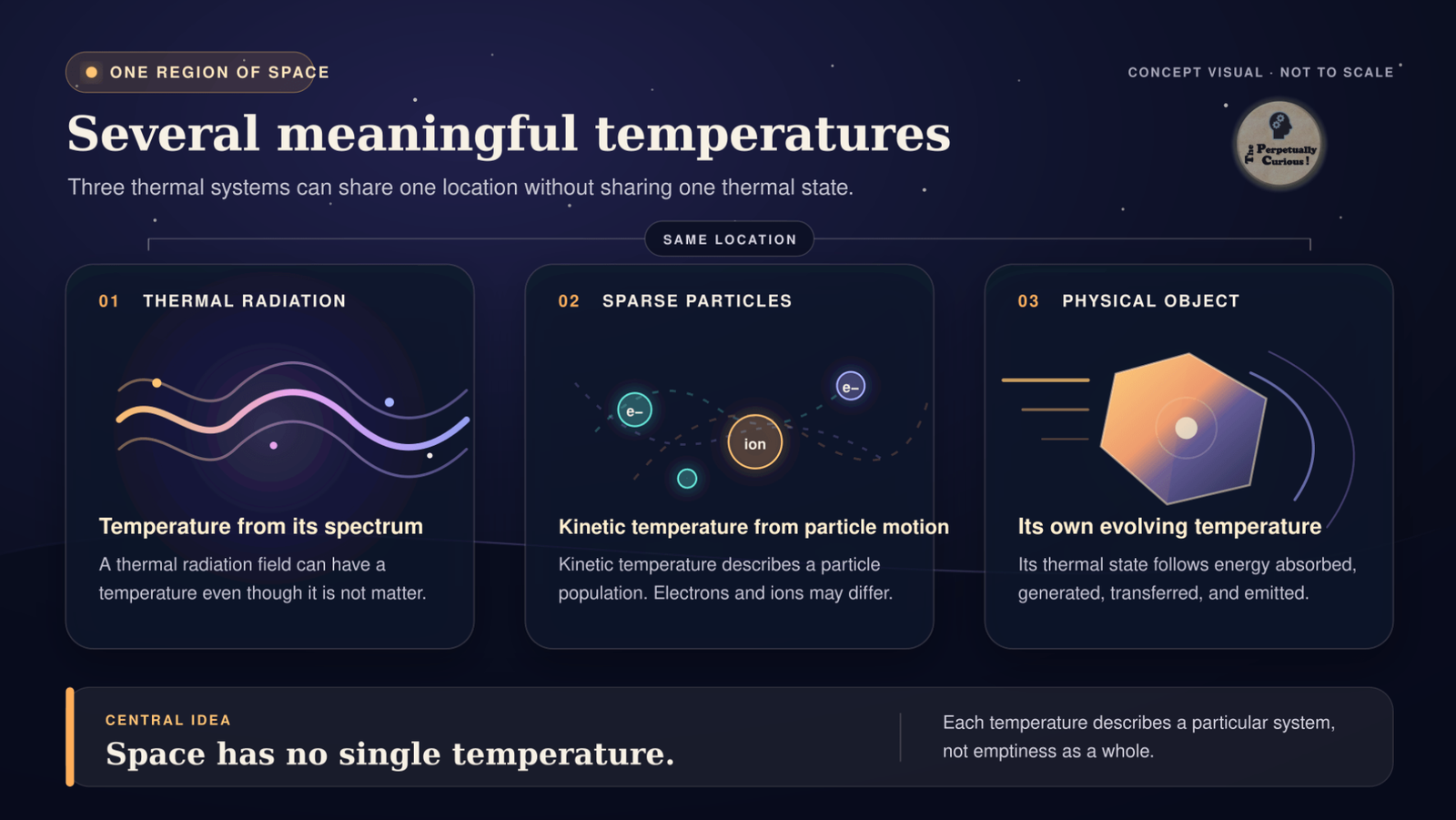
Space therefore has no single ambient temperature. At the same location, a sparse particle population may have one characteristic temperature, a surrounding radiation field another, and a physical object such as a thermometer, dust grain, or spacecraft yet another. These temperatures describe distinct systems that may not be in thermal equilibrium with one another.
A thermometer placed in a vacuum does not stop having a temperature, nor does it directly measure a universal “temperature of space.” It measures its own evolving thermal state. It can absorb and emit radiation, receive energy by conduction through physical supports, generate heat internally, and undergo occasional collisions with surrounding particles. If its energy gains and losses eventually balance, its reading may settle toward an equilibrium value determined by those exchanges.
What changes in interplanetary and interstellar space is not the existence of temperature, but the rate and pathways through which energy can be exchanged. To understand why highly energetic particles may still provide little heating, we must look next at the sparse matter occupying what we call the vacuum of space.
🌌 The vacuum of space and the scarcity of particles
Space is often described as a vacuum, but a vacuum is a region of extremely low matter density, not necessarily perfect emptiness. Under typical near-surface conditions, Earth’s atmosphere contains roughly 410 quintillion molecules per cubic inch (2.5 × 10¹⁹ per cubic centimeter). Across the Milky Way, the interstellar medium averages about 16 atoms per cubic inch (about one atom per cubic centimeter), although dense clouds and rarefied cavities can differ from that figure by many orders of magnitude. In the thin expanses between galaxies, the density may fall to roughly one particle per 35 cubic feet (about one particle per cubic meter). These are broad reference values because matter is distributed very unevenly throughout the cosmos.
As density falls, particles can travel increasingly great distances before undergoing direct collisions. The gas then ceases to behave like the continuous air familiar near Earth’s surface. A particle population may still possess a characteristic kinetic temperature derived from the distribution of its energies, but collisions may occur too rarely for local thermal equilibrium to develop. Electrons, ions, and neutral atoms can consequently retain different characteristic temperatures, while some nonthermal populations cannot be described completely by any single temperature.
Rare collisions do not mean that particles cease interacting. In collision-poor plasmas such as the solar wind, electric and magnetic fields can organize particle motion and transfer energy collectively. What becomes inefficient is the continual collisional mixing that helps ordinary atmospheric gases settle toward a shared thermal state.
Scarcity also limits how readily particles can change the temperature of a solid object. Even when individual particles carry considerable energy, too few may strike a surface to deliver substantial thermal power. Particle temperature alone therefore does not determine the temperature of a spacecraft, dust grain, or astronaut. At the same time, limited bulk heating does not make energetic particles harmless. Individual impacts can ionize matter or damage materials and biological tissue without creating the familiar sensation of hot air.
A vacuum therefore changes which pathways of energy exchange remain effective. To understand how an object warms or cools when matter is sparse, we must next distinguish among conduction, convection, and radiation.
🔥 How heat moves: conduction, convection, and radiation
In ordinary terrestrial environments, energy is transferred as heat through three principal mechanisms: conduction, convection, and radiation. Conduction transfers energy through microscopic interactions within matter, including vibrations and collisions among atoms or molecules and the movement of mobile electrons in materials such as metals. Convection transports energy through the bulk motion of a fluid. Under gravity, buoyancy can cause warmer, less dense fluid to rise while cooler, denser fluid sinks, creating natural convection. Radiation transfers energy through electromagnetic waves, including visible light and infrared radiation, and requires no material medium.
Across the open vacuum between separated objects, ordinary gas conduction is generally negligible. Convection also cannot transport heat across the gap when no continuous fluid connects the objects. Radiation, however, can cross the intervening emptiness.
Conduction and convection do not disappear simply because a system is in space. Conduction continues through a spacecraft’s structure, instruments, thermal straps, and other physically connected materials. Inside a pressurized cabin or fluid-cooling system, moving air or liquid can also transport heat. Microgravity greatly suppresses ordinary buoyancy-driven convection, but fans and pumps can maintain forced circulation and convective heat transfer.
Radiation provides the principal route of thermal exchange between a spacecraft and its external environment. A spacecraft near Earth may absorb direct sunlight, sunlight reflected by the planet, and infrared radiation emitted by Earth while releasing infrared radiation of its own. Radiation is therefore a two-way exchange whose net effect depends on direction, geometry, surface properties, and time, not merely on whether a bright source is present.
Radiation passing through a vacuum does not make the surrounding emptiness behave like warm air. Whether an object warms or cools depends on how much energy it absorbs or generates compared with how much it releases. The darkness of space tells us what visible light reaches the eye, not how much radiant energy crosses a region or what temperature a particular object will acquire.
Radiation can therefore cross the empty gap between separated objects, but the presence of radiation alone does not determine an object’s temperature. The next step is to examine what happens when that radiation meets matter.
☀️ Radiation, absorption, and why darkness does not mean cold
Radiation can cross a vacuum without first warming the intervening space as though it were air. Photons carry discrete amounts of energy, and when matter absorbs them, that energy enters the absorbing system. Depending on the photon’s energy and the material involved, absorption may excite electrons, increase molecular rotation or vibration, ionize atoms or molecules, or drive other physical and chemical changes. As the absorbed energy is redistributed through microscopic motions and interactions, some of it can contribute to thermal energy and raise the material’s temperature. Energy may also be stored in other forms or later re-emitted as radiation.
Sunlight reaching Earth illustrates this process. Some incoming radiation is reflected or scattered back toward space, some is absorbed by the atmosphere and clouds, and some reaches the land and oceans, where further absorption occurs. The absorbed portion adds energy to the Earth system. The same principle applies to the Moon, a dust grain, or the surface of a spacecraft, although the amount absorbed depends on composition, orientation, geometry, and wavelength-dependent surface properties.
Absorption is only one side of the exchange. Matter also emits thermal radiation. At temperatures familiar on planets and spacecraft, much of this emission lies at infrared wavelengths. Hotter bodies emit more energy per unit area and shift the peak of their thermal emission toward shorter wavelengths. Because incoming sunlight and outgoing thermal radiation occupy different wavelength ranges, a surface may interact with them quite differently. Visible appearance alone therefore cannot reveal how effectively a material absorbs sunlight or emits infrared radiation.
The vacuum does not deliver cold as though cold were a substance. An object tends to warm when the rate at which it absorbs or generates energy exceeds the rate at which it loses energy. It tends to cool when its losses exceed its gains.
A dark sky is therefore an optical condition, not a temperature reading. A surface in direct sunlight can reach a high temperature while the sky behind it remains visually dark. The reasons why space looks dark concern how visible light reaches an observer, not whether a nearby object is absorbing enough radiant energy to become warm.
A radiation field can occupy an otherwise nearly empty region and carry energy distributed across a range of wavelengths. If that field has a thermal spectrum, it can also be characterized by a temperature. What the vacuum lacks is abundant, collisionally interacting matter able to behave like a surrounding atmosphere with one shared thermal state. The thermal consequences of a radiation field emerge through the particular ways in which matter absorbs, redistributes, and emits its energy.
That distinction also explains why a region that appears dark to human eyes, or contains very cold matter, can still be rich in detectable radiation. No single telescope observes the entire electromagnetic spectrum. Instead, telescopes and other observatories designed for different wavelength bands detect radio waves, microwaves, infrared, visible light, ultraviolet, X-rays, or gamma rays and convert them into measurable signals. Infrared observations often trace thermal emission from relatively cool dust and other matter, while X-rays commonly reveal very hot plasmas or highly energetic processes. Radio astronomy can reveal cold gas, magnetic fields, and structures hidden by dust, although not every radio signal is thermal. These instruments do not measure one temperature of space. The spectra, intensities, directions, and time variations of radiation from particular sources can instead reveal temperature, composition, motion, and other physical conditions. When such measurements are rendered as images, visible colors may be assigned to wavelengths or intensity ranges that human eyes cannot see directly.
Once absorption, emission, and internal energy generation are considered together, the question becomes more precise: What temperature will an object approach as the rates of energy gain and loss move toward balance?
🌤 Radiative equilibrium: how objects find their temperature in space
An object exposed to space continually exchanges energy with its surroundings. It may absorb direct sunlight, reflected light, infrared radiation from a nearby planet, faint radiation from distant sources, or energy delivered by particles. It may also generate or dissipate heat internally through electronics, chemical reactions, radioactive decay, or other processes. At the same time, every real object above absolute zero emits thermal radiation of its own.
When energy arrives or is generated faster than it leaves, the object warms. As its temperature rises, its thermal emission generally increases strongly, creating a stabilizing response. When energy leaves faster than it arrives, the object cools, reducing the rate at which it radiates energy.
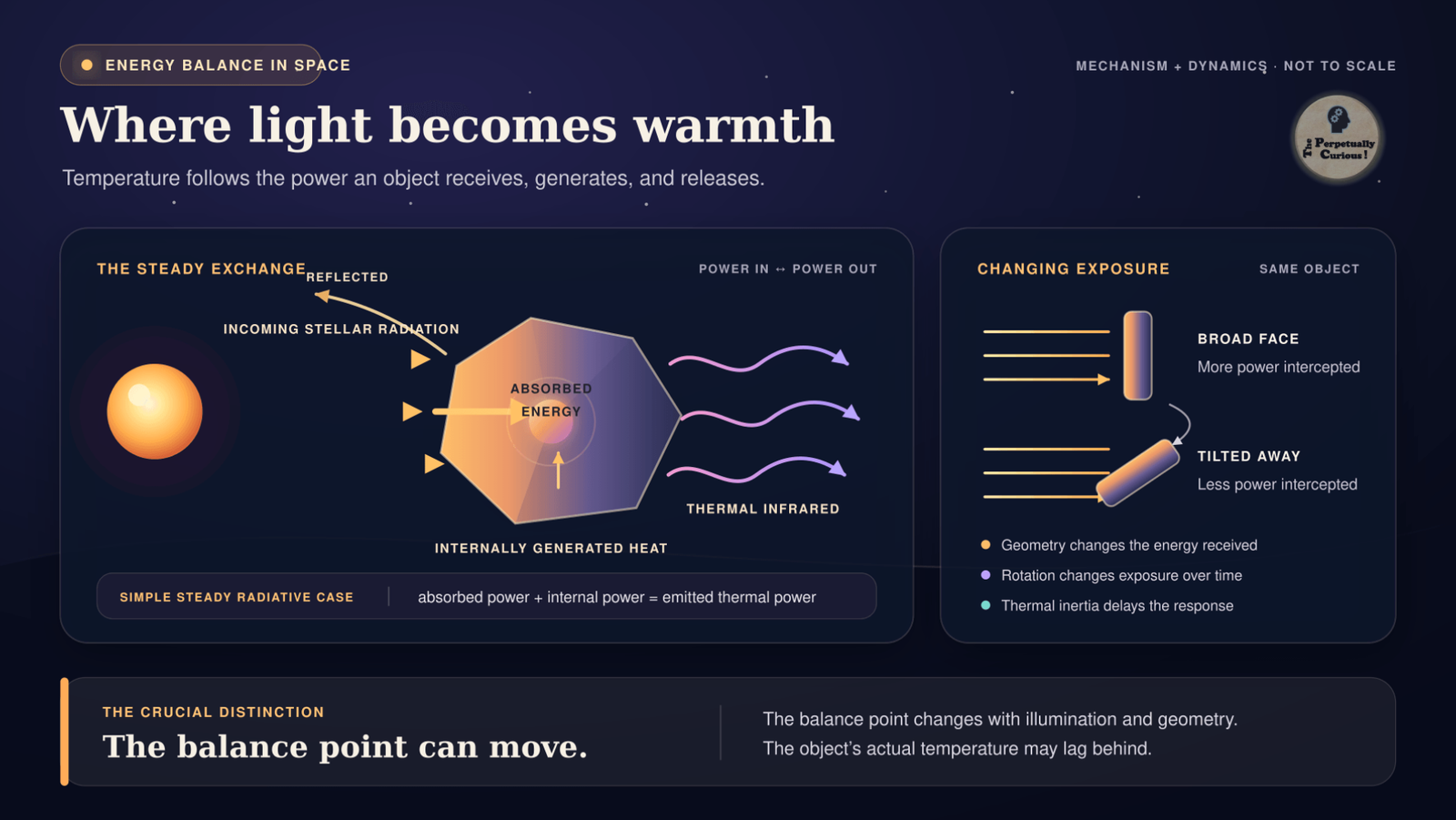
In the simplest steady radiative model, equilibrium is reached when the absorbed radiative power, together with any internally generated or dissipated power, equals the thermal power emitted. Real objects may also exchange energy through particle impacts or conduction along physical connections, so those contributions must be included in a fuller energy balance. The balance concerns power, or energy transferred per unit time. It does not mean that the object has stopped exchanging energy. Absorption and emission continue, but their net effect no longer changes its overall thermal state.
The resulting temperature depends on more than the intensity of the incoming radiation. Absorptivity describes how effectively a surface absorbs radiation, while emissivity describes how effectively it emits thermal radiation. Both can vary with wavelength. A surface that reflects much of the incoming solar radiation may still emit infrared radiation effectively. Specialized spacecraft coatings exploit this distinction to help regulate heating and cooling.
Geometry matters as well. A surface facing a radiation source directly intercepts more energy per unit area than the same surface tilted away. Shape determines both the projected area exposed to incoming radiation and the area available for thermal emission. A sphere illuminated from one direction, for example, intercepts sunlight across a circular cross-section but can emit thermal radiation from nearly its entire surface. Surfaces may also exchange radiation with one another, producing self-heating within cavities or between closely positioned components.
Rotation and internal conduction influence where absorbed energy travels. A slowly rotating body with poor thermal conductivity may develop extreme contrasts between illuminated and shaded regions. Faster rotation or stronger conduction can redistribute energy more broadly, although neither guarantees a uniform surface temperature. A spacecraft may deliberately isolate some components while conducting heat away from others.
Internal energy sources can shift the entire balance. A deep-space probe using radioisotope thermoelectric generators, for example, continues receiving thermal energy from radioactive decay even where sunlight is weak. Part of that energy is converted into electrical power, but most is released directly as heat, and much of the electrical power used aboard eventually becomes heat as well. Except for energy deliberately transmitted or otherwise exported, this power must ultimately be radiated to space during steady operation.
Radiative equilibrium describes the thermal state an object approaches under a particular set of conditions, not how quickly it reaches that state. Thermal mass and thermal inertia influence the response time. Under otherwise identical steady conditions, greater heat capacity does not by itself produce a different final equilibrium temperature, but it generally causes the object to warm and cool more slowly. When illumination repeatedly changes through rotation, eclipse, or movement between sunlight and shadow, stored energy moderates the resulting temperature swings.
Many objects in space never reach one perfectly fixed equilibrium temperature because their radiation environment, orientation, or internal power continually changes. Instead, they may settle into a repeating thermal cycle or move among several temporary balances.
Far from bright local sources, an object may continue cooling as it releases stored energy. It does not, however, cool toward a universal temperature belonging to the vacuum. The temperature it approaches depends on every remaining energy source, including faint surrounding radiation and any heat generated within the object. Even the cosmic dark contains a quiet radiative background.
🌌 The cosmic microwave background: a quiet thermal baseline
Across the observable universe, space is permeated by a faint radiation field known as the cosmic microwave background. It is relic light from an early stage of cosmic history. About 380,000 years after the Big Bang, the universe had cooled enough for atomic nuclei to capture electrons and form neutral atoms. With far fewer free electrons available to scatter light continually, photons could begin traveling across great distances. As the universe continued to expand, those photons were stretched to microwave wavelengths.
The spectrum of this radiation is extraordinarily close to that of a blackbody corresponding to approximately −455 °F (2.725 K; −270.4 °C). This temperature characterizes the radiation field through its measured spectrum. It does not mean that empty space is a material held uniformly at 2.725 K.
In an idealized region with no brighter radiation sources, negligible particle bombardment, and no internal power generation, a passive object able to absorb and emit radiation across the relevant wavelengths would gradually approach radiative equilibrium with the background. Its surface properties and heat capacity would influence how quickly it approached that state, and very weak radiative coupling could make the process extraordinarily slow.
Real objects rarely experience such isolation. Direct or reflected starlight, infrared radiation from nearby planets or dust, galactic emission, energetic particles, internal heat, geometry, and changing exposure conditions can all alter the balance.
The cosmic microwave background is remarkably uniform across the sky, but it is not perfectly featureless. After foreground emission and the much larger dipole produced by our motion relative to the background are accounted for, intrinsic temperature variations remain at roughly one part in 100,000. These variations preserve an imprint of early density differences that gravity later amplified as galaxies and the large-scale structure of the universe formed.
NASA’s COBE mission established the CMB’s nearly perfect 2.725 K blackbody spectrum and first detected its intrinsic anisotropies. WMAP later mapped those temperature variations with substantially greater detail and sensitivity.
The background therefore provides a widespread radiative reference, not an absolute minimum temperature that every system must obey. Near stars, planets, dust clouds, and operating spacecraft, stronger local energy sources usually overwhelm its influence and determine the temperatures that objects actually reach.
🌞 Near stars and planets: hot surfaces, cold shadows
Near a star, radiant energy can be intense even when the surrounding space remains extremely sparse. The Sun’s solar luminosity describes its total radiant power. As that radiation spreads outward across spheres of increasing area, the energy received per unit area decreases according to the inverse-square relationship. At Earth’s average orbital distance, a surface held perpendicular to the Sun’s rays above the atmosphere receives approximately 126 watts per square foot (1,361 watts per square meter). This irradiance establishes the available solar input, but it does not by itself determine the surface’s temperature.
How warm the surface becomes depends on the energy balance developed earlier. Orientation and geometry determine how much radiation it intercepts. Absorptivity and emissivity govern how effectively it absorbs incoming radiation and emits thermal radiation, while heat capacity, internal conduction, exposure time, and internally generated heat influence how its temperature changes.
Moving into shadow removes direct sunlight, but shadow is not itself a temperature. An object may retain stored energy and continue receiving reflected sunlight, infrared radiation from nearby bodies, energy delivered by particles, or heat generated within its own systems. Its temperature therefore changes over time as it approaches a new energy balance rather than falling immediately to a fixed value associated with darkness.
Atmospheres redistribute energy through winds, convection, and large-scale circulation. Oceans can extend that redistribution by storing and transporting heat across still greater distances. An airless body lacks these atmospheric and oceanic pathways, but its temperatures still depend on rotation, surface composition, local terrain, thermal conductivity, and the movement of heat through the ground.
The Moon demonstrates these effects clearly. One lunar solar day lasts about 29.5 Earth days, so many locations experience roughly two Earth weeks of daylight followed by roughly two weeks of darkness. Polar terrain can depart sharply from this pattern. Without a substantial atmosphere to transport heat between regions, illuminated and shaded surfaces can follow very different thermal histories. The Moon’s lunar regolith is also a poor thermal conductor, limiting the movement of heat into and through the ground and concentrating the strongest temperature changes near the surface.
Near the lunar equator, exposed surfaces can rise above approximately 250 °F (121 °C) in daylight and fall to about −208 °F (−133 °C) after nightfall. Deep within permanently shadowed polar craters, temperatures can drop below −410 °F (−246 °C). These are local, time-dependent conditions rather than temperatures shared by the entire Moon at once. Latitude, local time, terrain, depth, and illumination all matter.
The Moon is therefore not hot simply because sunlight reaches it or cold simply because it lacks substantial air. Its thermal extremes arise from prolonged illumination and darkness, limited redistribution, and the physical properties of its surface. Warmth near a star remains local, shaped by what intercepts the available energy and how that energy is absorbed, stored, transported, generated, and released.
The Moon provides a natural example of surfaces responding largely passively to changing illumination. Spacecraft encounter the same sunlight-and-shadow geometry but manage it through orientation, insulation, reflective coatings, conductive pathways, radiators, heaters, and active internal systems. The same physics thus becomes an engineering problem aboard a spacecraft.
🚀 Spacecraft, astronauts, and the experience of cosmic cold
Spacecraft do not simply become hot in sunlight and cold in shadow. Their temperatures emerge from a changing balance among absorbed radiation, internally generated heat, stored thermal energy, and emitted infrared radiation. Many spacecraft orbiting Earth repeatedly enter and leave the planet’s shadow, but their surfaces and components do not respond instantly. Heat capacity, conduction through the structure, orientation, surface properties, and the duration of each exposure all influence how rapidly their temperatures change.
Engineers manage these conditions through passive and active thermal-control systems. Multilayer insulation reduces unwanted radiative exchange, while specialized coatings regulate how strongly surfaces absorb sunlight and emit infrared radiation. Radiators provide carefully positioned surfaces through which spacecraft release waste heat. Heaters, temperature sensors, automated controls, conductive pathways, and circulating-fluid systems help keep instruments, batteries, electronics, and living spaces within their operating ranges.
Inside a pressurized spacecraft or space station, forced convection transfers heat between cabin air, equipment, and heat exchangers, while conduction and circulating fluids transport energy through the vehicle. That energy must ultimately cross from the spacecraft into the external environment. Most waste heat remaining aboard is rejected as thermal radiation from exterior radiators. Some systems can also discard energy by venting warmed material or through phase-change processes that expel a working fluid.
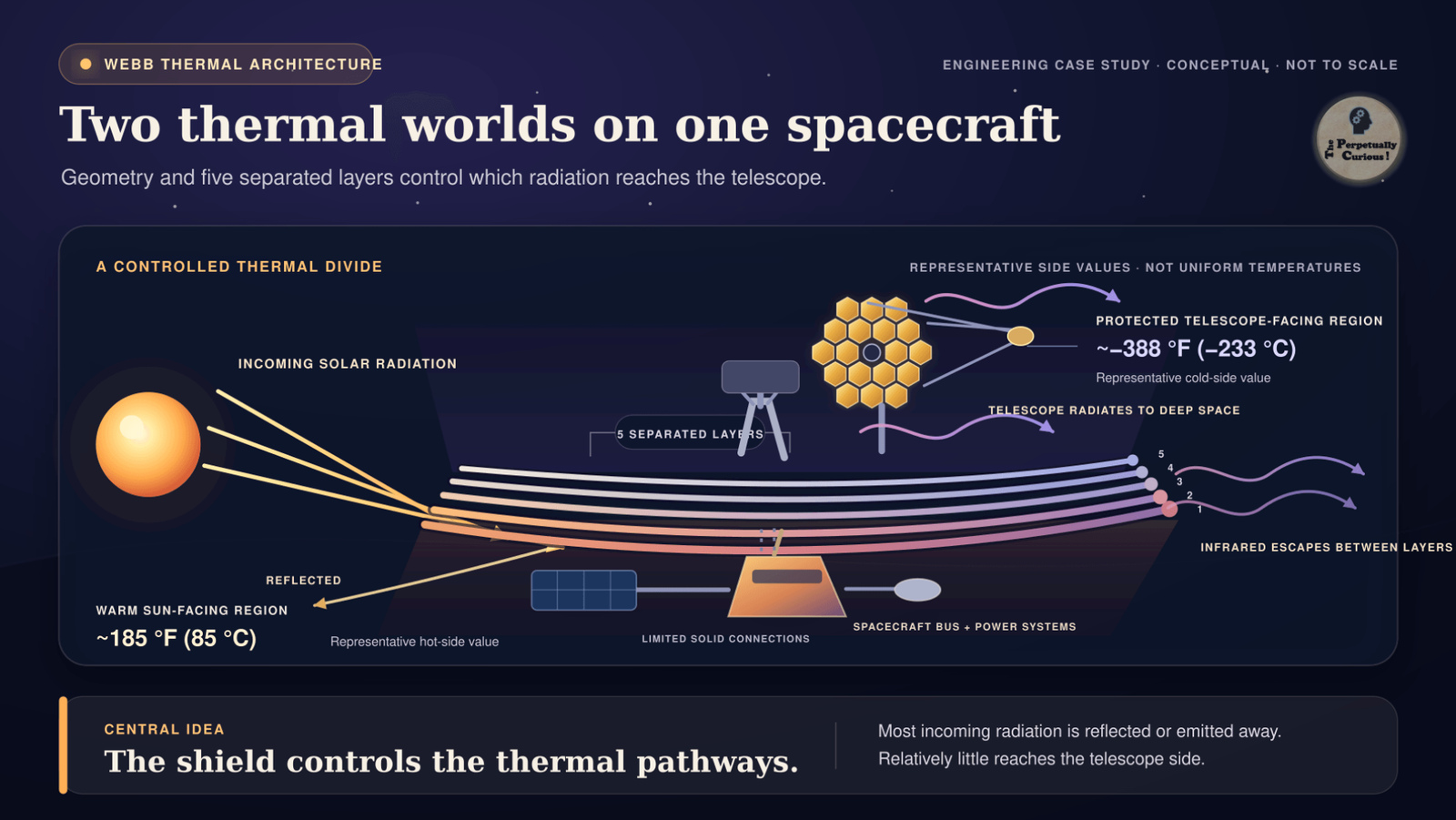
The James Webb Space Telescope demonstrates how deliberate geometry can maintain sharply different thermal environments within one observatory. Webb’s five-layer sunshield remains oriented between the telescope and radiation arriving from the general direction of the Sun, Earth, and Moon. NASA describes representative temperatures of approximately 185 °F (85 °C) on the hot side and approximately −388 °F (−233 °C) on the cold side. These values describe broad thermal zones rather than one uniform temperature across either side.
This contrast does not arise because a cold vacuum presses against the telescope-facing side. The sunshield reflects much of the incoming radiation and emits absorbed energy, while its separated layers and geometry greatly reduce the amount of heat transferred toward the observatory. Webb remains cold because relatively little energy reaches the telescope side and the energy that does arrive can continue radiating away. Its geometry therefore controls the routes by which radiation reaches, moves through, and leaves the spacecraft.
A spacesuit performs a similarly careful thermal-management task around a human body. It maintains pressure, supplies oxygen, removes carbon dioxide, limits exposure to thermal extremes, and helps protect against other environmental hazards. Insulation alone is not enough because an astronaut continually produces metabolic heat. Without cooling, physical work inside an enclosed pressure suit could cause overheating.
Water circulating through a liquid cooling and ventilation garment absorbs heat from the astronaut’s body and carries it away. The suit’s life-support system then transports and rejects that energy, with the particular method depending on the suit design. A suited astronaut therefore experiences a regulated internal environment rather than directly sensing a temperature belonging to the surrounding vacuum.
An unprotected person would not freeze instantly in space. The immediate dangers would be the loss of pressure and breathable oxygen. Hypoxia could cause loss of useful consciousness within seconds. At sufficiently low pressure, ebullism can occur, with water vapor forming within some body tissues and fluids. Moisture exposed at the mouth, eyes, and respiratory surfaces could also evaporate rapidly. The body would not instantly freeze or explode, but the exposure would quickly become fatal without prompt repressurization.
The body would continue losing energy through infrared radiation and through evaporation from exposed moisture. These processes do not resemble cold air or water drawing heat away by convection. The absence of a dense surrounding medium therefore makes pressure loss and oxygen deprivation far more immediate threats than whole-body cooling.
Spacecraft, spacesuits, and unprotected bodies can consequently follow very different thermal paths within the same region. What matters is not a single temperature assigned to space, but which systems exchange energy, through which mechanisms, and over what length of time. These contrasting cases return us to the article’s central paradox: if the cosmos contains so many radiant stars, why does their combined light not make every region warm?
🌠 Why space feels cold among so many suns
The universe contains an immense number of stars, but their combined radiation does not create one uniformly warm cosmic environment. Radiation from an individual star spreads across spheres of increasing area, so the irradiance it supplies decreases with the square of distance. Far from any bright local source, direct stellar heating is therefore weak.
Distance alone, however, cannot provide the complete explanation. Imagine an eternal, static universe uniformly filled with stars. A distant spherical shell of the same thickness as a nearby shell would contain more stars because its surface area is greater. Although the radiation received from each star would decrease with the square of its distance, the number of stars in each shell would increase by the same geometric factor. Successive shells could therefore contribute comparable amounts of starlight, and a sufficiently extended line of sight would eventually encounter a stellar surface. This is the reasoning behind Olbers’ paradox. Although the paradox is usually framed in terms of visible brightness, it also illuminates the broader question of the accumulated cosmic radiation field.
The real universe does not satisfy those idealized assumptions. It has a finite cosmic age, stars did not exist from the beginning, individual stars have finite lifetimes, and stellar and galactic populations have evolved throughout cosmic history. Because light travels at a finite speed, radiation has had only a finite time to reach any location. Cosmic expansion also stretches traveling light to longer wavelengths, reducing the energy carried by individual photons and diluting the radiation field.
The combined light from distant stars and galaxies therefore forms a real cosmic background, but it is generally faint compared with the intense illumination found near a star. An object between stars may radiate energy faster than it absorbs starlight or generates heat internally. It will then cool until its remaining energy gains and losses approach a new balance.
The universe is not radiatively empty. Beneath stronger local sources lies the cosmic microwave background, a nearly uniform relic radiation field with a blackbody temperature of approximately −455 °F (2.725 K; −270.4 °C). That value characterizes the spectrum of the radiation field. It is not a universal material temperature assigned to every particle population, object, or region of space.
In an idealized region with no brighter radiation sources, negligible particle heating, and no internal power generation, a passive object able to exchange radiation with this background could gradually approach a radiative equilibrium dominated by it. Real objects also encounter starlight, nearby planets, galactic emission, dust radiation, energetic particles, radioactive decay, operating systems, and other energy sources. Their temperatures continue to depend on what energy they absorb, generate, store, redistribute, and release.
Space therefore has no single temperature. Sparse particle populations, radiation fields, dust grains, planets, spacecraft, and living bodies can occupy the same region while maintaining very different thermal states. Light can cross a vacuum without making that vacuum behave like warm air, but wherever matter receives, generates, redistributes, and releases energy, a distinct thermal story unfolds.
In the quiet spaces between stars, light travels freely, yet warmth waits patiently for matter to receive it.
Pass this article along to someone curious and let the learning travel.
💡 Did You Know?
🌌 In Earth’s thermosphere, sparse particles can have very high average kinetic energies, yet the gas contains comparatively little thermal energy per unit volume and transfers little heat through ordinary collisions to an object moving slowly relative to it. Galaxy clusters show the same distinction on a far larger scale: their tenuous intracluster plasma can reach tens of millions of degrees Fahrenheit (tens of millions of kelvins).
🛰️ Spacecraft coatings are selected partly for their solar absorptivity and infrared emissivity. Under otherwise similar illumination and geometry, two surfaces that look alike in visible light can settle at different temperatures because color alone does not reveal how strongly each absorbs the full solar spectrum or emits infrared radiation.
🌫️ The well-shielded interiors of molecular clouds can have gas temperatures near −442 °F (10 K; −263 °C). Other parts of molecular clouds and the wider interstellar medium can be far warmer where ultraviolet radiation, cosmic rays, turbulence, or shock waves supply energy to their particles.
✨ A dust grain and the surrounding gas do not necessarily share the same temperature, particularly where collisions between them are infrequent. The grain’s size, composition, and local radiation environment influence how strongly it absorbs starlight and how efficiently it releases energy as infrared radiation.
🌗 On a small airless asteroid, rotation and thermal inertia work together to shape local day-and-night temperature contrasts. Faster rotation shortens the time each surface region spends in sunlight or darkness. Material with low thermal inertia heats and cools rapidly, whereas material with greater thermal inertia responds more slowly and can remain warmer after sunset.
🔭 Infrared observatories must be kept cold because their optics, structures, and detectors emit infrared radiation of their own. Reducing this self-generated background helps faint cosmic signals stand out. Webb’s sunshield passively cools the telescope and near-infrared instruments, while a dedicated cryocooler holds the Mid-Infrared Instrument’s detectors at about −448 °F (6.7 K; −266 °C).
Does space have a single temperature?
No. Even within the same region, a thermal radiation field, different particle populations, and physical objects can each be characterized by different temperatures. In a tenuous plasma, electrons and ions may not even share the same temperature. Each value describes the thermal state of a particular system, not one temperature belonging to space as a whole.
Why is deep space often described as about −455 °F (2.7 K)?
This shorthand refers to the cosmic microwave background, the relic radiation field left from the early universe. Its nearly perfect blackbody spectrum corresponds to approximately −455 °F (2.725 K; −270.4 °C). That figure characterizes the radiation field. It does not represent the average temperature of every particle, object, or region in deep space.
Would a thermometer placed in deep space simply read about −455 °F (2.7 K)?
No. A physical thermometer reports the temperature of its own sensing element, not a universal temperature assigned to its location. Its reading would depend on the radiation it absorbs and emits, internally generated heat, particle impacts, conduction through any supports or wiring, its surface properties, and the time allowed for those exchanges. Only an idealized passive instrument, sufficiently isolated from brighter sources and internal power, able to interact with the microwave background, and allowed enough time to approach equilibrium might settle at a temperature dominated by that background.
If stars are so hot, why does their combined light not make all of space warm?
Radiation from an individual star becomes more dilute as it spreads across greater distances, but distance alone is not the complete explanation. The universe has a finite age, stars have not shone forever, and stellar and galactic populations have evolved over cosmic time. Cosmic expansion also stretches much distant light to longer wavelengths, reducing the energy carried by its photons. The combined radiation from distant stars and galaxies therefore remains finite and is generally far weaker than the intense illumination found near a star.
If much of space is dark and some matter is extremely cold, how can telescopes detect it?
Telescopes and other observatories detect radiation in selected wavelength bands rather than sensing one temperature of space. Cold dust and gas can emit faint infrared, microwave, or radio radiation, absorb or scatter radiation from background sources, or reveal themselves through characteristic spectral lines. Hot plasmas and energetic events can produce ultraviolet, X-ray, or gamma-ray signals. Not every detected signal is thermal. By measuring radiation’s spectrum, intensity, direction, polarization, and variation over time, astronomers can infer temperature, composition, motion, magnetic fields, and other physical conditions. Measurements made outside visible wavelengths may then be mapped into visible colors for analysis and display.
How can the solar wind be hot without behaving like hot air?
The solar wind is an extremely dilute plasma flowing outward from the Sun. Its kinetic temperatures reflect the distributions of random particle velocities and energies relative to the bulk flow, while the energy transferred to an object also depends on particle density, flux, relative motion, electromagnetic interactions, and the properties of the material. Because the solar wind has an extraordinarily low density, it does not heat objects as dense hot air would. Even so, it can charge spacecraft, alter exposed surfaces, drive space weather, and interact strongly with planetary magnetospheres and atmospheres.
Does an object in shadow immediately cool toward −455 °F (2.7 K)?
No. Entering shadow removes direct sunlight, but it does not remove energy already stored within the object. The object may also continue receiving reflected light, infrared radiation from nearby bodies, energy from particle impacts, or internally generated heat. Heat capacity, emissivity, internal conduction, geometry, and exposure time influence how rapidly it cools, while the remaining energy sources determine the temperature it eventually approaches.
How can one spacecraft have hot and cold regions at the same time?
Different surfaces may face different radiation sources, remain behind a shield, or possess different absorptive and emissive properties. Insulation and deliberately limited conductive connections can preserve large temperature differences, while thermal straps and other pathways can redistribute heat where needed. The James Webb Space Telescope demonstrates this principle through its deliberately separated Sun-facing and telescope-facing thermal regions.
How do spacecraft stay within safe temperature ranges?
Spacecraft combine passive and active thermal-control methods. Multilayer insulation reduces unwanted radiative exchange, while specialized coatings regulate the absorption of sunlight and emission of infrared radiation. Thermal straps, heat pipes, and fluid loops transport energy. Radiators release waste heat, while heaters, sensors, orientation, and automated controls protect temperature-sensitive components.
Can a person freeze instantly in space?
No. The immediate dangers are rapid decompression and the loss of breathable oxygen. Hypoxia and ebullism can occur, with loss of useful consciousness possible within seconds. The body would continue losing energy through radiation and evaporation, but no surrounding cold gas would remove heat through ordinary atmospheric convection. Freezing would not be instantaneous, although continued exposure would quickly become fatal without repressurization.
Can heat travel through the vacuum of space?
Yes. Energy can be transferred as heat across a vacuum through thermal radiation, which travels as electromagnetic waves and does not require matter. Conduction requires interactions through matter, while convection requires the bulk movement of a fluid. Sparse particles in space can still transfer some energy through impacts, but radiation is the principal heat-transfer mechanism across a vacuum gap. This is why the Sun can warm Earth across nearly empty space and why spacecraft can release waste heat through radiators.
✨ Let this quiet warmth travel further
If this exploration changed how you imagine the cold of space, share it with someone who looks upward and wonders.
“Why Space Feels Cold Among So Many Suns: The Quiet Physics of Cosmic Warmth.” The Perpetually Curious!, August 2026.
https://www.theperpetuallycurious.org/articles/why-is-space-cold/Continue Exploring
For the curious mind: want to explore this theme through a few questions? Visit the Classic Quiz Studio, nestled under Explorations opens in a new tab ,and see where a few well-placed questions lead: Cosmic Exploration Quizzesopens in a new tab
For what comes next
Site Updates gathers occasional notes, new additions, and ways to keep in touch. RSS brings new publications to your feed reader in chronological order.
Choose the path that speaks to you, and let the next curiosity find you wherever your wondering takes you.