

The cosmos often reveals its rules most clearly where familiar categories begin to blur. Between giant planets and the smallest hydrogen-burning stars lies a dim frontier populated by brown dwarfs, objects massive enough for gravity to compress and heat their interiors, yet not massive enough to sustain the hydrogen fusion that powers stars. Some briefly burn deuterium, but sustained hydrogen fusion never takes hold. At this narrow threshold, brown dwarfs become more than cosmic in-betweens: they reveal where planetary and stellar physics begin to part ways.
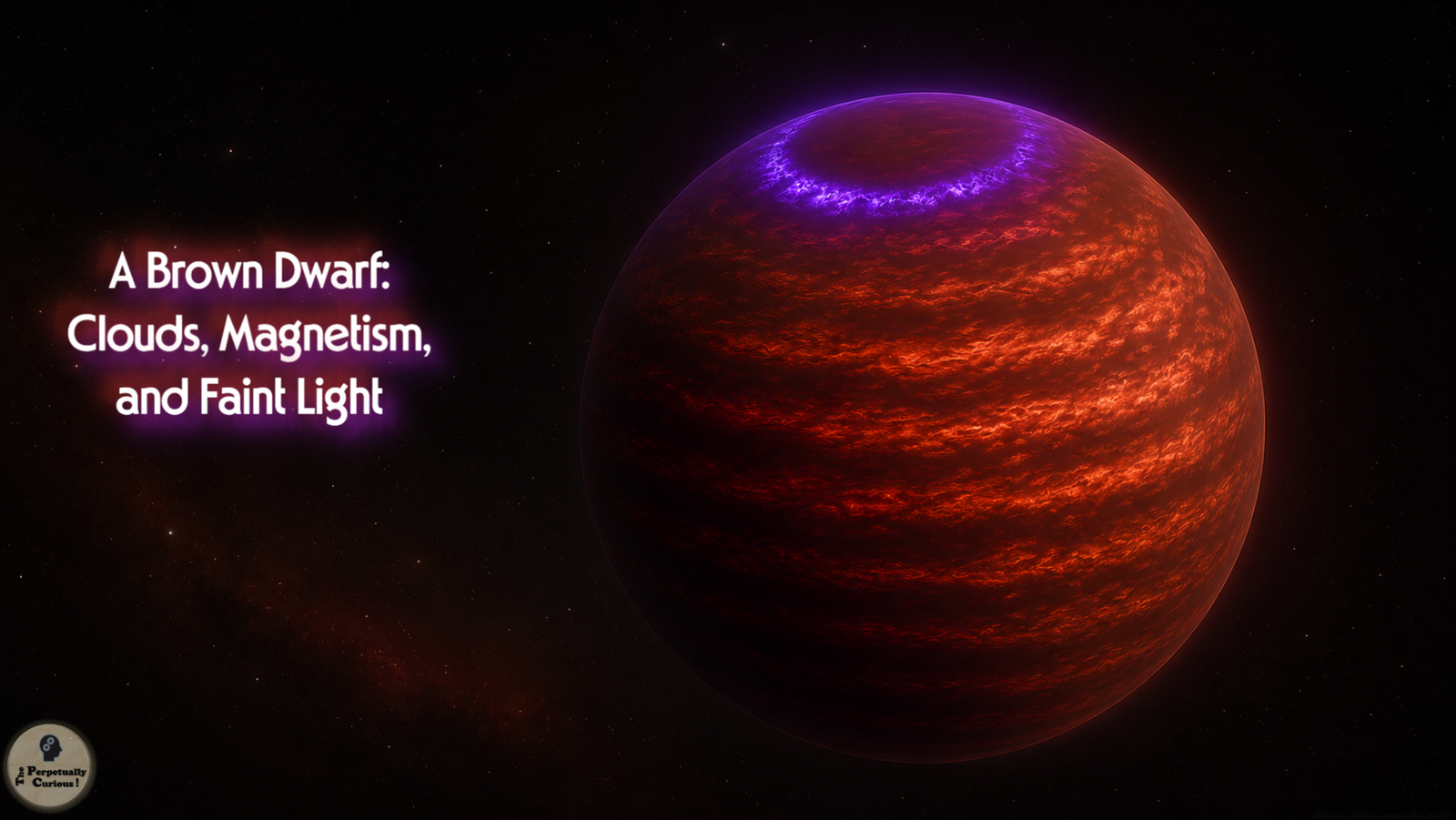
A brown dwarf drifts through the long night, carrying the quiet memory of a star that never came to be.
Its light softens with age, yet its presence endures, a patient witness to the slow turning of the galaxy.
In its fading glow, the boundary between what almost was and what still is becomes a gentle place to rest.
⚖️ What defines a brown dwarf
Brown dwarfs occupy a narrow but not perfectly fixed region between giant planets and the smallest hydrogen-burning stars. They are substellar objects, massive enough for gravity to compress and heat their interiors, but generally not massive enough to sustain the ordinary hydrogen fusion that defines a star. Astronomers often use about 13 times Jupiter’s mass as a practical lower boundary because objects near that mass can burn some of their primordial deuterium, a heavy isotope of hydrogen. Yet this is a convention rather than a universal dividing line. Depending on composition and on how much deuterium burning is used as the criterion, models place the threshold at roughly 11 to 16 Jupiter masses.
At the upper boundary, the conditions required for sustained hydrogen fusion finally become attainable. For material with a composition similar to the Sun, models place this limit near 0.075 solar masses, or about 7.5 percent of the Sun’s mass and 78.5 Jupiter masses, although composition can shift it. Above the threshold, an object can settle onto the main sequence as a very-low-mass red dwarf. Below it, ordinary hydrogen fusion never becomes a stable, long-term energy source. The familiar range of roughly 13 to 80 Jupiter masses is therefore a useful working guide rather than a perfectly sealed category. Mass alone does not settle every borderline case, because some classification approaches also consider how an object formed.
The term brown dwarf carries its own history of imperfect classification. Astronomer Jill Tarter introduced it in 1975, more than a decade after Shiv Kumar had predicted very-low-mass objects that could never sustain hydrogen fusion. The name is not a literal description of their color, but it endured as a practical label for an otherwise unnamed class. Observational confirmation would have to wait until the 1990s, when advances in infrared detection finally brought these faint threshold objects into view.
🪐 Neither planet nor star: A substellar path of its own
The familiar nickname “failed star” captures one physical limitation, but not the full identity of a brown dwarf. Brown dwarfs are self-gravitating spheres with dense interiors and layered atmospheres where molecules, clouds, and changing weather can develop. Many remain close to Jupiter in radius even while containing dozens of times its mass. They are therefore not loose debris, nor are they simply planets that grew too large or stars that stopped midway. They occupy a substellar regime with physical properties and an evolutionary path of their own.
They also appear in varied cosmic settings. Some orbit stars as companions, some belong to brown-dwarf binaries, and others move independently through interstellar space. Young brown dwarfs can retain disks of gas and dust, while a few have planetary-mass companions, showing that compact systems can form around objects that never sustain hydrogen fusion. Because low-mass companions can arise through more than one pathway, astronomers do not assume that every such object formed like a planet.
Their long-term evolution is quiet rather than explosive. Brown dwarfs do not follow the high-mass stellar evolution that ends in core-collapse supernovae, so they do not leave behind neutron stars, some of which are observed as pulsars. After any early deuterium burning has ceased and, in the most massive examples, lithium depletion has run its course, they continue releasing stored internal energy and gradually cool. This subdued future leads to a deeper question: what prevents gravity from carrying them across the threshold into sustained hydrogen fusion?
🔬 Why hydrogen fusion never stabilizes
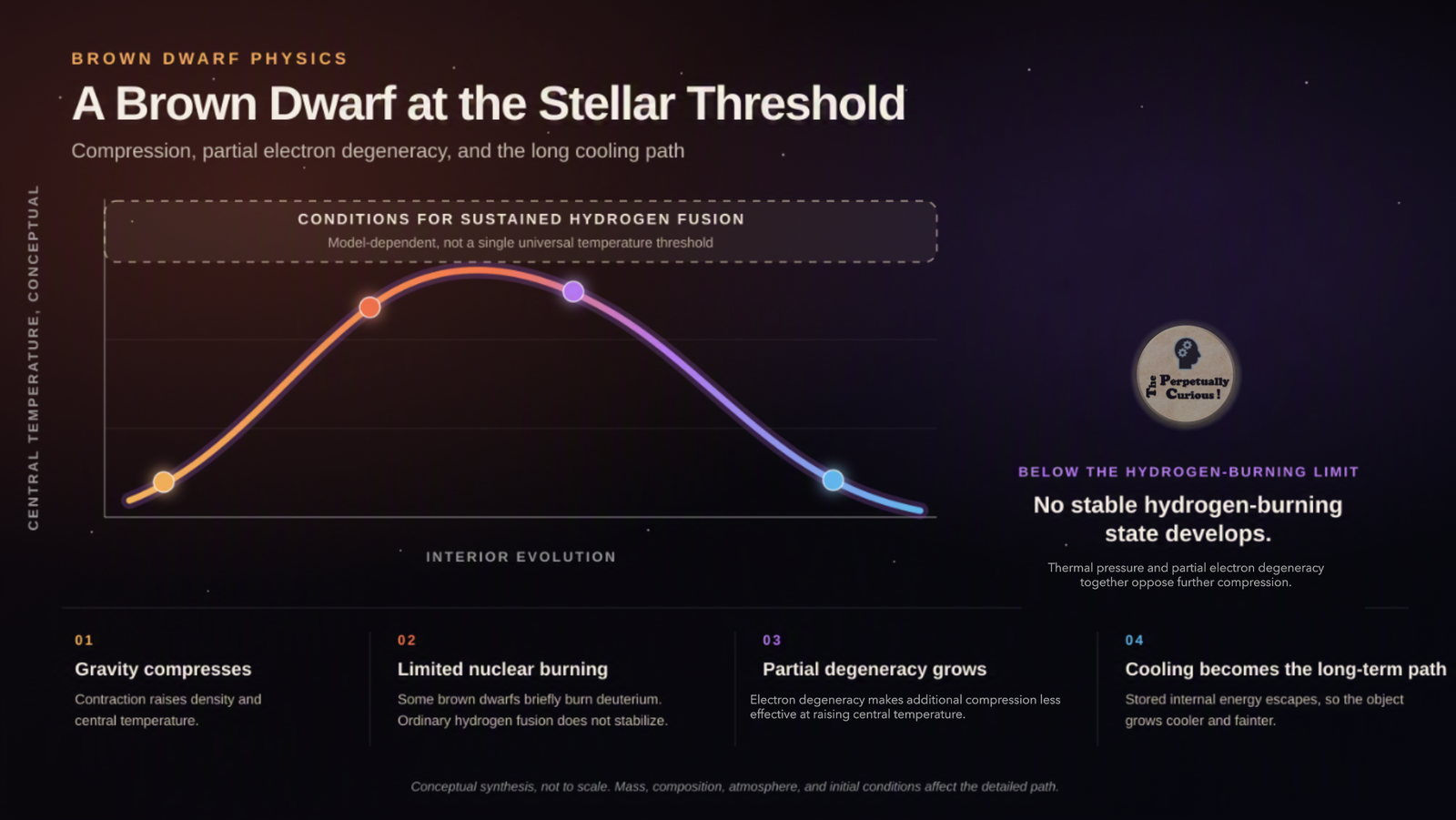
A forming star is shaped by a continuing contest between inward gravity and outward pressure. As material contracts, gravitational energy is converted into heat, raising the density and temperature of the interior. Yet becoming a true star requires more than briefly reaching temperatures at which hydrogen reactions can occur. Nuclear energy must be released rapidly and consistently enough to replace the energy escaping from the surface and establish a stable, self-regulating balance. For scale, the Sun’s core is about 27 million degrees Fahrenheit (15 million K), although the fate of a low-mass object depends on density, composition, and internal pressure as well as temperature. For material with a composition similar to the Sun, models place the minimum mass for sustained hydrogen burning near 0.075 solar masses, with the precise boundary shifting under different physical conditions.
Many brown dwarfs form through fragmentation and gravitational collapse broadly similar to the formation of low-mass stars, although more than one pathway may contribute to the population. As a young brown dwarf contracts, its interior heats. More massive examples can briefly burn deuterium and, at still higher masses, gradually deplete lithium through nuclear reactions. Ordinary hydrogen fusion, however, never becomes a lasting energy source capable of maintaining stable thermal support.
Before hydrogen burning can stabilize the object, the electrons in its dense interior become increasingly degenerate. Electron degeneracy pressure arises from quantum mechanics and depends primarily on how tightly matter is compressed rather than on temperature alone. As this pressure becomes more important, further contraction grows less effective at raising the central temperature. The interior eventually reaches a maximum temperature and then begins to cool, while any limited hydrogen reactions remain too weak to replace the energy radiated into space.
A brown dwarf is therefore not defined by a complete absence of nuclear activity. It is defined by the failure of ordinary hydrogen fusion to become a stable, long-term energy source. Once that threshold remains out of reach, another question follows naturally: what supports the object against gravity as its stored internal energy slowly escapes?
⚛️ A different kind of support
Brown dwarfs are not stabilized by fusion acting as an outward force. In hydrogen-burning stars, fusion replenishes thermal energy and helps maintain the pressure needed to balance gravity. Brown dwarfs never establish that self-sustaining state. Instead, as their interiors become denser, quantum mechanics plays an increasingly important role. The Pauli exclusion principle prevents electrons from occupying identical quantum states, and the resulting resistance to further compression contributes what physicists call electron degeneracy pressure.
This form of support differs from ordinary thermal pressure. Thermal pressure depends on both density and temperature, while degeneracy pressure is governed mainly by electron density and becomes comparatively insensitive to temperature as degeneracy strengthens. Brown dwarfs are not supported by one pressure source alone, especially while young, but electron degeneracy becomes increasingly important as they contract and cool.
That shift helps explain one of their most counterintuitive properties. Across much of the brown-dwarf mass range, radius changes only slightly, and a more massive brown dwarf can even be somewhat smaller than a less massive one of comparable age and composition. Additional mass produces stronger gravitational compression, increasing the interior density rather than expanding the object in direct proportion to its mass.
Young brown dwarfs initially retain substantial energy from formation, so thermal pressure still contributes strongly to their structure. As that energy escapes, partial electron degeneracy becomes a larger part of the balance resisting gravity. The underlying principle resembles the physics supporting white dwarfs, although white dwarfs are far denser and much more strongly degenerate. Brown dwarfs therefore represent a lower-density expression of the same quantum physics.
Degeneracy pressure limits how effectively continued contraction can raise the central temperature, but it does not eliminate every nuclear reaction. Some brown dwarfs briefly burn deuterium, while the most massive can gradually deplete lithium through nuclear reactions before settling into their long cooling evolution.
⚡ Brief nuclear moments
Brown dwarfs do not sustain the ordinary hydrogen fusion that powers stars, but some undergo shorter episodes of nuclear activity while they are young. Objects above the deuterium-burning threshold, often quoted as about 13 Jupiter masses but ranging from roughly 11 to 16 Jupiter masses under different model assumptions, can fuse primordial deuterium. This heavier isotope of hydrogen begins reacting at central temperatures near 1.8 million degrees Fahrenheit (1 million K), well below those required for sustained ordinary hydrogen burning.
Deuterium burning does not turn a brown dwarf into a star. Its duration and influence depend on mass, composition, formation conditions, and the amount of deuterium initially present. The released energy can slow contraction and temporarily alter the object’s luminosity and temperature evolution, but the limited fuel is eventually depleted. Brown dwarfs near the threshold may burn only part of their deuterium over a longer interval, while more massive objects generally begin burning it earlier and exhaust it more rapidly.
The most massive brown dwarfs can also become hot enough to destroy lithium through nuclear reactions. The precise boundary depends on evolutionary models, but it is commonly placed near 60 to 65 Jupiter masses, with depletion unfolding over time rather than beginning at one universal age. Unlike deuterium burning, lithium burning contributes little to the object’s total energy. Its greater value is observational: the presence or absence of lithium in an appropriately aged ultracool object can help astronomers constrain its mass, a method known as the lithium test.
Once these limited nuclear reactions end, no enduring fuel source replaces the energy radiated into space. Brown dwarfs then continue along their defining path of gradual cooling. Their faintness made confirmation an observational challenge, requiring astronomers to look beyond visible starlight to infrared emission and the molecular signatures of cool atmospheres.
🔭 How brown dwarfs came into view
At visible wavelengths, brown dwarfs are difficult to find. Much of their detectable emission emerges in the infrared, while companions near brighter stars can be overwhelmed by stellar glare. For decades after their theoretical prediction, astronomers found promising candidates but lacked the measurements needed to establish a distinct substellar population.
That changed as infrared telescopes, sensitive detector arrays, improved spectrographs, coronagraphs, and adaptive-optics systems opened new observational windows. Infrared instruments revealed faint thermal emission that photographic plates often missed, while spectroscopy identified molecules associated with atmospheres far cooler than ordinary stellar photospheres. High-contrast imaging also made it possible to separate dim companions from the light of nearby stars.
Two discoveries in 1995 marked the decisive transition from prediction to observation. Teide 1, found in the Pleiades star cluster, emerged as one of the first confirmed brown dwarfs, with the later detection of lithium confirming its substellar nature. Gliese 229B, detected beside the red dwarf Gliese 229A about 19 light-years away, provided an especially clear case because its spectrum contained strong methane absorption, revealing an atmosphere far cooler than that of an ordinary hydrogen-burning star.
The Gliese 229 system has since revealed another layer. In 2024, astronomers established that the object long known as Gliese 229B is itself a tight pair, now called Gliese 229Ba and Gliese 229Bb. The two brown dwarfs orbit each other every 12.1 days. What first appeared to be a single landmark brown dwarf was therefore two.
Wide-area infrared surveys then transformed a handful of discoveries into a diverse population. DENIS and 2MASS uncovered many nearby L- and T-type objects, while WISE extended the search to still colder brown dwarfs and enabled the establishment of the Y spectral class. Once astronomers could find these faint bodies in larger numbers, their changing spectra offered a way to trace how their atmospheres evolve as they cool.
🌡️ From L to T to Y: Atmospheres in transition
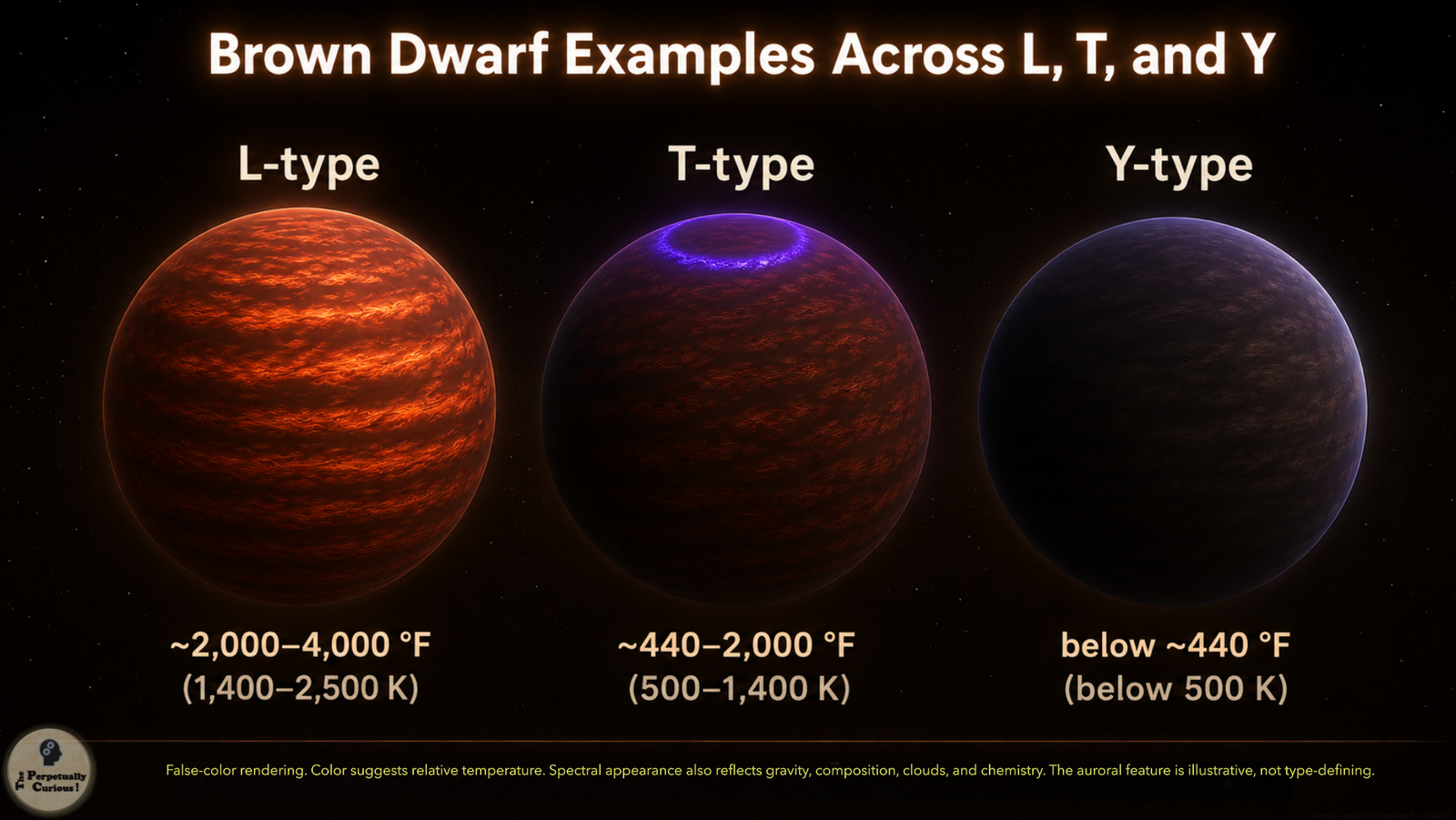
As brown dwarfs release their stored internal energy, their changing spectra place them within the L, T, and Y spectral classes. A single brown dwarf may move toward later classes as it cools, but the sequence is not a simple clock. Spectral appearance also depends on mass, surface gravity, composition, and cloud structure, so two objects of similar temperature may not look identical. The boundaries between the classes are therefore approximate rather than fixed.
Among brown dwarfs, L types occupy the warmer end of the sequence, commonly reaching effective temperatures of about 2,000 to 4,000 degrees Fahrenheit (1,400 to 2,500 K). Their atmospheres can contain clouds formed from iron-bearing compounds and silicate minerals, which absorb and scatter emerging radiation. Some objects classified as L dwarfs are actually very-low-mass stars, since spectral type describes observed light rather than mass or internal fusion alone.
Luhman 16, about 6.5 light-years away, is the closest known pair of brown dwarfs to the Sun. Its two components, classified approximately as L7.5 and T0.5, complete a mutual orbit in about 27 years. Because the pair spans the boundary between the L and T classes, it provides an especially valuable laboratory for examining how cloud structure and atmospheric chemistry change across that transition.
T-type brown dwarfs are cooler, broadly occupying temperatures from about 440 to 2,000 degrees Fahrenheit (500 to 1,400 K). Methane becomes prominent in their near-infrared spectra, while iron and silicate cloud decks can thin, fragment, or settle beneath the most visible atmospheric layers during the transition from L to T. The rapidly rotating T dwarf SIMP J013656.5+093347 completes a rotation in about 2.4 hours. Its changing brightness has been linked to evolving cloudy and clearer regions with different temperatures, while radio observations provide separate evidence of strong magnetic fields and auroral activity.
Y dwarfs extend the sequence below about 440 degrees Fahrenheit (500 K), bringing brown-dwarf atmospheres into temperature regimes comparable with those of cool giant planets. WISE 0855−0714, located about 7.4 light-years away, has an effective temperature near 53 degrees Fahrenheit (285 K) in JWST analyses. Its spectrum reveals water vapor, methane, ammonia, and carbon monoxide. Measurements also indicate that water becomes depleted in the upper atmosphere as it condenses. Current retrievals have not detected a distinct spectral signature from water-ice clouds, although cloud models for this exceptionally cold object remain under study.
The mass of WISE 0855 has not been measured dynamically, so estimates depend on its uncertain age and on evolutionary models. This ambiguity illustrates why temperature or spectral type alone cannot determine whether an isolated object has planetary mass or how long it has been cooling. Across the L, T, and Y classes, brown dwarfs provide accessible comparisons for interpreting giant exoplanet atmospheres, which can share similar clouds, molecules, and temperature regimes.
Spectra reveal the broad atmospheric transition from mineral clouds to methane-rich and increasingly cold chemistry. Yet a spectrum is still only a snapshot. To investigate weather, astronomers must also watch how a brown dwarf’s brightness changes as different regions rotate into view.
☁️ Clouds, chemistry, and changing weather
Brown dwarfs offer unusually accessible laboratories for studying atmospheres beyond the Solar System. Unlike hotter stars, their cool outer layers allow molecules and condensate clouds to survive. Unlike many exoplanets, free-floating brown dwarfs can be observed without the glare or strong irradiation of a nearby host star. Their emitted radiation comes mainly from internal heat, allowing astronomers to examine how a substellar atmosphere changes as the object cools largely on its own.
Clouds are central to that evolution. In warmer brown dwarfs, iron-bearing and silicate condensates can form deep, layered cloud structures. As an object rotates, uneven clouds and regions with different temperatures move into and out of view, producing measurable changes in infrared brightness. These variations provide evidence for atmospheric structures on planetary scales, although they do not by themselves identify individual storms or establish how long a particular feature survives. Observations at different infrared wavelengths can also probe layers at different atmospheric depths.
Spectroscopy adds another dimension. Absorption by water vapor, methane, ammonia, carbon monoxide, and other molecules helps constrain atmospheric composition and temperature-pressure structure. These measurements do not provide a direct thermometer for every point across the globe, but they allow increasingly detailed models of the atmospheric layers from which the observed radiation escapes.
The coldest brown dwarfs also reveal chemistry that departs from simple equilibrium. Vertical mixing and atmospheric circulation can carry molecules between layers faster than chemical reactions can restore the locally expected balance. Enhanced carbon monoxide and reduced ammonia relative to equilibrium predictions in some T and Y dwarfs provide evidence for this process, linking atmospheric motion to the spectra astronomers observe.
Clouds are not the only source of atmospheric complexity. Radio observations have revealed periodic pulses from some brown dwarfs, pointing to strong magnetic fields and auroral activity. Webb observations reported in 2024 revealed methane in emission and an upper-atmosphere temperature inversion in W1935. Later JWST imaging resolved W1935 as a close Y-dwarf binary, leaving it uncertain which component produces the methane feature. Auroral heating is one possible explanation, but the energy source remains unresolved because the system has no host star supplying a stellar wind analogous to the solar wind. Brown dwarfs therefore bring weather, chemistry, circulation, rotation, and magnetism together in systems that can be observed repeatedly as they change.
These atmospheric laboratories do not reproduce every kind of giant exoplanet. Strongly irradiated planets can develop temperature contrasts and photochemistry that isolated brown dwarfs do not experience. Even so, their shared molecules, clouds, and temperature regimes make brown dwarfs valuable reference points for testing the models used to interpret distant planetary atmospheres.
Understanding individual atmospheres, however, is only part of the larger picture. Astronomers must also ask how brown dwarfs form, where they are found, and how many populate the Galaxy.
🌌 Formation, companions, and the galactic census
Brown dwarfs appear to be numerous members of the Milky Way, but their total population remains uncertain. A 2017 study of the young star cluster RCW 38 estimated that the Galaxy may contain between 25 and 100 billion brown dwarfs with masses above 0.03 solar masses, or about 31 Jupiter masses. This figure is an extrapolation rather than a direct Galactic census, and it does not include still lower-mass objects. Brown dwarfs also grow fainter as they cool, surveys differ in sensitivity and sky coverage, and measurements from individual clusters or nearby populations must be extended cautiously across the wider Galaxy.
Their varied surroundings also reflect more than one possible formation history. Many brown dwarfs appear to arise through fragmentation and gravitational collapse broadly similar to the formation of low-mass stars. Disk fragmentation, early dynamical interactions, and other processes may also contribute. Some remain bound to stars as companions, some belong to brown-dwarf binaries, and others travel independently through interstellar space. An isolated brown dwarf may have formed directly rather than being ejected from a planetary system, while a planetary-mass companion may have arisen through fragmentation rather than planet-building within a disk.
Cooling further complicates the census. Temperature reflects both mass and age, so a relatively young, low-mass brown dwarf can resemble an older, more massive one. Surface gravity, composition, and cloud structure add further uncertainty. The coldest known objects are therefore not automatically the oldest, nor is a warmer brown dwarf necessarily younger.
Astronomers gain firmer answers from benchmark systems. When a brown dwarf accompanies a star whose age and chemical composition can be constrained, those properties provide valuable context for interpreting the companion. In brown-dwarf binaries, observations of the mutual orbit can also yield dynamical masses. These systems help calibrate atmospheric and evolutionary models that must otherwise infer mass and age from faint light alone.
The Galactic census matters, therefore, not merely as a count. Each well-characterized brown dwarf helps connect formation history, atmospheric change, mass, and age. Together, these objects reveal how densely and diversely the boundary between planets and stars is populated across cosmic time.
🌟 What brown dwarfs reveal about stellar evolution
Brown dwarfs make the boundary between planets and stars easier to see by showing what happens when sustained hydrogen fusion never takes hold. True stars spend much of their lives balancing inward gravity with pressure maintained by energy from hydrogen fusion, then change as their fuel supply and internal structure evolve. Brown dwarfs never enter a stable main-sequence phase or expand into red giants, and they do not progress through the later stages of nuclear burning reached by sufficiently massive stars. After their brief early nuclear reactions end, their long-term evolution is governed mainly by contraction, cooling, and the gradual release of stored internal energy.
This contrast gives brown dwarfs an important place in the study of stellar evolution. They show what happens when gravity compresses an object strongly enough to create a dense, hot interior, but not strongly enough for ordinary hydrogen fusion to become self-sustaining. The same broad contest among gravity, heat, pressure, and quantum mechanics shapes true stars, although sustained fusion changes the balance and opens an entirely different evolutionary path.
Electron degeneracy provides another connection, but not a perfect equivalence. It contributes increasingly to the support of brown dwarfs as contraction raises their density and cooling reduces the contribution from thermal pressure. Degeneracy can also become important within the dense cores and remnants of evolved stars. White dwarfs are far denser than brown dwarfs, and electron degeneracy pressure becomes their dominant support against gravity. Brown dwarfs therefore offer a lower-density expression of quantum physics that also shapes later stages of stellar evolution.
Their value lies not in being incomplete stars, but in revealing how sharply cosmic outcomes can diverge near a physical threshold. A relatively small difference in mass can separate an object that cools continuously from one that shines through sustained fusion for billions or, in the case of the smallest red dwarfs, potentially trillions of years. That same distinction shapes how each object will endure into the distant future.
⏳ The long cooling future
Brown dwarfs do not end in supernovae or produce the compact remnants left by stellar death. Once their limited nuclear reactions have ceased, they continue radiating internal energy retained from formation and released through contraction, becoming cooler and fainter over timescales far beyond the present age of the universe. The universe is about 13.8 billion years old, while the cosmic microwave background currently has a temperature of about 2.725 K, or roughly −455 degrees Fahrenheit (−270 degrees Celsius). No brown dwarf has existed long enough to approach such an extreme temperature.
The cosmic microwave background is not a fixed final temperature, however. In the standard expanding-universe model, its temperature continues to decline as space expands. Brown dwarfs would therefore cool within a radiation background that itself becomes progressively colder, rather than converging on the present microwave temperature as a permanent floor. Their precise cooling paths depend on mass, composition, atmospheric opacity, cloud structure, and initial conditions. More massive brown dwarfs generally remain warmer and more luminous than lower-mass objects of the same age, although different evolutionary tracks can overlap. Brown-dwarf atmosphere and evolutionary models confirm that atmospheric physics and composition significantly shape their cooling curves.
Over immense spans of time, their infrared glow would weaken until detecting them through emitted radiation became increasingly difficult. They would nevertheless persist as cold, self-gravitating bodies. Long after the most durable hydrogen-burning red dwarfs have exhausted their fuel, brown dwarfs may remain among the dark objects inhabiting the universe, alongside white dwarfs, neutron stars, black holes, planets, and other cold or compact bodies. They will not uniquely outlast every product of stellar evolution, but they may endure long after fusion-powered starlight has largely faded. This description is necessarily a projection based on standard models of long-term cosmic evolution.
Their distant future completes the lesson introduced at the boundary between planets and stars. Brown dwarfs never achieve the sustained fusion that makes stars shine, yet neither do they disappear when that threshold remains uncrossed. They continue through cosmic time as slowly cooling records of gravity, matter, and a stellar threshold never crossed.
Pass this article along to someone curious and let the learning travel.
Did You Know?
👥 The landmark object once known as Gliese 229B is actually a close pair, Gliese 229Ba and Gliese 229Bb. The two brown dwarfs orbit each other every 12.1 days. Resolving the pair helped explain why the system had appeared unusually faint for the total mass previously attributed to a single brown dwarf.
📏 Brown dwarfs can contain dozens of times Jupiter’s mass while remaining roughly comparable to Jupiter in size. Among brown dwarfs of similar age and composition, stronger gravitational compression can even make a more massive object slightly smaller than a less massive one. Age and composition also influence the radius.
🧪 Lithium can provide a clue to a brown dwarf’s mass. Objects below the lithium-burning boundary can preserve much of their primordial lithium, while sufficiently massive brown dwarfs gradually destroy it through nuclear reactions. Astronomers call this diagnostic the lithium test, although its interpretation also depends on age and on whether lithium remains detectable in the atmosphere.
🔤 An L-type spectrum does not automatically identify an object as a brown dwarf. The L class describes observed atmospheric and spectral properties rather than mass or internal fusion, so it includes both brown dwarfs and some very-low-mass hydrogen-burning stars.
What separates a brown dwarf from a star?
A brown dwarf does not sustain the ordinary hydrogen fusion that powers a star. It may briefly burn deuterium, and the most massive brown dwarfs can also destroy lithium through nuclear reactions, but these processes never become a stable, long-term energy source. The decisive physical distinction lies in whether the interior can maintain the conditions required for sustained hydrogen fusion.
Is 13 Jupiter masses a strict boundary between planets and brown dwarfs?
No. About 13 Jupiter masses is a widely used working boundary because substantial deuterium burning becomes possible near that mass. Depending on composition and the criterion used, models place the threshold at roughly 11 to 16 Jupiter masses. Some classification approaches also consider formation history, particularly whether an object formed through planet-building within a disk or through gravitational fragmentation. No single criterion resolves every borderline case.
How is a brown dwarf different from a rogue planet?
Brown dwarfs and free-floating planetary-mass objects can overlap in mass, temperature, and appearance, especially near the lower end of the brown-dwarf range. A rogue planet is generally understood as a planetary-mass object that is not gravitationally bound to a star, but that label alone does not establish how it formed. Some may have formed within planetary systems and later been ejected, while others may have arisen directly through collapse or fragmentation. When an object’s mass and formation history cannot be reconstructed, its classification may remain uncertain.
Are all L-type dwarfs brown dwarfs?
No. The L classification describes an observed spectrum and atmosphere, not mass or internal fusion. Many L dwarfs are brown dwarfs, but warmer members of the class can be very-low-mass stars that sustain hydrogen fusion. Age, surface gravity, composition, and cloud structure can also influence how an L-type object appears.
How do astronomers detect brown dwarfs when they emit so little visible light?
Astronomers rely heavily on infrared telescopes, which can detect the thermal radiation emitted by these cool objects. Spectroscopy reveals molecules such as methane, water vapor, and ammonia, while high-contrast imaging can separate faint companions from brighter stars. Proper-motion and parallax surveys help identify nearby isolated objects, while astrometric and radial-velocity measurements can reveal brown dwarfs orbiting stars. Radio observations can also characterize magnetic activity in some brown dwarfs.
Can brown dwarfs host planetary systems?
Young brown dwarfs can possess disks of gas and dust, and some have planetary-mass companions. One well-known example is 2M1207, whose companion lies at a projected separation of about 40 astronomical units. Such systems show that disks and low-mass companions can exist around substellar objects, although a companion’s mass and orbit alone do not establish whether it formed through planet-building or star-like fragmentation.
How do brown dwarfs help astronomers understand exoplanets?
Brown dwarfs can share temperatures, clouds, molecules, and atmospheric chemistry with many giant exoplanet atmospheres. Isolated brown dwarfs are often easier to observe because their spectra are not overwhelmed by a nearby host star. They therefore provide useful tests for cloud models, molecular chemistry, vertical mixing, and observational methods later applied to exoplanets. Strongly irradiated planets can behave differently, so brown dwarfs serve as comparisons rather than exact substitutes.
Why can temperature alone not reveal a brown dwarf’s mass or age?
Brown dwarfs cool continuously, but they do so at rates that depend on mass, composition, atmospheric structure, cloud properties, and initial conditions. A young, low-mass brown dwarf can therefore have a temperature similar to that of an older, more massive one. Temperature provides only part of the evidence needed to reconstruct an object’s physical history.
How do astronomers determine a brown dwarf’s mass?
The most direct measurements usually come from orbital dynamics. By tracking the mutual orbit of a binary, astronomers can calculate the system’s dynamical mass and, with sufficient orbital information, the masses of the individual components. A brown dwarf orbiting a star may also reveal its mass through the star’s radial-velocity or astrometric motion. Well-characterized host stars provide additional constraints on age and composition. For isolated objects, mass estimates rely more heavily on luminosity, gravity-sensitive spectral features, atmospheric measurements, and evolutionary models.
What happens to a brown dwarf over cosmic time?
A brown dwarf gradually radiates away its stored internal energy and becomes cooler and fainter. It does not expand into a red giant, explode as a supernova, or produce a neutron star or another stellar remnant. Over timescales far beyond the current age of the universe, it is expected to persist as an increasingly cold, self-gravitating object whose emitted radiation becomes progressively harder to detect.
✨ Where worlds and stars almost meet
Brown dwarfs remind us that the cosmos is shaped not only by what fully ignites, but also by what endures at the threshold. We invite you to share this exploration with readers who find wonder in the places where familiar categories begin to blur. Each shared curiosity helps the wider story of these boundary objects travel a little farther.
“Brown Dwarfs: Between Giant Planets and the Smallest Stars.” The Perpetually Curious!, August 2026.
https://www.theperpetuallycurious.org/articles/what-is-a-brown-dwarf/Continue Exploring
For the curious mind: want to explore this theme through a few questions? Visit the Classic Quiz Studio, nestled under Explorations opens in a new tab ,and see where a few well-placed questions lead: Cosmic Exploration Quizzesopens in a new tab
For what comes next
Site Updates gathers occasional notes, new additions, and ways to keep in touch. RSS brings new publications to your feed reader in chronological order.
Choose the path that speaks to you, and let the next curiosity find you wherever your wondering takes you.