

Gravity is the quiet sculptor of the cosmos. It shapes the paths of planets, guides the drift of moons, and anchors every step taken on the surface of a world. When we compare gravity across the Solar System, we begin to see how each planet carries its own gravitational signature.
That signature is not determined by size alone. A world’s mass, radius, and density combine in ways that can make a smaller planet pull more strongly than expected, or a giant world exert surprisingly modest gravity at its reference level. Comparing those differences turns gravity into a way of reading the physical character of worlds.
Historians note that Sir Isaac Newton later described watching an apple fall in an orchard, a quiet moment that encouraged him to reflect on why objects fall toward Earth. Whether the scene unfolded exactly as remembered is uncertain, yet the image has become a gentle symbol of curiosity. It reminds us that gravity reveals itself in simple motions long before it is written in equations.
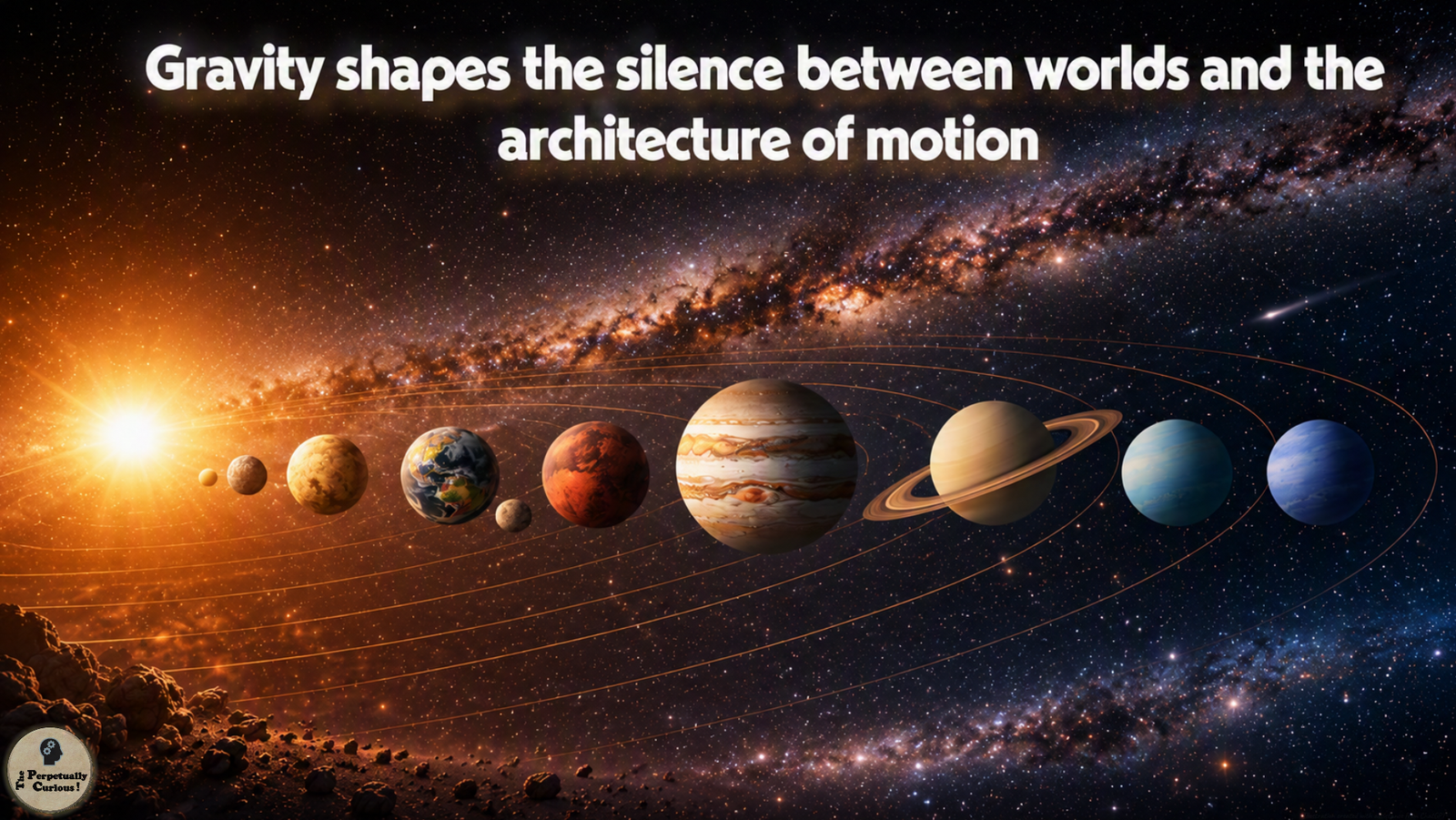
Gravity moves through every world with its own quiet signature, shaping how each planet holds its place in the dark.
Across these distant spheres, the same pull becomes a different story.
In that silent exchange, the architecture of motion reveals itself.
🌐 What gravity measures and why it is expressed in ft/s² (m/s²)
Gravity near a planet’s surface is an acceleration. If an object is released and allowed to fall freely, its speed increases with time. Near Earth, that increase is about 32.2 ft/s² (9.81 m/s²). The unit ft/s² reflects the change in velocity, measured in feet per second, during each second of fall. Gravitational acceleration is therefore not expressed in kilograms or pounds-force. Kilograms measure mass, while newtons and pounds-force measure force.
This understanding provides a foundation for comparing worlds. Gravity is not a vague pull. It is a measurable rate of change of motion. That rate depends on a planet’s mass and radius through the relationship:
where (g) is surface gravity, (G) is the universal gravitational constant, (M) is the mass of the planet, and (R) is its radius. The symbol (G) is the same everywhere in the universe. It does not change from planet to planet. Planets differ in gravity because their mass and radius differ, not because (G) changes.
This expression comes from classical physics, where Isaac Newton described gravity as a force that acts between masses. Modern physics, through physicist Albert Einstein’s general theory of relativity, describes gravity as the curvature of spacetime rather than a force in the traditional sense. Although this deeper view provides a more complete picture, the classical formula remains highly accurate for calculating surface or reference-level gravity on planets, moons, and many other objects in the Solar System. The values presented here therefore remain scientifically meaningful and widely used. For readers who wish to see how Earth’s value follows from the equation, a Supplementary Note on Earth’s Gravity appears later in this article.
🌌 Why planets pull differently
Planets vary in size, density, and internal structure. Some are compact and metal rich. Others are large and filled with lighter materials. Because surface gravity depends directly on a planet’s mass and radius, a small but dense world may have a stronger pull than a larger but less dense one. The extreme case of how tightly matter can be packed is illustrated by neutron stars, where immense density produces gravitational fields far beyond anything found on planets.
Density plays an indirect role. It reflects how tightly matter is packed and helps determine how much mass is contained within a given size. Mercury is small but very dense, which gives it a gravity similar to that of Mars even though Mars is larger. Saturn is enormous but has a low average density, and its large radius helps keep its reference-level gravity modest. Jupiter is vastly more massive, and its enormous mass produces the strongest reference-level gravity among the planets.
The diversity of mass and radius found in planetary systems beyond our own shows how these same principles can shape worlds across the galaxy. To see the differences within our Solar System clearly, it is helpful to place the values side by side.
For Jupiter, Saturn, Uranus, and Neptune, the values below are conventional reference-level gravity values rather than measurements at solid ground. These giant planets do not have hard surfaces on which a person could stand.
| Planet or body | Gravity (ft/s²) | Gravity (m/s²) | Interpretation |
|---|---|---|---|
| Mercury | 12.1 | 3.70 | Small but dense, with a large metallic core |
| Venus | 29.1 | 8.87 | Similar in size, mass, and density to Earth, with slightly lower values in each |
| Moon | 5.3 | 1.62 | Low mass and small radius produce gentle surface gravity |
| Earth | 32.2 | 9.81 | Substantial mass and high average density within a moderate radius |
| Mars | 12.2 | 3.71 | Larger than Mercury but less dense |
| Jupiter | 81.3 | 24.79 | Enormous mass produces strong reference-level gravity |
| Saturn | 34.3 | 10.44 | Large radius and low average density moderate its reference-level gravity |
| Uranus | 29.1 | 8.87 | Large radius helps keep its reference-level gravity comparable to Venus |
| Neptune | 36.6 | 11.15 | Dense and comparatively compact for an ice giant |
| Pluto | 2.0 | 0.62 | Small and icy, with low mass |
Values are approximate. For the giant planets, “gravity” refers to conventional equatorial or atmospheric reference levels rather than solid surfaces.
These values show that gravity is not simply a matter of size. Saturn is enormous, yet its reference-level gravity is only slightly higher than Earth’s because surface gravity depends on the balance between mass and radius. Mercury is small, yet its gravity is similar to Mars because it packs substantial mass into a smaller body. Jupiter’s pull is strong because its mass is immense.
A wider sense of how mass and radius combine across other planetary systems can be found in the study of exoplanets. Within our own Solar System, however, the comparison naturally leads to a more personal question: if gravity differs from world to world, how would those differences change the weight associated with the same mass?
🟦 Relative surface gravity compared with Earth
Expressing each value relative to Earth turns the raw accelerations into an intuitive scale and sets up the next question: how the same mass translates into different weights.
| Planet or body | Gravity ratio (Earth = 1.00) | Planet or body | Gravity ratio (Earth = 1.00) |
|---|---|---|---|
| Mercury | 0.38 | Jupiter | 2.53 |
| Venus | 0.90 | Saturn | 1.07 |
| Moon | 0.165 | Uranus | 0.90 |
| Earth | 1.00 | Neptune | 1.14 |
| Mars | 0.38 | Pluto | 0.063 |
Values are approximate ratios of local or reference-level gravity to Earth gravity. Earth is set to 1.00.
🧭 What gravity means for the weight we feel
Weight is the force that gravity exerts on a mass. Mass remains the same from one world to another, but weight changes with the local value of (g). In physics, weight is calculated in newtons, the SI unit of force, using the relationship:
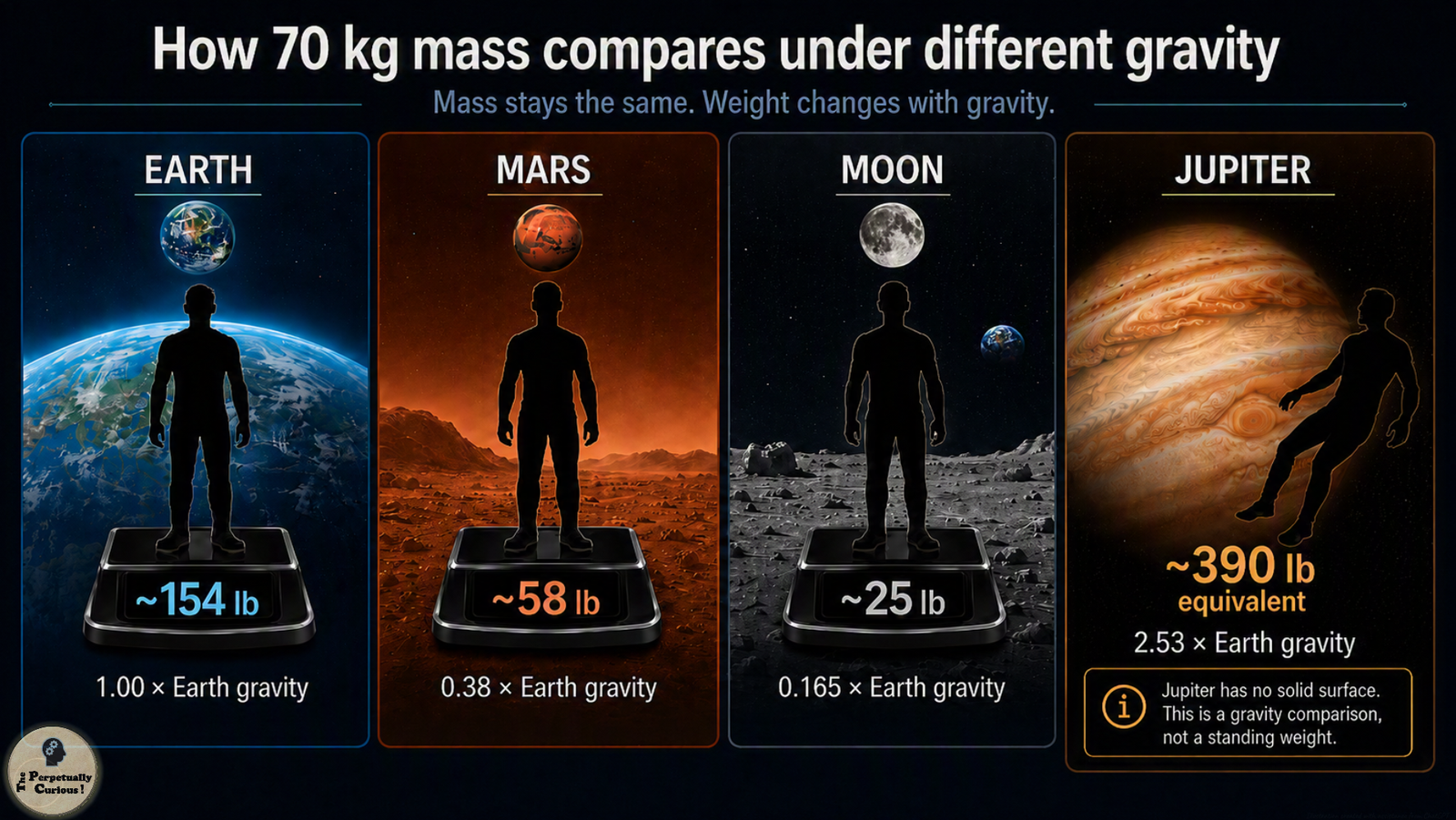
The result may then be converted into pounds-force for everyday intuition. A person with a mass of about 70 kilograms has a weight of about 687 newtons on Earth, which corresponds to about 154 pounds-force. On Mars, the same mass would weigh about 260 newtons, or about 58 pounds-force. On the Moon, it would weigh about 113 newtons, or about 25 pounds-force.
Under Jupiter’s conventional reference-level gravity, the same 70 kilogram mass corresponds to a force of about 1,735 newtons, or about 390 pounds-force. Because Jupiter has no solid surface, this is a gravitational comparison rather than the weight of a person literally standing on the planet.
These values follow the same relationship and make the contrast between mass and weight easier to see. The behavior of loose material on the Moon, described in studies of lunar regolith, offers another example of how a low-gravity environment can affect the motion of surface material.
🟩 How 70 kg (154 lb) feels under different gravity
Holding mass constant makes the comparison intuitive. The same 70 kilogram mass corresponds to very different supported weights under different gravitational accelerations. On solid-surface worlds such as Earth, Mars, and the Moon, this can be pictured as the force a supporting surface would exert against the mass. For Jupiter, the value is a reference-level comparison only because there is no solid ground on which to stand.
Movements may feel lighter or heavier as local gravity changes, and unsupported objects accelerate differently from one world to another. Everyday language often describes weight as something we feel, even though the underlying physical quantity is a force. On a solid surface, the familiar sensation of weight comes largely from the supporting surface pushing upward against the body while gravity pulls downward.
Small bodies in the asteroid belt provide another perspective. Some are so small that their surface gravity is extremely weak, allowing loose material to be disturbed much more easily than on a planet.
The same differences that alter personal weight also scale upward, influencing atmospheres, surface materials, and the long-term evolution of worlds.
🌱 How gravity shapes worlds
Gravity influences many aspects of planetary evolution. It helps determine how strongly a world can retain atmospheric gases, affects the scale of topography that materials can support, and shapes how liquids, ices, and loose surface material move. These effects do not act alone. Temperature, atmospheric composition, radiation, geological activity, material strength, and a planet’s broader space environment all help determine what a world ultimately becomes.
At a familiar scale, Earth’s atmospheric structure shows this balance clearly. Gravity keeps most atmospheric particles bound to the planet, while a smaller fraction of the lightest and fastest-moving particles can escape from the exosphere. Across planetary environments, atmospheric loss can occur through several thermal and non-thermal processes. Solar and ultraviolet radiation, solar-wind interactions, atmospheric composition, temperature, and gravity can all matter, while magnetic environments can modify some charged-particle interactions rather than acting as a simple on-or-off shield.
Gravity also reaches far beyond a world’s atmosphere or surface. The same gravitational relationships guide spacecraft through gravity assists, where a carefully arranged planetary encounter can change a spacecraft’s trajectory and speed relative to the Sun. Around Jupiter, the tidal forces that continually flex Io show another expression of gravity, with repeated deformation helping drive intense volcanic activity.
From the pull beneath our feet to the forces that sculpt distant worlds, gravity connects the familiar to the extraordinary.
Did You Know
💧 Saturn has a lower average density than water. Because surface gravity depends on both mass and radius, Saturn’s enormous radius helps offset the effect of its mass, leaving its reference-level gravity only modestly above Earth’s.
🧭 Earth’s gravity is slightly weaker at the equator than at the poles. Earth bulges outward at the equator, increasing the distance from its center, while rotation also produces a small outward effect that further reduces effective gravity there.
🌀 Jupiter’s strong gravity influences the orbits of many smaller bodies and helps shape the architecture of the Solar System.
🛰️ A gravity assist uses a planet’s gravity together with the planet’s orbital motion to change a spacecraft’s trajectory and its speed relative to the Sun, helping missions reach destinations that would otherwise require more propellant.
🪐 Some small asteroids have such weak surface gravity that loose rocks and dust can be disturbed far more easily than on larger worlds.
Why do planets have different surface gravity values?
Planets differ in mass, radius, and density. Surface gravity depends on both how much mass a planet has and how far the reference level lies from the planet’s center. Dense, compact planets tend to have stronger surface gravity than less dense planets of similar size. For giant planets, the quoted values refer to conventional atmospheric or equatorial reference levels rather than solid ground.
Is gravity the same everywhere on a single planet?
No. Gravity is usually similar across much of a planet, but it can vary with altitude, latitude, rotation, shape, and local mass distribution. These variations are generally much smaller than the differences in gravity from one world to another.
Why is gravity expressed in ft/s² (m/s²)?
Gravity is expressed in ft/s² or m/s² because gravitational acceleration describes how quickly velocity changes with time. Near Earth, an ideal freely falling object gains about 32.2 feet per second of speed during each second of fall when air resistance is neglected. The Supplementary Note on Earth’s Gravity above shows how the familiar value follows from the Newtonian formula and how it relates to standard gravity.
Is gravity a force or the curvature of spacetime?
In classical physics, gravity is described as a force that acts between masses. In general relativity, gravity is described through the curvature of spacetime produced by mass and energy. Newtonian gravity remains highly accurate for the planetary surface-gravity calculations used here, while general relativity provides the deeper modern framework.
What is escape velocity?
Escape velocity is the minimum initial speed required, in an idealized calculation that neglects atmospheric drag and further propulsion, for an object to escape a world without falling back. Near Earth’s surface, it is about 7 miles per second (11.2 kilometers per second). Escape velocity depends on both mass and radius, so surface gravity alone does not uniquely determine it.
Why do we still use Newton’s formula if relativity is more accurate?
Newton’s formula remains highly accurate for many practical calculations involving planets, moons, spacecraft trajectories, and other situations where relativistic effects are very small. General relativity becomes essential when gravity is exceptionally strong or when very high precision is required.
How is surface gravity calculated?
For an idealized spherical body, surface gravity is calculated using g = GM/R2, where G is the universal gravitational constant, M is the body’s mass, and R is the distance from its center to the reference level. Planetary masses and dimensions are determined through combinations of orbital observations, spacecraft tracking, imaging, and other measurements.
Does stronger gravity always mean a thicker atmosphere?
No. Stronger gravity can make it harder for atmospheric particles to escape, but atmospheric thickness and long-term retention also depend on temperature, composition, solar and ultraviolet radiation, atmospheric escape processes, geological replenishment, and interactions with the surrounding space environment. Magnetic fields can influence some charged-particle processes, but they are not a simple guarantee that an atmosphere will be retained. A broader treatment of these interacting factors appears in why Earth has a living atmosphere.
Would humans feel very different on planets with stronger or weaker gravity?
Yes, movement and supported weight would differ under different gravitational accelerations. Long-term human responses to gravity levels unlike Earth’s remain an active area of research, and conditions on giant planets cannot be reduced to a simple standing-weight comparison because they lack solid surfaces.
🤝 A gentle invitation to share
We kindly invite you to share and spread the word. If you know someone who may enjoy this exploration of planetary gravity, we would be grateful if you passed it along. Your support helps curiosity travel from one mind to another.
📘 Supplementary Note on Earth’s Gravity
This supplementary note provides the calculation for readers who wish to see how Earth’s near-surface gravitational acceleration follows from the Newtonian relationship while keeping the main article accessible.
Surface gravity for an idealized spherical body is calculated using:
Earth’s mass (M) is about 5.972 × 1024 kg. Earth’s mean radius (R) is about 3,959 miles (6.371 × 10⁶ m). The Newtonian gravitational constant (G) is about 6.67430 × 10⁻¹¹ m3 kg−1 s−2.
The symbol G is universal. It is the same constant in the Newtonian gravitational relationship wherever that relationship is applied. Worlds differ in surface gravity because their masses and radii differ, not because G changes.
Substituting the rounded values gives:
The numerator is about 3.986 × 10¹⁴, and the denominator is about 4.06 × 10¹³. Using these rounded values gives a Newtonian gravitational acceleration of about 9.82 m/s².
For many standard calculations, the conventional standard acceleration of gravity is defined as 9.80665 m/s², commonly rounded to 9.81 m/s². That corresponds to about 32.2 ft/s².
Actual local gravity on Earth varies slightly with latitude, altitude, Earth’s rotation, and differences in local mass distribution. The familiar 9.81 m/s² value is therefore best understood as the commonly used rounded standard value rather than a single measured global average.
“When Worlds Pull: Gravity Across the Planets and What It Reveals About Them.” The Perpetually Curious!, August 2026.
https://www.theperpetuallycurious.org/articles/gravity-on-other-planets/Continue Exploring
For the curious mind: want to explore this theme through a few questions? Visit the Classic Quiz Studio, nestled under Explorations opens in a new tab ,and see where a few well-placed questions lead: Cosmic Exploration Quizzesopens in a new tab
For what comes next
Site Updates gathers occasional notes, new additions, and ways to keep in touch. RSS brings new publications to your feed reader in chronological order.
Choose the path that speaks to you, and let the next curiosity find you wherever your wondering takes you.