

In the vast expanse of our universe, where darkness stretches for light-years and cold reigns supreme, something extraordinary happens. Stars are born. This process, far from being a simple ignition, represents one of nature’s most complex and beautiful phenomena. Like master chefs working with precise ingredients and conditions, the cosmos follows specific physical rules to create the luminous beacons that light our night sky.
The birth of a star requires more than cosmic wishful thinking. It depends on a convergence of conditions that can transform cold gas and dust into a self-luminous sphere of plasma. Understanding that transformation helps explain not only how stars form, but also how the planetary systems around them, and ultimately the conditions that made life possible, came to exist. The journey begins in a molecular cloud, where gravity works patiently against heat, turbulence, rotation, and magnetic support.
A star begins in quiet darkness, gathering its strength grain by grain until light becomes possible.
The first glow rises from patience and pressure, a small promise held within the cold.
In time, the universe answers, and a new point of warmth joins the long story of creation.
🧩 The foundation: from cloud collapse to hydrogen burning
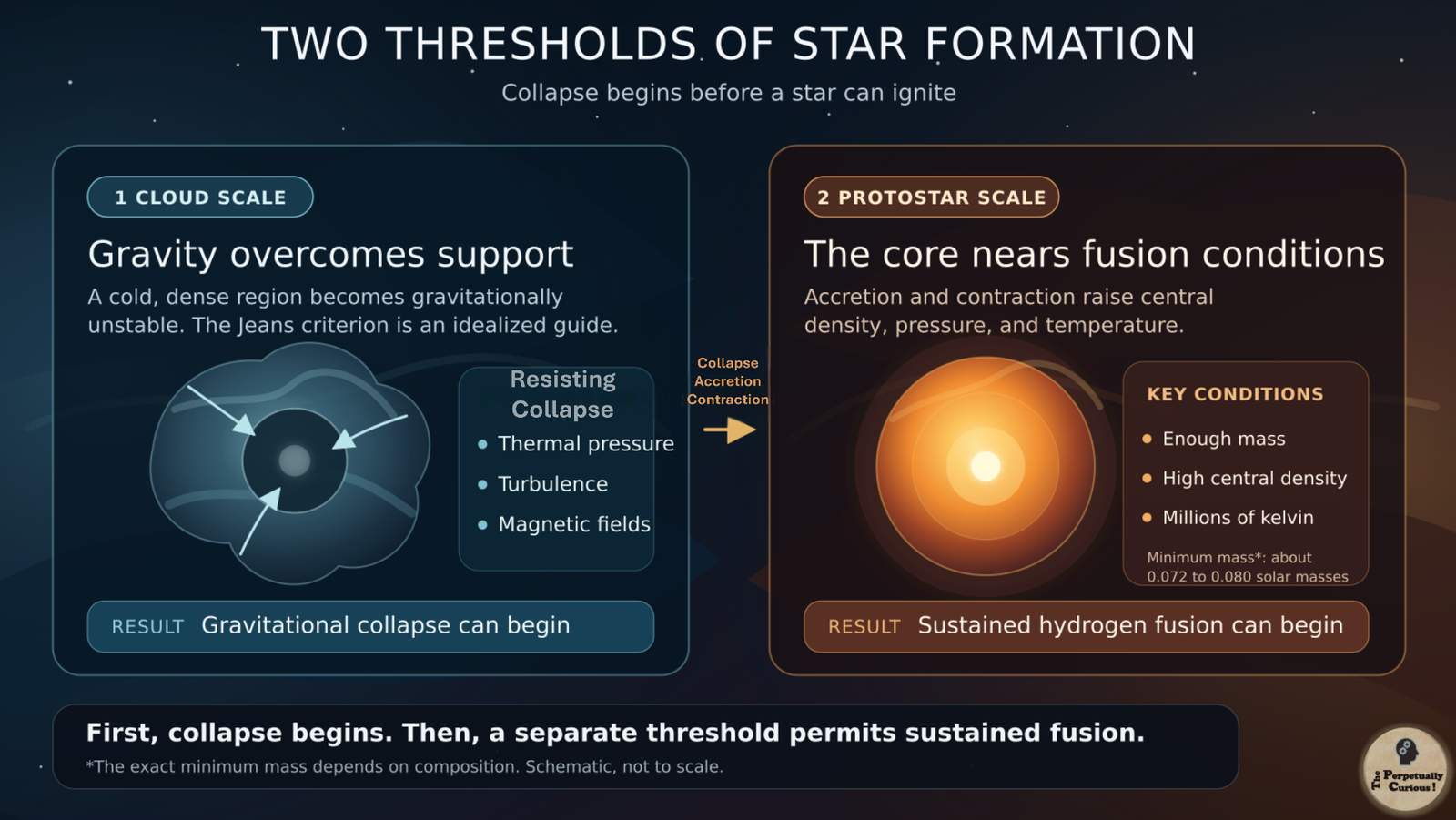
The recipe begins long before a protostar reaches fusion. A cold, dense pocket of a molecular cloud must first cross one threshold: gravity has to overcome support from heat, turbulence, and magnetic fields so collapse can begin. An idealized version of this balance is expressed by the Jeans criterion: at a given temperature and density, a region above a critical mass or size can become gravitationally unstable. Only after a protostar starts gathering mass does a second question arise: will it become massive enough to sustain hydrogen fusion and join the main sequence?
🏗️ The critical mass threshold
For the growing object itself, mass sets the next decisive boundary. A forming star generally needs about 0.072 to 0.080 times the mass of the Sun, depending on composition, or roughly 75 to 85 Jupiter masses, to sustain hydrogen fusion. This corresponds to about 3.2 to 3.5 × 10²⁹ pounds (1.4 to 1.6 × 10²⁹ kilograms). This hydrogen-burning minimum mass represents nature’s dividing region between true stars and substellar objects called brown dwarfs. For readers curious about why astronomers use the Sun as a standard unit, the article on solar mass explores this celestial yardstick in detail.
Why does mass matter so profoundly? Gravity is the engine that drives collapse and contraction. Once a dense cloud core becomes unstable, its own gravitational pull draws material inward. As the material falls, gravitational potential energy becomes heat, and the central region grows denser and hotter. The Orion Nebula, visible even through small telescopes, offers a striking view of this broader process, with young stellar objects at different stages embedded within glowing gas and dust.
The relationship between mass and stellar destiny extends far beyond ignition. More massive stars develop hotter cores, shine more brightly, and consume their nuclear fuel more rapidly. Stars near the minimum threshold become cool red dwarfs, the most common and longest-lived stars in the universe. Mass therefore helps determine whether sustained hydrogen fusion begins and, if it does, how the resulting star will live.
🔥 The temperature requirement
As gravitational contraction continues, the center of a protostar heats dramatically. For sustained hydrogen fusion to begin, core temperatures must climb into the millions of degrees. A Sun-like star reaches roughly 18 million degrees Fahrenheit (10 million kelvin) as it approaches stable hydrogen burning. Objects near the hydrogen-burning minimum mass can begin fusion at somewhat lower central temperatures because their greater central densities improve the probability of nuclear interactions.
Even these enormous temperatures would not be enough without quantum tunneling. Positively charged hydrogen nuclei repel one another electrically, but quantum mechanics gives a small fraction of close encounters a chance to cross the energy barrier and enter the range of the strong nuclear force. Fusion is therefore not the result of every collision. It emerges from vast numbers of particles, extreme conditions, and a small but persistent quantum probability.
The contrast with the starting cloud is extraordinary. Star-forming molecular clouds commonly remain near -442 to -424 degrees Fahrenheit (10 to 20 kelvin), only a little above absolute zero. Cold conditions reduce thermal motion, making it easier for gravity to overcome pressure support in sufficiently dense regions. Within structures such as the Eagle Nebula’s Pillars of Creation, dense pockets can continue contracting and warming as they move toward protostellar birth.
💫 The pressure cooker effect
Temperature alone does not determine whether fusion becomes self-sustaining. Continued contraction raises the protostar’s central density, temperature, and pressure while keeping nuclei in rapid motion. Quantum tunneling then gives a small fraction of proton collisions a chance to fuse. Pressure is part of the core’s physical state, but pressure gradients also resist further compression. Gravity must overcome that support during collapse, while energy from sustained fusion later helps the star establish hydrostatic equilibrium.
At these temperatures, hydrogen is no longer an ordinary gas of intact atoms. Electrons separate from atomic nuclei, producing plasma in which charged particles move at tremendous speeds. Star-forming regions such as the Carina Nebula show the external environments in which young massive stars emerge, although the conditions deep within their cores must be inferred through observation, physical theory, and stellar models.
As contraction proceeds, central temperature, density, and pressure rise together. When hydrogen fusion supplies energy at a rate capable of supporting the star over long periods, the object moves from its protostellar and pre-main-sequence stages toward stable main-sequence life. Gravity continues pulling inward, while pressure gradients supported by the hot interior act outward. This sustained balance is hydrostatic equilibrium, the condition that allows a star to shine steadily for millions, billions, or even trillions of years.
💧 The essential fuel: hydrogen
Even with sufficient mass, temperature, and density, a star cannot sustain its light without fuel. Hydrogen, the most abundant element in the universe, serves as the primary fuel during the main-sequence phase. Through a sequence of nuclear reactions, hydrogen nuclei ultimately combine to form helium, releasing energy because the final products have slightly less mass than the starting particles.
The Rosette Nebula and other large molecular clouds contain enough gas to form hundreds or thousands of stars. Yet only part of that material enters stars. Some remains in the surrounding cloud, some settles into circumstellar disks, and some is carried away by jets, winds, radiation, and later feedback from young stars.
In Sun-like and lower-mass stars, hydrogen fusion proceeds mainly through the proton-proton chain. In more massive stars, the carbon-nitrogen-oxygen cycle becomes increasingly important and is often dominant above roughly 1.3 solar masses, depending on composition. These reactions convert a small fraction of mass into energy and establish the long main-sequence chapter of a star’s existence. Over cosmic time, differences in mass and fusion rate shape how stars age over billions of years.
Mass, heat, density, and hydrogen define the route toward a main-sequence star. Yet they do not act in a vacuum. The surrounding cloud controls how quickly collapse proceeds, how much material reaches the center, and whether the outcome is one star, a multiple system, or a wider group.
🎭 The wider conditions that shape stellar birth
The broad physical requirements are only the beginning. Molecular clouds are structured, turbulent environments rather than uniform reservoirs. Their temperature, density, composition, geometry, motion, and magnetic fields influence where collapse begins, how matter moves inward, and what kind of stellar system emerges.
🎬 Initial conditions: setting the stage
Every star-forming region carries a distinctive combination of temperature, density, turbulence, geometry, and available mass. Relatively quiescent regions such as the Taurus Molecular Cloud are known especially for low-mass star formation in loose groups and associations, while complexes such as Cygnus X contain denser and more turbulent environments capable of producing massive stars and rich clusters. These examples illustrate tendencies rather than rigid rules, since each complex contains substantial internal variation.
Small differences can grow as collapse proceeds. A denser pocket may become gravitationally unstable before its surroundings. Turbulence can compress gas into filaments and knots, but it can also provide motion that resists collapse. The initial distribution of matter therefore helps determine how a cloud fragments, how many cores emerge, and how mass is divided among them.
Those starting conditions set the stage. Composition then changes how efficiently a cloud can cool, shield itself from radiation, and fragment.
✨ Metallicity: the cosmic seasoning
Astronomers call every element heavier than helium a metal. Although hydrogen and helium dominate a star-forming cloud, heavier elements and dust grains can make cooling more efficient and help shield dense regions from disruptive radiation. Cooling matters because gas that can release energy more effectively can remain cooler as it contracts, encouraging fragmentation into smaller structures.
Once collapse is underway, composition also affects opacity, which describes how readily radiation moves through matter. Atoms, ions, molecules, and dust can absorb and re-emit photons, changing how energy escapes from a forming star and its surroundings. The Large Magellanic Cloud provides a nearby laboratory for studying star formation at lower metallicity than much of the Milky Way.
The first generations of stars formed before heavy elements and dust became common, so their cooling and fragmentation pathways differed from those in present-day molecular clouds. For the wider background of that early universe, the cosmic microwave background preserves a much earlier record of the conditions from which later cosmic structure grew. Composition changes the available pathways, while magnetic fields help organize how matter moves through the cloud.
🧲 Magnetic fields: the invisible sculptors
Magnetic fields thread molecular clouds and interact with ionized particles embedded in the gas. Their influence can guide material along field lines, alter the rate and direction of collapse, and help transfer angular momentum outward. They do not act as a simple switch. Their importance varies with density, geometry, turbulence, and the degree to which neutral gas remains coupled to charged particles.
Observations of dense collapsing regions show that gravity can increasingly reshape local magnetic-field structures as material concentrates, even while magnetic fields continue to influence the larger cloud. This changing balance helps explain why stellar birth is neither an instantaneous free fall nor a perfectly regulated sequence. Modern observatories capable of probing cold, dust-shrouded regions are explored further in how space telescopes reveal hidden wavelengths.
Magnetic fields also connect directly to another challenge. As a cloud core contracts, conservation of angular momentum makes rotation increasingly important.
💫 The dance of rotation
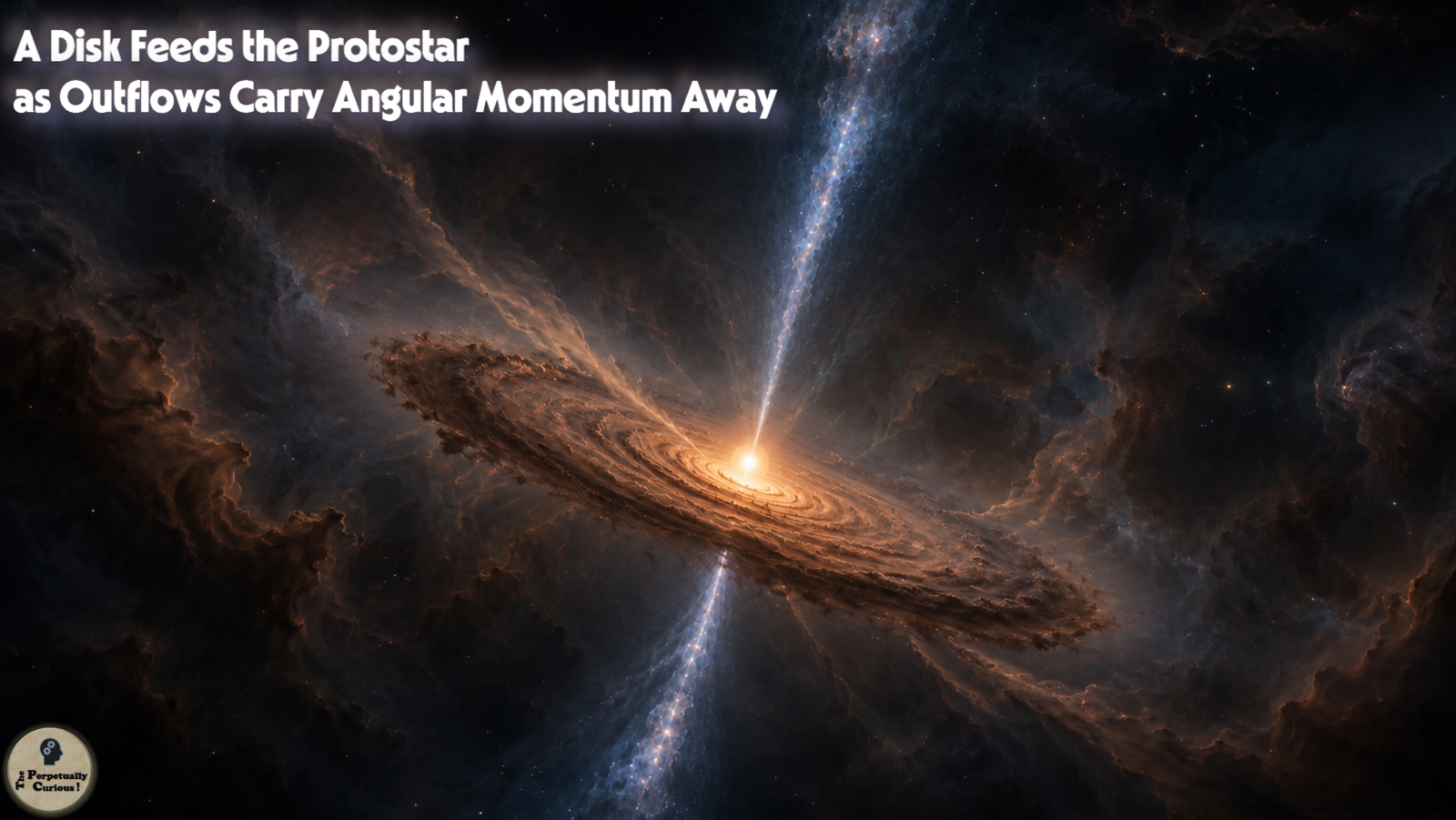
As material falls inward, conservation of angular momentum causes it to rotate faster, much like a figure skater drawing in extended arms. The infalling matter cannot simply collapse radially into a point. Much of it flattens into a rotating circumstellar disk around the growing protostar, where gravity, pressure, magnetic fields, turbulence, and orbital motion continue their negotiation.
This creates an angular-momentum barrier. Without ways to transport angular momentum outward, rotation would make it difficult for material to keep moving toward the central object. Magnetic braking, gravitational interactions within the disk, disk winds, and bipolar outflows can carry away part of that angular momentum. These processes allow some matter to accrete onto the protostar while other matter is redirected into the surrounding environment.
The disk around the young star HL Tauri, imaged in remarkable detail by ALMA, shows how rotation shapes a forming stellar system. Gaps and rings within such disks reveal that stellar birth and planetary assembly are closely connected, although the interpretation of individual structures remains an active area of research. The same continuity between a newborn star and its surrounding disk appears in the story of how the young Sun and Earth formed, where stellar birth and planetary assembly become consecutive chapters of one process.
⚡ External triggers and feedback: the cosmic spark
Some clouds also receive an external disturbance. Expanding ionization fronts, stellar winds, supernova shocks, spiral structure, and galactic interactions can compress gas enough to promote local collapse. The same feedback can also heat, stir, or disperse a cloud, so its effect is conditional rather than uniformly generative. Supernova 1987A is a well-studied example of shock energy moving through surrounding material, but it is better treated as evidence of powerful feedback than as direct proof that one particular neighboring cloud was triggered into forming stars.
Star formation is therefore part of a larger exchange rather than a one-way chain. Earlier generations return energy and enriched matter to their surroundings. In some regions that feedback prepares dense pockets for later collapse; in others it interrupts the process. Stellar death can help shape future stellar birth, but it does not guarantee it.
🌟 The moment of ignition: when stars begin to shine
By this point, the cloud-scale question has become a stellar one. If collapse and accretion have delivered enough mass, and if angular momentum has been transported outward, the protostar’s center can approach the conditions for sustained hydrogen fusion.
When fusion becomes an enduring energy source, the outward pressure supported by the hot interior can balance gravity’s inward pull over long timescales. The object does not stop changing, but it enters a comparatively stable phase as a hydrogen-burning main-sequence star. This transition is not a single visible flash. It is a physical change in the dominant energy source and internal balance of the forming star.
The journey takes different amounts of time for different masses. Massive stars can reach the main sequence in only a few million years, sometimes while still deeply embedded in their natal material. Sun-like stars require tens of millions of years, while the lowest-mass hydrogen-burning stars may require several hundred million years and, near the stellar boundary, about a billion years or longer to settle fully onto the main sequence. Young stellar objects in and around the Trapezium Cluster of the Orion Nebula reveal multiple stages at once, from embedded protostars to newly visible young stars.
Astronomers cannot watch one star complete the entire process within a human lifetime. Instead, they compare many stellar nurseries and young objects, using each as a frame in a much longer sequence. In this way, regions scattered across the galaxy become a collective record of stellar birth.
🎨 Beyond the recipe: understanding stellar diversity
Ignition marks a shared threshold, not a shared destiny. The mass assembled during formation now becomes the main clock and architect of the star’s future. Red dwarfs only modestly above the hydrogen-burning minimum can shine for trillions of years, while massive blue stars burn brilliantly and exhaust their core fuel in only a few million years.
Not every collapsing core produces a solitary star. Fragmentation within a cloud or disk can form binary and multiple systems whose members orbit a common center of mass. Interactions among growing stars, disks, and surrounding gas can alter their masses, separations, and eventual orbits. The broad recipe is shared, but the final arrangement can differ profoundly.
Stars of different masses build many elements through fusion and return some of them to space through winds and explosions. Other processes, including neutron capture in evolved stars, stellar explosions, and neutron-star mergers, contribute many heavier nuclei, so no single stellar pathway builds the entire periodic table. Across successive generations, this enrichment changes the material available for later stars, planets, atmospheres, and living systems.
The universe also contains objects that test the boundaries of the recipe. Brown dwarfs can emerge from collapse but never sustain ordinary hydrogen fusion. Very massive stars grow despite intense radiation and outflows. Multiple systems show that a single cloud core does not always lead to a single stellar outcome. These variations do not weaken the physical picture. They reveal how many paths the same underlying forces can take.
As stars mature and disperse from their birthplaces, their light contributes to the wider patterns seen from Earth. Some become part of the familiar constellations traced across the sky, even though most constellation stars are not physical companions and did not form together. Their scattered light stands against the apparent darkness of space, connecting the physics of stellar birth to one of humanity’s oldest views of the cosmos.
✨ Conclusion: the continuing story of stellar birth
Understanding star formation connects cloud-scale physics to the long evolution of galaxies. Every star records a temporary balance: gravity gathered the material, cooling allowed collapse to deepen, rotation and magnetic fields shaped the inflow, and fusion eventually supplied the energy that supports the new star.
From molecular clouds in the Milky Way to stellar nurseries in distant galaxies, the same broad principles appear again and again, but never as an identical script. Mass, composition, turbulence, magnetic fields, rotation, and environment shape each outcome. The result may be a red dwarf, a Sun-like star, a massive blue star, a binary system, or a brown dwarf that remains below the hydrogen-burning boundary.
The recipe began in cold darkness, with gravity working patiently through gas and dust. It ends not with a single finished object but with continuity: a star, a disk, possible worlds, and matter that may one day return to the next generation of stellar birth.
The cosmos continues to reveal objects that blur familiar boundaries, reminding us that nature often works through ranges and transitions rather than sharp categories. Each discovery adds another verse to the long story of stellar birth, a story that has unfolded since the universe’s earliest generations and continues wherever cold clouds gather enough matter for gravity to begin again.
Pass this article along to someone curious and let the learning travel.
💡 Did You Know
🌫️ A protostar can be nearly invisible in ordinary light even while it brightens from within. Dust absorbs much of its visible radiation and reradiates that energy at infrared and submillimeter wavelengths, which is why modern observatories can reveal stellar birth inside clouds that look dark to human eyes.
🚀 Jets from newborn stars can stretch for light-years, far beyond the small disks that launch them. Where the outflow strikes surrounding gas, shock-heated knots can glow, revealing the activity of a deeply buried protostar even when the young object itself remains hidden by dust.
What distinguishes a brown dwarf from a hydrogen-burning star?
Brown dwarfs can form through gravitational collapse broadly similar to low-mass stars, but they do not become massive enough to sustain hydrogen fusion in their cores. Some briefly fuse deuterium, depending on mass and composition, yet that short-lived reaction does not make them main-sequence stars. A focused guide to the boundary between brown dwarfs and the smallest stars explores this threshold in greater depth.
How long does it take for a star to form?
The timescale depends strongly on mass. Massive stars can reach the main sequence in a few million years, Sun-like stars require tens of millions of years, and the lowest-mass hydrogen-burning stars may require several hundred million years, reaching about a billion years or longer near the stellar boundary. The initial gravitational collapse and embedded protostellar stages occupy only part of that longer journey.
Can stars form in isolation, or do they always form in groups?
Many, and probably most, stars form in groups, associations, or clustered environments within molecular clouds. Some low-mass stars form in small, relatively isolated clouds such as Bok globules, but even apparently solitary stars may have originated near siblings that later dispersed.
What happens to material that does not become part of the star?
Some material remains in a circumstellar disk, where planets, moons, asteroids, and comets may eventually form. Other material is carried away by jets, winds, radiation, and outflows. Young stars can also heat, ionize, or disperse the cloud from which they formed.
Why do some regions of space form stars while others do not?
A region must become sufficiently cold, dense, and gravitationally bound for collapse to overcome thermal pressure, turbulence, rotation, and magnetic support. Regions that remain too warm, diffuse, turbulent, or strongly supported may resist collapse. Local conditions can also change over time as clouds collide, cool, fragment, or experience stellar feedback.
How do astronomers observe star formation when it takes millions of years?
Astronomers compare many clouds, protostars, disks, and young stars at different stages. Infrared, radio, submillimeter, visible-light, and X-ray observations reveal different parts of the process. Together, these objects form a statistical sequence, much as a forest containing seedlings, mature trees, and fallen trunks reveals a life cycle that no observer can watch from beginning to end.
What role does dark matter play in star formation?
Dark matter helps shape galaxies and the large-scale structures in which ordinary matter gathers, but it does not directly take part in the gas cooling, chemistry, pressure, magnetic fields, or fusion that form an individual star. A broader discussion of the evidence for dark matter explains how its gravitational effects are inferred.
Why is star formation often concentrated in spiral arms?
Spiral arms often contain or gather large reservoirs of molecular gas, and their changing gravitational environment can compress or reorganize that gas. Young, bright stars then make active regions of the arms especially visible. However, spiral structure is not governed by one universal fixed-wave mechanism, and observations show that some arms and clusters are transient or dynamically complex. Star formation also occurs outside spiral arms, so the relationship is a concentration and tendency rather than an exclusive rule.
What determines whether a molecular cloud forms one massive star or many smaller stars?
Fragmentation depends on temperature, density, turbulence, magnetic fields, geometry, rotation, composition, and the rate at which material flows into the cloud or core. Cooler gas often fragments more readily, while turbulence can either create dense pockets or support a region against collapse. The outcome is therefore statistical rather than governed by one simple variable.
How do binary star systems form from a collapsing cloud?
A rotating cloud core can fragment into two or more gravitationally bound condensations. A massive circumstellar disk can also become unstable and form a companion. Later accretion and gravitational interactions may change the members’ masses and orbits, so the observed binary system records both its initial fragmentation and its later evolution.
What is the maximum mass a star can have?
There is no single sharply measured upper boundary comparable to the hydrogen-burning minimum mass. The most massive known stars reach roughly 150 to 200 solar masses, while some inferred initial masses in exceptionally dense environments extend to a few hundred solar masses. The estimate depends on distance, multiplicity, mass loss, evolutionary stage, and whether present or initial mass is being compared. Radiation, winds, outflows, and interactions all make further growth difficult.
What exactly is a stellar nursery?
A stellar nursery is a region of gas and dust where dense pockets are forming stars. Famous examples include the Orion Nebula and the Eagle Nebula. A single nursery can contain cold starless cores, embedded protostars, circumstellar disks, newly revealed young stars, and older members whose radiation and winds are reshaping the remaining cloud.
Why do red dwarfs last so much longer than massive stars?
Red dwarfs have cooler cores and consume hydrogen much more slowly than massive stars. The lowest-mass red dwarfs are also fully convective, allowing a large fraction of their hydrogen to circulate through fusion-capable regions. Massive stars have much hotter cores and far higher fusion rates, so they use their accessible fuel in millions of years rather than the trillions of years predicted for the smallest red dwarfs.
🌠 Share the cosmic wonder
Illuminate minds across the cosmos.
We invite you to share this stellar journey with space enthusiasts, students, and curious minds. A deeper understanding of how stars form can change the way a familiar night sky is seen, turning each point of light into the visible outcome of a long and intricate physical transformation.
“The Cosmic Recipe: Understanding the Physical Criteria for Star Formation 🌟.” The Perpetually Curious!, August 2026.
https://www.theperpetuallycurious.org/articles/how-stars-form/Continue Exploring
For the curious mind: want to explore this theme through a few questions? Visit the Classic Quiz Studio, nestled under Explorations opens in a new tab ,and see where a few well-placed questions lead: Cosmic Exploration Quizzesopens in a new tab
For what comes next
Site Updates gathers occasional notes, new additions, and ways to keep in touch. RSS brings new publications to your feed reader in chronological order.
Choose the path that speaks to you, and let the next curiosity find you wherever your wondering takes you.