

One branch glows red while the tree beside it turns gold. Farther down the path, leaves have settled into russet brown. The same season has reached them all, yet each tree answers in its own colors. Beneath that familiar autumn scene, living leaves are changing their chemistry: green fades, pigments once hidden become visible, and some leaves make new red pigment before they fall.
The display begins with a quieter task. Many temperate deciduous trees are recovering useful materials from leaves they will soon shed. To understand the colors, we first need to follow the green as it disappears.
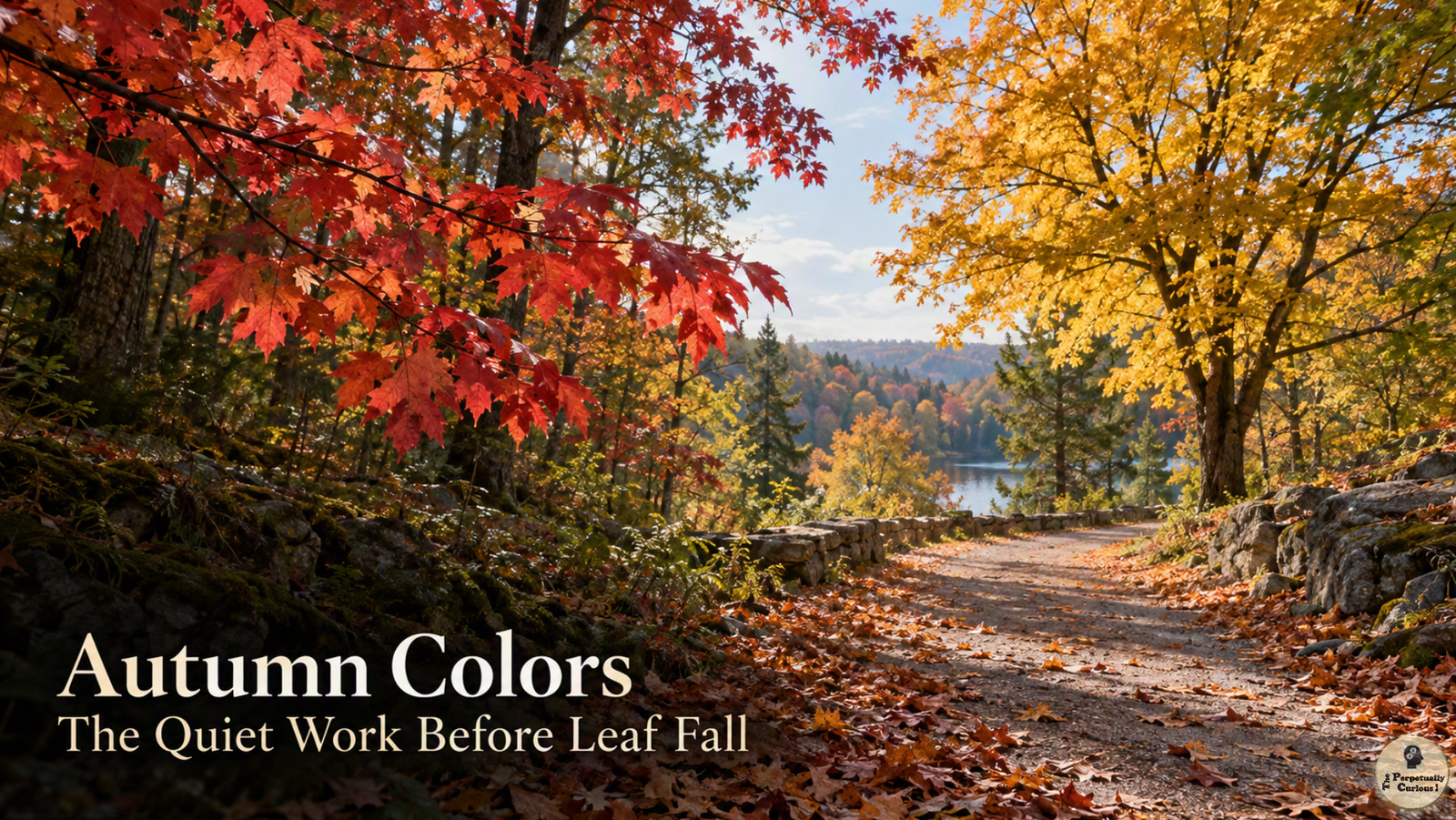
The season gathers its colors and lets them drift into quiet places.
Each leaf carries a small record of light and time.
In their falling, the forest remembers its own slow turning.
🍃 The green that begins to fade
During the growing season, chlorophyll absorbs light used in photosynthesis. Its abundance makes most leaves appear green and masks much of the yellow and orange already present. As days shorten and conditions shift, a leaf may enter senescence. This is an active, regulated process: the leaf dismantles parts of its photosynthetic machinery and transfers some reusable nutrients back into the tree.
Day length helps many trees keep seasonal time, while temperature, water availability, and species traits influence when the change begins and how it unfolds. Autumn color is one visible expression of plant timekeeping. As chlorophyll breaks down, its retreat makes another part of the leaf’s palette easier to see.
🎨 A palette revealed and renewed
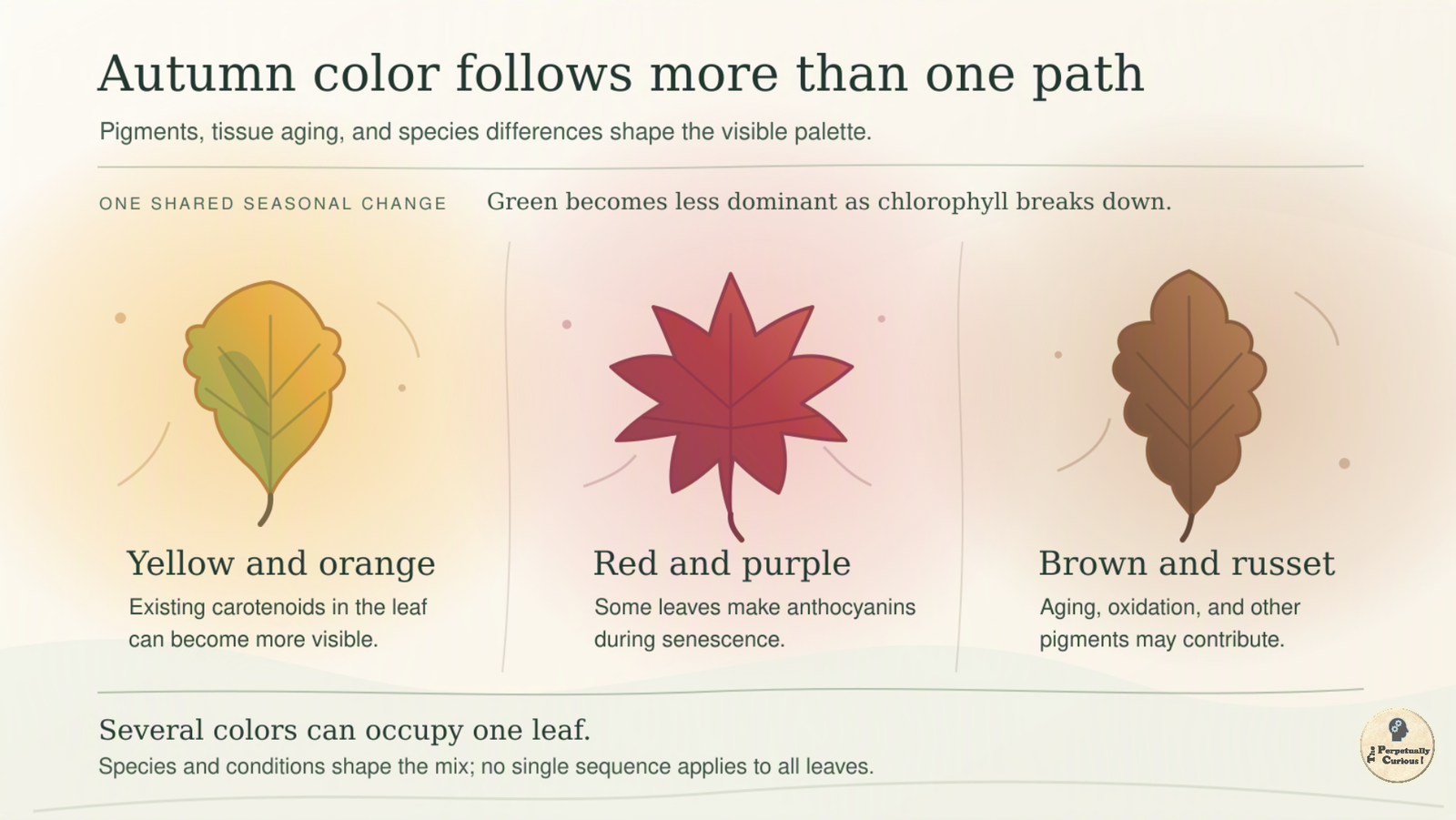
Carotenoids help leaves handle light during the growing season. As green declines, these existing pigments can show through as yellow and orange. Xanthophylls commonly contribute yellow, while carotenes can contribute yellow to orange. The proportions differ between leaves, and remaining chlorophyll can still affect the color we see.
Red follows a different path. In many species that turn red, autumn leaves synthesize anthocyanins during senescence. Light, cool conditions, and available sugars can favor their production, although a leaf must also have the biological capacity to make them. Anthocyanins may look red or purple depending on their cellular surroundings and the other pigments present.
Brown is less like a hidden final color waiting to be uncovered. It can develop as tissues age, their compounds oxidize, and cells die. Tannins may contribute to some brown tones, but no single pigment explains every russet leaf.
Leaves do not all follow the same path to color. Even for a species capable of vivid reds, pigment chemistry alone cannot tell us how a particular autumn will look. The conditions around each tree also matter.
🌤️ Why the display changes each year
Sunny days and cool nights can favor red anthocyanins in trees capable of producing them. There is no single nighttime temperature that turns every forest scarlet. Earlier conditions matter, too. Mild water stress may favor red pigment in some trees, while severe drought can damage leaves or bring them down before much color develops. Wind and heavy rain can shorten the show by removing leaves that had already changed.
Weather helps explain differences between years. Trees on the same path still differ under a shared sky because each species has its own capacity and timing for pigment changes.
🌳 Why neighboring trees take on different colors
Many maples can turn red or orange; aspens and birches often show yellow. Oaks can move through red, russet, and brown, depending on species and conditions. Even within one tree, leaves need not change uniformly. Sunlit and shaded parts of a crown may experience different conditions, while each leaf can carry its own mixture of pigments.
The diversity of leaf shapes is another sign that neighboring trees belong to different lineages, although outline alone does not predict autumn color. The species present help determine the landscape’s palette; weather modifies the colors and their timing. With that difference in mind, the next question is what the tree gains as a leaf approaches its end.
♻️ What a tree recovers before a leaf falls
As a leaf senesces, a tree can recover some of its nutrients, including nitrogen and phosphorus, before shedding it. The share recovered varies widely among species and conditions. A separation zone develops at the base of the leaf stalk during this wider process and eventually allows the leaf to detach. Recovery and separation overlap; the leaf is not simply sealed off first and emptied afterward.
In some species, anthocyanins may help protect the remaining working tissues from excess light while nutrient recovery continues. Experiments support a protective role in certain settings, while other tests have challenged a particular light-screen explanation in sugar maple. Scientists continue to investigate how the pigment works across species and why red autumn leaves evolved. The recovery of nutrients is well established; a universal purpose for every red leaf is not.
Nutrient recovery is only part of the transition; the leaf is also preparing to leave the tree. In climates with cold winters, dropping broad leaves can help many deciduous trees limit water loss and avoid the cost of maintaining them when liquid water may be harder to obtain. Other trees retain protected leaves or needles, and trees in different climates can follow other seasonal schedules. Color accompanies one particular strategy, rather than a rule for every tree.
When a leaf finally separates, the tree has kept part of its investment. The rest of that leaf begins a second life below the canopy.
🍂 What happens after the fall
Fallen leaves offer habitat and material for organisms on and beneath the ground. Some insects shelter in the litter through colder months, while fungi, bacteria, and small invertebrates help break it down. Nutrients move through the soil ecosystem as that work proceeds, at rates shaped by leaf chemistry, moisture, temperature, and the organisms present. Some leaves remain recognizable long after others have disappeared.
The path from green canopy to forest floor is a cycle of recovery and return. Autumn’s visible colors are a brief part of that longer movement, made legible for a moment in every leaf that changes.
🌅 Reading the season in a leaf
The red branch, the golden tree beside it, and the brown leaves along the path no longer tell quite the same story. Each color reflects a meeting of species, chemistry, and weather; each falling leaf marks a shift from the work of the canopy to the life below it. On an autumn walk, the differences between neighboring trees can make that quiet passage easier to see.
Pass this article along to someone curious and let the learning travel.
💡 Did you know?
🍁 More than one autumn color can occupy a single leaf. Chlorophyll, carotenoids, and, in some species, anthocyanins may overlap as different areas change, so a leaf need not pass through one uniform sequence of colors.
🌲 In North America, tamaracks, or American larches, are conifers that turn golden yellow and drop their needles in fall. Needle-shaped foliage does not always mean a tree remains evergreen.
🏞️ In Japan, momijigari is the practice of viewing autumn foliage. It is one way people have given time and attention to seasonal color, beyond the chemistry that produces it.
Why do leaves change color in fall?
As many deciduous trees enter leaf senescence, chlorophyll breaks down. Existing yellow and orange carotenoids become more visible, while some leaves make red or purple anthocyanins. The resulting color depends on the species and the conditions around the leaf.
Does one cold night make a tree turn red?
Cool conditions can favor red pigment production in some trees when leaves also receive light and retain the capacity to make anthocyanins. No universal temperature threshold applies, and one night rarely explains an entire canopy.
Why do some leaves turn brown rather than red?
Not all trees make autumn anthocyanins. Brown may appear as leaf tissues age or die and some of their compounds oxidize; it is not always a pigment that was hidden beneath green.
Why do deciduous trees shed their leaves?
For many trees in cold seasonal climates, shedding broad leaves helps reduce winter water loss and the cost of maintaining vulnerable foliage. Nutrient recovery before leaf fall lets the tree retain part of its earlier investment. Trees in other climates may shed leaves in response to different seasonal conditions.
Can a leaf fall while it is still green?
Yes. Species vary, and stresses such as drought or an early freeze can sometimes bring leaves down before their usual color develops.
Why do some oaks and beeches keep brown leaves through winter?
This is called marcescence. Dead leaves remain attached when the usual separation process is delayed or incomplete, sometimes falling as new growth begins. These leaves are not continuing to photosynthesize like green evergreen leaves.
Does a warmer climate always delay fall color?
No. Warm autumn weather, conditions earlier in the growing season, day length, drought, and species differences interact. Their combined effects can shift the timing, intensity, or length of a local display in different ways.
Can streetlights change when nearby trees turn color?
Artificial light at night may delay leaf aging or color change in some urban trees, but responses vary by species, lighting, and local conditions. A tree beside a streetlight will not necessarily stay green longer than every tree nearby.
🍁 Let the colors travel
If this story brought a familiar autumn scene into a new light, we kindly invite you to share it with friends and colleagues. Your support helps another curious reader notice the quiet work beneath the color.
“When Leaves Let Go: Why Autumn Colors Turn Red, Gold, and Brown.” The Perpetually Curious!, September 2026.
https://www.theperpetuallycurious.org/articles/why-do-leaves-change-color/Continue Exploring
For the curious mind: want to explore this theme through a few questions? Visit the Classic Quiz Studio, nestled under Explorations opens in a new tab ,and see where a few well-placed questions lead: Botanical Wonders Quizzesopens in a new tab
For what comes next
Site Updates gathers occasional notes, new additions, and ways to keep in touch. RSS brings new publications to your feed reader in chronological order.
Choose the path that speaks to you, and let the next curiosity find you wherever your wondering takes you.