

To someone crossing a river, a bridge can seem like a finished thing. In the forested hills of Meghalaya in northeastern India, some crossings emerge slowly from living trees. Roots are guided over water, joined to other roots, and tended as they thicken. The Khasi and Jaintia communities who developed these living root bridges work with a material that continues to grow after people begin walking across it.[1]
India’s cultural-landscape submission to UNESCO uses the local name Jingkieng Jri for these structures.[2] A photograph can show the crossing at a glance. Understanding how it endures takes a closer look at the tree, the connections within the bridge, and the people whose care continues long after its first crossing.
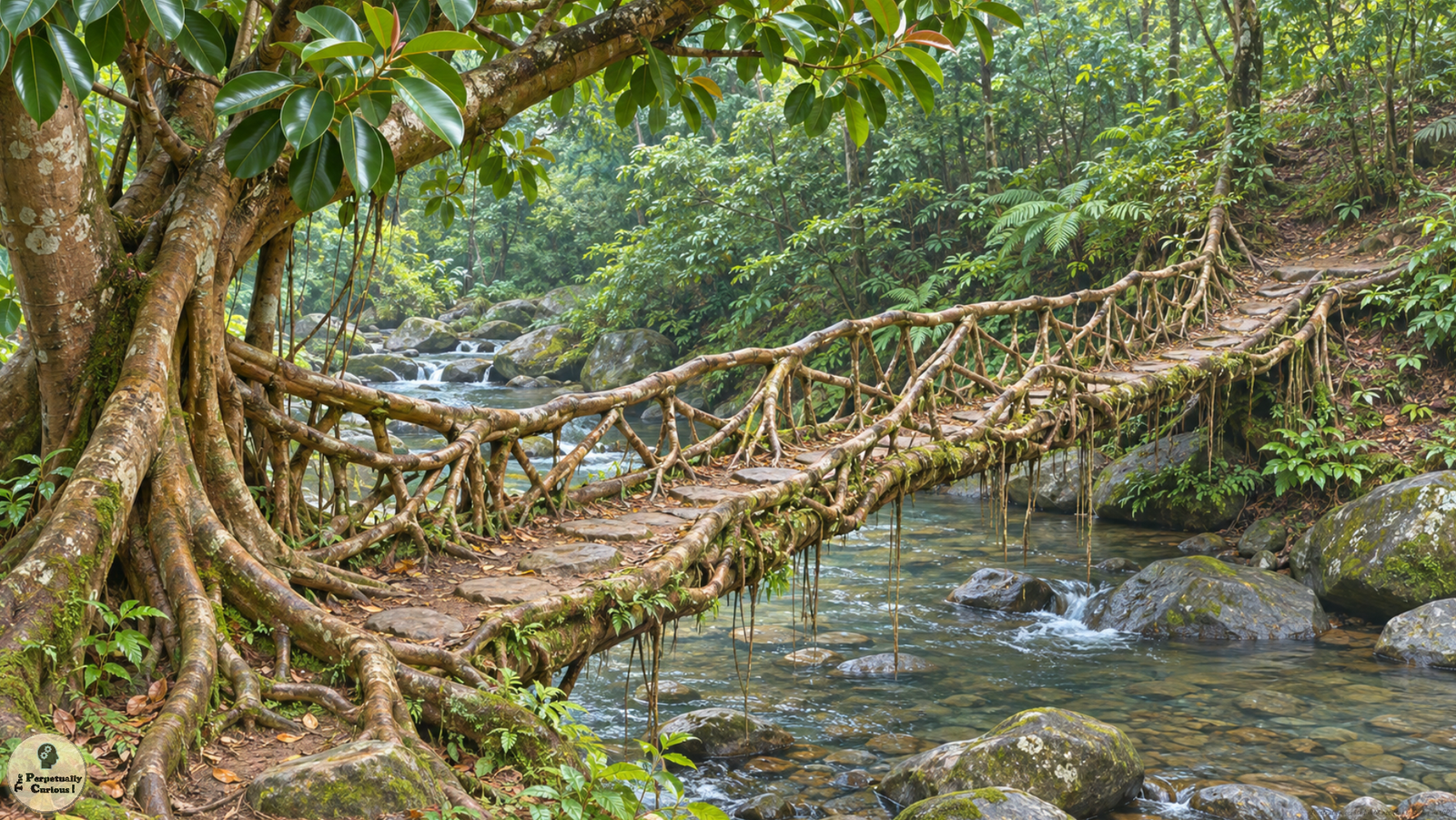
Some paths are built to endure the years. Others endure because they continue becoming themselves.
Between riverbanks and roots, the bridge remains what it has always been: not a finished thing, but a conversation carried forward through time.
🌧️ A crossing shaped by the rains
Across southern Meghalaya, steep valleys and monsoon-swollen rivers make movement between settlements and fields a persistent challenge. A crossing here belongs to a changing landscape: water levels rise, banks weather, and the conditions beneath a footpath can change with the season.
Living root bridges developed within this setting as practical links between homes, farms, villages, and markets. They are built through cultivation, with routes taking shape as living roots are positioned and maintained. The term “grown” captures the biology, but the bridge is also a work of skilled construction.
The landscape explains the need for a crossing. Growing one depends on the capacities of a particular kind of tree.
🌳 The tree that makes a bridge possible
The principal bridge-making species is Ficus elastica, the Indian rubber fig. It produces aerial roots, which develop above ground and can extend downward from its branches or trunk. Roots that reach suitable ground can establish themselves and thicken, becoming substantial parts of the tree’s supporting structure. The banyan’s aerial roots offer a related example: they can develop into pillars beneath spreading branches.
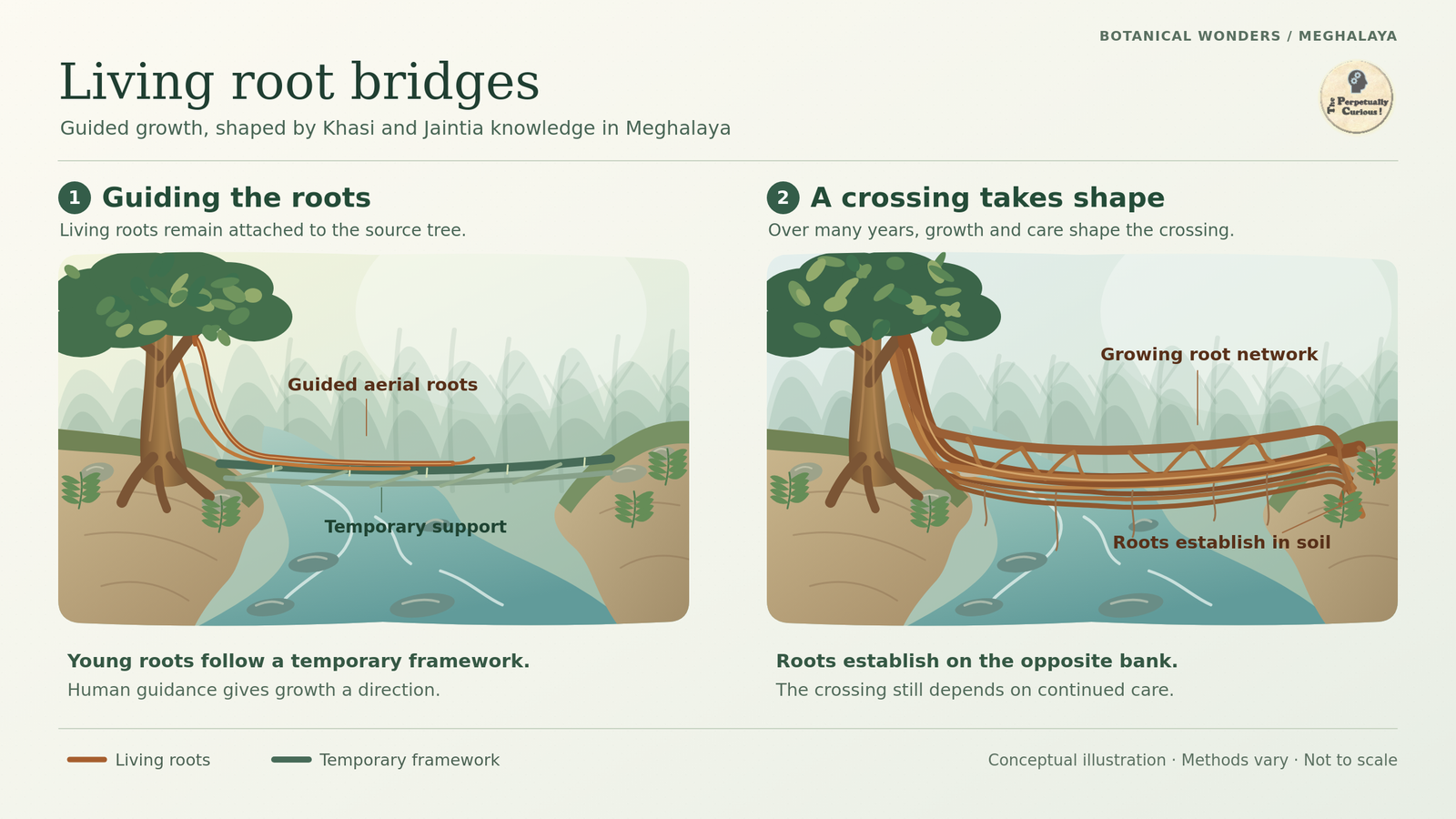
Bridge-makers redirect the aerial roots of Ficus elastica across a gap. Young roots can be guided while they are still pliable, allowing a tree’s natural growth to become the beginning of a path. They remain parts of living plants rather than becoming timber cut away from them.
That distinction explains both the promise and the patience involved. The crossing depends on growth, so its construction cannot be separated from the conditions that keep the trees alive.
🌉 Guiding a path across the water
Methods vary between sites. Bridge-makers may guide roots along wooden or bamboo frameworks, through channels made from areca palm trunks, or by directly positioning and intertwining them. The temporary supports establish a route while the living structure develops.
As roots reach the opposite bank and establish themselves, additional roots can be brought into the crossing. Development from a newly planted tree to a fully usable bridge can take several decades, with the interval depending on the span, growing conditions, and continuity of maintenance. There is no single construction timetable for every bridge.[3]
A photograph compresses that long process into one frame. It shows the path, while much of the work that made it possible remains outside the image: repeated visits, adjustments, and decisions about where the next root should grow.
Guidance brings the roots together. Their ability to become living connections adds another layer of strength.
🔗 When separate roots grow together
Roots in sustained contact can sometimes grow together through a process called inosculation. A crossing can therefore develop connections that go beyond the friction of a loose tangle. The roots may become joined by growth at their contact points.
This is related to plant grafting, although a root bridge is not assembled like an orchard tree with a selected shoot inserted onto a rootstock. Bridge-makers encourage connections within a growing network, using the plant’s capacity to form unions.
Not every contact becomes a successful union. Some roots remain separate, and some trained roots die before reaching the ground.[1] The bridge emerges through both biological growth and continued selection and guidance by its makers.
The resulting network helps explain why a bridge cannot be understood by looking at the thickness of one root alone. Its performance also depends on how its parts connect.
⚖️ Strength that develops, with limits
As living roots thicken, they add woody tissue. Their developing shape matters alongside their size: material placed differently within a root can change how it responds to a load.
In a 2019 field study, researchers documented differences between horizontally and vertically trained roots, including flattened and inverted T-shaped cross sections in some horizontal roots. The observations were consistent with adaptive growth influenced by orientation and mechanical loading, while the precise contributions of those influences remained questions for further study.[1]
Growth can reinforce a structure over time, but it does not follow that every footstep makes the bridge stronger.
Load-bearing performance belongs to the whole crossing: its roots, their connections, its anchorage, and its condition. The fact that a tree remains alive does not, by itself, show that every part of the crossing is sound.
Nor does a living network make damage impossible. Research records include accounts of bridges lost to floods, fires, and landslides. Continued growth offers possibilities for renewal, but it does not remove vulnerability.[3]
That dependence on condition brings another part of the bridge into view: the continuing work of its makers and maintainers.
🤲 The knowledge carried across generations
The bridge-making tradition includes choosing sites, nurturing trees, directing roots, and maintaining crossings within their surrounding landscape. India’s cultural-landscape submission to UNESCO describes this work as an intergenerational practice, linking physical structures with the knowledge and cooperation that sustain them.[2]
Maintenance can include guiding and tying roots, renewing material on the walking surface, and keeping approach paths usable. Arrangements differ between sites, with work undertaken by individuals, families, or communities.
This gives a bridge more than one history. The tree has an age, individual roots have ages, and the crossing has a history of use and renewal. Those timelines need not begin together. Accounts of very old bridges can preserve valuable community memory without providing an exact construction date.
The broader story of trees carrying time also distinguishes biological age from cultural continuity. For a root bridge, that distinction is especially useful: endurance involves living growth and the repeated human work that keeps a route usable.
Tourism adds another relationship. Visitors may bring income, while concentrated use can place pressure on crossings and their surroundings. The crossing’s role in village life remains part of its story as its audience widens.[3]
🏗️ What living architecture can learn
The practical knowledge used to guide these crossings also interests researchers studying botanical architecture. They examine how growth, branching, and living unions can participate in structural design, including how a structure can be assessed as its form changes. Meghalaya’s bridges offer an established example of working with these processes over long periods.
Their value as a reference does not make them a universal construction method. Climate, species, time, care, and the demands placed on a structure all shape what can grow successfully. A technique developed for a forest crossing cannot simply be enlarged into an urban building without new questions and evidence.
The deeper architectural idea is that a structure’s form can continue developing during its working life. In this setting, maintenance is also a form of making.
🌱 A path that remains unfinished
Seen from the bank, a living root bridge appears to hold a moment still: roots above water, a passage between trees. Yet its form carries the work of earlier hands and leaves room for hands still to come.
What appears to be a finished crossing remains a place of growth and care. People shape a path, then return to help it remain a path. Across the stream, the bridge carries a community’s movement. Through time, it carries the knowledge of how to keep growing.
💡 Did you know?
🌳 Some living root bridges incorporate roots from more than one Ficus elastica tree. A crossing can therefore develop as a joined network, rather than as roots extending from a single trunk.[3]
📏 Living root bridges vary greatly in size and form. The longest example measured in the 2019 field inventory was about 173 feet (52.7 meters), illustrating the range of crossings within the tradition rather than a standard bridge size.[1]
🌱 The same tradition of guiding living roots extends beyond bridges. Documented structures include ladders, steps, and platforms, showing how plant growth has been adapted to different needs within the landscape.[2]
🏠 The bridge-making Ficus elastica is also familiar as a rubber houseplant. Despite its name and historical use for latex, it is a different species from Hevea brasiliensis, the principal tree used in modern natural rubber production.[4]
🧱 A root bridge can include nonliving materials in its walking surface, such as stones or earth. “Living” describes its growing plant structure, rather than requiring every part of the crossing to be alive.[3]
Pass this article along to someone curious and let the learning travel.
How long does a living root bridge take to grow?
Development can take several decades from planting a tree to a fully usable crossing. The span, growing conditions, and regularity of care affect the timescale, so a fixed number of years can be misleading.
Do the roots remain connected to living trees?
Yes. The structural roots remain parts of living trees and can continue growing. The crossing is therefore different from a wooden bridge assembled from harvested timber.
Are some bridges hundreds of years old?
Some are reported to have histories extending across centuries, but precise ages are often uncertain. Community histories and other records help establish continuity; they do not necessarily date every root or identify a single year when construction began.
How much weight can a root bridge support?
There is no universal capacity for living root bridges. It depends on the particular crossing, its structural condition, and how it is loaded. A reported number of people on one bridge is not a general load rating.
Do root bridges grow stronger the more people cross them?
Not as a general rule. Roots can develop in ways consistent with a response to loading, but the field observations do not show that increasing foot traffic reliably strengthens a bridge. Growth over time, wear, damage, maintenance, and the condition of the whole crossing all matter.[1]
Is inosculation the same as grafting?
Both involve plant tissues forming a union. In a root bridge, neighboring roots may grow together where they are held in contact. Conventional horticultural grafting often joins a selected shoot or bud to a rootstock, giving a related biological process a different practical purpose.
Why is this tradition closely associated with Meghalaya?
The region’s wet monsoon climate, stream-cut valleys, Ficus elastica, and generations of Khasi and Jaintia knowledge have together shaped the tradition.[1] Its development involves the interaction of place, plant biology, and continued cultural practice. The suitability of this particular fig also depends on growing conditions; it is frost tender.[4]
💬 Let the story take root
If this meeting of plant life and human craft sparked your curiosity, we kindly invite you to share the article with friends and colleagues. A story of patient construction can travel much farther than the stream it crosses.
📘 Educational context
This article explains the botanical and cultural principles of living root bridges. It does not provide construction specifications or assess the condition or load capacity of any individual crossing.
Selected sources
- Ludwig F, Middleton W, Gallenmüller F, et al. (2019). Living bridges using aerial roots of ficus elastica – an interdisciplinary perspective. Scientific Reports, 9(1), 12226. [PMID: 31439904]
- Permanent Delegation of India to UNESCO. (2022). Jingkieng jri: Living Root Bridge Cultural Landscapes. Tentative List submission, UNESCO World Heritage Centre.
- Middleton W, Habibi A, Shankar S, et al. (2020). Characterizing Regenerative Aspects of Living Root Bridges. Sustainability, 12(8), 3267.
- Royal Botanic Gardens Victoria. (n.d.). Ficus elastica Roxb. HortFlora.
“Where Roots Become Roads: How Meghalaya’s Living Root Bridges Grow.” The Perpetually Curious!, November 2026.
https://www.theperpetuallycurious.org/articles/living-root-bridges-meghalaya/Continue Exploring
For the curious mind: want to explore this theme through a few questions? Visit the Classic Quiz Studio, nestled under Explorations opens in a new tab ,and see where a few well-placed questions lead: Botanical Wonders Quizzesopens in a new tab
For what comes next
Site Updates gathers occasional notes, new additions, and ways to keep in touch. RSS brings new publications to your feed reader in chronological order.
Choose the path that speaks to you, and let the next curiosity find you wherever your wondering takes you.