

A sheet of paper seems to offer almost nothing: a pale surface, a little weight, a space waiting for a mark. Yet a shopping list, a drawing, and a letter all depend on an intricate material hidden beneath that apparent simplicity.
In wood-based paper, part of the story begins with carbon taken from the air as a tree grows. Papermaking gives some of that plant material another form. Fibers that once belonged to a living structure become a surface on which people can leave traces of their own lives. How does something as solid as wood become something as thin and flexible as a page?
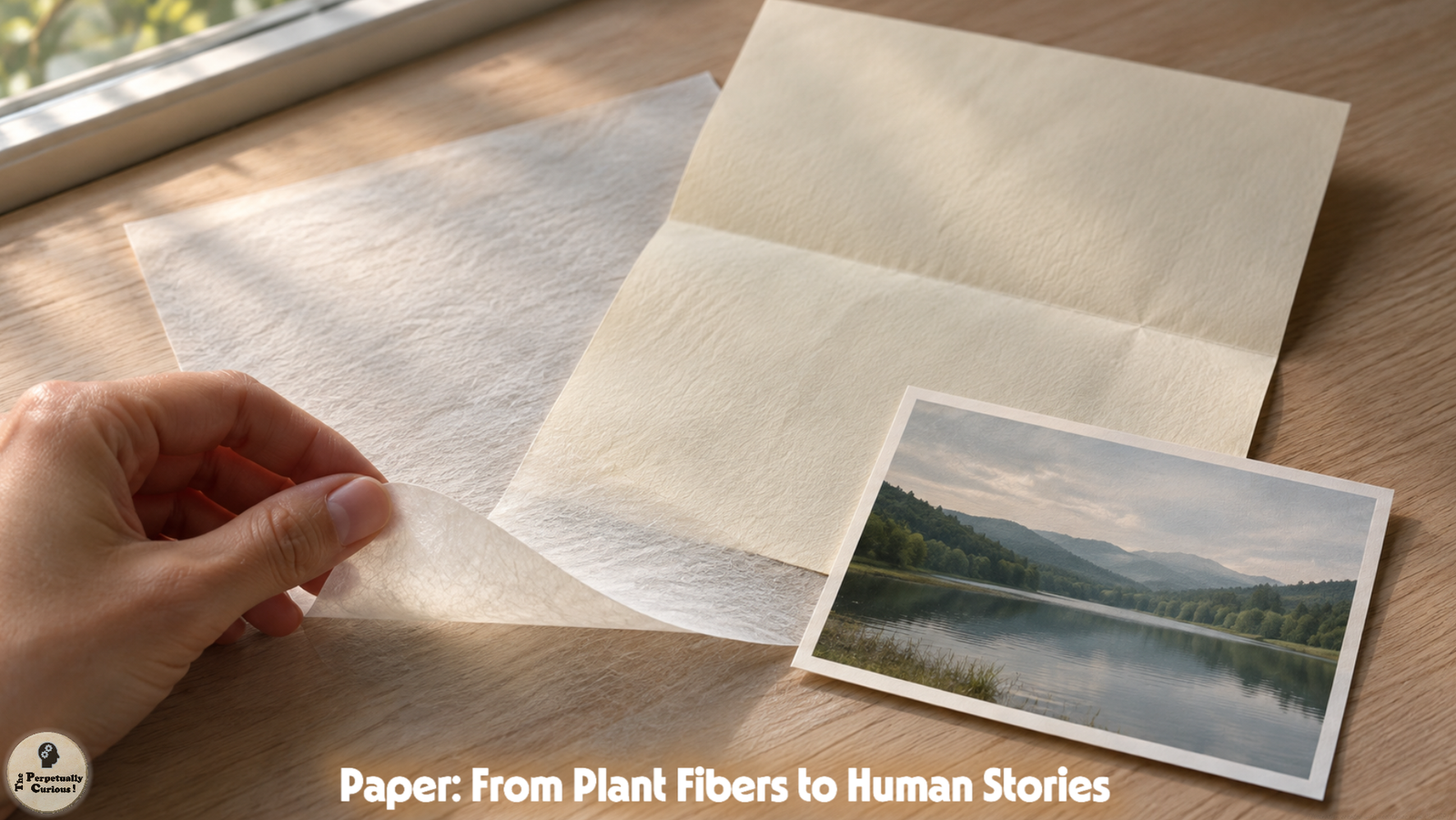
A tree once gathered light and air into living form.
Long after the wood is gone, its fibers may still carry a thought, a memory, or a familiar hand across time.
In that quiet transformation, matter becomes meaning.
📜 The discovery behind the page
Papermaking developed in China before the achievement traditionally associated with Cai Lun in 105 CE. The essential idea was to prepare plant fibers in water, gather them on a screen, and let the water drain away. Over time, the craft spread through Asia, into the Islamic world, and onward to Europe, changing as makers adapted it to available materials and local needs.[1]
Other writing surfaces followed different paths. Egyptian papyrus was formed from crossing layers of strips cut from the plant’s inner pith. It belongs to the broader history of plant-based writing materials, but its construction differs from a sheet formed from dispersed fibers. Each represents a distinct solution to making a writable surface.
Paper itself also developed many regional forms. Japanese washi traditions use inner-bark fibers from plants such as kozo, gampi, and mitsumata. European papermakers long relied on linen and cotton rags. The familiar association between paper and wood therefore tells only part of its history.
During the nineteenth century, continuous paper machines expanded production, and wood pulp became an increasingly important alternative to rags. Mechanization changed how sheets were formed, while pulping innovations broadened the raw materials that could supply them.[2]
Across handcraft and industry, the underlying discovery remains recognizable: plant fibers can be separated and brought together in a new arrangement. To understand why that arrangement holds, it helps to look inside the plant.
🌳 What a tree contributes
Wood contains cellulose, hemicellulose, and lignin. Cellulose consists of long chains of linked glucose units, organized into fine structures within plant cell walls. Hemicelluloses help connect and organize components of those walls, while lignin contributes rigidity and helps bind the woody structure together.
Papermaking usually preserves much of the fibrous cell-wall structure. It does not ordinarily dissolve wood into individual cellulose molecules and then weave those molecules into a page. The distinction matters because a paper fiber is already a complex structure, much larger than the molecules within it.
Different fibers bring different qualities. Softwood fibers are generally longer than hardwood fibers and can help provide strength, while shorter hardwood fibers can contribute to a smoother, more uniform surface. Makers often blend fibers to balance the properties a particular paper requires.
The first manufacturing problem is therefore to free useful fibers from the material surrounding them. That can be accomplished in more than one way.
⚗️ Releasing the fibers
Mechanical pulping uses grinding or refining to separate wood into pulp while retaining much of its lignin. Chemical pulping removes more of that lignin, generally producing a lower yield of pulp from the same amount of wood but fibers suited to strong, well-bonded sheets.
In the widely used kraft process, wood chips are cooked under pressure with an alkaline solution containing sodium hydroxide and sodium sulfide. The treatment breaks down and dissolves much of the lignin that holds the woody structure together. The resulting pulp is washed and prepared for further processing.[3]
Chemical pulp can still be brown. Bleaching, when required for the intended product, reduces the remaining colored material; making pulp and making it bright are related but separate tasks. Brown packaging paper is often deliberately left unbleached.
At kraft mills, the spent cooking liquid can also enter a recovery system that reclaims chemicals and uses the dissolved organic material as fuel.
Pulping produces the ingredients for a sheet. Giving those ingredients a coherent form requires water to play another role, first keeping fibers apart and then helping bring them together.
💧 How wet fibers become a sheet
Before sheet formation, pulp may be mechanically refined to make fibers more flexible and develop fine fibrils on their surfaces. This can increase contact between fibers, although excessive treatment can damage them or make water removal more difficult.
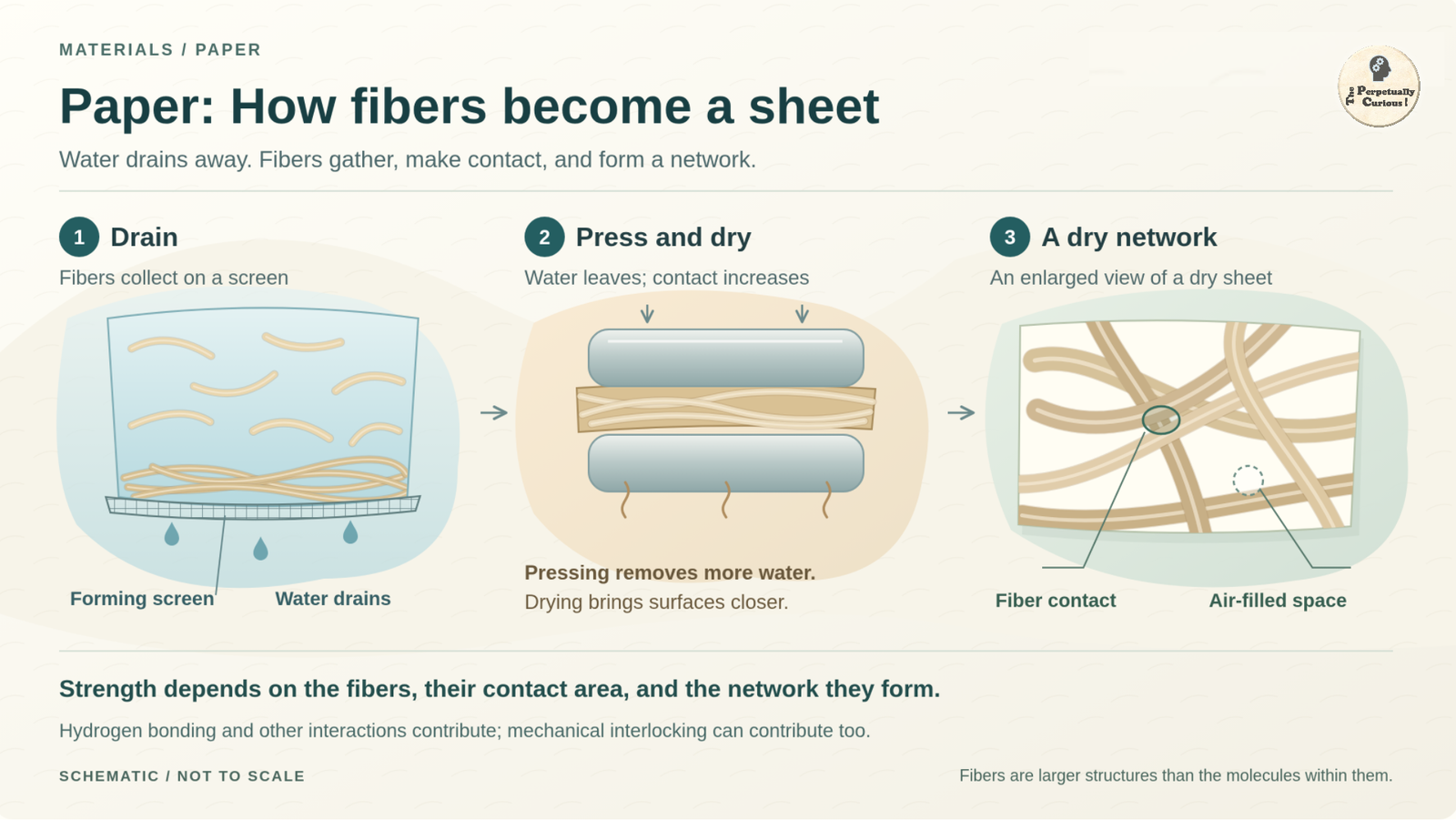
The prepared pulp is diluted with water and spread onto a forming screen or fabric. As water drains away, fibers accumulate into an overlapping mat. Pressing removes more water and increases contact, while drying draws neighboring surfaces closer together. Modern machines carry this sequence along a continuous moving web, which is eventually wound into rolls or cut into sheets.[2]
At those contacts, hydrogen bonding and other intermolecular interactions contribute to adhesion. Mechanical interlocking can contribute too. Paper strength depends on the fibers themselves, the area of contact between them, and the network they form, rather than on hydrogen bonds alone.[4]
The result is a sheet with both solid material and small spaces within it. That combination explains much of paper’s versatility. A useful page needs a connected network, but the size and arrangement of its pores help determine what happens when liquid or light reaches it.
🖨️ Giving paper a purpose
A paper towel and a book page ask different things of the same basic material. A towel needs an absorbent structure that draws liquid into its spaces through capillary action. Writing paper generally needs to slow liquid penetration so that a mark remains controlled.
Sizing helps regulate that interaction. Depending on the treatment, sizing can reduce wetting, strengthen the surface, or limit the spread of water-based inks. It does not automatically make a sheet waterproof. For a printed page, printing ink must work with a surface that manages how the liquid spreads, penetrates, and leaves its color behind.
Mineral fillers such as calcium carbonate and kaolin can improve opacity and smoothness, while coatings can create a more controlled printing surface. Fillers can interrupt fiber-to-fiber contact, so their benefits must be balanced against effects on strength.
Finishing changes the sheet further. Passing paper through rollers, a process called calendering, can make its surface smoother and alter its thickness and gloss. Paper is therefore a family of engineered materials, with properties shaped at several stages.
The same pores and surfaces that influence liquid penetration also affect the paths taken by light. Their arrangement helps explain why an ordinary page can look white.
☀️ Why a white page holds light
White paper owes much of its appearance to light scattering within its structure. At boundaries between fibers and air, light changes direction repeatedly. When relatively little visible light is absorbed, much of it can return as the broad mixture of wavelengths we perceive as white. Bleaching and mineral particles can also influence brightness and opacity.[5]
The same broad principle helps explain why snow is white, although the materials and detailed scattering structures differ. In both cases, many small boundaries redirect light through a material.
A page’s brightness is therefore a result of both chemistry and arrangement. Neither remains entirely unchanged with time.
⏳ Why some pages outlast others
Paper can discolor and weaken through several processes. Lignin-containing papers are particularly prone to light-induced yellowing, but lignin is not the only factor in deterioration. In the presence of moisture, acids can break cellulose chains into shorter pieces, making a sheet more brittle. Acids can come from manufacturing, pollutants, or changes within the paper itself.
For long-lived papers, makers can use purified pulp and an alkaline reserve that neutralizes acids. Storage conditions still matter. Heat, humidity, light, and pollutants influence deterioration, so a description such as “archival” cannot guarantee an exact lifespan. Suitable paper in favorable conditions can remain usable for centuries.[6]
Conservation treatments can sometimes slow further deterioration, but neutralizing acidity does not rebuild cellulose chains that have already broken. Preserving a page involves both the original material and what happens to it afterward.
Some sheets are preserved for what they carry. Others are repulped so their fibers can serve again.
♻️ What changes when paper returns
Recycling disperses recovered paper back into pulp, which is cleaned and prepared for another product. Some grades also require deinking. Fibers can be reused, but drying can leave them less able to swell and conform to neighboring fibers when rewetted, a change often called hornification. Contaminants and processing history also affect the next sheet.[7]
Some fibers are damaged or lost along the way. The outcome depends on the recovered material, the treatment it receives, and the requirements of the new product. There is no single recycling count that describes every fiber or paper grade.
A recovered fiber may enter a different kind of product, carrying the effects of earlier processing into its next use. Whether new or recovered, fibers give a sheet its physical possibilities. What a person places upon it begins another part of the story.
📖 A surface for human memory
A folded letter brings these properties together. Its sheet must withstand handling, hold a legible mark, and survive the conditions in which it is kept. Years later, a familiar curve of handwriting can make that ordinary surface particular to the person holding it.
The sheet that began as a space waiting for a mark now carries two histories: the material history of its fibers and the human history of the words. Behind the handwriting remain the choices about strength, water, light, and time that made the page possible.
Pass this article along to someone curious and let the learning travel.
💡 Did you know?
💧 Wet paper can become more translucent because water replaces some of the air in its pores, reducing the optical contrast at those boundaries. Less light is scattered back, allowing more to pass through. The effect varies with the paper’s structure and treatments.[5]
🔦 Some white papers contain fluorescent whitening agents that absorb ultraviolet light and emit visible blue light. This can offset a yellowish cast, so perceived whiteness can depend partly on the illumination as well as the sheet.[5]
🌡️ A page exchanges moisture with the surrounding air. As humidity changes, its fibers can swell or shrink, contributing to waviness or dimensional changes. Even a page that feels dry is still interacting with its environment.[8]
🔎 Traditional wire watermarks are built into a sheet during formation. A raised wire design on the mold leaves a thinner pattern that becomes visible when light passes through the paper. Such marks can help researchers investigate a sheet’s origins, although they do not establish provenance on their own.[9]
Can paper be made without wood?
Yes. Cotton, hemp, bamboo, and various other plant fibers can be used. Rag paper also shows that recovered textiles have a long history as papermaking materials. The suitability of a source depends on its fibers, processing requirements, and the intended product; being an alternative to wood does not by itself establish a lower environmental impact.
Why does ordinary paper tear more easily when wet?
Water swells fibers and weakens the network of contacts that helps a dry sheet hold together. The fibers do not simply dissolve, but the sheet becomes easier to deform and pull apart. Wet-strength treatments help some products retain more strength after soaking.
Why does ink spread on one paper but stay sharp on another?
The result depends on both the sheet and the ink formulation. Porosity, sizing, coatings, and surface texture influence wetting and penetration. A paper that works well with one kind of ink may behave differently with another.
Does “acid-free” mean that paper will last forever?
No. Acidity is one part of permanence. Fiber quality, alkaline reserve, other ingredients, and storage conditions also matter. A paper that is initially neutral can change as it ages, and permanence claims do not remove the effects of light, moisture, or physical damage.[6]
Is brown paper necessarily recycled?
No. Brown paper may contain unbleached virgin pulp, recovered fibers, or a blend. Recycled paper can also be white. Color alone does not establish a sheet’s fiber source or processing history.
Why is there no reliable universal number of trees per ton of paper?
Trees differ greatly in size, species, and usable wood content. Pulping yields also differ, while recovered fibers and mineral ingredients change how much fresh wood a product requires. A meaningful estimate therefore needs a defined feedstock and manufacturing process.
Why can paper fold or tear differently in different directions?
Many machine-made papers have a grain because more fibers lie along the direction of production than across it. That uneven orientation contributes to differences in bending and tearing behavior. Processing and fiber properties also matter, so a sheet does not have one universally “stronger” direction for every kind of force.[2]
How does paperboard differ from ordinary paper?
Paperboard is generally a heavier, thicker member of the same broad material family, often made in layers for stiffness and other structural properties. Corrugated board adds a fluted layer between flat sheets, creating a lightweight structure useful for packaging. The difference involves construction and intended performance as well as thickness.
🍃 Let these pages travel
If this article brought an ordinary sheet into sharper focus, we kindly invite you to share it with friends and colleagues. A page carries a mark; sharing carries the curiosity onward.
🎓 Educational context
This article provides a general introduction to papermaking, paper properties, and material aging. Manufacturing methods and product formulations vary; the discussion does not describe every paper grade or conservation treatment.
Selected sources
- Robert C. Williams Museum of Papermaking, Georgia Institute of Technology. (n.d.). Early Papermaking.
- Cornell University Library. (n.d.). Paper. Library Preservation and Conservation Tutorial.
- U.S. Environmental Protection Agency. (1990). Chemical Wood Pulping. AP-42, Volume I, Section 10.2. Reformatted January 1995.
- Hirn U, Schennach R. (2015). Comprehensive analysis of individual pulp fiber bonds quantifies the mechanisms of fiber bonding in paper. Scientific Reports, 5, 10503. [PMID: 26000898]
- Hubbe MA, Pawlak JJ, Koukoulas AA. (2008). Paper’s appearance: A review. BioResources, 3(2), 627-665.
- Library of Congress. (n.d.). The Deterioration and Preservation of Paper: Some Essential Facts.
- Hubbe MA, Venditti RA, Rojas OJ. (2007). What happens to cellulosic fibers during papermaking and recycling? A review. BioResources, 2(4), 739-788.
- Lin B, Auernhammer J, Schäfer JL, et al. (2022). Humidity influence on mechanics of paper materials: joint numerical and experimental study on fiber and fiber network scale. Cellulose, 29, 1129-1148.
- Library of Congress. (2026). A Summer of Historic Watermarks. Guardians of Memory. August 10, 2026.
“How Paper Is Made: From Plant Fibers to Human Memory.” The Perpetually Curious!, November 2026.
https://www.theperpetuallycurious.org/articles/how-paper-is-made/Continue Exploring
For what comes next
Site Updates gathers occasional notes, new additions, and ways to keep in touch. RSS brings new publications to your feed reader in chronological order.
Choose the path that speaks to you, and let the next curiosity find you wherever your wondering takes you.