

A cup of coffee can seem to begin with a bag of brown beans. On the tree, however, those beans first grow as seeds inside glossy fruits. Between the fruit and a familiar drink lie decisions about harvest, fermentation, drying, roasting, and brewing. Each stage changes what the next one can reveal.
The journey is shaped by both the plant and the people who grow and prepare it. To understand the flavor in a cup, we can follow the seed from the tree and watch where its possibilities change.
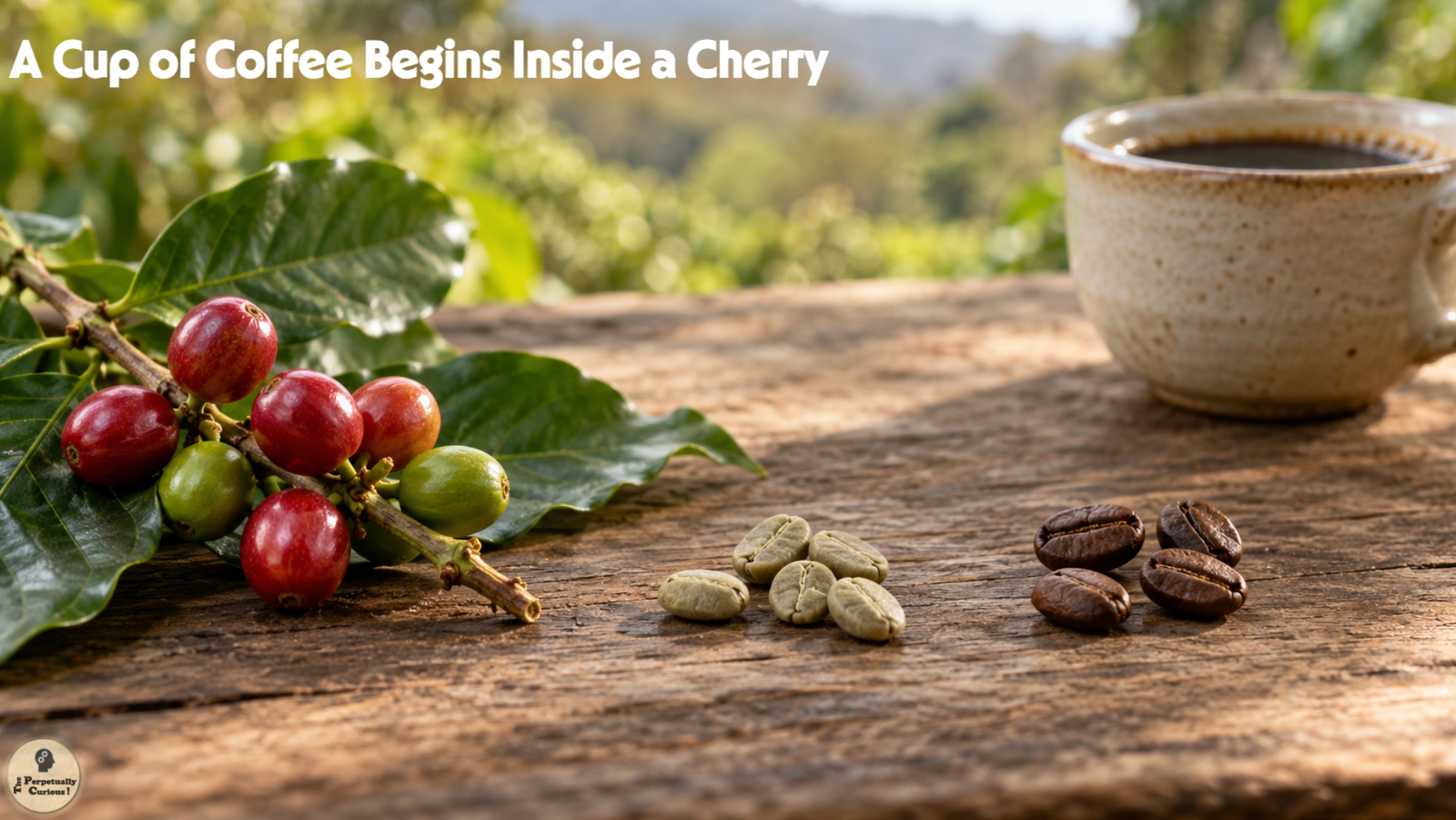
A seed travels farther than its shape suggests, carrying the quiet memory of fruit, fire, and water.
Each cup is a small unfolding of that long passage, shaped by hands, places, and patient change.
In its warmth, the journey settles for a moment before continuing on in us.
🌱 A seed becomes a coffee plant
Coffee plants belong to the genus Coffea. Growers commonly raise young plants in nurseries before transplanting them to fields, where rainfall, soil, shade, and temperature help determine how they establish and grow. The interval from planting to a useful harvest varies with species and growing conditions. Coffee is a perennial crop, so the plant can bear fruit through successive seasons rather than completing its life in a single harvest.
Most coffee grown for drinking comes from two species: Coffea arabica and Coffea canephora, the latter widely known in trade as Robusta. Arabica arose long ago through natural hybridization between ancestors of C. canephora and C. eugenioides. Its genetic history is one reason coffee varieties differ, but a name on the bag cannot by itself predict what a cup will taste like.
Arabica is often grown in cooler upland conditions, while many Robusta plantings tolerate warmer, lower elevations. These are broad patterns, not fixed altitude boundaries. Robusta seeds generally contain more caffeine than Arabica seeds, but the amount varies among plants. Cultivation, processing, and roasting also shape flavor, so neither species has one universal taste. Researchers and growers continue to work with diversity within and beyond these two widely cultivated species.
What the species contributes becomes tangible when the plant flowers.
🌸 A flower makes the fruit that holds the beans
Coffee flowers are often white and fragrant. After successful fertilization, their ovaries develop into fleshy fruits commonly called cherries. Most cherries hold two seeds with their flatter sides facing one another; some hold only one developed seed. A coffee bean is therefore a seed, while the cherry is the fruit around it. The broader story of how flowers become fruits and seeds helps make this familiar misnomer easier to see.
Arabica can often set fruit with its own pollen, whereas Robusta generally needs pollen from a genetically different plant. Bee visits can also improve fruit set under some conditions, including for self-fertile Arabica. A visit does not always result in pollen transfer; cacao’s tiny flower visitors illustrate how an insect’s route through a different blossom can matter. In coffee, these relationships with pollinators connect a small white flower with the eventual harvest, although the contribution of visitors varies by setting.
The young fruit grows and usually changes color as it ripens. Red is familiar, although some varieties produce yellow or orange ripe cherries. Color helps harvesters judge maturity, but the appropriate cue depends on the variety. Inside, the developing seeds remain enclosed by pulp, a sticky mucilage layer, and protective coverings. Harvest brings those layers into the next part of the story.
🍒 Harvesting selects the starting material
Coffee cherries on a plant do not always ripen together. In selective picking, harvesters can leave less ripe cherries on a branch and return for them later; strip picking and some mechanical methods gather fruit at mixed stages and require later sorting. The choice reflects terrain, labor, equipment, and the quality goals of the producer. Either way, fruit condition and handling after harvest matter.
The harvested cherry now poses a practical question: how should its flesh be separated from the seed, and how much time should the seed spend alongside the fruit as it dries? Water access, drying weather, equipment, and local practice all help determine which methods are workable. Processing answers the question in different ways, with no single recipe for flavor.
💧 Washed coffee separates fruit early
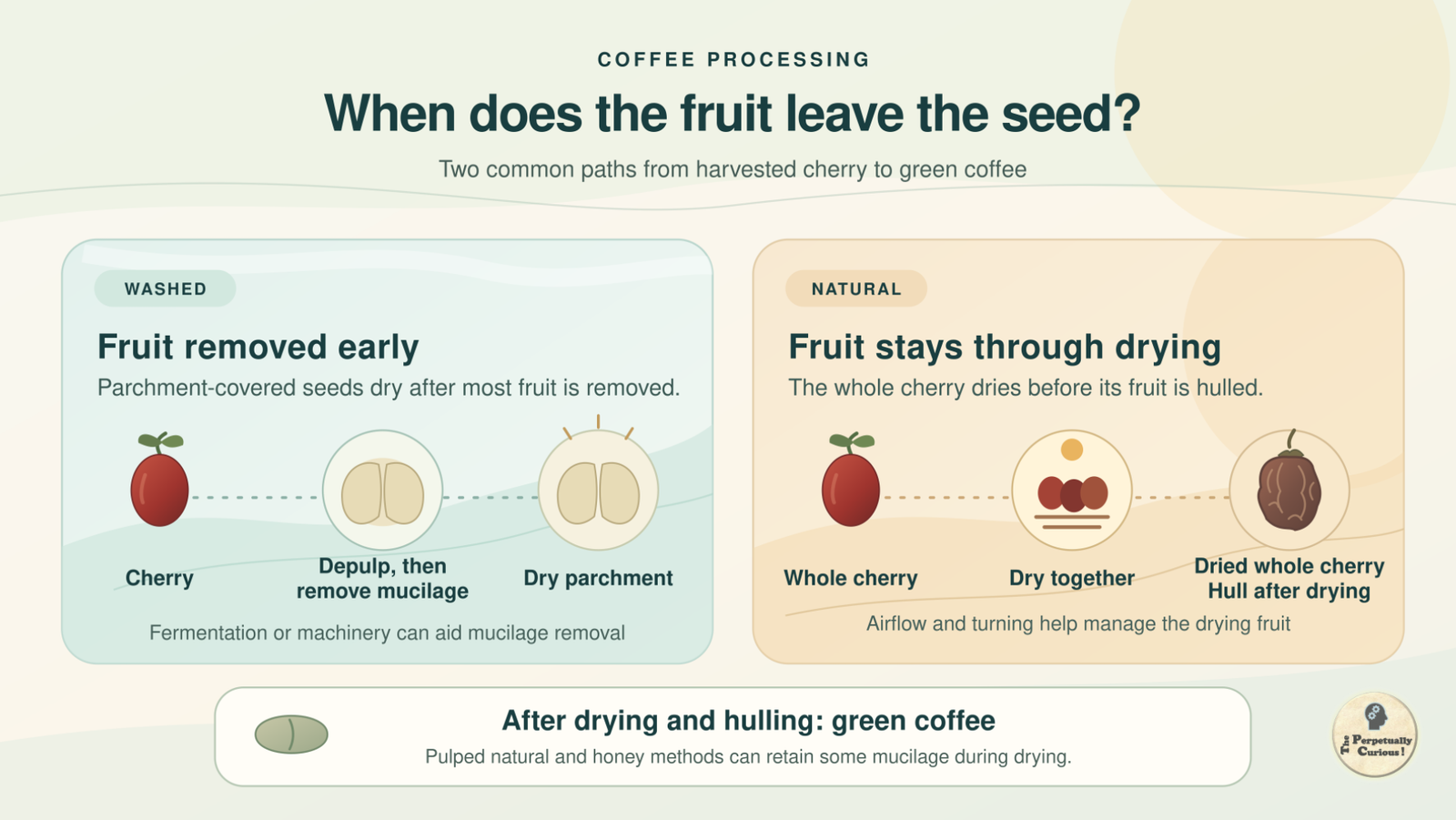
In a common washed process, ripe cherries are sorted and passed through equipment that removes the outer skin and much of the pulp. Sticky mucilage remains around the parchment-covered seeds. Producers may allow microorganisms and enzymes to loosen this layer during fermentation, use mechanical removal, or combine approaches. The coffee is then washed, where appropriate, and dried.
As in other fermented food traditions, microbes interact with a particular raw material, so there is no single fixed fermentation timer. Temperature, water, and the condition of the cherries affect what happens. Much of the microbial activity occurs in the fruit material surrounding the coffee seed, while the living seed may undergo changes of its own.
Washed coffees can be perceived as especially clear or bright, but the process does not guarantee a particular flavor. Water use and the disposal of pulp and wastewater also vary among mills. Untreated, organic-rich wastewater can harm receiving waters, which makes handling these byproducts a consequential part of processing.
Washed processing removes much of the fruit before drying. Another common path allows the intact cherry to dry around the seeds.
☀️ Natural coffee dries inside its cherry
In natural processing, whole cherries dry on patios, raised beds, or other prepared surfaces. Producers manage airflow and turn the fruit to limit uneven drying and spoilage. Depending on weather, equipment, and layer thickness, the process can take days to weeks. Once sufficiently dry, the outer fruit and coverings are removed by hulling.
Natural coffees are often associated with fuller body and fruit-like impressions, but variety, ripeness, microbial activity, drying conditions, and roasting all contribute. It would be too simple to say that fruit sugar merely seeps into the seed and makes the brewed coffee sweet. Processing can change precursor compounds and sensory outcomes through several interacting routes.
Some producers use other methods, including pulped natural or honey processing, in which some mucilage remains during drying. These names describe a family of practices rather than an exact flavor formula. Across all of them, stable drying becomes the bridge from a perishable harvest to a transportable green seed.
⚙️ Drying and milling protect what harvest has built
Processed coffee is commonly dried toward roughly 10% to 12% moisture before storage, although trade limits can be wider and safe conditions depend on the product and packaging. Drying too slowly or storing coffee with excess moisture can encourage deterioration. Overdrying can make the seeds fragile. Moisture content matters, but it does not describe every aspect of storage stability.
After drying, hulling removes parchment from washed coffee or the dried outer fruit from natural coffee. Sorting then separates unwanted material and visibly defective seeds, sometimes using screens, density equipment, or optical systems. The result is green coffee, named for its unroasted condition rather than for a promise that every seed will look vividly green.
The care does not end at the mill. Humidity, temperature, packaging, and time can affect how green coffee ages in storage and transit, even after it has reached a suitable moisture level. The journey to the roaster is part of the journey to the cup.
The green seed still carries possibilities rather than a finished coffee aroma. Heat will make many of those possibilities perceptible.
🔥 Roasting makes a new aromatic world
As green coffee heats, it loses moisture and changes color. Maillard reactions involving sugars and amino compounds contribute to browning and a broad range of new aroma molecules. Other thermal reactions occur alongside them. The familiar smell of roasted coffee is built from this combined chemistry, not from a single ingredient or reaction.
Roasters listen for a stage called first crack, when expanding gases and water vapor help create audible pops as the bean’s structure changes. Further roasting changes color, porosity, aroma, and the balance of perceived acidity and bitterness. Lighter roasts may leave more of certain fruit or floral impressions apparent; darker roasts often emphasize roasted and bittersweet notes. These are tendencies rather than flavor guarantees, and a dark roast is not inherently an espresso roast.
Caffeine is a poor guide to roast intensity. Its concentration and the caffeine delivered by a cup depend on the original coffee, the roast, how much ground coffee is measured, and how it is brewed. Roast-related differences can vary with how the coffee is measured and prepared. Flavor intensity alone cannot tell us the dose.
Roasted coffee contains volatile compounds and releases gas over time. Grinding exposes more surface to air, and brewing finally draws part of the roasted seed into water.
☕ Brewing draws a cup from the roasted seed
Grinding breaks roasted coffee into particles and changes the surface available for extraction. The size and distribution of those particles, contact time, water temperature, and brew ratio all influence the cup. Finer grinding can speed extraction while also changing flow through a filter. Neither fine nor coarse is intrinsically better; each makes sense within a brewing method.
Many hot brewing methods use water near 195°F to 205°F (about 90°C to 96°C), but good results depend on the method and coffee. The dissolved minerals and alkalinity of the water can also influence extraction and perceived flavor. Water hardness describes only part of that chemistry, so one mineral number cannot predict the cup by itself.
Filter brewing lets water pass through grounds over minutes. Espresso pushes water through a compact bed of finely ground coffee under pressure, producing a more concentrated beverage in a shorter time. These are different routes through the same underlying event: water dissolves and carries some of the roasted seed’s compounds into a drink.
Some roasted coffee follows an industrial version of that route. Manufacturers extract coffee with water, concentrate the resulting liquid, and remove much of its water by spray drying or freeze drying. The soluble coffee can later be reconstituted. Instant coffee therefore begins with the same kind of roasted seed, even though its path to a cup is different.
In the finished cup, aroma, perceived acidity and sweetness, bitterness, mouthfeel, and aftertaste offer ways to describe what the long sequence has produced. Tasters can describe those attributes separately from whether they like a coffee. Each impression carries traces of choices made from tree to brew, although no single tasting note identifies one cause.
The cup also meets a person. Serving size, caffeine dose, sleep, and individual biology all matter. The companion exploration of why coffee affects people differently follows the journey after the cup is lifted. The making of that cup leaves material behind as well, beginning with the fruit separated from the seed.
♻️ What the journey leaves behind
Parts of the removed coffee fruit may be composted or used in other ways. Where it is collected and dried for that purpose, coffee cherry skin and pulp can also become an infusion called cascara. After brewing, spent grounds can become an ingredient in compost, although large amounts of uncomposted grounds may inhibit the growth of some plants. None of these materials automatically closes an agricultural loop; their possible uses depend on how they are handled.
Return to the cup and the path is easier to recognize: a flower formed a fruit; a harvest selected it; processing prepared its seeds for storage; roasting made new aromas; brewing brought part of that chemistry into water. The brown bean no longer resembles the glossy cherry, but its journey has helped shape what the cup can become. The drink is a meeting of biological variation, place, careful work, and change.
Pass this article along to someone curious and let the learning travel.
💡 Did you know?
🌱 Most coffee cherries hold two seeds. When only one seed develops, it is often called a peaberry. The name describes the seed’s shape, not a separate coffee species.
🐝 In a laboratory study, caffeine in the nectar of several Coffea species helped honeybees remember a learned floral scent. The finding offers a glimpse of flower chemistry, but does not by itself establish how much nectar caffeine changes fruit set on farms.
🧪 Decaffeination generally takes place while coffee is still green, before roasting. It removes much of the seed’s caffeine, although the finished cup is not necessarily caffeine-free.
🍃 Tea and coffee come from different plant genera, yet both gain familiar flavors through a sequence of cultivation and processing. The account of how tea leaves become a drink makes a useful comparison with coffee’s seed-centered journey.
Are coffee beans really beans?
Botanically, they are seeds from the fruit of a Coffea plant. “Bean” is the familiar culinary and trade name.
What is the difference between washed and natural coffee?
Washed processing removes most of the cherry’s outer material before drying; natural processing dries the whole cherry before hulling. Each can influence flavor, but neither guarantees a particular tasting note or level of quality.
Does “honey processed” coffee contain honey?
The name usually refers to a method that leaves some of the fruit’s sticky mucilage on the parchment-covered seeds during drying. It does not mean that honey has been added.
Does every coffee have to ferment during processing?
Microbial activity can occur in the fruit and processing environment, but producers can remove mucilage mechanically rather than rely on a lengthy tank fermentation. Methods differ in how much fruit remains, how microbes act, and when drying begins.
Does a dark roast always have more caffeine?
No. Roast level alone does not establish caffeine per serving. Species, dose of ground coffee, roast-related mass and density changes, and brewing conditions all matter.
Does higher growing altitude always make better coffee?
No. Altitude often changes temperature and growing conditions, but variety, weather, harvest, processing, and roasting also affect quality. Elevation is context, not a quality grade.
What does “acidity” mean when people describe coffee?
In tasting, acidity describes a perceived brightness or tartness, not a single acid or an automatic sign of poor quality. The coffee’s composition, roasting, brewing, and water chemistry can all affect how it is perceived.
Can used coffee grounds help garden soil?
They can contribute organic matter when incorporated appropriately into compost. Heavy direct applications can have unwanted effects, and spent grounds are not a dependable way to make soil acidic.
🧭 Let the journey travel
The next cup may taste a little different when its hidden journey comes into view. We kindly invite you to share this piece with friends and colleagues who might enjoy following a seed through fruit, fire, and water. Your support helps the curiosity travel farther.
🎬 Watch the journey
Follow the path from flowering plant to roasted seed and brewed cup in our accompanying video.
“From Coffee Cherry to Cup: The Living Journey Behind Every Brew.” The Perpetually Curious!, September 2026.
https://www.theperpetuallycurious.org/articles/coffee-cherry-to-cup/Continue Exploring
For what comes next
Site Updates gathers occasional notes, new additions, and ways to keep in touch. RSS brings new publications to your feed reader in chronological order.
Choose the path that speaks to you, and let the next curiosity find you wherever your wondering takes you.