

During the 12-day Foton-M3 mission, researchers exposed dried tardigrades to space for ten days. Back on Earth, they rehydrated the animals and checked for coordinated leg movement as a sign of recovery. Over the follow-up period, survival among animals exposed to space vacuum and shielded from solar ultraviolet light was similar to survival among controls on Earth. Survival was substantially lower among animals exposed to both vacuum and solar ultraviolet light.[1, 2]
A water bear moving its legs after a spaceflight tells us what one animal can endure. A microbe dividing in a laboratory culture tells us it can grow under the conditions tested. Those are two ways to study the limits of life on Earth. Farther afield, scientists face a third question. What would count as evidence that a world actually harbors life?
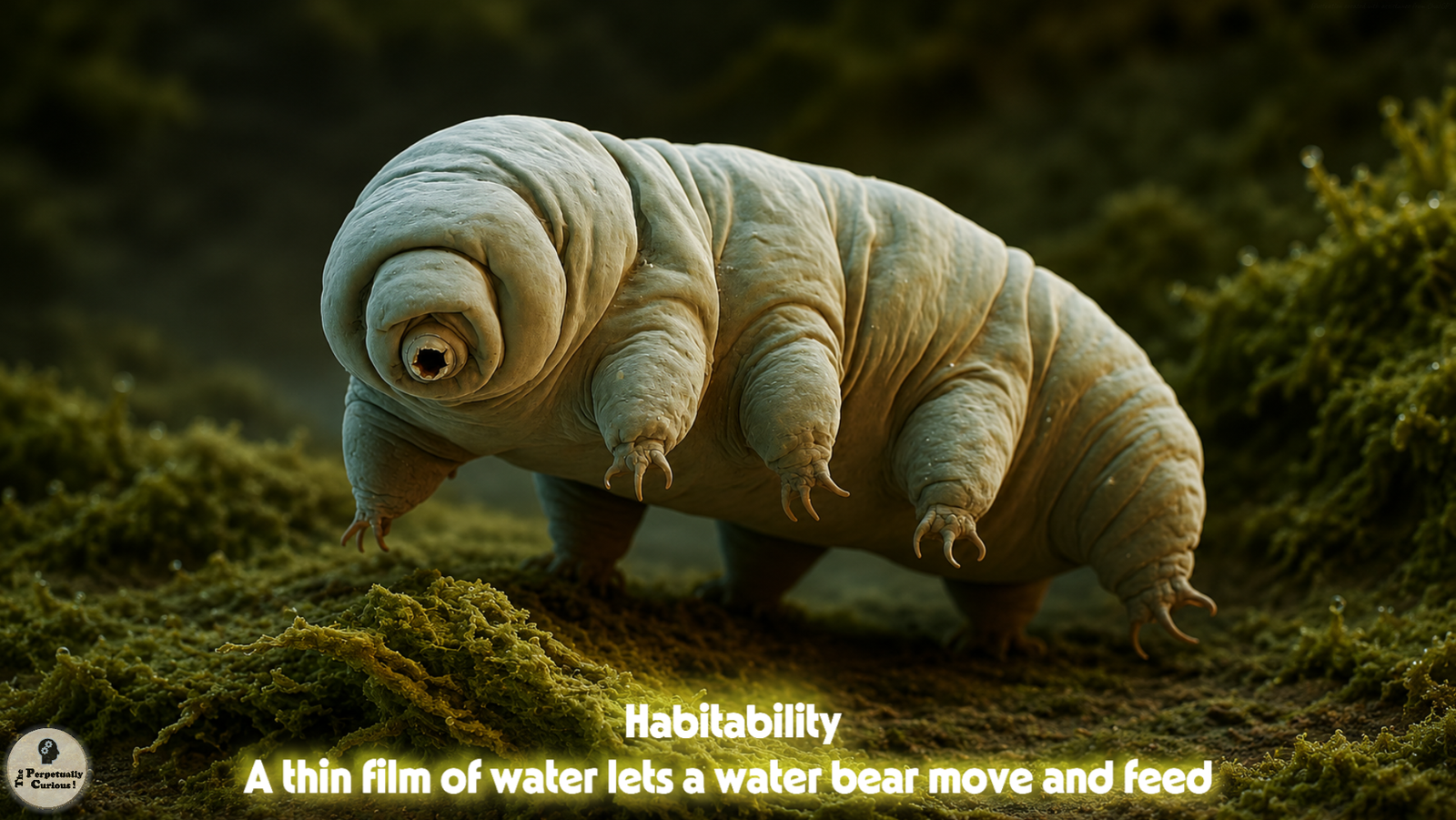
Between a drop of water and an ocean beneath ice lies a long chain of questions.
A small movement in a laboratory and a distant signal from a hidden sea are separated by worlds, yet both ask the same thing: under what conditions can life endure, and how might we recognize it when we finally see it?
🌡️ What makes an organism an extremophile?
An extremophile is an organism adapted to grow under conditions that many other forms of life cannot tolerate. Some extremophiles thrive in intense heat, while others grow in cold, high pressure, or strong acidity. The limits interact. Dissolved salts can help keep water liquid below its usual freezing point. At the same time, a very salty solution can leave too little water available for cells to use.[3]
A strain of the archaeon Methanopyrus kandleri, isolated from a deep-sea hydrothermal setting, multiplied at about 252°F (122°C) under high pressure in a laboratory study. At the cold end, a strain of the bacterium Planococcus halocryophilus from High Arctic permafrost grew at 5°F (−15°C) under laboratory conditions. In each case, researchers measured growth under a particular combination of conditions.[4, 5]
A drying patch of moss poses a different problem. The water a tardigrade needs to feed and move can disappear altogether.
💧 How a tardigrade waits for water
Tardigrades, also known as water bears, are microscopic animals. Many live in places where a thin film of water comes and goes. As their surroundings dry, some species pull in their legs and contract into a compact shape called a tun. Metabolic activity falls to very low levels in this reversible state, a form of cryptobiosis. If the animal survives the dry spell, it can resume activity when water returns.[1, 6]
Drying can damage the molecules that keep a cell working. Research on some tardigrades has shown that certain proteins help the animals survive drying. In laboratory experiments, these proteins formed a glasslike material that may help stabilize cellular components in the dry state.[6]
The animals in the orbital experiment were already dry when they went into space. Researchers measured recovery after they returned to Earth. For life as we know it to stay active, a habitat has to supply liquid water, suitable chemistry, and usable energy. Earth’s deep-sea vents show how water and rock can help supply that energy.[7]
🌊 How life makes a living in darkness
Seawater can seep into cracks in the seafloor, warm underground, and react with rock before flowing back into the ocean. Where vent fluids meet surrounding seawater, some microbes obtain energy from chemical reactions. They use that energy to build organic matter in a process called chemosynthesis. These microbes help sustain communities that include tubeworms in the dark.[7]
Near a vent, hot fluid mixes with cooler seawater. Temperature and chemistry can differ between the fluid leaving the vent and the water around it. For scientists studying icy moons, Earth’s vents suggest a question about a hidden ocean. Could reactions at its seafloor supply energy that life might use?[7]
🪐 Two ways to investigate a hidden ocean
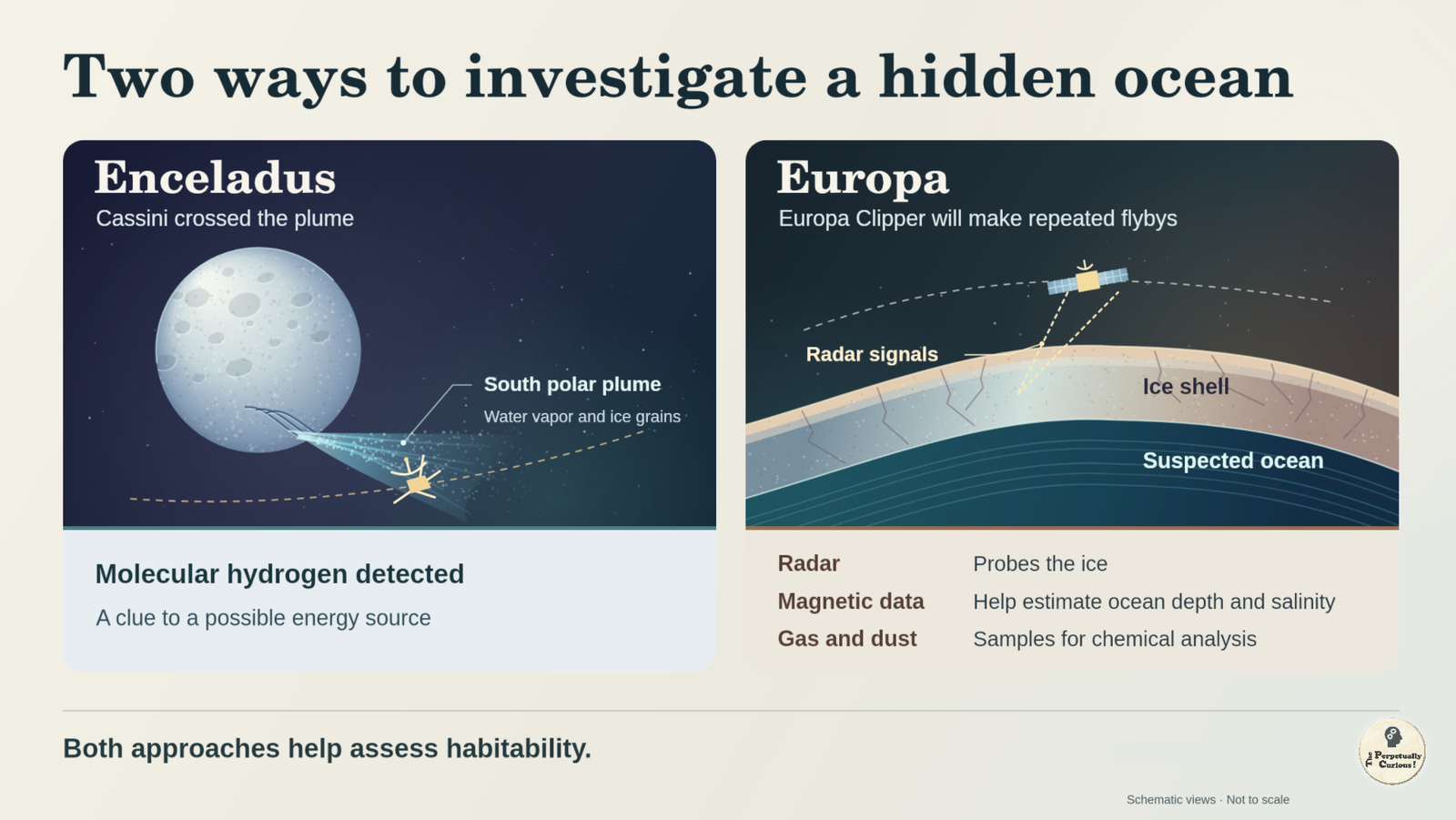
On Saturn’s moon Enceladus, water vapor and ice grains escape through fractures near the south pole. Cassini flew through the plume and detected molecular hydrogen. Reactions between water and rock can produce hydrogen, and some Earth microbes use hydrogen in reactions that yield energy. The finding points to a possible energy source in the hidden ocean.[8]
At Europa, a moon of Jupiter, several lines of evidence point to a salty ocean beneath the ice. Europa Clipper will use radar to probe the ice and magnetic measurements to help estimate the ocean’s depth and salinity. It will also collect gas and dust around the moon for chemical analysis.[9] The spacecraft is scheduled to reach Jupiter in 2030.[10] Together, these measurements will help scientists assess habitability by looking for liquid water, suitable chemistry, and usable energy. Finding evidence of life would call for a different kind of observation.[9, 11]
🔎 What would count as evidence of life?
A potential biosignature is a feature that might have been produced by life. It could be a structure in a rock, a pattern in reflected light, or a combination of gases in an atmosphere. Enceladus’s hydrogen is consistent with reactions between water and rock. It helps scientists assess what the ocean could offer. Any claim that a signal came from life would need evidence that distinguishes a biological source from plausible chemical or geological sources.[8, 12]
This is part of how scientists weigh signs of life beyond Earth. They ask whether independent observations point to the same explanation.[12]
In the laboratory, coordinated leg movement gave researchers an early sign of recovery after rehydration. A grain of ice or a faint radar echo can help bring a moon’s hidden environment into view. The search for life would take another step if a trace still pointed to biology after scientists had tested what the moon’s chemistry and geology could explain.
Pass this article along to someone curious and let the learning travel.
💡 Did you know?
🧊 A tardigrade revived from moss frozen for 30.5 years. After researchers thawed the Antarctic sample, two animals showed signs of recovery. One resumed feeding and later reproduced.[13]
🧪 A ring of Saturn carried clues from a hidden ocean. Some ice grains expelled by Enceladus feed Saturn’s E ring. Researchers found sodium phosphates in Cassini’s measurements of grains from that ring, giving them evidence of phosphorus in the moon’s ocean. On Earth, phosphorus is a component of DNA.[14]
🟣 Earth’s purple bacteria give astronomers another pattern to look for. Researchers measured light reflected from purple bacteria and modeled how their pigments might affect a planet’s spectrum. The models show how a surface covered with those microbes could reflect light differently from one covered with green vegetation.[15]
Did tardigrades survive the Beresheet crash on the Moon?
Their fate remains unconfirmed. The organization behind part of the payload reported that the lander carried dried tardigrades when it crashed in 2019.[16] Any survivors would still need liquid water to resume activity.[6] The Moon has water ice, but liquid water is unstable on the exposed lunar surface.[17]
How can an icy moon have an ocean far from the Sun?
A star’s habitable zone describes where starlight could allow a planet with a suitable atmosphere to retain liquid water at its surface.[18] An icy moon far from the Sun can have an internal source of heat. At Europa, repeated flexing under the pull of Jupiter’s gravity generates heat that could help keep an ocean liquid beneath the ice.[11] Cassini’s plume measurements point to reactions between water and rock beneath Enceladus’s ice.[8]
Could a world have the conditions for life and still be empty?
Yes. Habitability describes what an environment could sustain. Whether life ever arose there is a separate question about the world’s history. Evidence of liquid water, suitable chemistry, and usable energy tells scientists where to look. Evidence of life would have to come from further observations.[11, 12]
✨ From a drop of water to an ocean beneath ice
If this journey from a water bear to an icy moon made you curious, you are welcome to share it with someone who would enjoy following the evidence.
Educational context
Laboratory results apply to the organisms and conditions tested. At an icy moon, estimates of an ocean’s properties depend on how scientists interpret the measurements a spacecraft can make.
Selected sources
- Jönsson KI, Rabbow E, Schill RO, et al. (2008). Tardigrades survive exposure to space in low Earth orbit. Current Biology, 18(17), R729–R731. [PMID: 18786368]
- European Space Agency (ESA). (2008). Tiny animals survive exposure to space.
- Merino N, Aronson HS, Bojanova DP, et al. (2019). Living at the Extremes: Extremophiles and the Limits of Life in a Planetary Context. Frontiers in Microbiology, 10, 780. [PMID: 31037068]
- Takai K, Nakamura K, Toki T, et al. (2008). Cell proliferation at 122°C and isotopically heavy CH₄ production by a hyperthermophilic methanogen under high-pressure cultivation. Proceedings of the National Academy of Sciences, 105(31), 10949–10954. [PMID: 18664583]
- Mykytczuk NCS, Foote SJ, Omelon CR, et al. (2013). Bacterial growth at −15°C; molecular insights from the permafrost bacterium Planococcus halocryophilus Or1. The ISME Journal, 7(6), 1211–1226. [PMID: 23389107]
- Boothby TC, Tapia H, Brozena AH, et al. (2017). Tardigrades Use Intrinsically Disordered Proteins to Survive Desiccation. Molecular Cell, 65(6), 975–984.e5. [PMID: 28306513]
- NOAA Ocean Exploration. Hydrothermal Vents and Volcanoes.
- Waite JH, Glein CR, Perryman RS, et al. (2017). Cassini finds molecular hydrogen in the Enceladus plume: Evidence for hydrothermal processes. Science, 356(6334), 155–159. [PMID: 28408597]
- NASA. Europa Clipper Spacecraft Instruments.
- NASA. Europa Clipper Mission FAQ.
- NASA. Why Europa: Ingredients for Life.
- NASA Astrobiology. What is a biosignature?
- Tsujimoto M, Imura S, Kanda H. (2016). Recovery and reproduction of an Antarctic tardigrade retrieved from a moss sample frozen for over 30 years. Cryobiology, 72(1), 78–81. [PMID: 26724522]
- Postberg F, Sekine Y, Klenner F, et al. (2023). Detection of phosphates originating from Enceladus’s ocean. Nature, 618(7965), 489–493. [PMID: 37316718]
- Fonseca Coelho L, Kaltenegger L, Zinder S, et al. (2024). Purple is the new green: biopigments and spectra of Earth-like purple worlds. Monthly Notices of the Royal Astronomical Society, 530(2), 1363–1368.
- Oberhaus D. (2019). SpaceIL’s Crashed Spacecraft Spilled Tardigrades on the Moon. WIRED.
- NASA. (2019). A Few Things Artemis Will Teach Us About Living and Working on the Moon.
- NASA. What Is the Habitable Zone?
“What Tardigrades and Extremophiles Teach Us About Life Beyond Earth.” The Perpetually Curious!, November 2026.
https://www.theperpetuallycurious.org/articles/extremophiles-tardigrades-life-beyond-earth/Continue Exploring
For the curious mind: want to explore this theme through a few questions? Visit the Classic Quiz Studio, nestled under Explorations opens in a new tab ,and see where a few well-placed questions lead: Cosmic Exploration Quizzesopens in a new tab
For what comes next
Site Updates gathers occasional notes, new additions, and ways to keep in touch. RSS brings new publications to your feed reader in chronological order.
Choose the path that speaks to you, and let the next curiosity find you wherever your wondering takes you.