Explore by topic, question, or idea. Find articles, reflections, videos, puzzles, and curiosity pathways gathered across the site.
Press Enter or select Search. A newly typed query starts globally; filters are applied only through the visible rail.
10 results for “how seeds become cooking oil”
- The Perpetually Curious! › Canonical › Engineering & TechnologyArticle
🏭 Petroleum Refining: The Process Behind Heat, Pressure, and Design
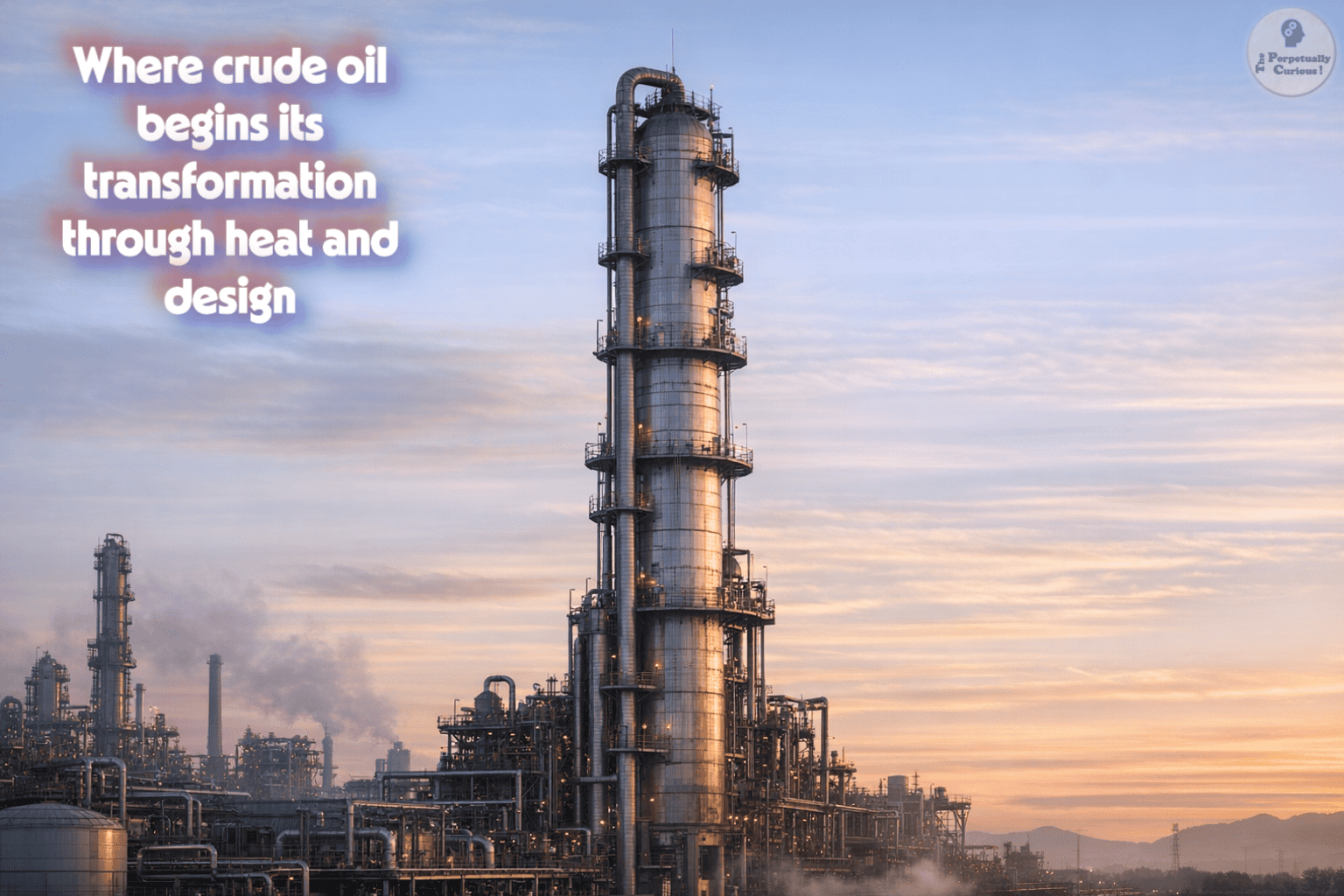
There is a quiet elegance in the way crude oil begins its transformation. It arrives as a dark, ancient liquid shaped by geological time, yet it enters the refinery as a material waiting to be understood.
- The Perpetually Curious! › Archives › Engineering & TechnologyArticle
🏭 Petroleum Refining: How Crude Oil Begins to Transform
Petroleum refining begins with a deceptively simple challenge: crude oil is not one substance. It is a dense mixture of hydrocarbons, trace elements, salts, and fine materials that arrived from geological history with no concern for human categories. A refinery must first make that mixture readable.
- The Perpetually Curious! › Archives › Engineering & TechnologyArticle
✏️ Pencil Making: How Graphite and Cedar Become a Line
From section: Why the wood mattersIf the core sits off center, the point may become uneven.
- The Perpetually Curious! › Canonical › Engineering & TechnologyArticle
🚂 Echoes of Steam, Currents of Steel: Train Engines and the Rise of High-Speed Motion
From section: 🛢️ Diesel arrives: internal combustion on the railsDiesel engines were generally more efficient than steam locomotives, required less day-to-day servicing, and did not depend on frequent water stops. The diesel fuel inside these locomotives also begins in the wider world of petroleum refining, where crude oil is separated and processed into usable fuel streams.
- The Perpetually Curious! › Canonical › Engineering & TechnologyArticle
🖋️ Printing Ink: The Science and Living History Behind the Printed Page
From section: 🎨 What ink is made of: The foundation of color and formAdditives fine tune the ink’s behavior. Surfactants improve wetting, waxes enhance rub resistance, and driers accelerate oxidation in certain oil-based systems. These small adjustments allow inks to perform consistently across a wide range of substrates and conditions.
- The Perpetually Curious! › Canonical › Engineering & TechnologyArticle
🧪 The Quiet Alchemy of Pencil Making: How an Everyday Tool Comes into Being
From section: 🧩 Bringing core and casing together: The pencil sandwichThe sandwiches are clamped under pressure while the adhesive cures. During this time, the wood and core become a single composite piece. Once the glue has set, the sandwiches are ready to be shaped into the familiar form that fits comfortably between fingers.
- The Perpetually Curious! › Canonical › Engineering & TechnologyArticle
🚆 Quiet Power on the Rails: Understanding Hydrogen Trains and Their Emerging Role
From section: 🔋 How fuel cells and batteries work together… This partnership shapes how the train accelerates, recovers energy, travels between refueling stops, and performs across different routes. Those operating consequences become clearer when range, speed, and refueling are considered together.
- The Perpetually Curious! › Canonical › Engineering & TechnologyArticle
🧪 The Making of Toothpaste: The Subtle Science Behind a Daily Ritual
Toothpaste is often seen only in passing, a small ribbon of color pressed onto a brush before the day begins or ends. Yet behind this familiar gesture lies a carefully engineered material shaped by chemistry, physics, and sensory design.
- The Perpetually Curious! › Archives › Engineering & TechnologyArticle
🖋️ Printing Ink: What Happens When a Wet Drop Meets Paper
Freshly printed letters look complete almost as soon as they appear. At the microscopic scale, however, the mark is still becoming itself. A thin liquid film has just struck a surface made of fibers, pores, coatings, and air spaces.
- The Perpetually Curious! › Archives › Engineering & TechnologyArticle
🚂 Train Engines: How Steam, Diesel, and Electricity Reach the Wheels
At a railway station, the source of motion can announce itself in very different ways. A steam locomotive breathes through exhaust beats and visible vapor. A diesel locomotive carries a steady mechanical pulse. An electric train may leave with little more than the sound of…