Explore by topic, question, or idea. Find articles, reflections, videos, puzzles, and curiosity pathways gathered across the site.
Press Enter or select Search. A newly typed query starts globally; filters are applied only through the visible rail.
211 results for “the science behind familiar moments”
- The Perpetually Curious! › Canonical › Cosmic ExplorationArticle
🌌 The Hunt for the Invisible: Understanding Dark Matter Through Science’s Greatest Detective Story
From section: 🌀 Mapping the invisible architectureOur solar system moves through this halo as it orbits the Milky Way at roughly 490,000 miles per hour (790,000 kilometers per hour). In leading particle models, dark matter interacts so weakly with ordinary matter that this motion produces no sensation and no familiar friction. …
- The Perpetually Curious! › Archives › Botanical WondersArticle
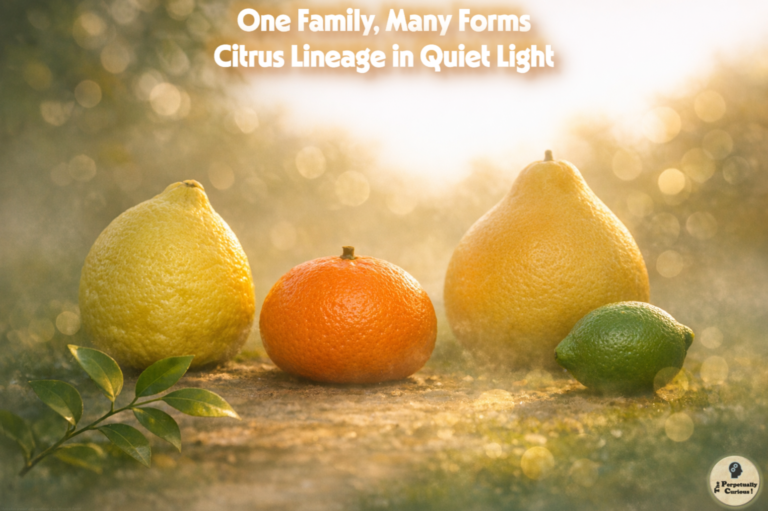
🍊 Citrus Family Tree: How Ancient Lineages Became Familiar Fruits
From section: Three ancestors behind the fruit bowlThree ancestors behind the fruit bowl Citron, Citrus medica, carries a thick rind, strong fragrance, and relatively little pulp.
- The Perpetually Curious! › Canonical › Biology & HealthArticle
🌫️ Why We Get Hiccups: The Reflex Beneath Every Small “Hic”
… First comes the physical event itself: a sudden muscular contraction, a quick interruption of airflow, and the familiar “hic.” Beneath that small interruption is a wider story about breath, timing, reflexes, and the nervous system’s ability to coordinate the body in fractions of a second.
- The Perpetually Curious! › ArchivesArticle
👀 In View Today: A Daily Visual Gateway into Curiosity
Curiosity does not always begin with a long explanation. Sometimes it begins with a single image, an unexpected detail, or a familiar subject seen from a different angle. In View Today offers one image-led opening each day.
- The Perpetually Curious! › Archives › Cosmic ExplorationArticle
The Universe's Greatest Mystery: Why You Exist at All 🌌
The Cosmic Coin Flip That Created Everything In the universe's first moments after the Big Bang, the universe played a game of annihilation that should have left nothing behind. Matter met antimatter in a cosmic battlefield, particle pairs destroying each other in perfect flashes of pure energy.
- The Perpetually Curious! › Canonical › Cosmic ExplorationArticle
🌟 Brown Dwarfs: Between Giant Planets and the Smallest Stars
The cosmos often reveals its rules most clearly where familiar categories begin to blur. Between giant planets and the smallest hydrogen-burning stars lies a dim frontier populated by brown dwarfs, objects massive enough for gravity to compress and heat their interiors, yet not…
- The Perpetually Curious! › Archives › Wilderness & Homestead CreaturesArticle
The Symphony of Stripes: Decoding Nature's Most Elegant Barcode 🦓
Where Mathematics Meets Majesty ✨ A zebra against the African sunrise creates a living masterwork, stripes that have inspired human art and science for millennia.
- The Perpetually Curious! › Canonical › Biology & HealthArticle
🧠 The Brain’s Guarded Border: How the Blood-Brain Barrier Protects Us and Complicates Treatment
From section: 🧪 Designing a medicine that can cross… An active medicine can be temporarily modified into a form that crosses more readily, then converted back after entry. The familiar example is levodopa. …
- The Perpetually Curious! › Canonical › Biology & HealthArticle
🧠 The Neural Symphony: How Neurons, Glia, and Networks Shape Human Experience
From section: 🎨 From cell types to emotional statesThis is where a familiar public story begins to break down. If emotions are distributed network states, then calling dopamine a "pleasure chemical" or serotonin a "happiness chemical" cannot capture what those molecules actually do.
- The Perpetually Curious! › Canonical › Biology & HealthArticle
☀️ Sunlight, Skin, and the Quiet Alchemy of Vitamin D
From section: ⚖️ Natural limits and self‑regulationVitamin D status therefore depends on more than the amount produced in the skin. Dietary intake, supplementation, metabolism, age, and other biological factors can also contribute. Beyond these internal controls, familiar external barriers such as glass, clothing, and sunscreen alter how much UVB reaches the skin.