Explore by topic, question, or idea. Find articles, reflections, videos, puzzles, and curiosity pathways gathered across the site.
Press Enter or select Search. A newly typed query starts globally; filters are applied only through the visible rail.
72 results for “how rain transforms”
- The Perpetually Curious! › Canonical › Botanical WondersArticle
🌲 When Trees Carry Time: Oldest Tree Species, Ancient Forests, and Sacred Trees
Across continents and epochs, trees have shaped Earth’s story in ways both visible and hidden. Some living lineages trace their ancestry to worlds where dinosaurs walked, some tree-like forest-builders first rose in Devonian landscapes and later vanished into stone, and a few…
- The Perpetually Curious! › Canonical › Engineering & TechnologyArticle
🚂 Echoes of Steam, Currents of Steel: Train Engines and the Rise of High-Speed Motion
The story of train engines is a story of how societies learned to move people and goods across landscapes that once felt impossibly vast. It begins with wooden rails, gravity, and horses, then grows into the thunderous age of steam, the practical reach of diesel power, and the…
- The Perpetually Curious! › Canonical › Botanical WondersArticle
🍃 Pirandai (Cissus quadrangularis): Tradition, Botany, and Quiet Scientific Curiosity
Some plants enter human life with immediate brilliance, while others become significant through quieter forms of presence that unfold across time. Pirandai, the Tamil name for Cissus quadrangularis, belongs to this quieter realm.
- The Perpetually Curious! › Canonical › Cosmic ExplorationArticle
🌌 Borrowing the Orbits of Giants: How Gravity Assists Carry Spacecraft into the Deep
On certain nights, the planets appear as quiet lanterns suspended in the dark, drifting along their ancient paths. To the eye, they seem serene and still. Yet each one is a massive world in motion, circling the Sun with tremendous momentum. For spacecraft, these worlds are not only destinations.
- The Perpetually Curious! › Canonical › Biology & HealthArticle
💧 Why We Cry: The Quiet Science of Tears, Sadness, and Grief
There is a moment, just before tears appear, when the world seems to hold its breath. The chest tightens, the throat gathers a quiet ache, and the eyes begin to shimmer as if carrying a small, unspoken truth.
- The Perpetually Curious! › Canonical › Engineering & TechnologyArticle
🖋️ Printing Ink: The Science and Living History Behind the Printed Page
Ink is one of the most familiar materials in daily life, yet it remains quietly extraordinary. A thin film of color on a page can carry memory, instruction, art, or identity. It can last for a single day or endure for centuries. When we look closely, ink becomes a story about…
- The Perpetually Curious! › Canonical › Engineering & TechnologyArticle
🧪 The Quiet Alchemy of Pencil Making: How an Everyday Tool Comes into Being
A pencil rests so lightly in the hand that it can be easy to forget the long journey that brought it into existence. It begins in forests where softwoods grow in patient rings, and in geological seams where carbon has settled into crystalline layers.
- The Perpetually Curious! › Canonical › Cosmic ExplorationArticle
The Cosmic Recipe: Understanding the Physical Criteria for Star Formation 🌟
In the vast expanse of our universe, where darkness stretches for light-years and cold reigns supreme, something extraordinary happens. Stars are born. This process, far from being a simple ignition, represents one of nature's most complex and beautiful phenomena.
- The Perpetually Curious! › Canonical › Cosmic ExplorationArticle
✨ Constellations: Quiet Patterns, Shared Skies, and the Stories We Trace Together
On a clear night, the sky stretches outward in a quiet sweep of light, and the stars appear as scattered points that invite the human mind to connect them. Across generations, people have traced patterns among these distant suns, creating constellations that carry memory, orientation, and meaning.
- The Perpetually Curious! › Archives › Planet EarthArticle
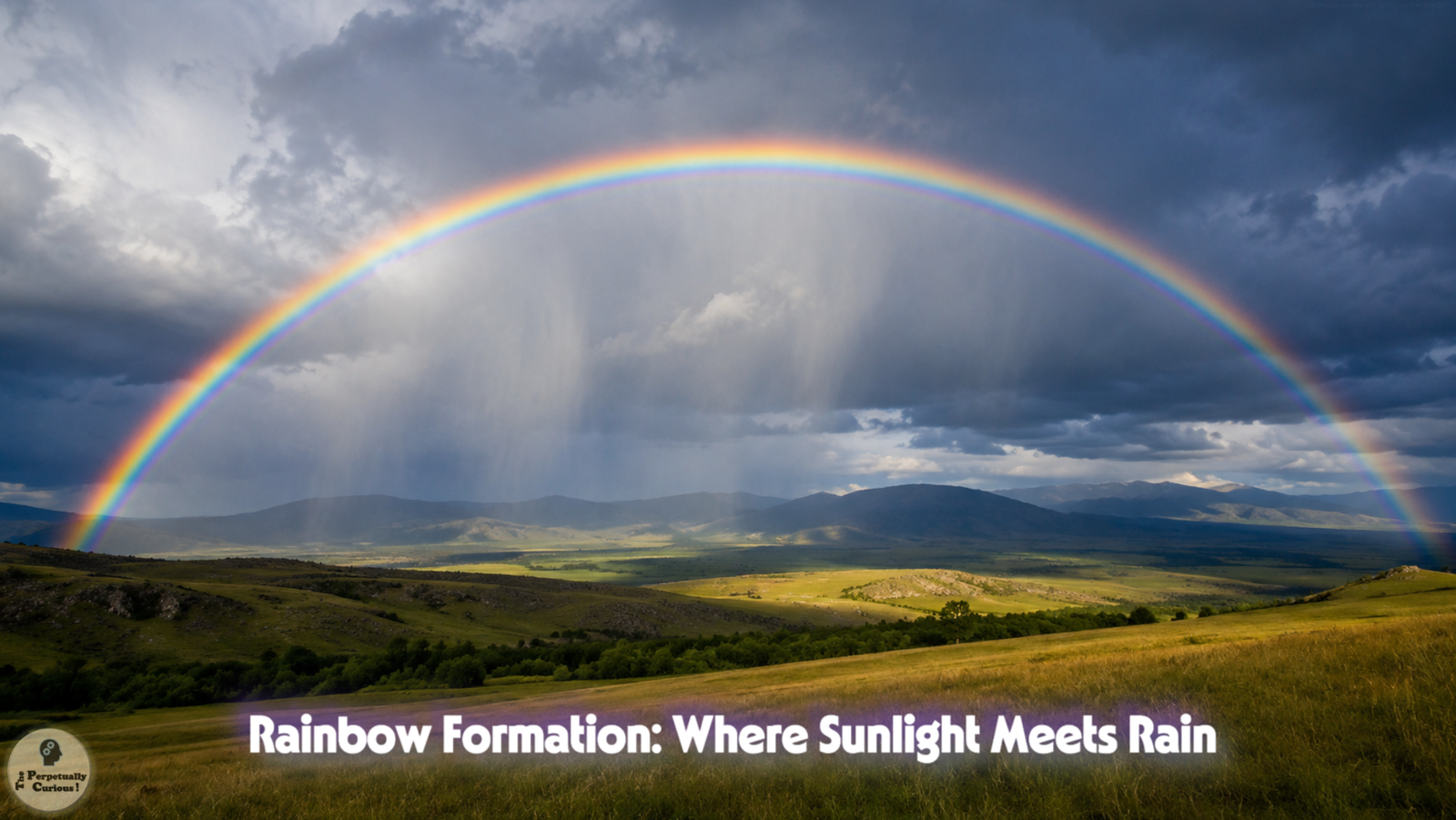
🌈 Rainbow Formation: Why Every Observer Sees a Different Arc
From section: Why the bow changes when you moveThe required sightlines therefore pass through a different part of the rain or mist.