Explore by topic, question, or idea. Find articles, reflections, videos, puzzles, and curiosity pathways gathered across the site.
Press Enter or select Search. A newly typed query starts globally; filters are applied only through the visible rail.
25 results for “microplastics in the ocean how tiny fragments travel”
- The Perpetually Curious! › Canonical › Cosmic ExplorationArticle
🌍 When Earth First Took Shape: A Planet Born from Cosmic Dust
From section: 🌊 From fire to water: Cooling, oceans, and early atmosphere… Early Earth may have hosted a global or near-global ocean, although the timing, extent, and stability of those first oceans remain active areas of research.
- The Perpetually Curious! › Archives › Cosmic ExplorationArticle
The Asteroid Belt: Ancient Fragments of Our Solar System's Story 🌌
On New Year's Day 1801, Italian astronomer Giuseppe Piazzi made a discovery that would transform our understanding of the solar system. While searching for a suspected planet between Mars and Jupiter, he found something else entirely: the first of millions of rocky fragments…
- The Perpetually Curious! › Canonical › Cosmic ExplorationArticle
✨ Constellations: Quiet Patterns, Shared Skies, and the Stories We Trace Together
From section: 🧭 Constellations as tools for orientationConstellations also guided navigation. Sailors in the Pacific used star paths to cross vast ocean distances, while travelers in deserts used bright patterns near the celestial poles to maintain direction at night. These patterns became memory devices in the sky, linking practical knowledge with cultural meaning.
- The Perpetually Curious! › Canonical › Cosmic ExplorationArticle
🌌 The Universe’s Ancient Whisper: Decoding the Cosmic Microwave Background
… After Penzias and Wilson connected with a Princeton group preparing to search for predicted relic radiation, the meaning of the noise became clear. They had encountered the cosmic microwave background, or CMB, the oldest light that can travel freely to us.
- The Perpetually Curious! › Canonical › Cosmic ExplorationArticle
🌌 Borrowing the Orbits of Giants: How Gravity Assists Carry Spacecraft into the Deep
From section: 🪐 The Core Idea of a Gravity AssistThis gain is not created from nothing. The spacecraft has taken a tiny amount of orbital energy from the planet. The planet loses an almost unimaginably small fraction of its own momentum. …
- The Perpetually Curious! › Canonical › Cosmic ExplorationArticle
🌌 Why Space Looks Dark in a Universe Filled with Light: Understanding the Quiet Cosmos
From section: ✨ How light becomes visibleWhen a flashlight shines in a dark room, the beam often appears as a visible cone. Dust, smoke, and tiny particles in the air scatter some of the light toward the observer, making the path of the beam visible. …
- The Perpetually Curious! › Canonical › Cosmic ExplorationArticle
🌙 Quiet Worlds, Vast Stories: Some Lesser-Known Moons of Our Solar System
As we travel from the inner reaches of the solar system outward through the Saturn system, then farther still to Neptune before turning inward again toward Uranus, the narrative will unfold in a continuous arc that shows how these modest worlds deepen our understanding of the solar system.
- The Perpetually Curious! › Canonical › Cosmic ExplorationArticle
🌌 Why Space Feels Cold Among So Many Suns: The Quiet Physics of Cosmic Warmth
From section: 🌌 The vacuum of space and the scarcity of particlesAs density falls, particles can travel increasingly great distances before undergoing direct collisions. The gas then ceases to behave like the continuous air familiar near Earth’s surface. …
- The Perpetually Curious! › Canonical › Cosmic ExplorationArticle
🛰️ When Fire Meets Air: How Spacecraft Reenter Earth’s Atmosphere
From section: Frequently Asked Questions+… A controlled return usually begins with a retrograde deorbit burn. The spacecraft briefly fires its engines or thrusters opposite its direction of travel, reducing its orbital speed enough to lower part of its path into denser atmosphere. The maneuver does not slow the spacecraft for landing by itself. …
- The Perpetually Curious! › Archives › Cosmic ExplorationArticle
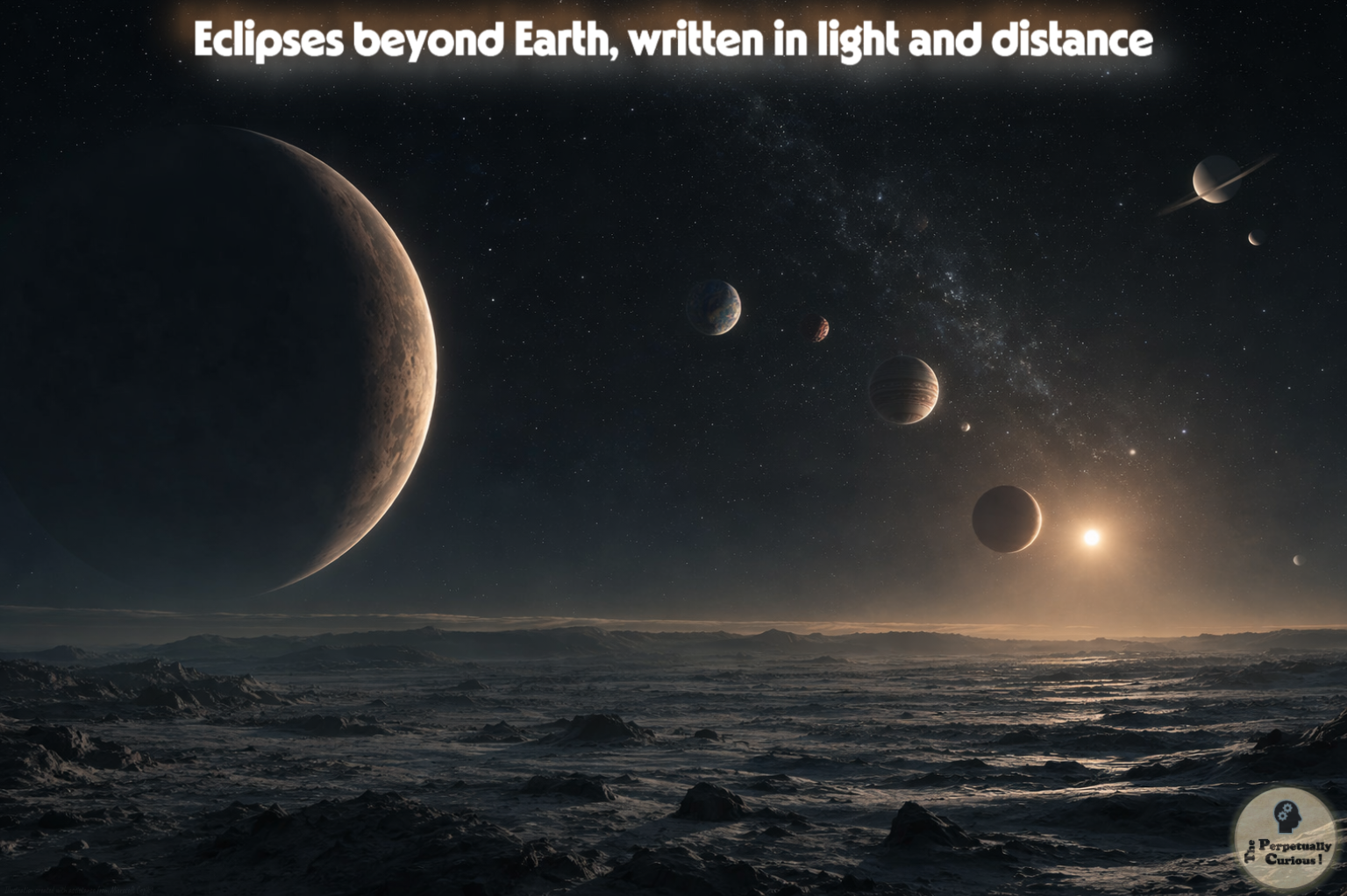
🌘 Eclipses Across the Solar System: When Shadows Travel
An eclipse can feel like a rare celestial exception, but the underlying arrangement is simple. A light source shines, one world blocks that light, and another surface receives the shadow. On Earth, the Sun, Moon, and our planet create the examples we know best.