Explore by topic, question, or idea. Find articles, reflections, videos, puzzles, and curiosity pathways gathered across the site.
Press Enter or select Search. A newly typed query starts globally; filters are applied only through the visible rail.
158 results for “the second brain speaks first when parkinson disease begins in your belly”
- The Perpetually Curious! › Canonical › Biology & HealthArticle
🌫️ Why We Get Hiccups: The Reflex Beneath Every Small “Hic”
… First comes the physical event itself: a sudden muscular contraction, a quick interruption of airflow, and the familiar “hic.” Beneath that small interruption is a wider story about breath, timing, reflexes, and the nervous system’s ability to coordinate the body in fractions of a second.
- The Perpetually Curious! › Canonical › Biology & HealthArticle
🌫️ When the World Blurs for a Moment: Why We Sneeze
From section: 👃 A reflex born in the noseThe story of a sneeze begins on the surface of the nasal mucosa, a moist and richly innervated tissue that lines the inside of the nose. This surface is home to sensory nerve endings responsive to mechanical, chemical, inflammatory, and thermal signals. …
- The Perpetually Curious! › Canonical › Planet EarthArticle
🌧️ When Clouds Let Go: Why It Rains and How Raindrops Are Born
Rain arrives in many forms, from a quiet drizzle that softens a morning landscape to a sweeping downpour that transforms streets and fields. Although familiar, every rainfall begins with an atmospheric story unfolding above us.
- The Perpetually Curious! › Canonical › Planet EarthArticle
🌈 When Sunlight Paints the Rain: The Quiet Geometry of Rainbow Formation
From section: 💧 Inside a raindrop: refraction, reflection, and dispersionWhen sunlight reaches a nearly spherical water droplet, its path begins to change. First, the light is refracted as it crosses from air into water. …
- The Perpetually Curious! › Canonical › Biology & HealthArticle
☀️ Sunlight, Skin, and the Quiet Alchemy of Vitamin D
The journey begins with the light itself. Only a narrow band of the Sun’s ultraviolet radiation can initiate this photochemical sequence, making wavelength the first key to understanding how sunlight and skin meet.
- The Perpetually Curious! › Canonical › PhysicsArticle
💡 Listening to Matter When It Learns to Glow: How an Incandescent Light Bulb Works
Every time an incandescent light bulb brightens a room, something remarkable begins inside its fragile glass world. A current enters through the base, flows through a tightly coiled tungsten filament, and raises the metal to a temperature hot enough to shine.
- The Perpetually Curious! › Canonical › Engineering & TechnologyArticle
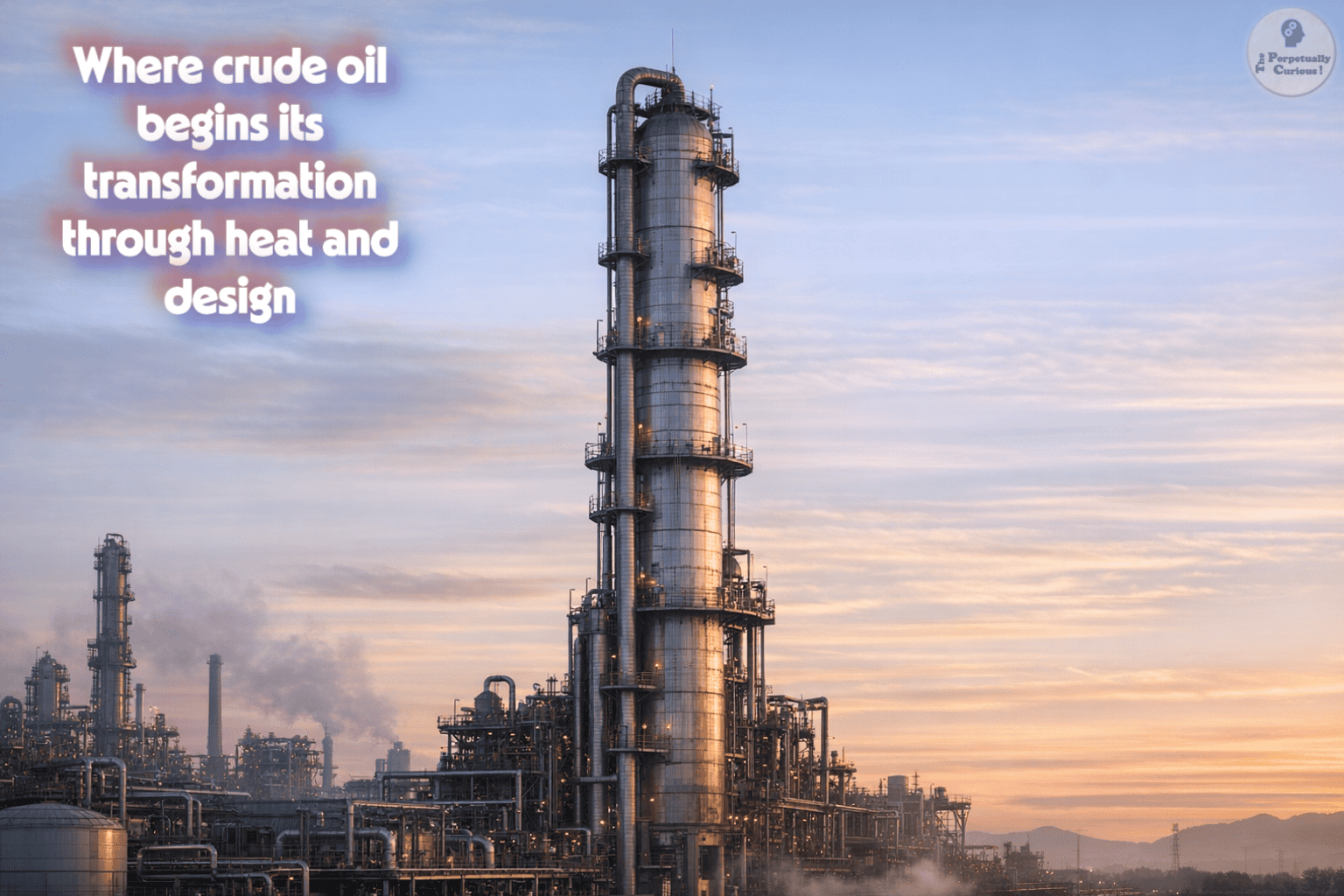
🏭 Petroleum Refining: The Process Behind Heat, Pressure, and Design
There is a quiet elegance in the way crude oil begins its transformation. It arrives as a dark, ancient liquid shaped by geological time, yet it enters the refinery as a material waiting to be understood.
- The Perpetually Curious! › Archives › Engineering & TechnologyArticle
🏭 Petroleum Refining: How Crude Oil Begins to Transform
Petroleum refining begins with a deceptively simple challenge: crude oil is not one substance. It is a dense mixture of hydrocarbons, trace elements, salts, and fine materials that arrived from geological history with no concern for human categories. A refinery must first make that mixture readable.
- The Perpetually Curious! › Canonical › Biology & HealthArticle
💧 Why We Cry: The Quiet Science of Tears, Sadness, and Grief
Emotion begins as a sequence of signals moving through deep neural pathways.A tear forms only when these precise impulses reach the circuits that guide the surface of the eye.In that small trace of water, the body reveals how feeling becomes visible.
- The Perpetually Curious! › Canonical › Planet EarthArticle
🌇 When the Sky Becomes a Painting: Why Clouds Glow Red and Orange at Sunset on Earth
Sunset color is not a single event but a progression that begins high above the surface and continues downward through the atmosphere. Sunlight first encounters the upper layers of air, where gas molecules scatter shorter wavelengths and allow longer wavelengths to pass through. …