Explore by topic, question, or idea. Find articles, reflections, videos, puzzles, and curiosity pathways gathered across the site.
Press Enter or select Search. A newly typed query starts globally; filters are applied only through the visible rail.
226 results for “trees that drink the sky how certain species shape water and land in south india”
- The Perpetually Curious! › Canonical › Biology & HealthArticle
🌫️ Why We Get Hiccups: The Reflex Beneath Every Small “Hic”
From section: 🐾 Evolutionary echoes: infants, amphibians, and possible originsAnother hypothesis looks further back in evolutionary history. Some researchers have noted that the pattern of muscle contraction and airway closure in hiccups resembles movements used by certain amphibians and lungfish to move water across gills while protecting air-breathing structures.
- The Perpetually Curious! › Canonical › Biology & HealthArticle
🌫️ When the World Blurs for a Moment: Why We Sneeze
From section: 👃 A reflex born in the noseA broader appreciation of how sensory receptors shape bodily responses can be found in the study of neurons, which reveals how diverse cell types collaborate to create unified experiences.
- The Perpetually Curious! › Canonical › Biology & HealthArticle
💧 Why We Cry: The Quiet Science of Tears, Sadness, and Grief
Emotion begins as a sequence of signals moving through deep neural pathways.A tear forms only when these precise impulses reach the circuits that guide the surface of the eye.In that small trace of water, the body reveals how feeling becomes visible.
- The Perpetually Curious! › Canonical › Engineering & TechnologyArticle
🖋️ Printing Ink: The Science and Living History Behind the Printed Page
From section: 🎨 What ink is made of: The foundation of color and formAdditives fine tune the ink’s behavior. Surfactants improve wetting, waxes enhance rub resistance, and driers accelerate oxidation in certain oil-based systems. These small adjustments allow inks to perform consistently across a wide range of substrates and conditions.
- The Perpetually Curious! › Canonical › Planet EarthArticle
🌐 How SONAR Uses Sound to Map the Hidden Ocean Depths
… SONAR, which stands for Sound Navigation and Ranging, is one of the main ways humans listen to and illuminate this hidden realm. By sending sound into water and listening for its return, SONAR turns echoes into information about distance, shape, and motion. …
- The Perpetually Curious! › Canonical › Biology & HealthArticle
☕ The Molecular Democracy: Why Coffee Affects People Differently
Two people share a pot of coffee. For one, the cup brings a welcome lift that seems to fade into the afternoon. For the other, its presence may still be felt when the room grows quiet at night. The drink looks familiar, yet the experience follows a different course. Why does…
- The Perpetually Curious! › Canonical › Biology & HealthArticle
🌌 What Causes Déjà Vu: The Science Behind Familiar Moments
There are moments when the present feels as though it has slipped into the shape of a memory. A person may step into a hallway, hear a fragment of conversation, or notice the angle of afternoon light, and a quiet ripple of familiarity rises without warning.
- The Perpetually Curious! › CanonicalReflection
Quiet Cycles of Life
Across leaf, water, and sky, gases trade places in quiet loops. Noticing that rhythm can make the living world feel more connected.
- The Perpetually Curious! › Archives › Environment & SustainabilityArticle
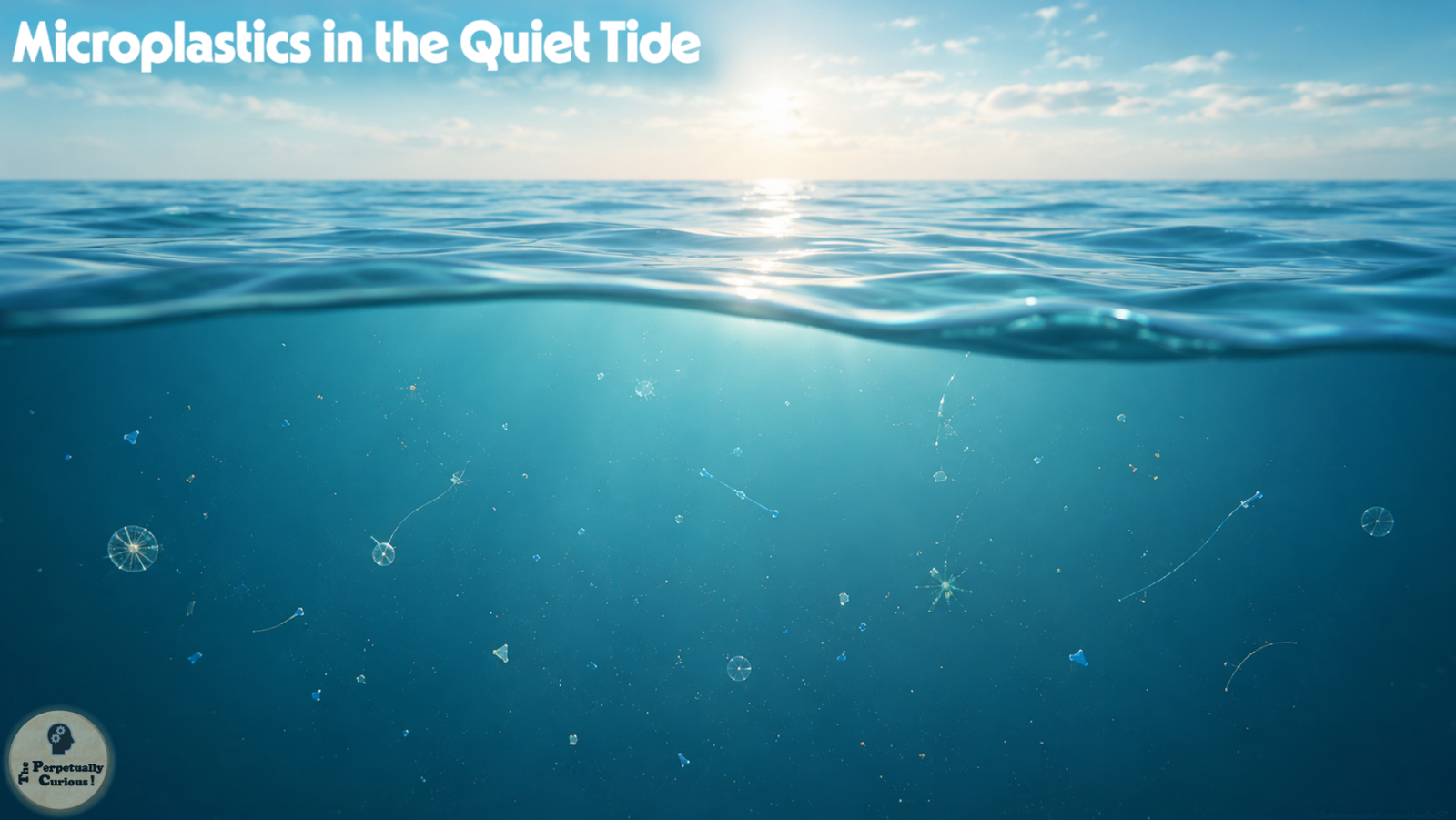
🌊 Microplastics in the Ocean: How Tiny Fragments Travel
Microplastics in the ocean are not only small pieces of plastic. They are mobile fragments, shaped by weathering, water movement, and the living systems they pass through.
- The Perpetually Curious! › Canonical › Engineering & TechnologyArticle
🚆 Quiet Power on the Rails: Understanding Hydrogen Trains and Their Emerging Role
A train moves through the landscape with a calm purpose, carrying its quiet fire toward the horizon.In the stillness between stations, its light breath of water and warmth settles into the air.The rails continue forward, steady and patient, as new forms of motion find their place in the world.