

Coal may appear simple at first glance, a dark stone lifted from the ground or burned for heat. Yet each piece carries a quiet memory of landscapes that no longer exist. Within its dark layers are traces of ancient forests, swamps, still waters, buried roots, and plant matter that escaped complete decay hundreds of millions of years ago. To understand how coal is formed is to follow a slow geological story in which life, water, sediment, pressure, and heat all work across deep time. This journey from living vegetation to dense, carbon-rich rock is known as coalification, and it unfolds over immense spans of time beneath the surface of Earth.
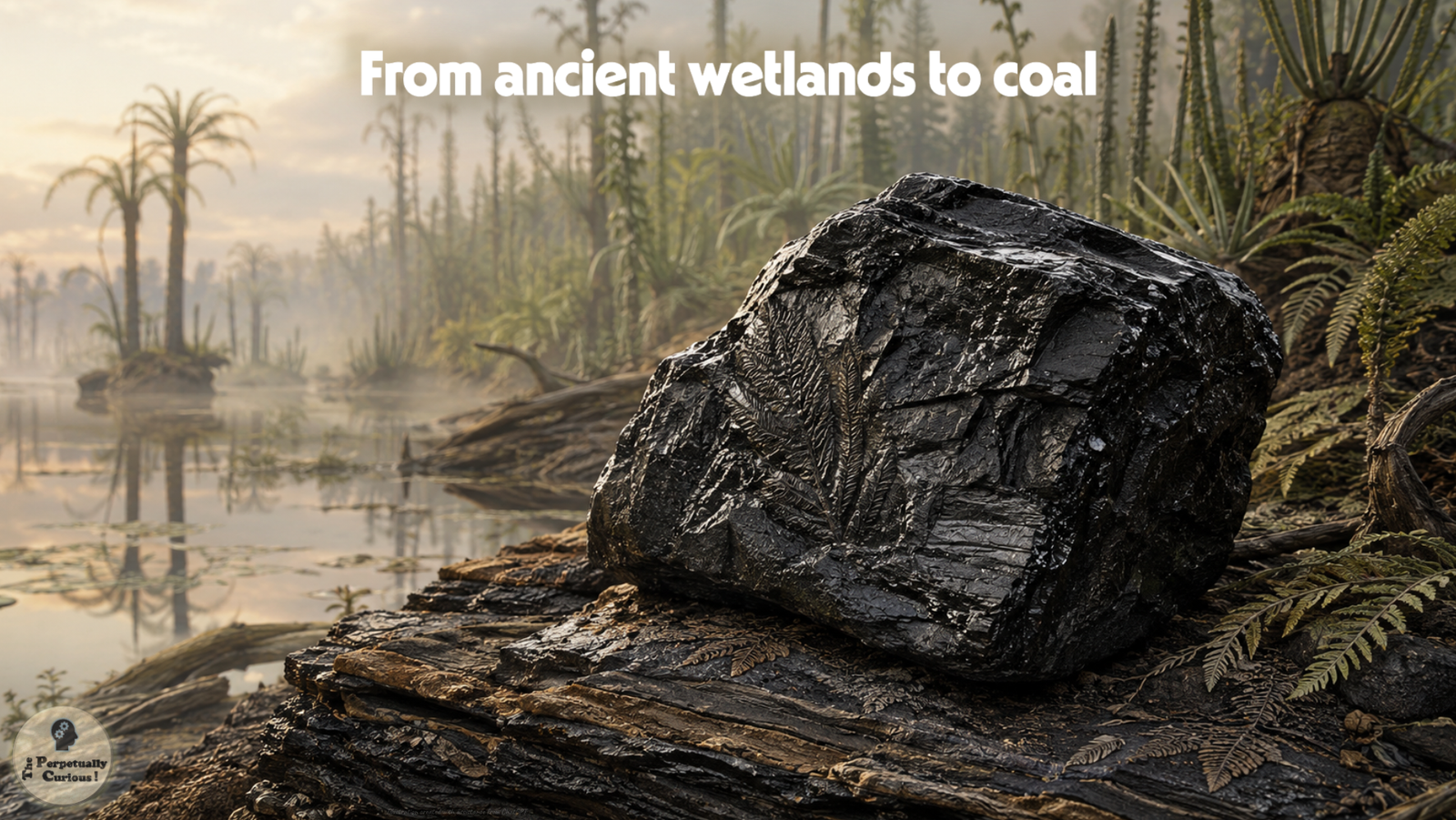
A quiet patience moves through every coal seam, carrying the memory of forests that once breathed beneath ancient skies. In its dark layers, time settles gently, holding the shapes of roots and waters that have long since passed away. What remains is a stillness that honors the slow work of Earth, a calm reminder of how deeply the past rests within the present.
🌑 What coal really is
Coal is an organic sedimentary rock composed primarily of carbonaceous material, along with hydrogen, oxygen, nitrogen, sulfur, mineral matter, and inherent moisture. Its carbon-rich substance comes from plant remains that were compacted, buried, and chemically altered over geological time. The internal structure of coal contains macerals, which are organic constituents that reflect different plant tissues and degrees of alteration. Some macerals originate from woody stems and roots, others from waxy leaves or spores, and still others from partially oxidized or charred material.
As coalification proceeds, the organic material changes chemically. With increasing burial and heating, oxygen and hydrogen are gradually reduced relative to carbon, and the remaining structure becomes denser, darker, and more carbon-rich. At higher ranks, the molecular structure becomes more condensed and aromatic, reflecting the slow chemical reorganization occurring deep underground.
This description of coal as a rock made from altered plant remains naturally leads to a deeper question. How does living vegetation become buried, preserved, and eventually converted into a dense, carbon-rich material that can be mined in thick seams?
🌿 Ancient swamps where coal begins
Coal formation usually begins in low-lying, waterlogged environments where plant growth is vigorous and decay is slowed. Coal begins with a quiet paradox: life had to grow abundantly, but decay had to remain incomplete. Many coal deposits trace back to ancient swamps, mires, and coastal peatlands where fallen leaves, trunks, and roots accumulated in shallow, oxygen-poor water. In such settings, the water may be low in oxygen and slightly acidic, which limits the activity of decomposers. The same low-oxygen chemistry that darkens waterlogged mud also helps explain why buried plant remains can escape rapid decay. As a result, plant material is only partially broken down and can build up over centuries to millennia to form thick layers of peat.
The vegetation in these ancient swamps often included towering lycopsids, early ferns, seed ferns, and early gymnosperms. Their trunks and roots created dense networks that trapped organic debris. Over time, repeated cycles of plant growth, death, and burial built up peat layers that could reach many feet in thickness. These ecosystems shifted with climate cycles, sea level changes, river movement, and basin subsidence, which influenced where peat accumulated and how long swamp conditions persisted.
Eventually, changes in rivers, sea level, or local climate caused these peat-rich swamps to be buried. Sediment from nearby rivers, coastal currents, or shallow seas covered the peat with layers of sand, silt, and clay. Once burial began, the story of coal formation moved from the surface into the subsurface, where pressure and temperature gradually increased with depth. This transition marks the point at which surface ecology gives way to physical compaction and slow chemical change.
⏳ Burial, pressure, and the process of coalification
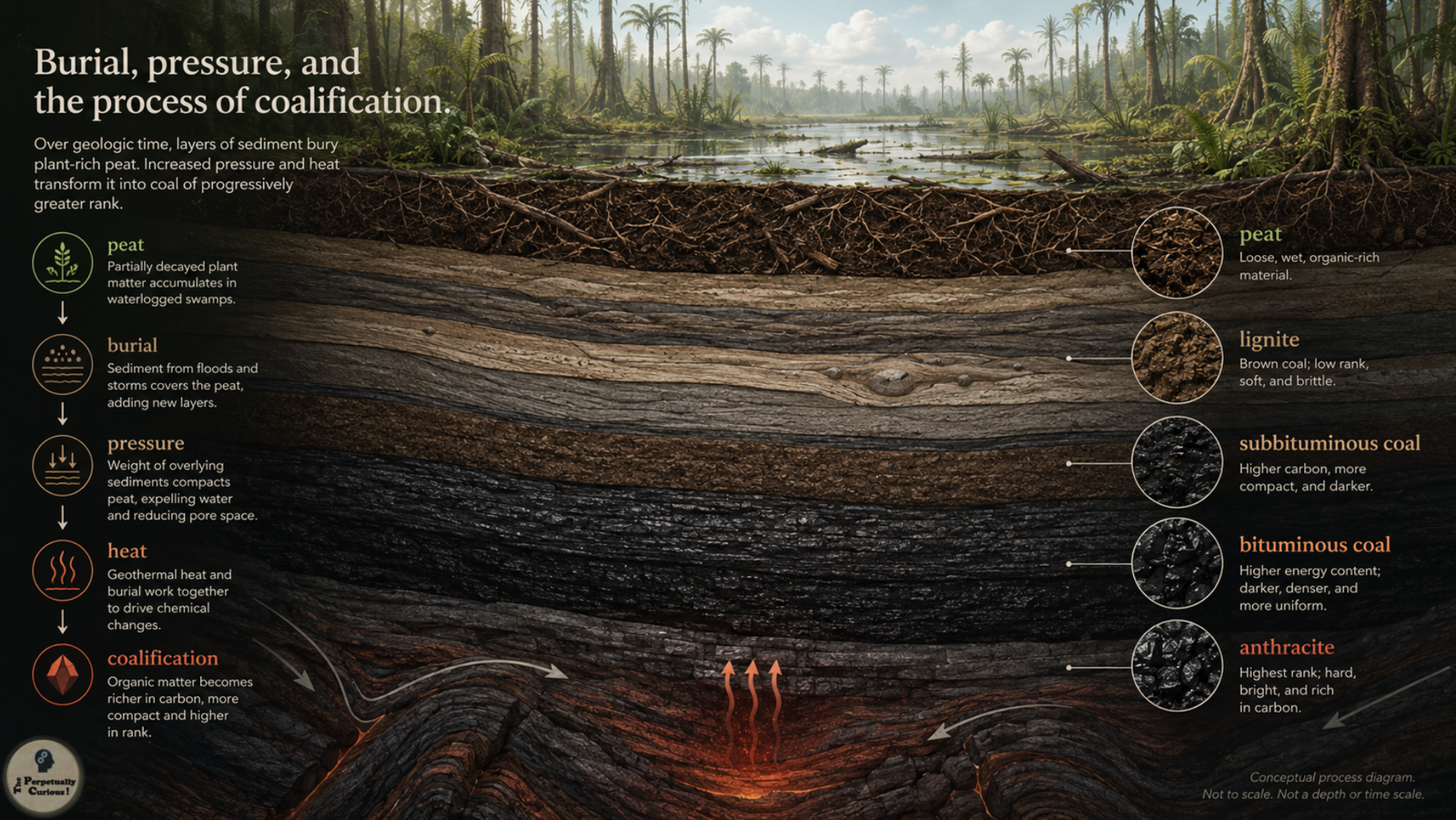
As peat is buried beneath accumulating sediment, the weight of the overlying layers compresses it. During early burial, water is squeezed out, the peat shrinks, and the organic matter becomes more compact. With increasing depth, geothermal heat rises, and chemical reactions gradually expel water, methane, carbon dioxide, and other volatile components. This progressive concentration of carbon and removal of water and volatiles is known as coalification.
Coalification does not follow one fixed depth ladder everywhere. The rank that develops depends on burial depth, maximum temperature, geothermal gradient, basin history, tectonic setting, and time. For that reason, depth and temperature ranges are best understood as broad guides rather than universal thresholds.
This transformation is slow far beyond human timescales. Peat may accumulate over thousands to tens of thousands of years, but coalification requires sustained burial and heating over much longer geological intervals. Many major coal deposits are hundreds of millions of years old, although the process is usually discussed in millions to hundreds of millions of years rather than billions of years.
Early coalification produces lignite, often after burial through hundreds to several thousand feet of sediment, with temperatures commonly remaining relatively low compared with higher-rank coal. Lignite often preserves recognizable plant structures, which indicates that the transformation is still incomplete.
With further burial and heating, lignite can pass into subbituminous coal, an intermediate rank, and then bituminous coal. In many basins, bituminous coal is associated with deeper burial, often from several thousand feet to depths beyond 10,000 feet (roughly 1,000 to more than 3,000 meters), where higher temperatures promote greater loss of moisture and volatile matter. At this stage, the coal becomes darker, denser, and more uniform.
In some regions, continued heating can produce anthracite, the highest rank of coal. Anthracite may form through deep burial, tectonic deformation, or local heating during mountain-building events. Folding and faulting can increase pressure and heat flow locally, helping drive coal toward higher rank when the surrounding geological conditions allow it.
Heat quietly reorganizes ancient plant matter during coalification, slowly reshaping its molecular structure. Aromatic structures become more common, and the coal becomes progressively richer in carbon. Thick accumulations of peat can compact into much thinner coal seams, preserving a compressed geological record of ancient wetlands rather than a one-to-one thickness of former forest.
🔍 The ranks of coal
Coal is commonly classified into ranks that reflect its degree of coalification. These ranks are based on properties such as carbon content, moisture, volatile matter, and heating value, and they provide a convenient way to describe how far the original plant material has been transformed. Reported percentages can vary depending on whether coal is measured as received, dried, or adjusted for mineral matter, so rank values are best understood as useful ranges rather than exact boundaries.
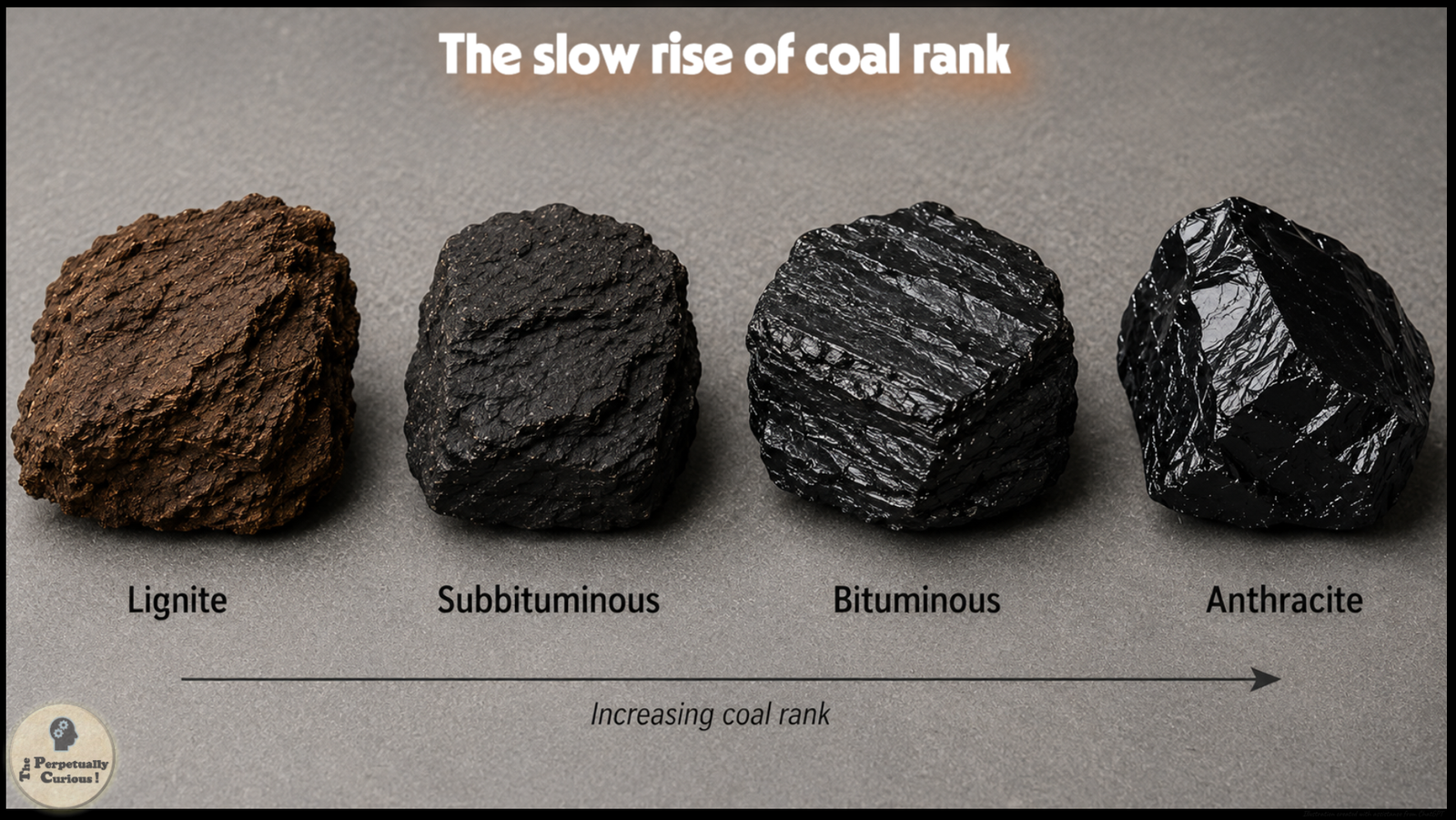
Lignite is often referred to as brown coal. It is the lowest rank and is usually less deeply altered than higher-rank coals. Lignite typically contains about 25 to 35 percent carbon by weight on an as-received basis and has relatively high moisture compared with higher-rank coal. Its texture is often crumbly, and plant structures may still be visible.
Subbituminous coal represents a further step in coalification. It is usually dark brown to black and contains about 35 to 45 percent carbon on a comparable as-received basis. Its moisture content is lower than that of lignite, and its heating value is higher.
Bituminous coal is the most abundant rank in many regions. It is harder and shinier than lignite and subbituminous coal, and it typically contains about 45 to 86 percent carbon. Its moisture content is lower, its volatile matter is more altered, and its energy content is higher.
Anthracite is the highest rank of coal. It usually contains about 86 to 97 percent carbon and has very low moisture. Anthracite is hard, brittle, and has a bright sheen. Its formation often reflects deep burial, tectonic heating, or other geological histories that exposed the coal to higher thermal maturity.
These ranks can be viewed as chapters in a long geological biography, each recording a different stage in the transformation of ancient plant matter. In this sense, coal is not one uniform material, but a family of related rocks shaped by original vegetation, wetland chemistry, burial history, and heat.
🌍 Coal in Earth’s long story
The ranks of coal also carry a hidden calendar, because each stage of coalification reflects not only the nature of the original peat but also the burial, heating, and geological history that followed. Most economically important coal deposits formed during specific intervals of Earth history, particularly during the Carboniferous Period, which spans roughly 359 to 299 million years ago, and in later periods such as the Permian and parts of the Cretaceous and Paleogene. During these times, many low-lying regions supported extensive forests and swampy wetlands where conditions favored the accumulation of peat.
Coal seams preserve ecological snapshots. Fossil plant fragments, spores, and microscopic structures can be studied to reconstruct the composition of ancient forests and wetlands. In some cases, coal-bearing sequences also record changes in sea level, river pathways, and tectonic activity, which influenced where and how peat accumulated and was buried.
Coal deposits are unevenly distributed across continents because peat formation requires specific combinations of climate, vegetation, basin stability, and hydrology. Regions that experienced long periods of humid conditions and slow subsidence often accumulated thick peat layers that later became coal. Some major coal basins also formed across parts of the former southern supercontinent Gondwana, where Permian wetlands left extensive coal-bearing strata across southern continents.
Coal is a bridge between biology and geology. It begins as living tissue and ends as a rock. Its formation involves ecological processes at the surface and physical and chemical processes at depth. This dual nature makes coal a valuable subject for studies of Earth’s long-term carbon and oxygen cycles, ancient climate, and the evolution of terrestrial ecosystems.
🔧 Coal in everyday and industrial history
Coal has played a significant role in human history because coalification concentrated ancient plant matter into a dense, combustible rock. In many regions, lignite and bituminous coal were used in home stoves for heating, where their combustion provided warmth during cold seasons. Coal also contributed to metallurgy, especially when certain bituminous coals were converted into coke, a porous carbon-rich fuel used in iron and steel production.
Coal tar, produced during some coal-processing and coke-making operations, also became a source of industrial chemicals, early synthetic dyes, and some tar-based road-surfacing materials. That narrower tar-based history sits beside, but is not the same as, the later development of modern asphalt roads, which commonly rely on petroleum-derived bitumen. Pulverization became another important industrial technique, where coal was ground into fine particles to improve combustion efficiency by increasing the surface area exposed to air. This process allowed coal to burn more uniformly, supporting boilers and early industrial machinery.
These uses illustrate how a rock formed from ancient plant matter became woven into the daily lives, materials, and technologies of human societies.
🚂 Coal and the rise of steam power
Coal’s concentrated energy also made it central to the age of steam engines. In the nineteenth century, coal fueled boilers that heated water into steam, which then powered locomotives, factories, pumps, mills, and ships. Energy stored in ancient plant matter over geological time was suddenly released on human timescales, becoming one of the forces behind industrial expansion.
Early power plants also relied on coal combustion to generate steam, which turned turbines and produced electricity. In transportation, steam power helped trains cross continents and ships travel long distances with greater reliability than wind alone could provide.
These historical uses highlight how coal, formed in ancient swamps, became more than a geological archive. It also became a material foundation for technological change, industrial growth, and the movement of people and goods across a rapidly changing world.
Pass this article along to someone curious and let the learning travel.
Did You Know
💧 Some coal seams contain thin layers of clay that record ancient floods, preserving moments when rivers briefly overtopped their banks and swept fine sediment into peatlands.
🌫 Certain coal deposits preserve microscopic charcoal particles, which suggest that ancient wildfires occasionally burned nearby forests and contributed carbon to the peat.
🌐 In some basins, coal seams occur in rhythmic patterns that may reflect long-term climate cycles, including shifts in humidity and temperature that influenced peat formation.
🌲 Some coal-bearing layers preserve fossilized tree trunks, roots, spores, and other plant remains, providing direct evidence of the vegetation that once grew in ancient swamps.
🧪 The chemical structure of coal becomes more aromatic as rank increases, reflecting the gradual reorganization of organic molecules under heat and pressure.
🌊 Some coal deposits formed in coastal environments influenced by tides, where alternating layers of peat and sediment record shifting water levels.
🌋 Anthracite can form not only from deep burial but also from tectonic heating during mountain-building events, which can raise temperatures enough to drive coal to its highest rank.
🔬 Some coal deposits contain coal balls, mineral-rich nodules that can preserve plant tissues in remarkable detail before the surrounding peat is fully compressed into coal.
🌧 Peat accumulation requires plant productivity to exceed decay, which means that coal deposits often indicate past climates that were humid and rich in vegetation.
🔎 Coal rank is not judged by appearance alone. Measurements such as moisture, volatile matter, fixed carbon, heating value, and vitrinite reflectance help geologists determine how far coalification has progressed.
How do scientists identify ancient plant species within coal?
Microscopic analysis of spores, cuticles, cell structures, and other fossil plant remains allows scientists to reconstruct the vegetation that formed the original peat.
Why do coal seams sometimes occur in repeated layers?
Repeated coal seams often reflect cycles of peat formation, flooding, sediment burial, subsidence, and vegetation recovery.
Can coal form beneath glaciers?
Coal formation requires abundant vegetation, so active glacial environments do not usually produce coal. However, glacial sediments can later bury, cover, or disturb peat and coal-bearing layers that formed during earlier warmer intervals.
How do scientists determine the age of a coal seam?
Scientists often estimate the age of coal-bearing strata using radiometric dating of nearby volcanic ash layers, fossil assemblages, and stratigraphic relationships with surrounding rocks.
Why do some coal seams vary greatly in thickness?
Variations in thickness reflect differences in peat accumulation rates, environmental stability, basin subsidence, and the duration of swamp conditions.
Can coal form in cold climates?
Coal can form in cooler climates if plant productivity remains high and decay is slowed by waterlogged conditions. Temperature alone does not prevent peat accumulation, although climate strongly influences vegetation and wetland stability.
Can coal form in marine environments?
Coal usually forms in terrestrial or coastal wetland settings rather than fully marine environments. Peat accumulation requires abundant land-plant material, which is most common in swamps, mires, and coastal peatlands.
Why do some coal seams contain sulfur?
Sulfur content can vary depending on the environment in which the peat accumulated. Coastal or marine-influenced settings may introduce sulfate-rich waters, which can lead to higher sulfur levels in the resulting coal.
How do geologists determine coal rank in the field?
Geologists may first examine appearance, hardness, brightness, and fracture, but precise rank determination depends on laboratory measurements such as moisture, volatile matter, fixed carbon, heating value, and sometimes vitrinite reflectance.
What is the difference between coal rank and coal type?
Coal rank describes the degree of coalification, from lignite through anthracite. Coal type refers to the organic constituents, or macerals, that reflect the original plant material and its alteration history.
Is coal considered a renewable resource?
Coal is generally classified as a nonrenewable resource because it forms over millions of years, far longer than human timescales.
How long does it take for coal to form?
Coal formation usually requires millions of years, not simply a few human generations. Peat accumulation may take thousands to tens of thousands of years, while coalification occurs over much longer geological intervals after sustained burial and heating. Many major coal deposits are hundreds of millions of years old, but coal formation is usually discussed in millions to hundreds of millions of years rather than billions of years.
Does coal formation continue today?
Peat is still forming in modern wetlands, but present-day peat has not yet undergone the deep burial, heating, and long geological alteration needed to become coal.
Does all peat eventually become coal?
Not all peat becomes coal. Some peat deposits remain near the surface and may be eroded, oxidized, or disturbed. Coal formation requires sustained burial, compaction, and elevated temperatures over geological time.
Is coal the same as charcoal?
Coal and charcoal are different materials. Coal forms naturally from buried plant matter over geological time. Charcoal is usually made when wood or other plant material is heated with little oxygen, so it can be produced on human timescales rather than through deep burial and coalification.
Are diamonds made from coal?
Diamonds are not usually made from coal. Most natural diamonds form much deeper within Earth’s mantle under extreme pressure and temperature, while coal forms from buried plant matter in sedimentary basins much closer to the surface. The “coal becomes diamond” idea is a common misconception.
Are coal seams always associated with the same geological period?
Coal seams are not restricted to a single geological period. Significant coal-bearing strata occur in the Carboniferous, Permian, and parts of the Mesozoic and Cenozoic eras.
Can coal help scientists understand past environments?
Coal can provide valuable information about past environments. Its composition, associated sediments, and fossil plant remains can be used to infer ancient vegetation, climate conditions, hydrology, and basin history.
Why are some coals brown while others are black?
Lower-rank coals such as lignite often retain more moisture and less-altered plant material, giving them a brownish appearance. Higher-rank coals are usually darker, denser, and richer in carbon because they have undergone greater coalification.
🌟 When a small stone carries an ancient story
We kindly invite you to share this reflection with friends, family, or anyone who enjoys quiet stories of Earth’s deep past. A simple piece of coal may seem ordinary, yet it carries the memory of ancient swamps, forests, still waters, and the slow geological patience that shaped it across immense time.
“How Coal Is Formed: The Slow Birth of Black Stone Across Deep Time.” The Perpetually Curious!, July 2026.
https://www.theperpetuallycurious.org/articles/how-coal-is-formed/Continue Exploring
For what comes next
Site Updates gathers occasional notes, new additions, and ways to keep in touch. RSS brings new publications to your feed reader in chronological order.
Choose the path that speaks to you, and let the next curiosity find you wherever your wondering takes you.