

Set a tomato beside a peach, an avocado, a strawberry, and a seedless grape, and the familiar fruit bowl begins to look like a collection of contradictions. The tomato holds many small, tender seeds. The peach appears to guard one seed inside a stone. The avocado invests in a single large seed. The strawberry wears what look like seeds on its surface, while the grape seems to have misplaced its seeds altogether.
These differences are not botanical indecision. They are variations on one of the central passages in a flowering plant’s life: the movement from flower to fruit, from ovule to seed, and from one generation to the possibility of another. To answer the question fully, two kinds of why must remain together. Development explains how fruit and seed arise from the same flower, while ecology and evolution help explain why their forms have become so varied. The story therefore begins before the fruit exists, while its future is still arranged inside a flower.
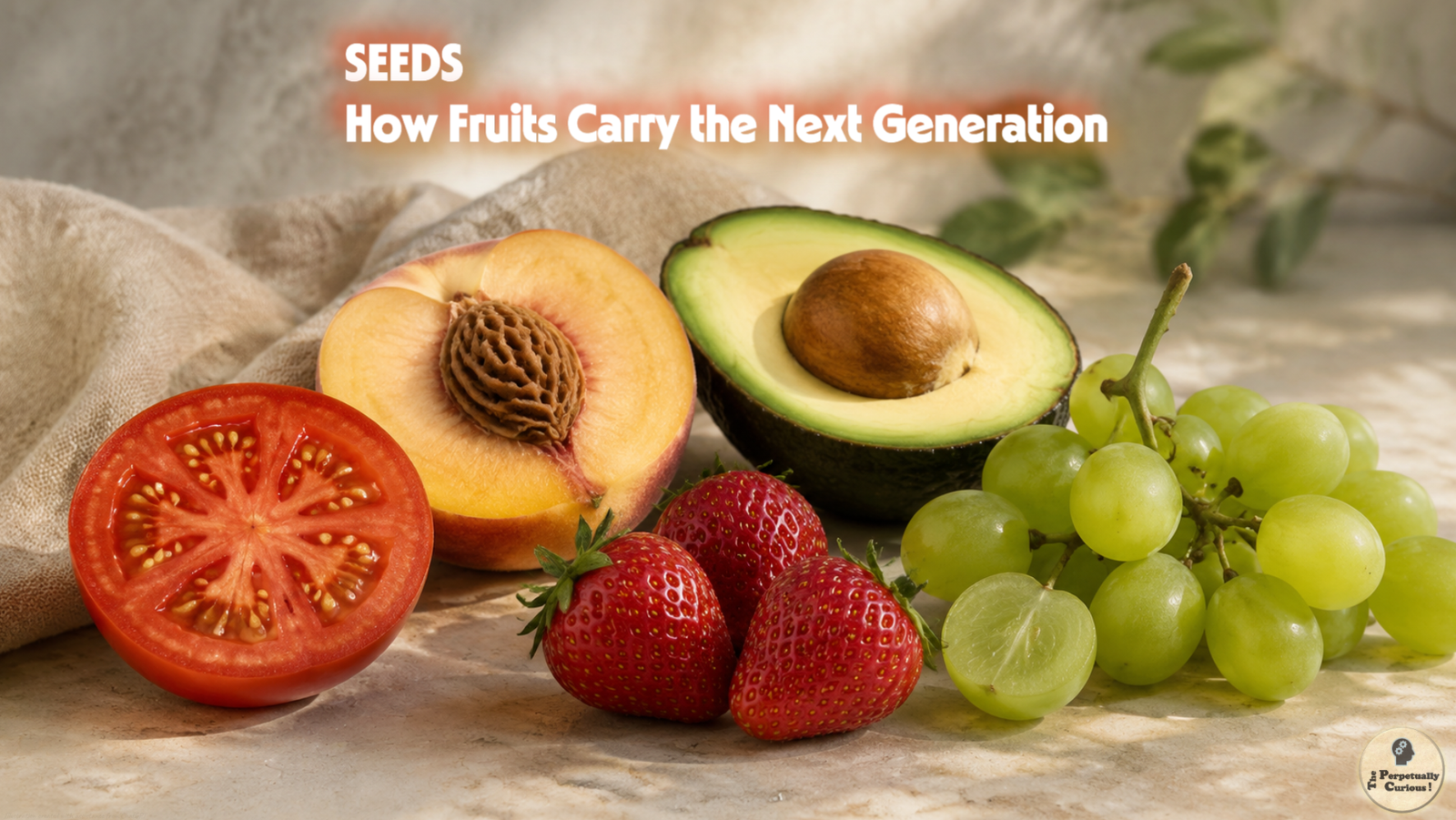
A seed waits in its small chamber, carrying the quiet hope of another beginning.
The fruit around it holds the memory of sunlight and rain, offering its sweetness to the world.
In every journey from branch to ground, life moves forward in gentle, patient ways.
🌼 A fruit begins as part of a flower
In flowering plants, or angiosperms, ovules develop within the flower’s ovary. After successful pollination and fertilization, one or more ovules may develop into seeds. At the same time, the ovary usually matures into a fruit, and its wall becomes the fruit wall, called the pericarp. Each seed contains a young plant embryo, together with tissues that protect it and, in many species, nourish its earliest growth.
Because many seeds arise through sexual reproduction, they also carry new combinations of inherited traits. A seed is therefore not only a protected embryo. It is often a genetically distinct beginning.
This shared origin explains the usual partnership between fruit and seed. The developing fruit surrounds the seeds while they mature. Later, the fruit may help release them, carry them, or attract an animal that moves them elsewhere. Protection and dispersal are common roles, but fruit did not evolve according to one universal plan, and not every fruit performs those roles in the same way.
The botanical meaning of fruit is therefore much broader than the sweet produce aisle suggests. Pea pods, capsules, and cereal grains are fruits, as are true botanical nuts, while many culinary nuts are seeds or seed-containing fruit parts.
Even familiar fruits complicate the pattern. Apples and strawberries include substantial tissues derived from floral structures beyond the ovary. The usual sequence from fertilization to seed and fruit also has exceptions, since some fruits can develop without mature seeds.
Once this basic architecture is clear, the next mystery is not simply why a fruit contains seeds. It is why one fruit may carry a single seed while another carries dozens, hundreds, or only unfinished traces.
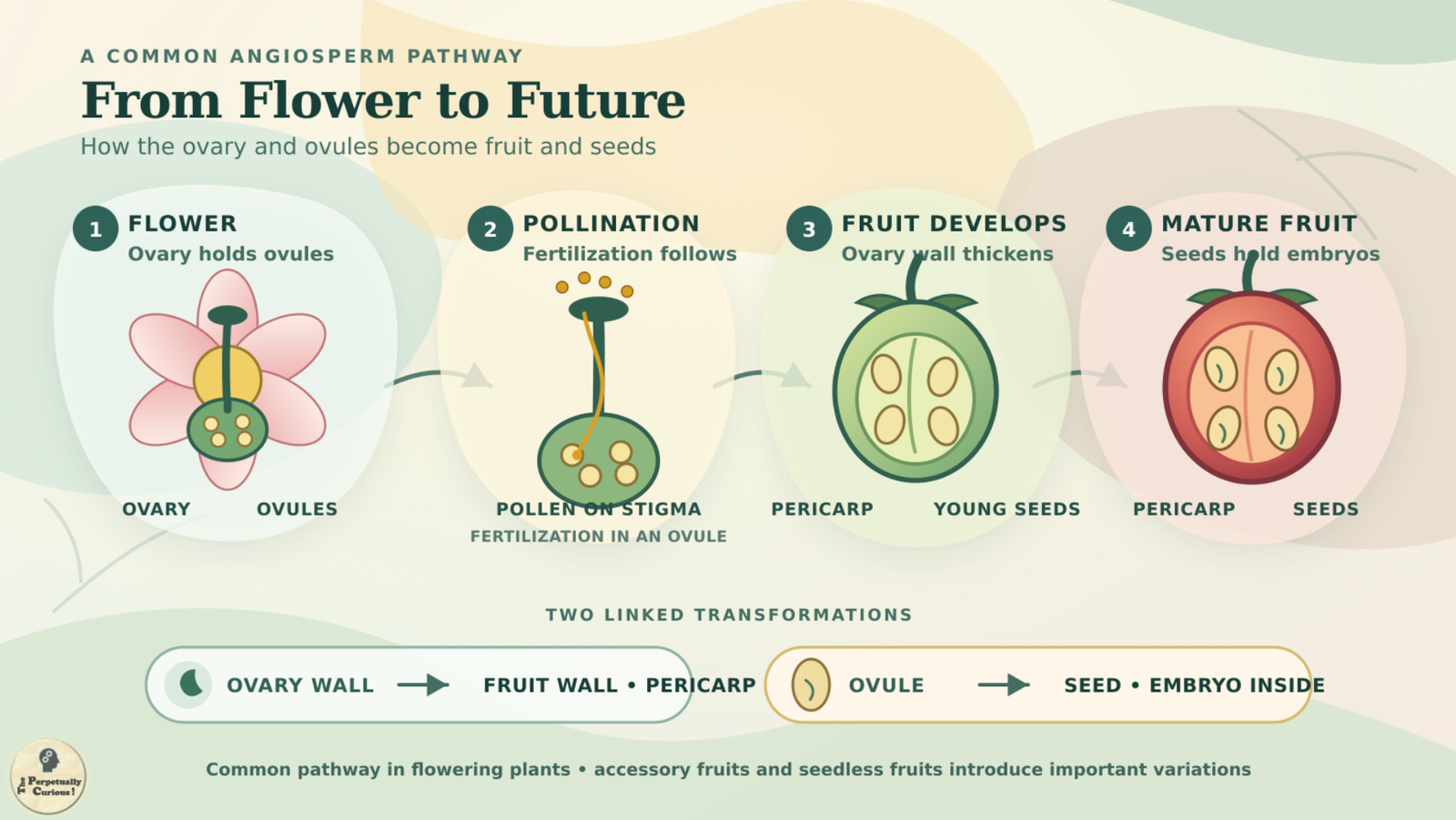
⚖️ Plants divide reproductive investment in different ways
The possible number of seeds begins with the number and arrangement of ovules in a flower. Genetics and floral development help establish that starting point. The final number of mature seeds may also depend on whether ovules are fertilized successfully, whether developing embryos remain viable, and whether the plant has enough resources to complete their development.
The citrus family tree offers a familiar example. Cultivar genetics, hybrid ancestry, and pollination can combine to produce fruits with very different seed counts, even among close botanical relatives.
Seed size introduces another layer. A large seed can hold substantial reserves in its cotyledons or endosperm. Those reserves may support a seedling while it establishes roots and leaves, especially where light, water, or nutrients are difficult to obtain immediately. A small seed contains less stored material, but a plant can often produce more small seeds from a limited reproductive budget. Small seeds may also be easier for wind, water, or animals to carry.
This creates a widely observed size-and-number trade-off, but it is not a rigid law that predicts every species. Seed size also reflects ancestry, habitat, plant form, dispersal route, dormancy, and the conditions under which seedlings establish. A large seed does not guarantee success, and a small seed is not an inferior beginning. Each represents a different distribution of risk and resources.
An avocado and a tomato make the contrast visible. One surrounds a large seed with considerable reserves. The other distributes its investment among many much smaller seeds. Both arrangements can reproduce a plant successfully, but they place their possibilities in different packages.
Size and number explain part of the variation. They do not yet explain why a tomato seed feels tender, why a bean becomes food, or why the center of a peach seems built like a small piece of wood. For that, the layers around the embryo matter.
🛡️ Protection changes what a seed feels like
A typical seed contains an embryo, stored or supporting tissues, and an outer seed coat derived from the ovule’s integuments. These components vary greatly. The seed coat may be thin and permeable, or it may become thick, water-resistant, chemically defended, or physically hard. Such traits can protect the embryo from damage, pathogens, or seed-eating animals. In some species, a resistant coat also helps postpone germination until water can enter or other conditions become suitable.
Not every hard object at the center of a fruit is the seed itself. In peaches, cherries, and related stone fruits, the familiar pit is mainly a hardened inner layer of the fruit wall called the endocarp. The actual seed rests inside it. This distinction matters because the fruit wall and the seed coat can contribute different kinds of protection. What appears to be an unusually hard seed may actually be a seed enclosed within a hardened part of the fruit.
Bael fruit presents another arrangement: a hard, woody rind surrounds soft, aromatic pulp in which the seeds are embedded. Here again, the toughest layer belongs to the fruit rather than to the seed itself.
Softness and edibility are equally layered. When people eat peas, beans, or lentils, they are eating seeds whose stored reserves can also nourish the emerging seedling. Many culinary nuts are seeds or contain the seed as the principal edible portion. In other fruits, people eat the fruit wall or another floral tissue while leaving the seed untouched. A seed may be tender because its coat is relatively thin, because it is small, or because the fruit is eaten before all of its tissues become fully hardened.
Edibility, however, is not a universal botanical category. A seed eaten by one species may be rejected or damaged by another. Maturity and preparation can also change texture and chemistry. Some seeds contain structural barriers or defensive compounds, so the fact that a fruit’s flesh is edible does not make every enclosed seed equivalent as food.
Protection solves the problem of keeping an embryo intact, but it creates the next challenge in the story. Once the seed is mature, how does it leave the parent plant, and how far must it go?
🍒 Some fruits turn appetite into transport
In many fleshy fruits, ripening changes color, aroma, texture, acidity, and sugar content. These changes can make the fruit noticeable and rewarding to animals at roughly the time when its seeds are ready for release. A bird or mammal may swallow the fruit and later excrete or regurgitate intact seeds. Another animal may remove the flesh and discard the seed, carry it away, or cache it for later.
Peepal figs make this sequence especially intricate: specialized fig wasps pollinate flowers enclosed within the fig structure, while birds and bats may later disperse the resulting seeds.
The relationship is not a perfectly negotiated contract. Some fruit-eating animals destroy seeds and act as seed predators rather than dispersers. Others move seeds only occasionally. Seed survival may depend on whether an animal swallows, crushes, spits out, or stores the seed. Fruit traits also reflect evolutionary history and physical constraints, so color or scent alone cannot identify a dispersal partner with certainty.
Still, the combination of attractive flesh and a protected seed can be remarkably effective. The edible portion offers energy to an animal, while the seed may travel beyond the parent plant’s immediate surroundings. That movement can reduce competition with the parent, help a seed escape locally concentrated enemies, or place it in a different patch of habitat. None of those outcomes is guaranteed, but dispersal widens the range of possible destinations.
Fleshy fruits are only one part of the story. Many fruits never become sweet, colorful, or succulent, yet they still shape where their seeds go.
🌬️ Other fruits travel without being eaten
Dry fruits reveal how easily everyday language hides botanical diversity. A maple’s paired wings, a milkweed pod, a burr, a cereal grain, and a legume pod are all connected to flowering and fruit development, even though few people would place them beside peaches and grapes.
What travels is not always the bare seed. Botanists use the word diaspore for the dispersal unit, which may be a seed, an entire fruit, or a seed traveling with attached fruit or floral structures. That distinction brings many apparently unrelated travelers into the same story.
Diaspores may move through air, float on water, cling to feathers or fur, fall under gravity, or be thrown when a dry fruit splits suddenly. Some pass through more than one stage of movement. A seed may first drop to the ground and later be carried by an ant, a rodent, flowing water, or another agent.
The five-winged fruits of the Arjuna tree make this distinction visible. As the fruits fall, their projecting wings interact with the air, making the whole fruit, rather than a bare seed, the traveling unit.
Not every plant sends its seeds far away, and a few do not disperse them in the usual sense at all. Many seeds land close to the parent, while some germinate beneath it or even begin development while still attached. Dispersal therefore ranges from dramatic travel to almost no relocation. Distance is not automatically beneficial, since a seed that travels far may arrive in an unsuitable place.
Dispersal also has two dimensions. Movement carries a seed through space, while dormancy can carry its possibility forward through time. A dormant seed can delay germination even after reaching a destination. Its coat and internal physiology may hold the embryo in waiting until particular combinations of moisture, temperature, light, or other cues are present. The seed’s journey is therefore not only a question of where it goes, but also of when it begins to grow.
These ecological roles make the word useful surprisingly difficult. Usefulness changes depending on whether the observer is a plant, an animal, an ecosystem, or a person.
🧺 Usefulness depends on who is looking
Humans value seeds in many ways because they package embryos with protective tissues and, in many species, stored reserves. Beans, lentils, peas, and many grains are eaten largely for their seed tissues. Other seeds provide oils drawn from their stored energy reserves, flavors, beverages, planting material, or fibers associated with their outer surfaces. Coffee beans and cacao beans are also seeds, even though their everyday names rarely invite us to picture the flowers and fruits from which they came.
The uses are not always culinary. Neem seeds yield an oil used in products such as soaps and in certain forms of pest management, illustrating how stored seed compounds can enter material and agricultural life as well as food.
Much of what we casually call a nut is also a lesson in the difference between culinary and botanical names. Not all culinary nuts are botanical nuts, and a true botanical nut is itself a dry fruit enclosing a seed rather than simply a bare seed. Almonds and pistachios are the edible seeds of fruits with hardened inner layers, while peanuts are legume seeds that mature inside underground pods. Chestnuts are true botanical nuts whose hard fruit walls enclose the edible seeds, and the familiar walnut kernel is the edible seed inside a hard inner fruit wall and outer husk. A snack bowl therefore gathers several kinds of fruits and seeds under one culinary name, united by how people use them rather than by a single botanical design.
Other seeds may have little direct human use, yet that does not make them ecologically unimportant. They may renew plant populations, feed other organisms, sustain relationships with dispersers, or remain dormant until a later opportunity for germination. Some never germinate or survive to maturity. Plants commonly produce more seeds than will become mature individuals, and each seed enters a landscape shaped by chance, competition, damage, and changing conditions.
Human preferences add another layer to this variation. Cultivation may favor larger edible seeds, thinner coats, reduced dormancy, fewer defensive compounds, or fruits with small and unobtrusive seeds. In other cases, people have favored fruits with no fully developed seeds. That apparent exception leads back to the developmental relationship with which the article began.
🍌 Seedless fruit still has a reproductive story
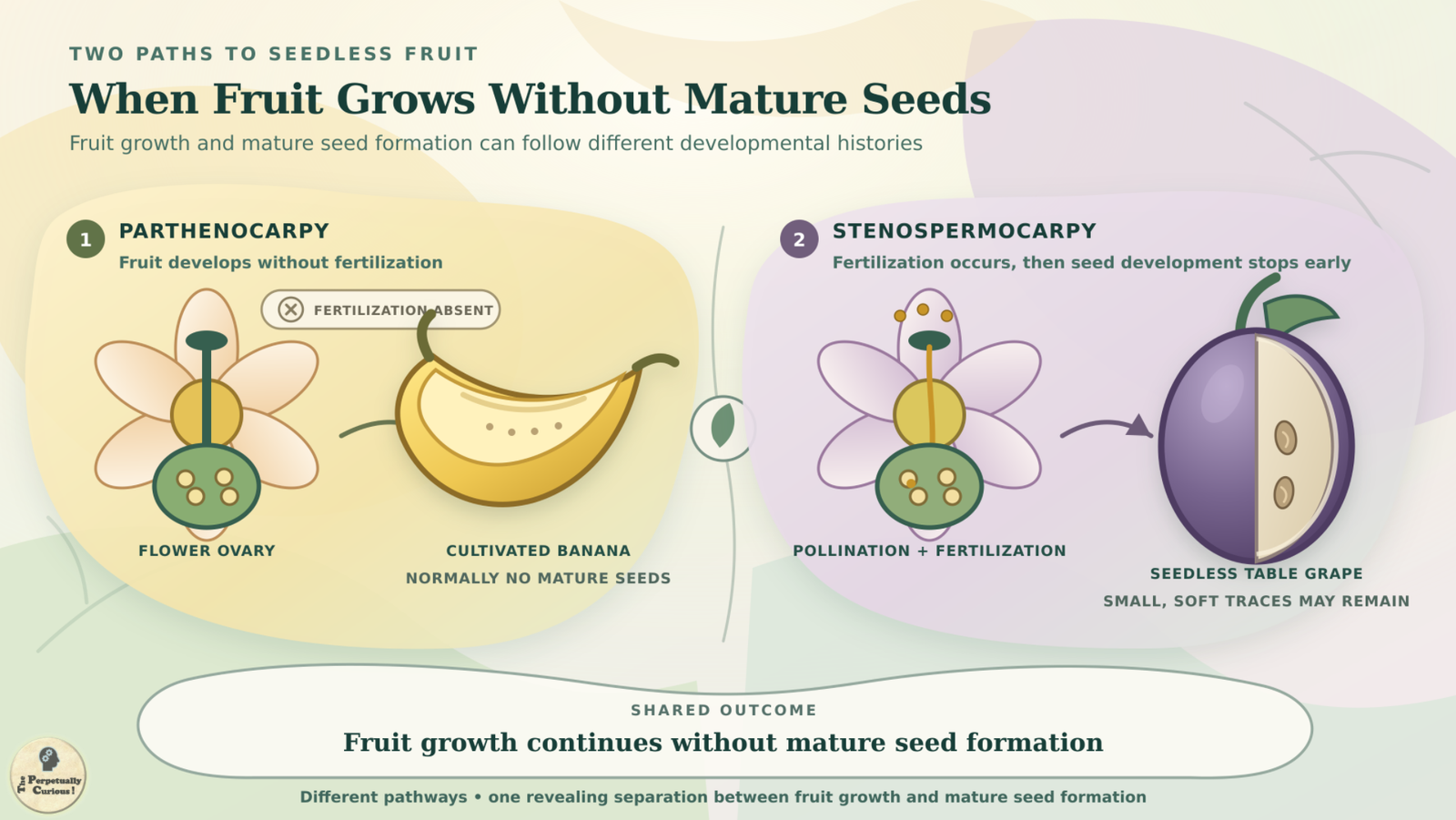
A seedless fruit does not mean that the plant has abandoned reproduction. It means that fruit growth and mature seed formation have become separated in that particular developmental pathway.
In parthenocarpy, a fruit develops without fertilization and normally lacks mature seeds. In stenospermocarpy, pollination and fertilization occur, but seed development stops early. Many familiar seedless table grapes follow this second pathway, which helps explain the small or soft seed traces sometimes found inside them. Naturally occurring variation, mutation, hybridization, and human selection can all contribute to seedless fruits in different plant groups.
In many plants, pollination and fertilization alter hormone signaling in the ovary, and developing seeds can contribute signals that support fruit set and growth. Parthenocarpy shows that related growth pathways can be activated without mature seed formation.
Many cultivated seedless plants are therefore maintained through vegetative propagation. Cultivated bananas make this separation especially visible: many common edible forms develop parthenocarpic fruit, often have severely reduced fertility, and are perpetuated through suckers or tissue culture. Elsewhere, cuttings, grafting, runners, or other clonal methods can preserve a cultivar without requiring a mature seed from each fruit. Meanwhile, related wild plants or other cultivars may continue to reproduce through seeds.
Seedlessness therefore does not overturn the connection between flower, fruit, and seed. Instead, it reveals that the signals coordinating fruit growth and seed development are closely linked but not inseparable. What looks like an empty center is another variation in the same larger reproductive history.
🌍 Variation is the strategy, not the exception
Return to the fruit bowl, and its contradictions begin to resolve. There is no single best seed and no ideal fruit. Seed number begins with floral architecture, then passes through pollination, fertilization, development, and resource availability. Seed size balances reserves with reproductive quantity. Seed coats and fruit walls influence protection, dormancy, and release. Animals, wind, water, gravity, and delayed germination shape what happens next. Human cultivation adds another layer without replacing the deeper evolutionary story.
Not every feature is a perfect adaptation. Some traits persist because of ancestry or developmental constraint, and the same feature may serve more than one function. A hard layer may protect a seed, influence dormancy, and alter which animals can handle it. A fleshy fruit may attract useful dispersers as well as destructive consumers. Biology is often coherent without being simple.
A fruit is a meeting place between a flower and a possible future. Some hold one well-provisioned beginning. Others scatter possibility among many. Some enlist wings, water, or appetite. Others wait almost where they formed. Together, they show that plants do not begin again in one way. They begin again through variation itself.
Pass this article along to someone curious and let the learning travel.
💡 Did You Know?
🍓 The small structures on a strawberry’s surface are not naked seeds. Each is an achene, a tiny dry fruit that usually contains one seed, while the red portion develops mainly from the flower’s enlarged receptacle.
🌾 A cereal grain is botanically a dry, one-seeded fruit called a caryopsis. Its fruit wall is closely fused with the seed coat, which is why a grain of wheat, rice, or corn is more than a bare seed.
🌸 Many orchids produce extremely small seeds with very little stored food. Their germination in nature commonly depends on compatible mycorrhizal fungi that supply resources to the developing orchid.
🌊 In several mangrove lineages, the embryo begins germinating and continues developing while still attached to the parent plant. The resulting propagule is released only after development is already underway.
🔀 Some plants produce more than one kind of dispersal unit on the same individual. When the fruit forms differ, botanists often call the phenomenon heterocarpy; when the seeds differ, the term heterospermy may be used. Either pattern may distribute risk through diaspores with different dispersal or dormancy traits.
☕ Most coffee fruits contain two seeds facing one another. Those seeds become the familiar beans, which is why the journey from coffee cherry to cup is also a journey through the hidden life of a seed.
Why does one fruit have one seed while another has many?
The potential seed count begins with how many ovules the flower develops. The mature count also depends on successful fertilization, embryo survival, and available resources. Across species, seed size and number often involve a trade-off, although ancestry and ecology prevent any single rule from explaining every fruit. The citrus family tree offers a familiar comparison because related fruits and cultivars can differ markedly in seed count.
Do all seed plants produce fruits?
No. Botanical fruits are produced by flowering plants. They develop from an ovary, sometimes together with other floral tissues. Gymnosperms, including conifers, produce seeds without enclosing them in a true ovary-derived fruit.
Can a fruit develop without pollination or fertilization?
Some fruits can develop through parthenocarpy without fertilization. Depending on the plant, pollination may be absent or may provide a stimulus even though fertilization does not follow. Other apparently seedless fruits begin after pollination and fertilization but lose normal seed development early. The pathway varies among species and cultivars, and cultivated bananas provide a familiar example of parthenocarpic fruit maintained through vegetative propagation.
Why does an apple seed not grow into the same apple variety?
An apple seed usually contains a genetically distinct embryo formed through sexual reproduction, not a genetic copy of the fruiting tree. That is why named apple cultivars are commonly preserved through grafting rather than seed. The seed can still grow into an apple tree, but its fruit may differ in flavor, texture, size, and other traits.
Is a peach pit the same thing as a peach seed?
No. The pit, or stone, is primarily the hardened endocarp, which is the inner part of the fruit wall. It encloses the actual seed.
Does a larger seed always produce a larger or stronger plant?
No. Larger seeds often provide more reserves during early establishment, but adult plant size and long-term survival depend on genetics, habitat, competition, water, nutrients, disturbance, and many other factors.
Why can some seeds survive being eaten?
Small size, a resistant coat, or being swallowed without crushing may allow a seed to pass through an animal intact. Removing the surrounding pulp or passing through a digestive tract may sometimes alter germination, but the outcome depends on both the seed and the animal. Many other seeds are damaged or destroyed instead. In the case of Peepal figs, fruit-eating birds and bats can become dispersal partners when seeds survive transport.
Why do some seeds remain dormant or never germinate?
Dormancy can prevent germination even when a seed is alive. Depending on the species, changes in temperature, moisture, light, seed-coat permeability, or internal hormone balance may be needed before growth begins. Other seeds may be nonviable because development was incomplete or because aging, pathogens, physical damage, or unsuitable conditions prevented survival. A seed that does not sprout is therefore not necessarily dormant, and a dormant seed is not necessarily dead.
Can every seed inside an edible fruit be eaten?
No general rule links edible fruit flesh with edible seeds. The flesh, fruit wall, seed coat, and internal seed tissues have different structures and chemistry. Edibility also varies with species, maturity, the organism consuming it, and preparation.
Are all nuts seeds?
No. In everyday language, the word “nut” groups together several kinds of hard-shelled foods. Botanically, a true nut, such as a chestnut or hazelnut, is a dry fruit that encloses a seed. Almonds and pistachios are seeds taken from other kinds of fruits, peanuts are seeds from legumes, and the walnut kernel is the seed enclosed within the walnut fruit. The part people eat is often seed tissue, but the surrounding structures and botanical fruit types differ. Pine nuts offer another variation: they are seeds collected from conifer cones, so unlike the other examples, they never develop inside a fruit.
🌱 Let curiosity travel farther
We kindly invite you to share and spread the word. If this exploration brought new meaning to an ordinary fruit bowl, we encourage you to share it with friends and colleagues. Your support helps curiosity travel farther, carrying one small idea toward another place where understanding may take root.
“Why Fruits Have Seeds: The Many Ways Plants Begin Again.” The Perpetually Curious!, August 2026.
https://www.theperpetuallycurious.org/articles/why-do-fruits-have-seeds/Continue Exploring
For the curious mind: want to explore this theme through a few questions? Visit the Classic Quiz Studio, nestled under Explorations opens in a new tab ,and see where a few well-placed questions lead: Botanical Wonders Quizzesopens in a new tab
For what comes next
Site Updates gathers occasional notes, new additions, and ways to keep in touch. RSS brings new publications to your feed reader in chronological order.
Choose the path that speaks to you, and let the next curiosity find you wherever your wondering takes you.