

On a clear night, light arrives from stars scattered across an immense depth of space. Radiation from different stars can overlap in space. Yet the sky still offers points of light, recognizable patterns, and spectra that astronomers can study. Why does all that overlapping starlight not become an indistinguishable luminous fog?
The answer begins by separating a physical crossing from a blended view. Ordinary visible starlight traveling through the near-vacuum of space generally passes through other starlight without appreciable scattering. Whether those overlapping journeys appear as distinct stars or a soft glow depends on the path, the instrument, and how much information the arriving light allows us to recover.
The night sky holds many journeys at once. Understanding their crossings begins with what light actually adds together.
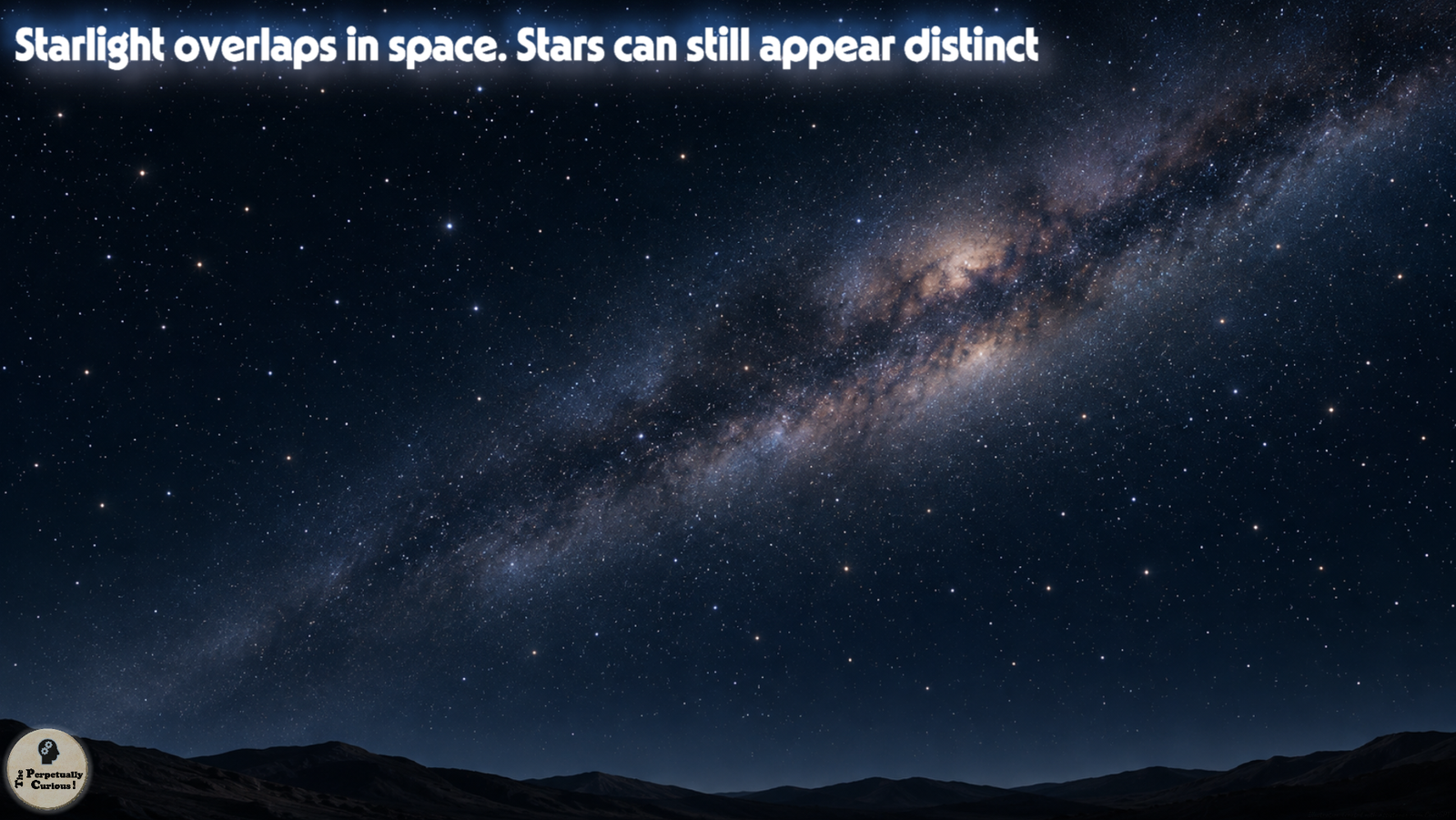
Across the dark, countless lights may share the same vastness without surrendering their separate journeys.
Some arrive clearly, some mingle at the edge of perception, yet each carries something of where it has been.
The sky keeps their crossings quietly, and still leaves room for wonder.
🌠 What happens when light crosses light?
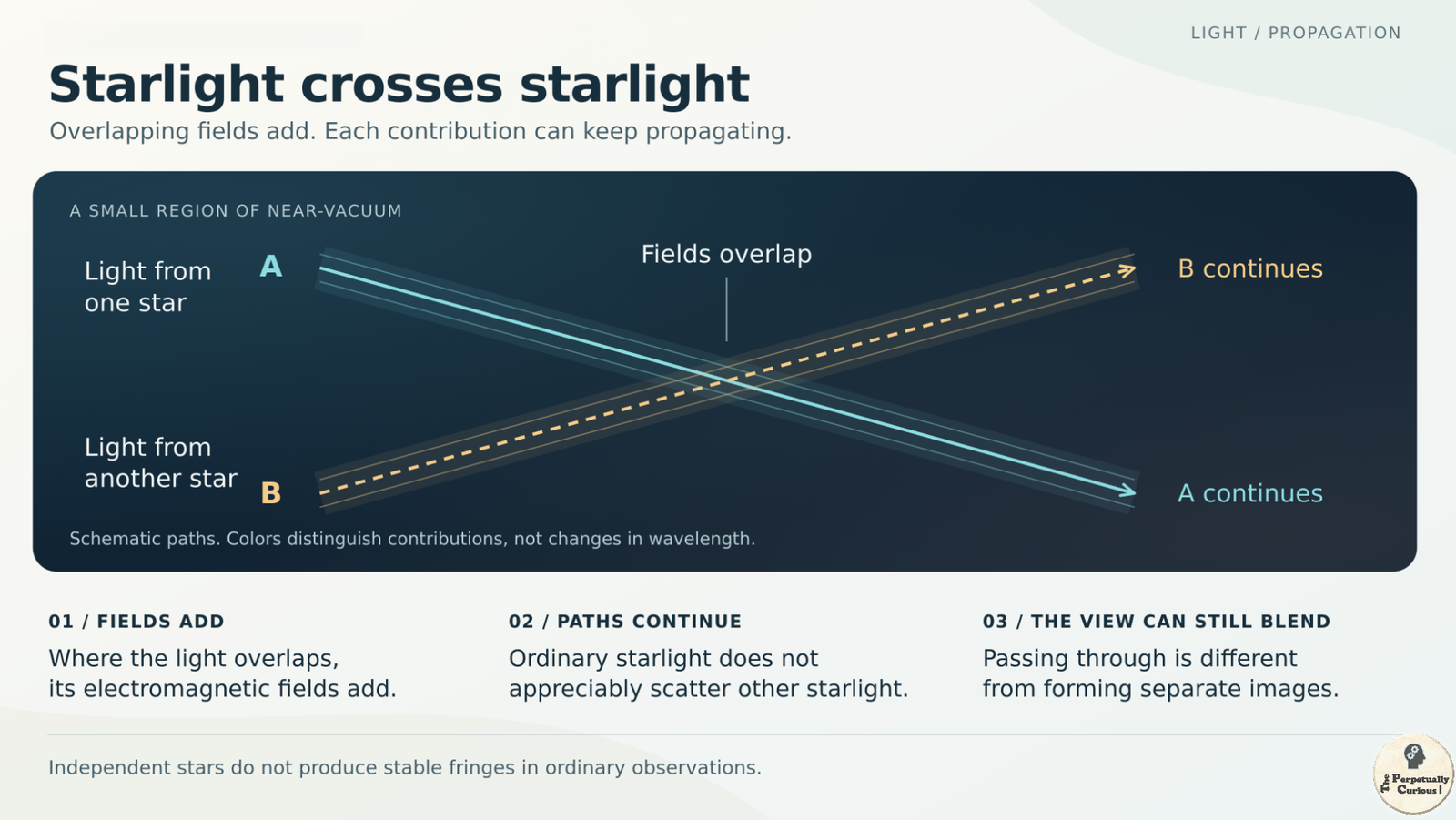
Light is an electromagnetic wave, with oscillating electric and magnetic fields. In the classical description of light in vacuum, these fields obey the principle of superposition: where waves overlap, their fields add. Each contribution can continue to propagate without the crossing permanently redirecting or transforming it.
Think of two flashlight beams crossing in a dark room. Beyond the intersection, each beam continues toward its own destination. Their meeting does not turn them into a third beam traveling somewhere between the two. The room contains air rather than vacuum, but the crossing illustrates the distinction between occupying the same region and colliding like solid objects.
Superposition does allow interference. Where suitably coordinated waves meet, their fields can reinforce or oppose one another, producing brighter and darker regions. That changes the distribution of detected light; it does not mean that the waves have become a new substance. For two independent stars, the relative timing of their oscillations fluctuates, so ordinary observations do not retain a stable interference pattern between them.[1]
That distinction explains the crossing. To understand the view, we must follow the light one step farther, into an eye or a telescope.
🔭 Why stars can remain separate in an image
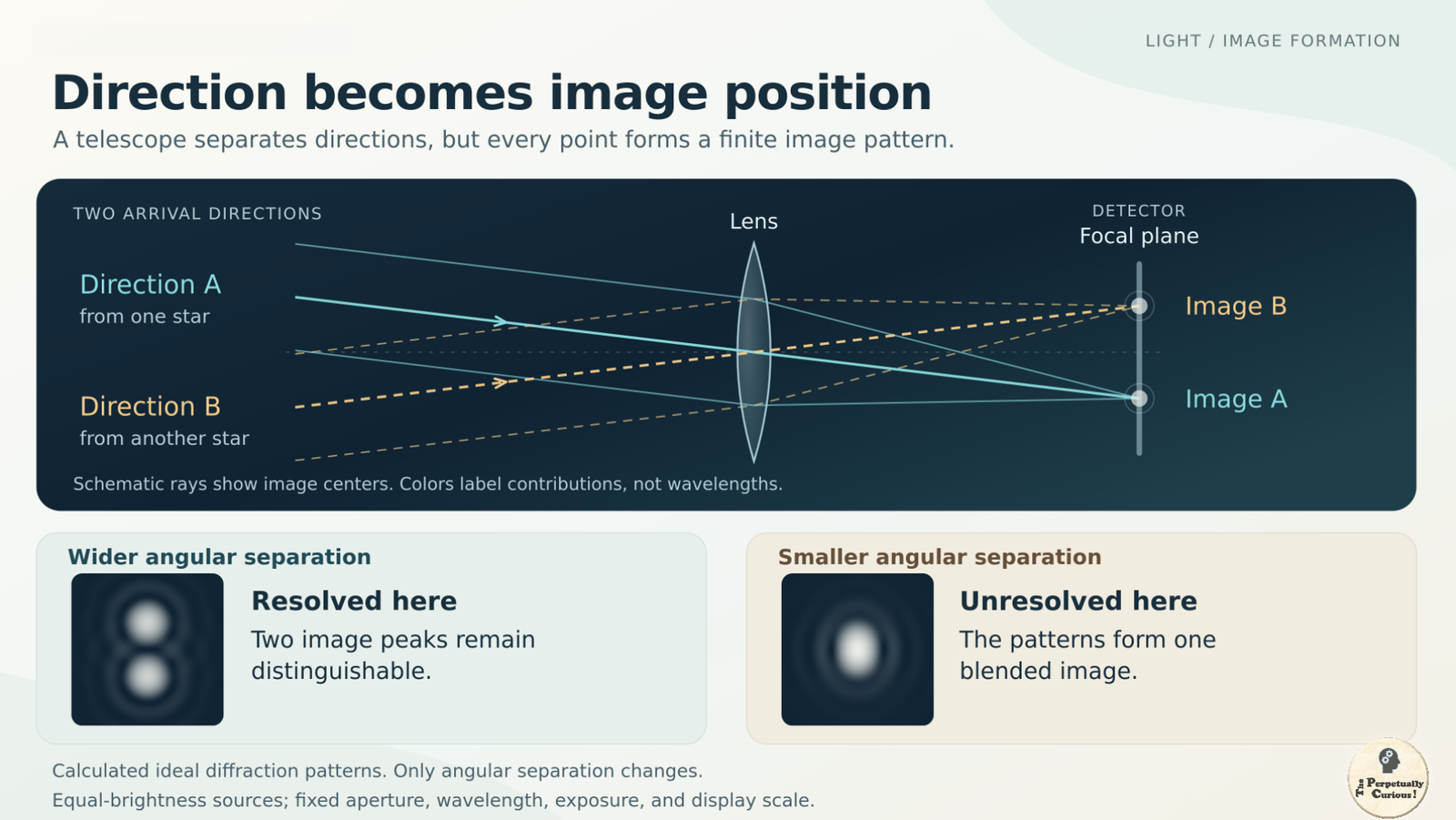
An optical telescope gathers light over its opening and uses curved mirrors or lenses to form an image. Within its field of view, light arriving from different directions is focused toward different positions. This angular information is the first practical clue to where a signal originated.
The separation is never infinitely precise. Because light behaves as a wave, even ideal optics spread the image of a distant point source into a small diffraction pattern. If two stars appear sufficiently close together, their patterns overlap and the instrument may record one blended spot. A larger aperture can improve the diffraction-limited separation at the same wavelength, although optical quality, atmospheric turbulence, and the brightness contrast between the stars also matter.[1]
Ground-based instruments look through moving air that can blur images. Space telescopes avoid atmospheric turbulence and can observe wavelength bands that the atmosphere strongly absorbs or blocks, although their own optics and detectors still impose limits.
An ordinary optical camera accumulates a signal within each pixel during an exposure, rather than following every oscillation of the incoming field.[2] For independent stars, the fluctuating interference contribution averages away, so their measured brightness contributions ordinarily add when they fall on the same pixels, provided the detector is operating within its usable range.[1]
Many faint, unresolved stars contribute to the soft glow of the Milky Way. Their light has become blended in our observation, without requiring the stars’ radiation to have scrambled itself during the journey.
Separating two points tells us where light appears to come from. Comparing their brightness requires another step: understanding how distance and intervening matter change the amount of light that reaches us.
🌫️ What makes starlight fainter along the way?
Even an unobstructed star looks fainter with increasing distance because its light spreads over a larger area. For an approximately isotropic source with steady output in nearby space, doubling the distance reduces the received power per unit area to one quarter, if intervening absorption and scattering are negligible.
This separates two useful quantities. Luminosity is the power the star emits; flux describes the power received per unit area. Astronomers often express stellar output using solar luminosity, taking the Sun as a common scale. A star can have a large intrinsic output and still look faint from far away.
Interstellar dust adds another effect. Grains absorb some light and scatter some out of the direct line of sight. Together, these processes cause extinction. In visible light, shorter wavelengths are generally diminished more strongly, so the remaining direct starlight often looks redder. The star itself need not have cooled or reduced its output.[2]
There is no universal dust correction for every star. A red appearance may reflect a cooler stellar surface, intervening dust, or both. Astronomers compare colors with spectral features and other information to estimate which explanation fits, carrying the remaining uncertainty into their results.
Brightness and color therefore carry clues about both the star and its journey. To distinguish those influences, astronomers need a more detailed record of the arriving light.
🌈 How astronomers recognize a stellar signal
Direction gives a place on the sky. A spectrum adds information about what kind of light is arriving. By separating light into wavelengths, astronomers reveal patterns of absorption and emission associated with atoms, ions, and molecules. Stellar spectra can constrain temperature, composition, and motion, while intervening gas can leave additional absorption features.
These patterns are informative, but they are not unique name tags. Different stars can have similar spectra, and an individual detected photon does not announce the name of its source. Identification comes from combining measurements with the surrounding astronomical context.
An unresolved binary offers a useful example. Its image may resemble one point, yet its spectrum can contain two sets of stellar absorption lines. As the stars orbit, those lines can shift back and forth through the Doppler effect. Under favorable conditions, changes across repeated observations reveal two contributors that the image alone could not separate.[2]
Infrared observations can reveal stars obscured in visible light, while radio astronomy traces interstellar gas and other processes. Each wavelength band adds a different part of the picture.
Sometimes these clues allow a convincing separation. Sometimes several explanations remain compatible with the data. Light’s ability to overlap without appreciable interaction does not guarantee that every blended observation can be uniquely untangled.
A blended image can conceal several sources. The reverse is also possible: several images can trace back to one source, if gravity has changed the light’s route.
🌀 When gravity changes the apparent sky
Mass curves spacetime and can deflect the light traveling through it. Under suitable alignments, gravitational lensing can magnify a background source, distort its apparent shape, or produce multiple images. Several points of light can therefore be different views of one distant object.
Those routes can also produce different arrival times. If a lensed source changes brightness, the same variation can appear in its different images at different times. Matching those variations helps astronomers connect apparently separate images to a common source.[3]
Lensing complicates the map while adding another kind of evidence. By revealing how mass is distributed, these distortions contribute to the evidence for dark matter.
These images add another layer to the original puzzle. Understanding the sky requires tracing how light traveled, as well as deciding which arriving signals can be distinguished.
🌙 Many journeys, an imperfectly readable sky
The featureless fog imagined at the beginning is not an inevitable result of light crossing light. Fields can overlap without appreciably scrambling one another, while an observation can still blend several sources into one glow. Distance, intervening matter, optics, spectra, and repeated observations each help explain the view.
No single clue makes the sky perfectly readable. Crowded fields, faint signals, and similar sources can leave real ambiguity. Astronomy works within those limits by combining evidence rather than assuming that every arrival comes with an unmistakable return address.
The wonder survives that uncertainty. Across the darkness, light can share a region without erasing another journey. What reaches us is sometimes distinct, sometimes blended, and still capable of telling us something about a distant sun.
Pass this article along to someone curious and let the learning travel.
💡 Did you know?
🔭 Interference can reveal finer detail
Astronomers can deliberately combine light collected from the same celestial source at separated telescopes. By controlling the paths and analyzing the resulting interference, they can measure details finer than either telescope could resolve alone. This technique, interferometry, turns the wave behavior of light into a tool for observation.[4]
🌫️ Dust emits at other wavelengths
Dust does more than hide visible stars. After absorbing radiation, dust grains emit energy at longer wavelengths, often in the infrared. A region that looks dark in visible light can therefore become an observable source in another part of the spectrum.[2]
✨ A sky pattern need not be a physical group
Stars that appear near one another can lie at very different distances. The familiar patterns associated with constellations therefore describe an Earth-based view, rather than necessarily tracing a physical gathering of neighboring stars. Apparent closeness and actual closeness are different parts of the sky’s geometry.
If red and blue light overlap, do they become new purple photons?
Ordinary overlap in vacuum does not convert red and blue photons into a new kind of photon. The arriving light can contain both wavelength ranges, and a visual system or color camera may register a combined color. That perceptual or recorded combination is different from changing the frequencies of the light during its crossing.
Can starlight cancel other starlight and make the sky dark?
Destructive interference can produce dark regions under suitable conditions, but unrelated stars do not maintain the stable phase relationships needed to cancel one another across an ordinary view of the sky. The broader question of why space looks dark involves how light reaches an observer and the universe’s history, rather than stars continually extinguishing one another’s radiation.
Why does the Milky Way look like a faint cloud?
The unaided eye cannot distinguish many of the faint, closely spaced stars along the Milky Way’s band, so their light forms a soft glow. Glowing interstellar gas contributes in some regions, while dust obscures parts of the view and creates dark lanes. The result combines unresolved starlight with emission and obscuration.[2]
Can astronomers always separate two stars from a blended spectrum?
No. Separation depends on the quality of the measurements and whether the contributors have distinguishable features or changes over time. Two similar stars, a very faint companion, or insufficient spectral resolution can leave an ambiguous combined signal. A spectrum supplies evidence; it does not guarantee a unique reconstruction.
Does a faint star necessarily produce less energy than a bright one?
No. Apparent brightness depends on distance and intervening material as well as the star’s own output. Solar luminosity compares intrinsic power with the Sun’s output, rather than ranking stars by how bright they look from Earth.
Can photons ever interact with other photons?
Yes. Quantum electrodynamics permits photon-photon interactions, and light-by-light scattering has been observed in high-energy experiments.[5] Such interactions are negligible for ordinary visible starlight passing through interstellar space.
Does a telescope in space remove every source of blur or uncertainty?
No. It avoids atmospheric turbulence and atmospheric absorption, but diffraction, optical imperfections, detector effects, background radiation, and limited signal still matter. Whether two sources can be distinguished depends on the instrument, the wavelength, the observation, and the sources themselves.
✨ Let this light travel farther
We kindly invite you to share this article with friends and colleagues who have wondered how a crowded universe remains readable. A small question beneath the night sky can carry a conversation a long way.
📖 Educational context
This article explains ordinary starlight propagation and astronomical observation for a general audience. Its examples simplify situations whose detailed interpretation depends on wavelength, environment, instrument response, and measurement uncertainty.
Selected sources
- Ling SJ, Sanny J, Moebs W. (2016). University Physics Volume 3. OpenStax. Sections 3.1, Young’s Double-Slit Interference, and 4.5, Circular Apertures and Resolution.
- Fraknoi A, Morrison D, Wolff S. (2022). Astronomy 2e. OpenStax. Chapters 5, Radiation and Spectra; 6, Astronomical Instruments (including Section 6.3, Visible-Light Detectors and Instruments); 17, Analyzing Starlight; 18, The Stars: A Celestial Census; 20, Between the Stars: Gas and Dust in Space; and 25, The Milky Way Galaxy (Thinking Ahead).
- National Aeronautics and Space Administration (NASA). (2020). Mosaic of Gravitationally Lensed Quasars. Released January 8, 2020.
- European Southern Observatory (ESO). (n.d.). Interferometry.
- ATLAS Collaboration. (2019). ATLAS observes light scattering off light. CERN. Published March 17, 2019.
“Silent Crossings: Why Starlight Does Not Mix in Space.” The Perpetually Curious!, November 2026.
https://www.theperpetuallycurious.org/articles/why-starlight-does-not-mix/Continue Exploring
For the curious mind: want to explore this theme through a few questions? Visit the Classic Quiz Studio, nestled under Explorations opens in a new tab ,and see where a few well-placed questions lead: Cosmic Exploration Quizzesopens in a new tab
For what comes next
Site Updates gathers occasional notes, new additions, and ways to keep in touch. RSS brings new publications to your feed reader in chronological order.
Choose the path that speaks to you, and let the next curiosity find you wherever your wondering takes you.