

At the base of many fingernails lies a pale crescent, a small moon beside the cuticle. It is often clearest on the thumbs and can be faint or out of sight on other nails. That crescent has a name, the lunula. It is the part of the nail’s growth tissue you can see through the hard nail plate. A similar sense of quiet patterning appears in the arcs and ridges of palm lines, where deeper structures also leave their mark at the surface.
The journey into this crescent begins with what we see on the surface, then moves gently beneath it, following the layers of structure and growth that give rise to the pale crescent called the lunula. Each section builds on the previous one, forming a continuous narrative that connects appearance, anatomy, variation, and the subtle rhythms of the body.
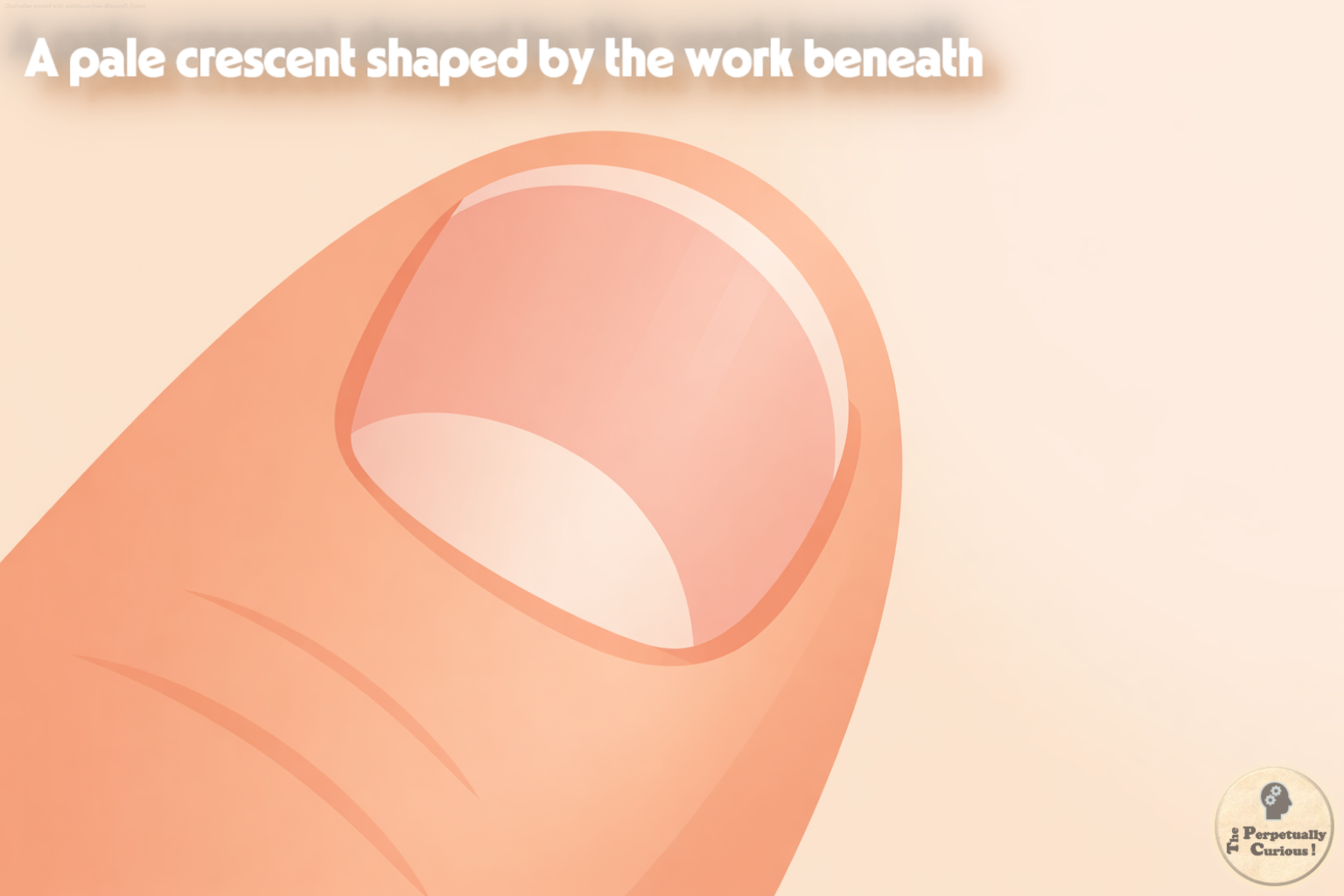
The pale crescent rests at the base of the nail like a small memory of the deeper work beneath the surface.
It holds the quiet shape of growth that continues whether we notice it or not.
In its soft arc, the body leaves a gentle reminder of the patient rhythms that carry us forward.
🌱 The foundation beneath the crescent: How the nail grows
To understand the lunula, it helps to begin with the architecture of the nail itself. A fingernail is not simply a plate resting on the finger. It is a layered structure shaped by living cells beneath the skin.
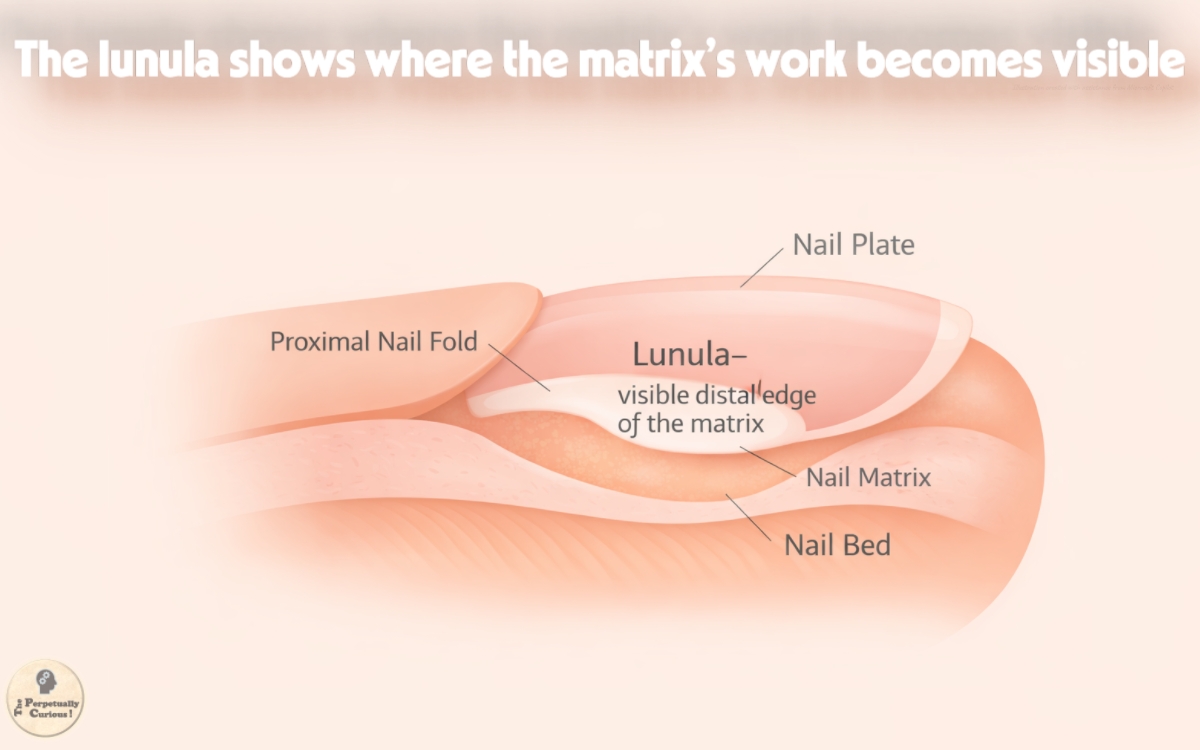
The visible hard portion is the nail plate, a smooth sheet of keratin that protects the fingertip. Because this plate is rich in keratin, henna can stain fingernails, and the stained portion can remain visible as the nail grows outward. Beneath the plate lies the nail bed, a vascular tissue that gives most of the nail its pink color. At the base, tucked beneath the proximal nail fold, is the nail matrix, where new nail cells are produced.
The lunula is the part of the matrix that shows through the nail plate. The standard anatomical explanation for its pale color points to thicker tissue and light scattered by cells in the matrix. Farther along the finger, the thinner, more vascular nail bed gives the nail its pink tint.[1]
Keratin formation is one example of how the body depends on the precise behavior of proteins. Readers interested in how changes in protein structure can alter biological function may find broader context in the science of protein misfolding.
The crescent has its beginnings before birth. In one study of human embryos and fetuses, researchers saw the first visible outline of the future fingernail as early as seven weeks of gestation.[2] A separate review places the appearance of the lunula at about fourteen weeks.[3]
This anatomy provides the foundation for everything that follows. The lunula is neither a symbol nor a separate organ. It is a visible window into the nail’s growth zone, offering a glimpse of the cellular machinery that continually builds the nail over time.
🌜 Why the lunula looks like a moon
The arc traces the curved front edge of the matrix where it shows through the nail plate. The rest of the matrix lies beneath the proximal nail fold, the cuff of skin at the base of the nail.[1][3]
A crescent is easiest to recognize when enough of that edge shows through. On some nails only a narrow part of the arc is visible.[3]
👍 Why the thumb lunula is often the most visible
The pale crescent is often easiest to see on the thumb.[1] How much of it you can see depends in part on how far the nail matrix extends and how much of it the nail fold covers.[4]
Compare your thumb with your little finger on the same hand. You may see a clear crescent on the thumb and only a sliver, or none at all, on the little finger. Both nails grow from a matrix, even when its pale edge is hidden.[4]
🌈 Why lunulae vary from person to person
Some people have a clear crescent on several fingers. Others see one mainly on their thumbs. These are the features to compare when looking at two nails.[4]
- The nail plate through which the crescent is seen
- How far the matrix extends toward the fingertip
- How much of the matrix the proximal nail fold covers
- Which finger you are looking at
Variation is a natural feature of biological systems. The lunula is not meant to look identical on every finger or every person. It reflects the quiet diversity of human anatomy. Readers who enjoy exploring how the body expresses individuality in subtle ways may find a parallel in how people differ in caffeine metabolism.
That comparison works across hands as well. The crescent can vary from finger to finger and from person to person.[4]
🧬 Can lunula appearance run in families?
Two family members may notice similar crescents. What shows at the surface depends on several parts of nail anatomy, including the length of the matrix and how much of it the nail fold covers.[4]
A family resemblance alone cannot show which feature, if any, was inherited.
The crescent is a feature you can look for beyond your fingers, too.
🦶 Lunulae in toenails
Toenails, like fingernails, grow from a matrix at the base of the nail.[1] A pale crescent can show there too. When the crescent is out of sight, the matrix still produces the nail plate.
🐾 Are lunulae unique to humans?
Mice have a lunula too. In a study comparing mouse claws with human nails, anatomists identified a pale, pointed area at the base of the mouse claw. It is an example of how a similar growth structure can have a different outline.[4]
The human crescent and the pointed mark in mice both bring a small part of the nail’s growth tissue into view.[4]
🧪 The lunula as a living growth zone
In the matrix, living cells multiply and form the hard nail plate. As new nail forms at the base, the plate slides forward over the nail bed.[1]
An injury at the base of a nail can affect the plate that grows afterward. Changes can take months to show as the fingernail grows, and a scar in the matrix can cause a persistent split.[5]
The slow and steady nature of nail growth reflects the broader theme of biological timing, and readers interested in how the body maintains long-term rhythms may appreciate the exploration of biological clocks.
This understanding prepares us for the next section, which explores what the lunula may or may not suggest about health.
🩺 What the lunula may reflect about health
A crescent that has always looked the same and one that has recently changed tell different stories.
A large lunula can be a normal variation. Clinicians have also reported enlargement after a local nail injury.[6] Other clinical reports describe changes in shape or color in several conditions.[3] One appearance can have several explanations.
When evaluating a change, clinicians consider its timing, the rest of the nail, and other findings.
The appearance of the lunula alone cannot establish a medical diagnosis.
🧭 Cultural interpretations and scientific clarity
The moon is already in the name. Lunula means “little moon”, a description of the shape that makes the mark easy to notice.
The pale arc comes from how the nail is built.[1][3] Readers curious about how cultures interpret visible features of the body can explore the wider history of traditional medicine.
🔍 Observing without interpreting too much
As people become more aware of body features, it is easy to overinterpret small variations. The lunula is a good example of a feature that invites curiosity but does not require constant monitoring.
As a nail grows, marks in the plate travel toward the tip. The lunula stays near the base because it marks tissue beneath the plate.[1]
🌐 A small crescent that reveals a larger story
By now, the narrative has moved from surface observation to deeper structure, from structure to growth, and from growth to cautious interpretation. The lunula becomes a symbol of how the body reveals its inner workings through small, visible clues.
This small crescent connects the everyday act of looking at one’s hands to the continuous work of cell division and renewal. It reminds us that even familiar parts of the body contain layers of complexity that can be explored with curiosity and respect. In this way, the lunula becomes a quiet reminder that the body often reveals its deeper patterns through subtle and familiar forms.
Pass this article along to someone curious and let the learning travel.
💡 Did You Know
🌙 The lunula is the pale edge of the matrix you can see through the nail plate.[1]
🌙 How much of the crescent you can see varies even across the fingers of one hand.[4]
🌿 In a study of 22 healthy young adults, fingernails grew about 3.5 millimeters per month on average. Toenails grew about 1.6 millimeters per month.[7]
🦶 The big toenail grew faster than the other toenails in the same study.[7]
⏳ Changes after a nail injury can take months to show as the fingernail grows out.[5]
🌡 Clinicians have reported that a lunula can enlarge after a local nail injury.[6]
🌬 To measure growth, the study tracked how far a mark on the nail moved from the nail fold between measurements.[7]
🖐 The study found no statistically significant difference in nail growth between the right and left sides.[7]
🧒 In one study of development before birth, researchers could see the outline of a future fingernail as early as seven weeks of gestation.[2]
What is the white half moon on my nail called?
It is called the lunula. It is the part of the nail matrix you can see through the hard nail plate.[1][3]
Why is the lunula more visible on my thumb?
It often stands out on the thumb. Matrix length and the amount of tissue covered by the nail fold help determine how much of the crescent you can see.[1][4]
Is it normal to have no visible lunula on some nails?
Yes. The matrix is still there, even when the nail fold hides the crescent.[4]
Can the lunula indicate health problems?
Clinicians have described changes in lunula color, shape, and size in several settings. They interpret those changes in context. A lunula by itself cannot establish a diagnosis.[3][6]
Why is the lunula white?
Thicker tissue and light scattered by cells in the matrix help explain the pale color. The thinner, more vascular nail bed farther along the finger looks pink.[1]
Can I see a lunula on my toes?
Yes, a toenail can show a pale crescent at its base. The toenail grows from a matrix whether the crescent is visible or hidden.[1]
Does the lunula move as the nail grows?
The nail plate moves toward the tip. The lunula stays near the base because it is the visible part of the matrix beneath that moving plate.[1]
Why do some people have very large lunulae?
A larger crescent can be a normal variation. How far the matrix extends and how much of it the nail fold covers help determine its visible size.[4][6]
Is lunula appearance hereditary?
Relatives may have similar-looking nails. The visible crescent alone cannot tell you which parts of nail anatomy they inherited.
Do other parts of the body show similar individual variation?
Yes. The body expresses individuality in many subtle ways, and readers who enjoy this theme may appreciate the exploration of diverse neurons.
Do animals have lunulae?
Yes. Anatomists have documented a pointed, pale lunula in mouse claws. That is one specific example beyond human nails.[4]
🤝 A gentle invitation to share
We invite you to share this article with readers who appreciate quiet science in everyday details. Every share helps more people discover how familiar features of the body can carry thoughtful biological stories.
Selected sources
- Holzberg M. (1990). Nails. In Walker HK, Hall WD, Hurst JW, eds. Clinical Methods: The History, Physical, and Laboratory Examinations, 3rd ed., chapter 108. Butterworths.
- Munteanu O, Filipoiu FM, Cirstoiu MM, et al. (2021). A Comprehensive Study Regarding the Intrauterine Development of Nails. Organogenesis, 17(1–2), 14–19. [PMID: 33783325]
- Cohen PR. (1996). The lunula. Journal of the American Academy of Dermatology, 34(6), 943–953. [PMID: 8647987]
- Fleckman P, Jaeger K, Silva KA, Sundberg JP. (2013). Comparative anatomy of mouse and human nail units. The Anatomical Record, 296(3), 521–532. [PMID: 23408541]
- Lafreniere AS, Misati G, Knox A. (2023). Approach to nail trauma for primary care physicians. Canadian Family Physician, 69(9), 609–613. [PMID: 37704235]
- Basu P, Cohen PR. (2018). Macrolunula: Case Reports of Patients with Trauma-associated Enlarged Lunula and a Concise Review of this Nail Finding. Cureus, 10(7), e2998. [PMID: 30245952]
- Yaemsiri S, Hou N, Slining MM, He K. (2010). Growth rate of human fingernails and toenails in healthy American young adults. Journal of the European Academy of Dermatology and Venereology, 24(4), 420–423. [PMID: 19744178]
“Little Moons at the Base of Our Nails: The Quiet Science of the Lunula.” The Perpetually Curious!, May 2026.
https://www.theperpetuallycurious.org/articles/white-half-moon-on-nails/Continue Exploring
For the curious mind: want to explore this theme through a few questions? Visit the Classic Quiz Studio, nestled under Explorations opens in a new tab ,and see where a few well-placed questions lead: Biology & Health Quizzesopens in a new tab
For what comes next
Site Updates gathers occasional notes, new additions, and ways to keep in touch. RSS brings new publications to your feed reader in chronological order.
Choose the path that speaks to you, and let the next curiosity find you wherever your wondering takes you.